Jyotirlingas and Astrological Connection: Twelve Shiva Shrines and Their Link with the Zodiac
By Pt. Abhishek Sharma
Spiritual and astrological links between twelve Jyotirlingas, planets and zodiac signs
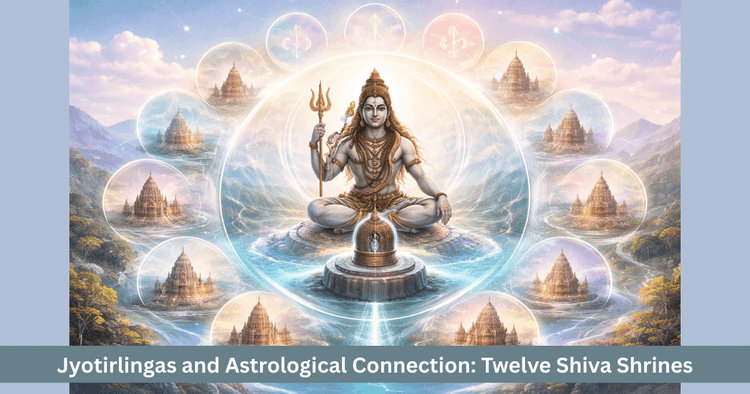
Table of Contents
Jyotirlingas are not just places of pilgrimage. They are revered as expressions of Lord Shiva where Jyoti, meaning light and Linga, meaning formless consciousness, meet as one. In the Vedic tradition the twelve Jyotirlingas are honoured as powerful centres of devotion. In many later interpretations their locations are also viewed as lying in regions that are sensitive to natural energies and celestial patterns, which deepens the experience of meditation and worship there.
From an astrological perspective each Jyotirlinga is associated with a particular planetary quality, zodiac sign or inner theme, so that the seeker can relate devotion to the language of the horoscope. In this way devotion, sacred geography and astrology come together to offer healing, protection and guidance to the one who walks the path.
How Are Jyotirlingas Spiritually Linked With Astrology
In traditional narratives Jyotirlingas are the shrines where Shiva revealed himself as a pillar of blazing light.
Later astrological explanations look at these shrines in the following way.
- Certain interpretations suggest that the regions around some Jyotirlingas may resonate strongly with natural forces and the path of the heavens, creating a subtle field that supports spiritual practice.
- Devotees sometimes relate these shrines to the zodiac signs and to planets in exaltation or special dignity, as a symbolic bridge between worship and planetary energy.
- At some shrines the presence of the Divine Mother is profoundly strong along with Shiva, which represents the union of Shaiva and Shakta traditions.
Through all these views the central idea remains that a Jyotirlinga pilgrimage is an inner journey of purification, surrender and awakening, far more than a mere physical tour.
Legend of Jyotirlinga in Shiva Purana and Its Inner Message
The story of the Jyotirlinga, described in the Shiva Purana, carries a deep spiritual teaching.
Once a dispute arose between Brahma and Vishnu over who was supreme. To end this conflict Shiva manifested himself as an endless pillar of fire and light rising up and down without limit.
- Shiva declared that whoever could find the end of this light column would be recognised as the highest.
- Vishnu went downward and Brahma travelled upward in search of the limits of this fiery pillar.
- After great effort Vishnu could not find the end and honestly admitted that the pillar was infinite.
- Brahma falsely claimed that he had reached the top and produced a ketaki flower as false witness.
Shiva could not accept this untruth.
- He cursed Brahma that formal worship of the creator would not be prevalent in the world.
- He blessed Vishnu for his honesty and declared that Vishnu would be worshipped eternally.
- Places associated with the descent of this column of light came to be revered as Jyotirlinga shrines.
The story teaches that Jyotirlingas are not only holy places. They are also reminders that truthfulness, humility and the dropping of ego are the real foundations of worship.
Combined Presence of Jyotirlinga and Shakti Peetha
From a spiritual and astrological angle some Jyotirlingas are understood as places where the energy of Shiva and the power of Goddess Parvati are both especially strong.
Traditional descriptions mention four such key centres where Jyotirlinga and Shakti Peetha feelings meet.
- At Srisailam the Mallikarjuna Jyotirlinga is worshipped along with Bhramaramba Devi.
- At Ujjain the region of Mahakaleshwar Jyotirlinga is also associated with the revered Harsiddhi Devi.
- In Varanasi the worship of Vishalakshi Devi runs alongside that of Kashi Vishwanath.
- At Baidyanath Dham the devotional stream often carries both Shiva and Shakti bhava together.
Such places help the seeker feel that Shiva’s radiance and the Mother’s compassion are not separate energies. They are two complementary faces of the same consciousness.
Twelve Jyotirlingas as a Symbolic Wheel of Twelve Zodiac Signs
The twelve Jyotirlingas can be understood in a symbolic relationship with the twelve zodiac signs. This is a reflective framework rather than a rigid rule, yet it offers helpful insight.
Aries and Ramanathaswamy Jyotirlinga, Rameshwaram
At Rameshwaram Shiva is worshipped as Ramanathaswamy. The story here is linked with Rama’s return from Lanka. Rama felt the need to atone for the killing of Ravana, who, though an enemy, belonged to a Brahmin lineage.
- To worship Shiva, Rama sent Hanuman to Mount Kailash to bring a sacred linga.
- The auspicious time for worship approached and Hanuman had not yet returned. To honour the time Sita shaped a linga from sand, called Ramalinga and the worship was performed.
- When Hanuman arrived he felt hurt that the worship had not waited for him. To honour his devotion Rama declared that devotees would first worship the Vishwalinga brought by Hanuman and then the Ramalinga.
Rameshwaram is connected with the Aries principle, often linked to the exaltation of the Sun. Worship here is seen as supportive for dissolving karmic burdens and inner guilt.
Taurus and Somnath Jyotirlinga, Prabhas
Somnath is deeply connected with the story of Chandra, the Moon god. Chandra married several daughters of Daksha Prajapati but showed his affection mainly toward Rohini.
- Daksha urged him to be fair and equal but Chandra did not follow this advice.
- Daksha then cursed Chandra that his radiance would gradually wane.
- Chandra performed penance at Prabhas and Shiva, pleased with his devotion, placed him upon his head.
- The curse continued as the Moon’s waxing and waning, yet he regained full light at every full moon through Shiva’s grace.
Taurus is associated with the exaltation of the Moon. Worship at Somnath is therefore linked with health, vitality and healing from chronic weakness.
Gemini and Nageshwar Jyotirlinga, Darukavan
Nageshwar stands in the region called Darukavan. Here the legend speaks of the demoness Daruka and the suffering of devotees under her rule.
- Empowered by a boon, Daruka began to oppress those around her.
- In response to the prayers of devotees Shiva appeared in the form of Nageshwar and destroyed the demonic force.
- Popular belief remembers that Lord Krishna also prayed to Shiva here, as this shrine lies close to Dwarka.
Nageshwar is related symbolically to Gemini and to the energy of Rahu. Worship here is understood as helping to overcome inner poisons such as anger, greed and harmful obsessions.
Cancer and Omkareshwar Jyotirlinga, Mandhata
Cancer in this framework is related to inner nourishment and, in some interpretations, to exalted Jupiter. The story of Omkareshwar speaks of the Ikshvaku king Mandhata and his sons.
- Two sons of Mandhata performed intense austerities in this region and pleased Shiva.
- Shiva manifested as a Jyotirlinga on the mountain now called Mandhata.
- At the request of the sages, Shiva’s presence is worshipped as two shrines, Omkareshwar and Amareshwar or Mamleshwar.
Under the Cancer theme Omkareshwar symbolises self knowledge, heart wisdom and compassion. Practice here is seen as stabilising the mind and softening the heart.
Leo and Vaidyanath Jyotirlinga, Deoghar Region
Vaidyanath Dham is associated with the legendary devotion of Ravana.
- Ravana undertook severe penance and asked Shiva to come to Lanka.
- Shiva agreed to travel as a linga with the condition that it must not touch the ground until it reached its destined place.
- Through a turn of events during the journey the linga was placed upon the earth and the site where this occurred came to be honoured as Baidyanath.
Leo is tied to the strong solar principle. Here Shiva is revered as Vaidya, the divine healer. Vaidyanath therefore symbolically supports matters of children, intellect, mantra and inner mental balance.
Virgo and Mallikarjuna Jyotirlinga, Srisailam
The story of Mallikarjuna reflects the subtle emotions within the family of Shiva.
- A question arose about who should marry first, Ganesha or Kartikeya.
- They were challenged to make three circumambulations of the world.
- Kartikeya immediately set off on his peacock mount, while Ganesha circled his parents and declared that they were the world for him.
- Feeling outwitted, Kartikeya withdrew to Mount Krounch.
- Moved by their son’s pain, Shiva and Parvati went to look for him and appeared at Srisailam, where Shiva manifested as Arjuna and Parvati as Mallika, together known as Mallikarjuna.
Virgo is linked with intellect, service and practical wisdom. Mallikarjuna is associated with wealth, recognition and fruits of sincere effort within this theme.
Libra and Mahakaleshwar Jyotirlinga, Ujjain
The legend of Mahakaleshwar describes King Chandrasena of Ujjain and the devotion of the boy Shrikhar and the priest Vridhi.
- Chandrasena was absorbed in Shiva worship.
- Shrikhar wished to join the king in worship but was turned away and sent out of the city.
- He later overheard plans for an attack on Ujjain by hostile kings with the help of the demon Dushan.
- Shrikhar and Vridhi prayed intensely to Shiva for protection.
- Shiva appeared as Mahakal, destroyed Dushan and saved the city.
Mahakaleshwar is the only south facing Jyotirlinga and is linked with the exaltation of Saturn in Libra. Worship here is associated with longevity, health and protection across time.
Scorpio and Grishneshwar Jyotirlinga, near Ellora
The story of Grishneshwar, also called Ghushmeshwar, centres on a devout woman named Ghushma.
- To worship Shiva she undertook the vow to perform daily abhishekam of many lingams and immerse them in a water tank.
- Shiva, pleased with her devotion, blessed her with a son.
- Another woman, consumed by jealousy, killed the child.
- Even in her grief Ghushma continued her worship without hatred.
- Shiva then appeared, restored her son and promised to remain there as Grishneshwar.
Scorpio is related to the intense energies of Ketu and Mars. Worship at Grishneshwar is symbolically linked with removing uncertainty in work and facing hidden fears with courage.
Sagittarius and Kashi Vishwanath Jyotirlinga, Varanasi
Kashi Vishwanath is directly tied to the story of Shiva as the infinite column of light. When Brahma and Vishnu disputed their supremacy, Shiva’s fiery pillar emerged. Varanasi is revered as the region where this first Jyotirlinga presence of the light column became especially manifest.
- Because of this the shrine is seen as a unique centre of knowledge, liberation and direct awareness of truth.
Sagittarius is connected to Ketu as mokshakaraka, the indicator of liberation. Worship at Kashi Vishwanath is therefore associated with moksha, wisdom and purification of past deeds.
Capricorn and Bhimashankar Jyotirlinga, Sahyadri
The story of Bhimashankar focuses on the demon Bhim, son of Kumbhakarna.
- After learning of his father’s death in Rama’s time, Bhim vowed revenge and performed severe penance to please Brahma.
- Granted great powers, he began to oppress people and imprisoned the devotee Kamrupeshwar.
- Bhim forced Kamrupeshwar to worship him but the devotee continued to worship Shiva.
- When Bhim tried to destroy the lingam Shiva appeared and reduced him to ashes.
Capricorn is associated with the exaltation of Mars. Bhimashankar therefore symbolically represents protection from enemies and adverse forces.
Aquarius and Kedarnath Jyotirlinga, Himalaya
Kedarnath is linked with the Pandavas and their need for atonement after the Mahabharata war.
- The Pandavas were advised to seek Shiva’s forgiveness.
- Shiva, not easily willing to pardon them at once, took the form of a bull and tried to hide in the Himalayan region.
- Bhima recognised the bull and caught hold of its hind part.
- The bull form disappeared into the ground and later appeared in five separate places.
- The hump emerged at Kedarnath, the arms at Tunganath, the navel and stomach at Madhyamaheshwar, the face at Rudranath and the head at Kalpeshwar.
Kedarnath uniquely has a triangular lingam. Under the Aquarius symbol, associated with exalted Rahu, Kedarnath points toward deep philosophy and strengthening of spiritual resolve.
Pisces and Trimbakeshwar Jyotirlinga, Trimbak
The story of Trimbakeshwar recalls the life of Rishi Gautama and his wife Ahilya on the Brahmagiri hills.
- During a severe famine Gautama used his devotion to maintain a source of water and food in his ashram.
- Other sages, jealous of his merit, attempted to defame him and poisoned the water, accusing him of wrongdoing.
- Ahilya prayed to Shiva and Gautama also sought Shiva’s help for purification.
- Shiva released Ganga as Godavari in that region and sanctified the land.
At Trimbak three lingams are worshipped, representing Brahma, Vishnu and Shiva. Pisces, linked with exalted Venus, frames Trimbakeshwar as a place of rebirth like renewal and washing away of sins.
Essential Messages of the Jyotirlinga and Zodiac Connection
The symbolic link between the twelve Jyotirlingas and the twelve zodiac signs illustrates that for every area of life, for every mental state and karmic field, there is a supportive presence of Shiva expressed through one or another shrine.
Here
one shrine emphasises atonement and release from guilt, another health and healing, another wealth, responsibility and balance, while yet another highlights liberation, detachment and inner knowledge.
When devotion and astrology walk together, a seeker does not live in fear of planets. Instead the seeker learns to harmonise with planetary energies and to move steadily closer to the light of Shiva.
Frequently Asked Questions
Is the connection between Jyotirlingas and zodiac signs scriptural or symbolic.
The link between Jyotirlingas and zodiac signs is mainly a symbolic and interpretative framework that connects devotion with astrology. Classical scriptures primarily describe Jyotirlingas as centres of Shiva’s light, while later traditions map them onto signs and planets to aid contemplation.
Does worship at a specific Jyotirlinga automatically remove related planetary defects.
Worship, mantra and faith certainly stabilise and uplift the mind. The easing of planetary difficulties should be understood in a spiritual and psychological way. When a seeker purifies conduct, thoughts and lifestyle, the grace of Jyotirlinga worship strengthens this transformation from within.
Do Jyotirlingas that are linked with Shakti Peethas have a different kind of effect.
Where Shiva and Shakti are both strongly present, the influence tends to highlight balance, compassion and inner strength at the same time. Such shrines teach not only renunciation or only power but a courageous heart filled with love and responsibility.
Should a person focus only on the Jyotirlinga associated with their own zodiac sign.
The path of devotion is not limited to one’s sign. A person may feel a special pull toward the shrine that corresponds to their sign, yet all Jyotirlingas are manifestations of the same radiant Shiva. Any shrine that truly touches the heart is worthy of deep worship.
How is a Jyotirlinga pilgrimage different from ordinary astrological remedies.
Astrological remedies often aim at short term balance for specific planetary issues. A Jyotirlinga pilgrimage is a long term spiritual discipline, meant to transform character, perception and life direction. The goal is not only to gain benefits but to purify the entire way of living.
What does moon sign reveal about me?
My Moon SignDid you like it?
Author

Pt. Abhishek Sharma (63)
Experience: 20
Consults About: Family Planning, Career
Clients In: Punjab, Haryana, Delhi
Share this article with friends and family
About ZODIAQ
ZODIAQ is an online Vedic Astrology platform. It connects clients seeking astrological advice to experienced astrologers with deep knowledge. Our users also generate kundali and perform kundali milan for free. ZODIAQ also offers services to the Astrologers. Astrologers utilize various offerings by ZODIAQ to serve their clients effectively.
If you are a User
Consult with experienced astrologers and seek their guidance. You can also order handwritten Janm Patrika report with life prediction prepared by experienced astrologers. Generate accurate Kundali, perform Kundali Matching and check horoscope and muhurat. Utilize our online library for all the necessary astrological and spiritual information.
If you are an Astrologer
Create accurate kundali for your clients and perform Kundali Matching for up to 5 people at a time. Write comprehensive Janm Patrika report for your clients with ZODIAQ. Check client details anytime by saving it in client directory. Become more productive by tracking how many clients you guide every day.
WELCOME TO
ZODIAQ
Right Decisions at the right time with ZODIAQ
