Twelve Jyotirlingas: From Light and Lingam to the Path of Liberation
By Aparna Patni
The twelve principal Jyotirlinga temples in India and their spiritual significance
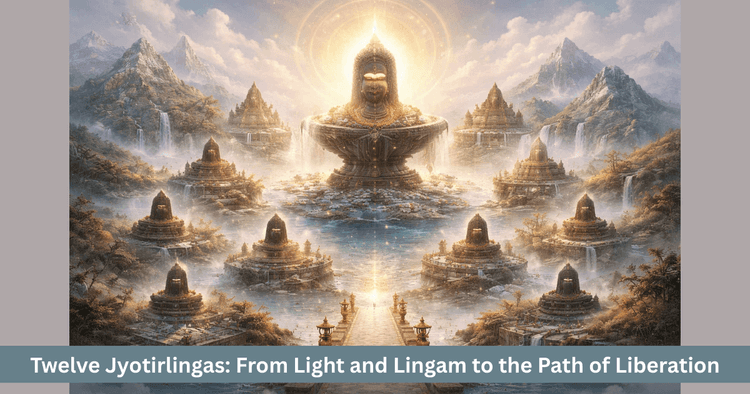
Table of Contents
The term “Jyotirlinga” is formed from two Sanskrit words, Jyoti and Linga. Jyoti means light, radiance and inner divine brilliance. Linga is the formless symbol of Shiva that represents the subtle balance of creation, preservation and dissolution. A Jyotirlinga is therefore a sacred place where Shiva is revered as a pillar of light, manifesting as self born radiant consciousness in the form of a lingam.
In India twelve principal Jyotirlingas are described, recognised as some of the holiest abodes of Lord Shiva. The journey to these twelve Jyotirlingas is viewed not only as pilgrimage but also as a discipline of inner purification, release from karmic weight and movement toward liberation. Devotees believe that by taking refuge in these Shiva shrines a person can lighten past karmas and grow closer to the divine presence.
Spiritual Significance of the Twelve Jyotirlingas
The twelve Jyotirlingas are spread across different regions of India.
From the Himalayan ranges in the north to the ocean washed shores in the south, from the western lands of Saurashtra to the eastern regions of Jharkhand, these Shiva shrines create a subtle spiritual circle across the land.
Some of the main devotional beliefs around the Jyotirlingas can be understood as follows.
- Each Jyotirlinga symbolises a distinct aspect or special quality of Shiva’s presence.
- Worship, mantra recitation and sincere prayer at these centres are believed to cleanse sins gathered over many births.
- Those who complete the pilgrimage of all twelve shrines with devotion are said to move closer to moksha, the liberation from bondage.
- These temples also hold immense historical, cultural and architectural value alongside their spiritual importance.
The path of Jyotirlinga pilgrimage is both an outer journey and an inner movement from darkness back to light.
Twelve Jyotirlingas with Location and Darshan Timings
The following table offers a concise view of the twelve Jyotirlingas with their locations, facing direction and commonly observed darshan timings.
| Jyotirlinga | City or Region | State | Facing Direction | Opening Time | Closing Time |
|---|---|---|---|---|---|
| Somnath | Prabhas Patan | Gujarat | East | 6:00 morning | 9:00 night |
| Mallikarjuna | Srisailam | Andhra Pradesh | East | 4:30 morning | 10:00 night |
| Mahakaleshwar | Ujjain | Madhya Pradesh | South facing | 4:00 morning | 11:00 night |
| Omkareshwar | Mandhata Island | Madhya Pradesh | East | 5:00 morning | 9:30 night |
| Kedarnath | Kedarnath | Uttarakhand | West | 4:00 morning (open season) | 9:00 night (open season) |
| Bhimashankar | Bhimashankar region | Maharashtra | East | 5:00 morning | 9:30 night |
| Kashi Vishwanath | Varanasi | Uttar Pradesh | East | 3:00 morning | 11:00 night |
| Trimbakeshwar | Trimbakeshwar | Maharashtra | East | 5:30 morning | 9:00 night |
| Vaidyanath | Deoghar | Jharkhand | East | 4:00 morning | 9:00 night |
| Nageshwar | Near Dwarka | Gujarat | West | 6:00 morning | 9:00 night |
| Rameshwar | Rameshwaram | Tamil Nadu | East | 5:00 morning | 9:00 night |
| Grishneshwar | Near Ellora | Maharashtra | East | 5:30 morning | 9:30 night |
In shrines such as Kedarnath darshan is possible only for a limited part of the year, while many other Jyotirlingas remain open throughout the year.
Meaning of the Word Jyotirlinga and Shiva’s Radiant Form
Understanding the origin of the word “Jyotirlinga” reveals more of its inner sense.
- Jyoti here symbolises light that is formless, limitless and unbound.
- Linga points to Shiva’s symbol, containing within it the seed of universal consciousness.
Traditional narratives describe how Shiva once revealed himself as an endless column of fire and light. Places where this radiant presence was anchored became revered as Jyotirlingas. Devotees feel that in these twelve shrines Shiva’s luminous energy is especially accessible and deeply felt.
Brief Spiritual Overview of the Twelve Jyotirlingas
Each Jyotirlinga expresses a particular mood or teaching of Shiva. The following sections offer a short spiritual introduction to each.
1. Somnath Jyotirlinga, Prabhas Patan, Gujarat
Somnath is regarded as one of the oldest Shiva temples in India. Over history this shrine has faced destruction and rebuilding many times, yet the flame of devotion has remained alive.
According to Shiva Purana, the Moon god Chandra was cursed by his father in law Daksha Prajapati and began to lose his radiance. Chandra performed deep penance in the region of Prabhas. Pleased with his devotion, Shiva manifested as a Jyotirlinga and restored the Moon’s brilliance. From this grace the shrine received the name Somnath, the Lord of Soma. Even today the sea shore, the towering temple and the sound of evening worship create a powerful devotional atmosphere.
2. Mallikarjuna Jyotirlinga, Srisailam andhra Pradesh
Situated in the Nallamala hills, the Mallikarjuna Jyotirlinga reveals the tender parental aspect of Shiva and Parvati. Here Shiva is worshipped as Mallikarjuna and the Goddess as Bhramaramba.
Traditional lore says that Shiva and Parvati came to this sacred hill to remain close to their son Kartikeya. Because of this it is recognised both as a Jyotirlinga and as a Shakti Peetha. In this complex the devotional currents of Shiva and Shakti flow together in a very natural way.
3. Mahakaleshwar Jyotirlinga, Ujjain, Madhya Pradesh
On the banks of the river Shipra in Ujjain stand the shrine of Mahakaleshwar, a direct symbol of Shiva as Mahakal, Lord of Time and Death. The lingam here is regarded as self born, emerging from the earth itself.
Mahakaleshwar is also known for being a south facing Jyotirlinga, called Dakshin Mukhi. This direction is linked with deeper themes of time, mortality and the unknown. The famous pre dawn Bhasma Aarti, performed with sacred ash, reminds the devotee of the cycles of creation and dissolution.
4. Omkareshwar Jyotirlinga, Mandhata Island, Madhya Pradesh
Mandhata Island in the Narmada river forms a natural shape that resembles the sacred syllable “Om”. From this form arises the name Omkareshwar, the Lord of Om.
The temple complex has artistically carved pillars, towers and stone work. The main lingam is considered self manifested. The presence of the Narmada and the quiet island atmosphere make Omkareshwar a favourite place for meditation and contemplation.
5. Kedarnath Jyotirlinga, Himalayas of Uttarakhand
Kedarnath is located high in the Himalayas, around 3583 meters above sea level, on the banks of the Mandakini. It is one of the twelve Jyotirlingas and also a key shrine of the Himalayan yatra.
Devotional tradition holds that after the war of Mahabharata the Pandavas sought Shiva’s grace to be freed from the burden of their actions. Shiva appeared for them in the region of Kedara. The ancient temple is linked both with the Pandavas and later with Adi Shankaracharya. Because of harsh weather, its doors remain open only for a limited part of the year.
6. Bhimashankar Jyotirlinga, Sahyadri Hills, Maharashtra
In the midst of dense forest and hills stands Bhimashankar, where nature and devotion meet. One traditional story describes Shiva taking a fierce form here to destroy the demon Tripurasura and from his perspiration the Bhima river arose.
The temple architecture follows the Nagara style, with detailed stone carvings. The surrounding wildlife sanctuary, with its rich flora and fauna, offers seekers a chance to experience silence and the living presence of the natural world.
7. Kashi Vishwanath Jyotirlinga, Varanasi, Uttar Pradesh
On the western bank of Ganga stands Kashi Vishwanath, the beloved shrine of Shiva as Vishweshwara, Lord of the Universe.
There is a long standing belief that due to Shiva’s presence in Kashi, death in this city leads to liberation from the cycle of birth and death. The dark stone lingam of Vishwanath and a ritual bath in Ganga are counted among the most sacred experiences of a devotee’s life. Renewal and reconstruction of the temple over time, its golden shikhara and the surrounding ghats have made Kashi a unique spiritual city.
8. Trimbakeshwar Jyotirlinga, Trimbakeshwar, Maharashtra
Near Nashik, Trimbakeshwar holds a special place because the lingam here carries the symbolic power of the trinity, Brahma, Vishnu and Shiva.
This shrine stands close to the source of the Godavari river, which further enhances its sacredness. The black stone architecture and ancient ambience encourage gravity, reflection and devotion in the mind of the pilgrim.
9. Vaidyanath Jyotirlinga, Deoghar Region, Jharkhand
Vaidyanath Dham, also known as Baidyanath, is associated with the story of Ravana’s devoted worship of Shiva.
In devotional lore Ravana offered intense penance and sacrifice to please Shiva and sought invincibility. Shiva appeared and granted him boons. The name Vaidyanath points to Shiva as the divine healer, the remover of disease and suffering. The worship here is believed to support release from pain and inner ailments.
10. Nageshwar Jyotirlinga, Near Dwarka, Gujarat
On the Saurashtra coast, Nageshwar Jyotirlinga is connected with the symbol of Naga, the serpent and protection. It is said Shiva manifested here as Nageshwar Mahadev to protect his devotee Supriya from the demon Daruka.
Nageshwar is seen as a shield from poison, fear and negative forces. The tall statue of Shiva in the temple complex against the backdrop of the sea and the open sky offers a powerful reminder of divine guardianship.
11. Rameshwaram Jyotirlinga, Tamil Nadu
Rameshwaram, on a serene island, is closely linked with the narrative of the Ramayana. It is believed that after the victory over Lanka, Rama worshipped Shiva here and installed the linga known as Ramanathaswamy.
Within the complex there are twenty two sacred water tanks, called Theerthams. Bathing in these waters is considered purifying. The long pillared corridors and the sound of the sea create a rare combination of architectural beauty and spiritual stillness.
12. Grishneshwar Jyotirlinga, near Ellora, Maharashtra
Grishneshwar, also called Ghushmeshwar or Ghushrneshwar, literally means Lord of Compassion. It is recognised as the twelfth Jyotirlinga and stands not far from the caves of Ellora.
One cherished legend tells of a devoted woman, Kusuma or Ghushma, who worshipped a Shiva lingam daily by immersing it in water with unwavering faith. After her son’s death she continued her worship without hatred. Moved by her devotion, Shiva restored her son to life and promised to stay there as Grishneshwar Jyotirlinga. A special feature of this temple is the permission to touch the lingam and perform personal abhishekam.
Traditional List of the Twelve Jyotirlingas and Their Places
In the Hindu tradition the twelve Jyotirlingas are described in a classical list, with their regions and a brief description.
| No. | Jyotirlinga | State | Location | Short Description |
|---|---|---|---|---|
| 1 | Somnath | Gujarat | Prabhas Patan, Saurashtra | Ancient shrine, rebuilt several times across history |
| 2 | Mallikarjuna | Andhra Pradesh | Srisailam hill, on river bank | Called the Kailash of the south, shrine of both Shiva and Shakti |
| 3 | Mahakaleshwar | Madhya Pradesh | Ujjain, bank of Shipra | Self born lingam, south facing, known for Bhasma Aarti |
| 4 | Omkareshwar | Madhya Pradesh | Island in Narmada | Island shaped like Om, self manifested Shiva lingam |
| 5 | Kedarnath | Uttarakhand | Himalaya, on Mandakini | High altitude shrine open only in limited months |
| 6 | Bhimashankar | Maharashtra | Sahyadri hills, Bhima region | Linked with Tripurasura legend, surrounded by forests and hills |
| 7 | Kashi Vishwanath | Uttar Pradesh | Varanasi, on Ganga | Central Shiva shrine of Kashi, deeply associated with liberation |
| 8 | Trimbakeshwar | Maharashtra | Near Nashik, by Godavari source | Symbol of the trinity, close to origin of river Godavari |
| 9 | Vaidyanath | Traditional views | Deoghar and other locations | Connected with Ravana’s devotion, Shiva as divine healer |
| 10 | Nageshwar | Gujarat | Near Dwarka, Darukavan region | Linked with serpent symbolism and protection from negativity |
| 11 | Rameshwar | Tamil Nadu | Rameshwaram island | Tied to Rama’s worship of Shiva, includes twenty two sacred tanks |
| 12 | Grishneshwar | Maharashtra | Near Ellora, close to Daulatabad | Lord of compassion, associated with the devotion of Kusuma |
Different traditions sometimes suggest varying exact locations for Vaidyanath and Nageshwar, yet the devotional essence of the twelve Jyotirlingas remains the same.
Is Visiting All Twelve Jyotirlingas a Path to Moksha
Within devotional understanding there is a strong belief that visiting all twelve Jyotirlingas with faith, discipline and purity helps the soul move closer to moksha.
A few core points about this pilgrimage are worth noting.
- Physical travel alone is not considered enough. Inner purity, ethical living and sincere devotion are equally important.
- Some pilgrims plan a single extended journey, moving in a broad circle through India and covering each shrine in sequence.
- Others visit different Jyotirlingas across several years, completing the circle gradually as life allows.
The pilgrimage becomes a combined path of travel, mantra, meditation and character building that prepares the inner being for liberation.
Traditional Categories of Sacred Places and the Jyotirlingas
Hindu tradition speaks of different categories of sacred places and dhams. The twelve Jyotirlingas belong to those special shrines where Shiva’s radiance is considered firmly anchored.
Classical descriptions often include
- geographical details of each place
- historical accounts of attacks, rebuilding and royal patronage
- older regional names such as Dakshin Kailash, Avantika, Darukavan
- mention of nearby temples, sacred rivers and related shrines
Through this we see that the Jyotirlingas are not only centres of worship but also living pillars of India’s spiritual and cultural memory.
Common Questions about the Twelve Jyotirlingas
What are the twelve Jyotirlingas and why are they so revered.
The twelve Jyotirlingas are the principal Shiva shrines where he is honoured as a pillar of light in lingam form. Worship at these shrines is believed to purify the heart, reduce karmic burden and support the journey toward liberation.
Are some Jyotirlingas considered especially important to visit first.
All twelve are equally sacred in principle. Yet many devotees choose to visit Somnath, Mallikarjuna, Mahakaleshwar, Kedarnath and Kashi Vishwanath early in their pilgrimage because of their strong traditional reputation and powerful narratives.
Is any single Jyotirlinga regarded as the most powerful.
Scripturally all Jyotirlingas are manifestations of the same divine Shiva. In popular devotion Kashi Vishwanath and Somnath are often spoken of with special reverence, yet the real depth of power depends on the seeker’s own connection and experience.
Do the directions in which these temples face have spiritual meaning.
Many Jyotirlingas face east, which is linked with purity and rising light. The south facing form of Mahakaleshwar is related to the deeper themes of time and death. West facing shrines like Kedarnath and Nageshwar are also regarded as unique expressions of Shiva’s protection and grace.
Are there only twelve Jyotirlingas in the traditional list.
Yes, the classical list describes twelve. Some other temples are honoured symbolically as an additional or hidden Jyotirlinga but the recognised core group in the tradition contains twelve names only.
Must the twelve Jyotirlingas be visited within a single journey.
There is no strict rule. It is considered beneficial whenever in a lifetime a devotee gradually completes darshan of all twelve with sincerity. Some complete the circle in one journey, others over many years.
Are women and all communities allowed to worship at these shrines.
The Jyotirlingas are generally open for worship to women and men alike and to devotees of all backgrounds. Local customs may shape certain details of ritual, yet the essential spirit of these shrines is inclusive.
What is considered a favourable time to visit the Jyotirlingas.
Many pilgrims choose Mahashivaratri and the sacred month of Shravan as particularly auspicious periods. During such festivals crowds are larger, so those who prefer quieter darshan sometimes select other times of the year.
Are the twelve Jyotirlingas connected in a deeper spiritual way.
Yes, they are seen as twelve expressions of the one infinite Shiva. From Somnath in the west to Grishneshwar near Ellora, these shrines are experienced as luminous points of the same divine field, holding the land of India within a circle of Shiva’s presence.
What does moon sign reveal about me?
My Moon SignDid you like it?
Author

Aparna Patni (63)
Experience: 20
Consults About: Family Planning, Career
Clients In: Punjab, Haryana, Delhi
Share this article with friends and family
About ZODIAQ
ZODIAQ is an online Vedic Astrology platform. It connects clients seeking astrological advice to experienced astrologers with deep knowledge. Our users also generate kundali and perform kundali milan for free. ZODIAQ also offers services to the Astrologers. Astrologers utilize various offerings by ZODIAQ to serve their clients effectively.
If you are a User
Consult with experienced astrologers and seek their guidance. You can also order handwritten Janm Patrika report with life prediction prepared by experienced astrologers. Generate accurate Kundali, perform Kundali Matching and check horoscope and muhurat. Utilize our online library for all the necessary astrological and spiritual information.
If you are an Astrologer
Create accurate kundali for your clients and perform Kundali Matching for up to 5 people at a time. Write comprehensive Janm Patrika report for your clients with ZODIAQ. Check client details anytime by saving it in client directory. Become more productive by tracking how many clients you guide every day.
WELCOME TO
ZODIAQ
Right Decisions at the right time with ZODIAQ
