Hasta Nakshatra and Savitur: Golden-Handed Divinity, Awakening, Action, Practice and Astrological Insight
By Pt. Abhishek Sharma
Savitur, Dexterity, Creation, Duty, Service in Life, Spiritual Practice, FAQs
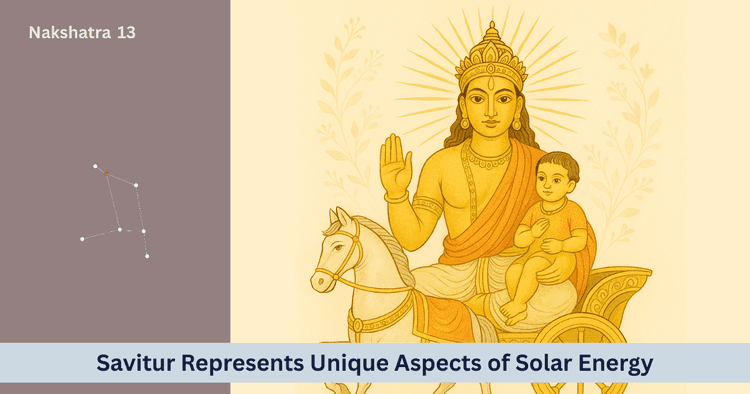
Table of Contents
Hasta Nakshatra, celebrated as the “Hand Star” in Vedic astrology, opens the door to a whole constellation of meanings, manual skill, artistry, transformative power, service and the twinned mysteries of karma and grace. The constellation’s secret heartbeat, however is found in its presiding deity: Savitur, the golden-handed Aditya, whose presence embodies not simply the birth of day but also the awakening of skill, inspiration and the capacity to make the invisible into reality. Understanding Savitur is thus essential for unlocking both Hasta’s outward gifts and its unseen inner power, the zone where earthly talent and spiritual radiance unite.
Savitur: The Solar Deity of Beginnings and Blessings
Savitur is one of the twelve Adityas, sons of Aditi, representing unique aspects of solar energy in the Vedic worldview. Unlike Surya, who blazes as the full midday Sun, Savitur rules dawn, the subtle golden glow lifting the world from the realm of dreams into the field of action.
- Savitur’s sunlight does not glare, it gently stirs, inspires and activates the body, mind and soul.
- His domain is not just physical but psychological: he urges every being to arise, seek purpose and act.
- In this sense, Savitur is the original spark of innovation, the impulse toward renewal and the force behind all true beginnings.
Etymology, Depictions and Vedic Praise
The name "Savitur" is derived from the root “su”, to inspire, to set in motion. His hands, described as golden (“hiranya hasta”) in the hymns, symbolize sacred creativity, the transmission of blessings and the ability to transform aspiration into achievement.
- In countless hymns, Savitur is associated with qualities such as awakeness, quickening, bestowal and brilliance.
- He is called upon in times of fog, confusion or when one seeks to start anew, for his radiance is both protection and a promise of new directions.
Rigveda References
- Rigveda III.62.10 (Gayatri): Savitur is invoked as the universal inspirer, whose golden arms touch the world and fill every heart with purpose. He is the one who “instigates auspicious thoughts and illuminates intellect and soul.”
- Hymns of Awakening: Other verses speak of Savitur as the divine architect of dawn, driving away ignorance, inspiring the ability to work and create and granting immortality through spiritual growth.
- Cosmic Motion: Savitur is the divine force ensuring the movement of planets, seasons and all living rhythms, a reminder that change, action and evolution are sacred.
The Gayatri Mantra: Direct Invocation of Savitur’s Light
The Gayatri Mantra, “Om Bhūḥ, Bhuvaḥ, Svaḥ | Tat Savitur Vareṇyaṃ | Bhargo Devasya Dhīmahi | Dhiyo Yo Naḥ Prachodayāt”, remains one of the most chanted and respected spiritual prayers in all Hindu traditions.
- Spiritual Purpose: It is more than a set of beautiful words; it is a metaphysical plea for Savitur’s light to spark the mind and awaken the soul’s highest faculties.
- Universal Scope: Unlike many ancient hymns, Gayatri was always meant for all, across gender, lineage and social background, embodying Savitur’s impartial grace and nurturing energy.
- Daily Practice: Recitation at sunrise and sunset aligns the individual's inner world with the cosmic flow, stimulating clarity, discipline and inspiration.
Practical Power of the Mantra
- Practiced meditators often attest to increased focus, creative awareness and inner tranquility through regular Gayatri japa.
- Gayatri is seen not only as a prayer for enlightenment but as a tool for harmonizing personality, breaking inertia and cultivating inner strength.
Astrological, Cultural and Everyday Relevance of Hasta and Savitur
Hasta’s Open Hand: Symbolism and Significance
The motif of the open hand is universal: it stands for skill, benevolence, readiness to bestow and divine agency.
- Skill and Service: Hasta natives are drawn to fields requiring dexterity, healing, arts, crafting, education, counseling and diplomacy.
- Problem Solving and Healing: Just as Savitur “turns darkness to light,” Hasta individuals are fixers, healers and enablers. They do not simply solve their own problems, they elevate and assist others.
- Spiritual Creativity: Many Hasta natives combine practical action with spiritual or psychological healing; their hands bless, protect and nurture.
Practical, Ritual and Celebratory Traditions
- Key Rituals:
- Reciting the Gayatri Mantra with intention, sunrise and sunset, ideally facing east to greet Savitur.
- Keeping hands and workspace clean, treating all acts of labor as sacred.
- On Hasta Nakshatra days, offering white flowers, water and whole grains to the rising sun.
- Festival Observances:
- Surya festivals such as Makar Sankranti and Ratha Saptami are relevant moments to honor Savitur’s power, inviting fresh energy and wisdom.
- During Hasta Nakshatra, acts of service, charity or creative pursuit are especially auspicious, believed to multiply blessings.
Puranic and Epic Narratives
- The Daksha Yagna myth tells how Savitur, though wounded in an epic conflict, is restored by Shiva, who grants him the “golden hand.” This bestowal evolves Savitur from mere facilitator to healer, redeemer and enlightened expressor, qualities mirrored in many Hasta natives, who find meaning through recovery, selfless action or second chances.
Hasta Natives: Personality, Potential and Empowerment
Core Gifts and Typical Life Path
- Natural artisans, healers, educators, communicators and spiritual seekers.
- Exceptional adaptability, the ability to sense opportunity and choose the most effective moment to act.
- Life experience often includes periods of helping others, solving group or family challenges or leading through supportive roles.
Inner Challenges, Growth and Potential
- Sometimes struggle with doubt about their impact, since their power is often subtle and “enabling” rather than grandiose.
- Achieve greatest results by focusing on continual skill refinement, regular selfless service and balancing ambition with deep humility.
- The “open hand” is both a literal and metaphoric key: giving, receiving, healing and creating form the axis of their destiny.
Hands as Instruments of Dharma
- Hasta natives are encouraged, throughout life, to treat every act, no matter how mundane, as a form of worship and offering.
- Regular engagement with the arts, handcrafts or community service is not just a talent but a sacred duty.
Psychological, Spiritual and Societal Lessons
- Obstacles are seen as invitations for awakening and innovation, channeling Savitur’s archetype of renewal.
- Every action, if performed with mindfulness and pure intent, becomes a tool for spiritual advancement.
- Connection with mentors, traditions and group rituals (chanting, celebration, collective projects) strengthens Hasta natives’ sense of purpose and well-being.
Frequently Asked Questions
Who is the ruling deity of Hasta Nakshatra?
Savitur, the golden-handed solar god of dawn, blessing and creative motion.
What is the core strength or gift of Hasta individuals?
Manual dexterity, creative vision, the power to heal and empower others, adaptability and practical service.
How does the Gayatri Mantra connect to Savitur?
The Gayatri is a direct invocation of Savitur, asking for illumination, wisdom and guidance for the intellect and soul.
Which careers and service roles are ideal for Hasta natives?
Medicine, yoga, the visual and performing arts, design, writing, counseling, diplomacy, education and roles centered on helping or enabling others.
What is the secret to lasting success for Hasta individuals?
Combining skill with selfless service, continually refining both hand and heart, keeping faith and making every deed, large or small, an offering to the divine.
What does Nakshatra reveal about me?
My NakshatraDid you like it?
Author

Pt. Abhishek Sharma (63)
Experience: 20
Consults About: Family Planning, Career
Clients In: Punjab, Haryana, Delhi
Share this article with friends and family
About ZODIAQ
ZODIAQ is an online Vedic Astrology platform. It connects clients seeking astrological advice to experienced astrologers with deep knowledge. Our users also generate kundali and perform kundali milan for free. ZODIAQ also offers services to the Astrologers. Astrologers utilize various offerings by ZODIAQ to serve their clients effectively.
If you are a User
Consult with experienced astrologers and seek their guidance. You can also order handwritten Janm Patrika report with life prediction prepared by experienced astrologers. Generate accurate Kundali, perform Kundali Matching and check horoscope and muhurat. Utilize our online library for all the necessary astrological and spiritual information.
If you are an Astrologer
Create accurate kundali for your clients and perform Kundali Matching for up to 5 people at a time. Write comprehensive Janm Patrika report for your clients with ZODIAQ. Check client details anytime by saving it in client directory. Become more productive by tracking how many clients you guide every day.
WELCOME TO
ZODIAQ
Right Decisions at the right time with ZODIAQ
