How did Krishna teach Indra humility?
By Pt. Abhishek Sharma
Leadership, Dharma, Ego and the Balance of Power for Jyeshtha
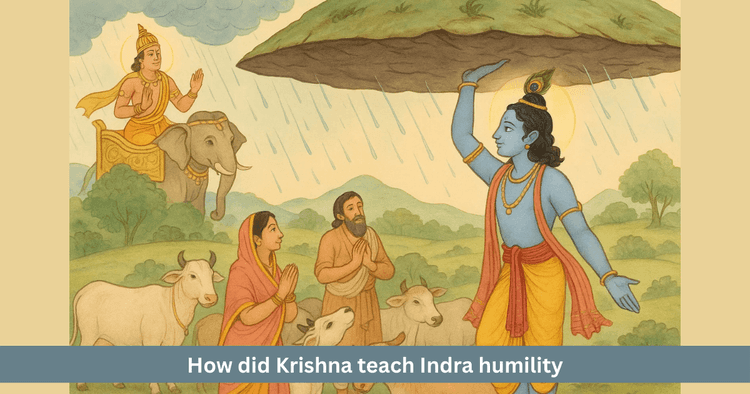
Table of Contents
Across Vedic and Puranic tradition, Indra epitomizes supreme sovereignty and celestial might. Yet, the tale of Krishna humbling Indra, as told in the Bhagavata Purana, reveals a greater truth: that real leadership springs not from pride but from humility, self-awareness and dharma. This legend is a mirror for Jyeshtha Nakshatra, where power and stewardship meet the perennial test, can authority bow to a higher principle?
The Ritual of Indra Worship in Gokul: Habit, Fear and the Question of Dharma
For generations, Gokul’s villagers offered elaborate rituals to Indra, the god of rain, making him the linchpin of their prosperity. Fields, cattle and all lifeblood depended on his favor.
- What began as gratitude turned over years to a fearful habit. The worship became more about appeasement than genuine devotion.
- Like Jyeshtha’s natives, villagers found refuge in tradition but lost touch with their core responsibilities.
- True “dharma” was eclipsed by empty forms, duty replaced by compliance and anxiety.
Krishna’s Wisdom: Redefining Duty
Young Krishna, wise even as a boy, observed that the villagers’ worship was not rooted in their real dharma.
- He urged them to ground their piety in labor, farming, herding and serving the earth and animals.
- The true source of Gokul’s abundance was Govardhan Hill, providing all the essentials of life.
- Inspired by Krishna, the first Govardhan Festival was held, shifting emphasis from placating power to honoring creation, nature and effort.
Indra’s Rage and Blindness
Indra, affronted by the villagers’ new priorities, was seized by pride and lashed out wildly.
- He summoned storm, rain and flood, nearly destroying the livelihoods he once protected.
- In his rage, the preserver became the destroyer, a stark warning for all leaders: power misused leads to ruin, not respect.
- This moment distills the challenge for Jyeshtha natives: to resist the shadow of arrogance and the erosion of justice.
Krishna Lifts Govardhan: The Living Shelter of True Leadership
Moved by the people’s plight, Krishna performed the wondrous, lifting the whole Govardhan Hill on his little finger.
- All creatures of Gokul, people and animals, found safety beneath the mountain’s vast canopy.
- For seven days and nights, Krishna stood firm, embodying the strength and service expected of a true leader.
- His endurance, compassion and humility became the living ideal, using power for protection, not domination.
Indra’s Realization and Surrender
Despite all might, Indra’s storms could not shake Krishna. Ultimately, he accepted his limits, abating the rain and bowing before Krishna.
- Broken of pride, Indra recognized that power must serve dharma, not ego.
- Krishna forgave him, cementing the lesson: leadership must align with humility, compassion and the will to serve.
Jyeshtha Nakshatra: Symbolic Parallels and Practical Lessons
Power and Duty
- Jyeshtha natives are born for leadership but the test is in service, not self-glorification.
- Real protection requires compassion and responsibility, even in hardship.
The Danger of Ego
- Indra’s fall from grace is a timeless lesson for all in power, pride blinds, isolates and harms.
- Only patience, respect and adaptability sustain true authority.
Dharma and Mercy
- Krishna’s act is the essence of nurturing; leaders are called not just to direct but to defend and uplift the most vulnerable.
- Service, patience and empathy: these shape a legacy, not mere power or victory.
Humility and Balance
- Power misused breeds dread but tempered with humility, it fosters trust and durability.
- The greatest Jyeshtha is one who shelters and elevates, not one who dominates.
- Every trial will test the ego; but mastery is found when humility softens ambition and invites lasting worth.
Accepting Cosmic Order
- Cosmic law decrees that personal glory always bows to universal harmony.
- Embracing the higher order is the seed of sustainable greatness.
Clear Guidance for Life
- Leadership’s true value lies in service, patience and public well-being, not just title or force.
- Find strength in humility, the heart of Jyeshtha’s light.
- In every challenge, provide security and mercy to others; this is the noblest dharma.
- Conquering pride is the key to unwavering respect and authentic achievement.
Frequently Asked Questions
Q1: What was Krishna’s greatest lesson to Indra?
A: That real leadership is obedience to humility, service and justice.
Q2: What does the story offer Jyeshtha people on a psychological level?
A: To abandon dominating ego for service, adaptability and steady caring of others.
Q3: What was Indra’s fatal flaw?
A: Succumbing to pride, forgetting duty and value of mutual respect.
Q4: How does Krishna’s lifting of Govardhan inspire Jyeshtha nativies?
A: Through practical leadership, providing shelter even at personal cost.
Q5: Why is humility the ultimate key to leadership?
A: Because it endows authority with patience, trust and a legacy of deep, lasting excellence.
What does Nakshatra reveal about me?
My NakshatraDid you like it?
Author

Pt. Abhishek Sharma (63)
Experience: 20
Consults About: Family Planning, Career
Clients In: Punjab, Haryana, Delhi
Share this article with friends and family
About ZODIAQ
ZODIAQ is an online Vedic Astrology platform. It connects clients seeking astrological advice to experienced astrologers with deep knowledge. Our users also generate kundali and perform kundali milan for free. ZODIAQ also offers services to the Astrologers. Astrologers utilize various offerings by ZODIAQ to serve their clients effectively.
If you are a User
Consult with experienced astrologers and seek their guidance. You can also order handwritten Janm Patrika report with life prediction prepared by experienced astrologers. Generate accurate Kundali, perform Kundali Matching and check horoscope and muhurat. Utilize our online library for all the necessary astrological and spiritual information.
If you are an Astrologer
Create accurate kundali for your clients and perform Kundali Matching for up to 5 people at a time. Write comprehensive Janm Patrika report for your clients with ZODIAQ. Check client details anytime by saving it in client directory. Become more productive by tracking how many clients you guide every day.
WELCOME TO
ZODIAQ
Right Decisions at the right time with ZODIAQ
