Jyeshtha Nakshatra Symbol: The Talisman and Vedic Meaning
By Pt. Amitabh Sharma
Vedic Emblem of Authority, Protection and Seniority
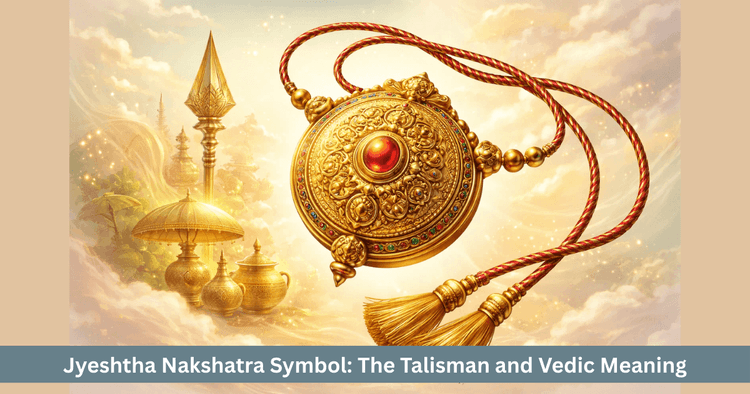
Table of Contents
Jyeshtha Nakshatra in Vedic astrology represents seniority, responsibility, authority and the burden that comes with power. The primary symbol of this Nakshatra is an earring or protective talisman, which carries a deep and living meaning in Indian spiritual and cultural tradition. This symbol is not merely decorative. It reflects protection, constant vigilance, social status and the weight of leadership that is felt from within at all times.
The word Jyeshtha itself conveys a great deal. It means the eldest, the most senior and the one who stands in the foremost position. In ancient India, sacred talismans and ornaments were worn by those who were regarded as guardians of family, lineage, state or dharma. Such holders did not only enjoy authority, they also carried the duty to protect and guide others. Natives of Jyeshtha Nakshatra similarly appear in protective and leadership roles in life, whether in family, profession or a wider social space.
The Talisman: A Living Symbol of Protection and Power
In Vedic tradition, a talisman is never worn like an ordinary ornament. There is a deep spiritual purpose behind wearing it. The work of the talisman is to protect the wearer, shield from unseen dangers and maintain distance from negative energies. This symbol makes it clear that the energy of Jyeshtha Nakshatra is not only shining power but also protection, guardianship and duty.
The dimensions of the talisman symbol can be understood in several ways. It represents protection from unseen dangers. It indicates defence from negative energies and hidden enemies. It serves as a seal of authority and responsibility. It marks the spiritual or social seniority of a person. It is often seen that people influenced by Jyeshtha Nakshatra naturally take up the role of protector within their family, work environment or community.
Who Traditionally Wore Earrings and Talismans
In ancient times, earrings or talismans were not worn only for decoration but as marks of position and duty. Those who wore them usually belonged to the most responsible class of society. These included kings, warriors, priests and elders of clans. They all shared a common feature. They were expected to protect others. They had to take decisions. They had to form and uphold rules.
Natives of Jyeshtha Nakshatra often find themselves in similar roles, whether they desire it or not. Very often they are the eldest sibling at home. They must take care of younger members. They become the decision makers of the family. In professional life they rise to positions of authority and guidance. People expect them to step forward and show direction in difficult situations.
The Burden of Being First in Jyeshtha Nakshatra
The talisman symbol shows not only protection but also weight. Unlike a crown or throne, it does not express honour only outwardly but also signifies an inwardly felt responsibility. When a crown is removed, the head becomes lighter but a talisman rests very close to the body. It is not removed easily. It constantly reminds the wearer of duty.
The life of Jyeshtha natives often passes through exactly this experience. Success enters their life but along with that success come pressure, loneliness and the heavy expectations of others. They are often the ones who wake up first, stand up first in a crisis and still keep thinking deeply even in moments of happiness. Many of them feel that life has demanded maturity from them very early.
Deeper Spiritual Meaning of the Talisman
From a spiritual perspective, the talisman does not only provide outer protection but symbolises protection through wisdom. It points out that true safety does not come only from external measures but from inner awareness, discernment and balance. Natives of Jyeshtha Nakshatra are usually alert and sensitive by nature.
The spiritual message of the talisman appears on several levels. It inspires one to remain aware of unseen forces and subtle energies. It teaches one to avoid ego and to use authority in a balanced manner. It strengthens inner courage and the capacity to remain steady in difficult times. Jyeshtha natives often read situations without words and sense danger or imbalance earlier than others.
Connection of Jyeshtha Nakshatra with Indra
The presiding deity of Jyeshtha Nakshatra is Indra, the king of gods. The story of Indra and the talisman symbol of Jyeshtha are deeply connected. Indra possesses power, yet the same power keeps him in constant danger. He has to protect his position and status again and again. He often attains victory and at other times experiences downfall.
This journey of Indra gives a significant teaching. Authority never remains permanent unless it is governed by humility, responsibility and dharma. Natives of Jyeshtha Nakshatra also pass through similar ups and downs in life. On one side they receive leadership, influence and respect and on the other side they face tests, criticism and inner conflict.
The talisman also expresses the strong protective instinct of this Nakshatra. Jyeshtha natives fiercely guard their family, their reputation, their territory and their moral boundaries. When they feel that someone is crossing a line, they stand very firmly.
Does the Jyeshtha Symbol Always Remind of Vigilance
Because a talisman is worn permanently on the body, it becomes a constant sign of awareness. The energy of Jyeshtha Nakshatra gives importance to strategic thinking, the ability to identify rivals, contained emotions and clearly defined boundaries. This Nakshatra teaches that it is not wise to trust easily at all times, it is better to first understand and evaluate.
Jyeshtha natives are also selective in their emotional life and trust only a few people. They do not share everything with everyone. This nature often keeps them safe, yet if the balance is lost the same quality can turn into excessive suspicion, power struggles and fear of losing control. The philosophy of the talisman reminds that the aim of protection is not to create fear but to cultivate balanced caution.
Shadow Side of the Talisman Symbol
Like every powerful symbol, the talisman also has shadow aspects. When the energy of Jyeshtha becomes unbalanced, this symbol can express itself in certain negative ways. A person may start doubting almost everything. Relationships and work can become sites of continuous power struggle. Ego and the desire for excessive control may increase. A constant fear can grow that authority or status might slip away.
In such times it becomes essential to remember the true message of the talisman. Its purpose is not to make a person harsh or separate from others but to help them become a wise, balanced and responsible guardian. When Jyeshtha natives use their position of authority for service and protection, the symbol shines in its highest form.
Leadership Psychology of Jyeshtha Nakshatra
The leadership of Jyeshtha Nakshatra is different in nature from several other leadership oriented Nakshatras. Some Nakshatras show leadership through charm, enthusiasm or inspiration. Jyeshtha expresses leadership in a more defensive and strategic style. Such leaders give priority to safety and control before showing outward brilliance.
Certain traits clearly outline the leadership style of Jyeshtha. This leadership is defensive, not overly showy. It is protective, not based only on charisma. It is strategic and thoughtful in decision making, not driven only by emotional reaction. The talisman symbol points to leaders who take decisions through control, alertness and experience, not only by outer charm.
Impact of the Talisman Symbol in Daily Life
In daily and practical life, the meaning of the talisman becomes very visible. The energy of Jyeshtha values responsibility more than simple enjoyment. Natives often occupy roles where the position is high, yet stress and pressure are also high. They are given senior roles but they must struggle continuously to carry those roles properly.
Many Jyeshtha natives feel that life has asked for maturity from them quite early. In childhood or youth they take decisions for family or work that usually elders or very experienced people take. Their authority is often tested through opposition. Whatever respect they receive is usually gained after endurance, hard work and persistent struggle.
Why the Talisman Is the Perfect Symbol for Jyeshtha
In Indian astrology, power is always considered sacred, yet at the same time it is explained that power becomes dangerous if misused. The talisman symbol of Jyeshtha Nakshatra keeps reminding of this subtle truth. It says that authority appears attractive, yet it carries equally great choices and challenges.
The talisman warns that seniority always calls in responsibility. One who sits at the top does not receive only honour but must also accept accountability. Protection does not mean only saving others, it also demands that one remain awake at every level. Power must always be guarded with wisdom and restraint. Jyeshtha Nakshatra lives this truth very deeply.
Ultimately, the earring or protective talisman symbol of Jyeshtha Nakshatra teaches that authority comes along with burden. Protection requires constant vigilance. Seniority is not only about respect, it asks for maturity. Power becomes truly meaningful only when it is handled with great care, humility and a dharmic vision. Jyeshtha Nakshatra reminds that being the strongest does not always mean being the happiest, it often means being the most responsible.
Frequently Asked Questions
What is considered the main symbol of Jyeshtha Nakshatra
The main symbol of Jyeshtha Nakshatra is the earring or protective talisman, which represents protection, vigilance, status and the burden of leadership.
What is the spiritual significance of the talisman symbol
The talisman symbol represents protection through wisdom, awareness of unseen forces, caution against ego and the capacity to maintain inner strength in difficult times.
How can the connection between Indra and Jyeshtha Nakshatra be understood
Indra is the presiding deity of Jyeshtha Nakshatra. His story shows power, danger, victory, defeat and the struggle to protect his position, which reflects responsibility and tests in the life of Jyeshtha natives.
What are the main traits of natives born under Jyeshtha Nakshatra
Natives of Jyeshtha Nakshatra are generally protective, vigilant, responsible and willing to step forward in challenging situations. They naturally become protectors and decision makers in family, workplace or society.
In what forms can the negative side of the talisman symbol appear
When unbalanced, this symbol can appear as excessive suspicion, power struggles, ego and fear of losing control. In such times, the real message of the talisman guides one back towards balanced caution and responsible leadership.
What does Nakshatra reveal about me?
My NakshatraDid you like it?
Author

Pt. Amitabh Sharma (56 Years)
Experience: 20
Consults About: Family Planning, Career
Clients In: Punjab, Haryana, Delhi
Share this article with friends and family
About ZODIAQ
ZODIAQ is an online Vedic Astrology platform. It connects clients seeking astrological advice to experienced astrologers with deep knowledge. Our users also generate kundali and perform kundali milan for free. ZODIAQ also offers services to the Astrologers. Astrologers utilize various offerings by ZODIAQ to serve their clients effectively.
If you are a User
Consult with experienced astrologers and seek their guidance. You can also order handwritten Janm Patrika report with life prediction prepared by experienced astrologers. Generate accurate Kundali, perform Kundali Matching and check horoscope and muhurat. Utilize our online library for all the necessary astrological and spiritual information.
If you are an Astrologer
Create accurate kundali for your clients and perform Kundali Matching for up to 5 people at a time. Write comprehensive Janm Patrika report for your clients with ZODIAQ. Check client details anytime by saving it in client directory. Become more productive by tracking how many clients you guide every day.
WELCOME TO
ZODIAQ
Right Decisions at the right time with ZODIAQ
