The Myth of Indra and Vritra: The Soul of Jyeshtha Nakshatra and Cosmic Dharma
By Aparna Patni
The Secret of Strength in Jyeshtha through Battle, Sacrifice, Vajra and Awakening
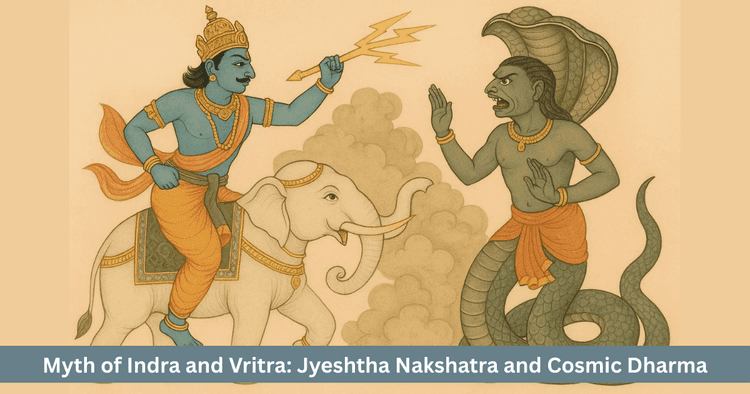
Table of Contents
The ancient Vedic saga of Indra and Vritra is far more than a celestial battle; it is an epic of order versus chaos, morality versus self-indulgence, courage against resignation and ultimately a metaphysical lesson in power, leadership and cosmic balance. The narrative beautifully echoes every nuance of Jyeshtha Nakshatra, where force, sovereignty, self-control and ultimate responsibility weave the very fabric of destiny. Across every turning point, decision, adversity or command, this myth stands as a living example for Jyeshtha natives, imparting inspiration, vigilance and wisdom.
The Rise of Vritra: Obstruction, Drought and the Existential Threat
Vritra, the snake-demon, the “Blocker,” personifies everything in nature and human arcana, that causes stagnation and decay. In Vedic lore, he is not just a demon but the nemesis of cosmic and spiritual flow.
- Vritra’s literal meaning, “one who blocks or restrains.”
- The sacred waters, rivers and clouds were stopped; the womb of life ran dry, fields withered and Earth was rendered desolate.
- Water’s stagnation represents the stagnation of life, consciousness, emotional and mental processes.
- Vritra signals those seasons when greed, pride, fear or mental inertia freeze our inner and outer landscape.
Deeper Perspective:
Vritra is a force both outside and within. He disrupts the balance of self, family, society and cosmos. Conquering Vritra demands not just outer confrontation but also deep self-examination and annihilating our innermost blockages.
The Gods’ Entry: Sage Dadhichi’s Supreme Sacrifice
Baffled by Vritra’s power, the gods experience the humbling limits of their might. Realizing that no normal weapon can destroy Vritra, they turn to Sage Dadhichi, a sage renowned for his great discipline and spiritual fire.
- The gods plead for a weapon forged from Dadhichi’s bones, alone infused with the spiritual force to defeat Vritra.
- Dadhichi consciously and calmly decides to give up his mortal body for the higher good.
- It is said he gave his disciples one final lesson, entered ultimate meditation and left his body in full awareness, the bones thus sanctified.
- This act is not mere asceticism but a cosmic vow for the survival of truth, balance and dharma.
Deeper Significance:
Dadhichi’s sacrifice transcends the limits of personal identity and dissolves the boundaries of ego for the welfare of the world. It is the zenith of yogic spirit, noble service and compassion. This is the inner core of any true leader in all times.
Forging the Vajra: Tapas, Radiance and the Birth of Power
The Vajra is not simply Indra’s thunderbolt; it is the living embodiment of spiritual intensity, resolve and self-offering.
- Created not just from bones but the sacred fire, intention and ultimate will.
- Vajra stands for Jyeshtha’s “Arohana Shakti”, latency transformed into transcendent courage and action.
- The transformation of Dadhichi’s body into Vajra: energy spiritualized, the ultimate alchemy of physical strength into cosmic potency.
- It is eternal, unyielding and becomes the weapon and badge of undying resolve.
The Human Lesson:
True power is not latent but awakened by surrender, when one’s limitations, desires and obsessions are left behind for a greater purpose, we discover our divine Vajra.
The Battle of Indra and Vritra: The Deepest Allegory
Indra, king of immortals, rides the white elephant Airavata, charging into a war that is just as much about the cosmos as about his soul. The battle resonates as an inner and outer drama, of stamina, moral clarity and unwavering responsibility.
The Battle
- Vritra counterattacks with cyclones of darkness, drought and disorder, shaking even the gods.
- Indra, burdened with the hopes of all beings, presses on alone.
- He personifies unbending leadership, courage, devotion to duty and dharma.
- The decisive strike of the Vajra ends Vritra; waters are freed, Earth is reborn, cosmic order restored.
The Ideal of Leadership, Sacrifice and Justice
- Indra’s struggle is not just triumph, it’s the restoration of cosmic law and the return of balance and fertility.
- His decisive force is not violent conquest but the enactment of higher will, at the crossroads of virtue, knowledge and collective wellbeing.
Jyeshtha Nakshatra: Spiritual, Philosophical & Psychological Expansions
Leadership and Duty
Jyeshtha natives are always entrusted with significant responsibilities, be it in family, work, society or their inner realm.
- Leadership here means shelter, empathy, unwavering protection.
- As Indra confronts his pride and solitude, so Jyeshtha natives must master stress, secrecy or self-doubt.
- They excel when leadership is tempered with fairness, balance and principle.
Sacrifice, Solidarity and Service
- Dadhichi’s tale proclaims there can be no success without personal sacrifice for a greater good.
- At home, work or in love, Jyeshtha finds fulfillment by prioritizing collective good over personal gain.
- True teamwork arises when ego is replaced by care, justice and fairness.
Strength, Purpose and Control
- Vajra is force in service of dharma, not blind violence or authority.
- Natives are urged to wield Mercury’s intellect, self-mastery and prudent communication.
- Power used for greed or domination invites downfall; power for justice and order liberates.
The Inner Vritra: The Psychological Dimension
- Vritra lives within as fear, inertia, craving or pride, halting the flow of consciousness.
- Jyeshtha’s mission is to face and overcome these blocks for authentic, courageous living.
Flow of Waters: Unlocking Emotion and Healing
- Water stands for life, feeling, vision, spiritual sensitivity.
- Vritra’s blockade depicts depression, repression or detachment.
- Indra’s triumph is the return of clarity, vitality and transcendence.
For Jyeshtha Natives: The Living Message of the Indra-Vritra Myth
- Greet every trial with leadership, courage and inner ethics.
- Relationships thrive on protection, mystery and gentle assurance.
- Self-mastery, intellect, stamina and resilience define your strength.
- All power must be aligned with selfless purpose and cosmic order.
Conclusion
Indra-Vritra and Jyeshtha Nakshatra, at every layer, outer and inner, reveal the eternal play of courage, resolve, wisdom, justice and responsibility. The myth is a spiritual mirror, inviting us to craft our personal Vajra through self-mastery and compassion.
Indra’s valor, Dadhichi’s sacrifice, the defeat of Vritra and the flow of life restored, represent the journey every Jyeshtha soul must embrace: Leadership manifest not in dominance but in stewardship, service and an unwavering commitment to universal harmony.
Frequently Asked Questions
Q1: What does Vritra truly symbolize?
A: Vritra is not merely a demon but a metaphor for inner and outer stagnation, fear and all that blocks progress in life.
Q2: Why is Dadhichi’s teaching essential to real leadership?
A: Dadhichi’s example shows lasting leadership is built when self-interest is sacrificed for the greater good.
Q3: What is the profound meaning of the Vajra?
A: Vajra signifies willpower, intellect, spiritual power and the wise use of strength and resilience.
Q4: How does this myth inspire Jyeshtha natives’ personal journey?
A: It reminds them that the greatest obstacle is the ego and internal struggle; true leadership requires conquering one’s inner Vritra.
Q5: When is this myth most relevant in a Jyeshtha life?
A: Especially at phases of duty, leadership or internal dilemma, when discernment, self-sacrifice and universal harmony matter most.
What does Nakshatra reveal about me?
My NakshatraDid you like it?
Author

Aparna Patni (63)
Experience: 20
Consults About: Family Planning, Career
Clients In: Punjab, Haryana, Delhi
Share this article with friends and family
About ZODIAQ
ZODIAQ is an online Vedic Astrology platform. It connects clients seeking astrological advice to experienced astrologers with deep knowledge. Our users also generate kundali and perform kundali milan for free. ZODIAQ also offers services to the Astrologers. Astrologers utilize various offerings by ZODIAQ to serve their clients effectively.
If you are a User
Consult with experienced astrologers and seek their guidance. You can also order handwritten Janm Patrika report with life prediction prepared by experienced astrologers. Generate accurate Kundali, perform Kundali Matching and check horoscope and muhurat. Utilize our online library for all the necessary astrological and spiritual information.
If you are an Astrologer
Create accurate kundali for your clients and perform Kundali Matching for up to 5 people at a time. Write comprehensive Janm Patrika report for your clients with ZODIAQ. Check client details anytime by saving it in client directory. Become more productive by tracking how many clients you guide every day.
WELCOME TO
ZODIAQ
Right Decisions at the right time with ZODIAQ
