What Is the Mystery of Moola Nakshatra and the Churning of the Ocean-How Was Nirriti Born and What Does It Symbolize?
By Pt. Suvrat Sharma
The Profound Spiritual Symbols Linking Moola Nakshatra, the Ocean’s Churning and Nirriti-Jyeshta
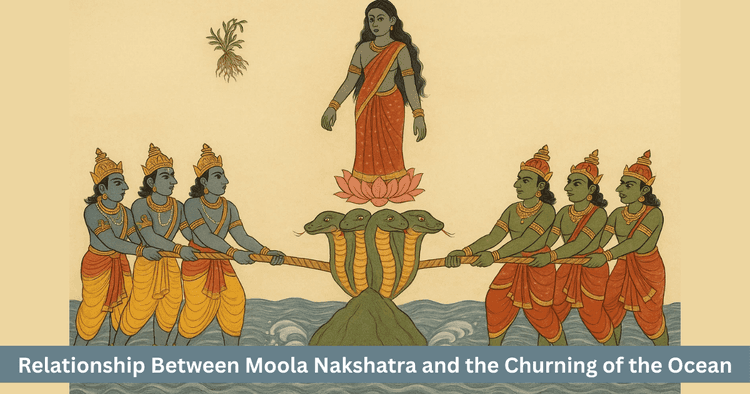
Table of Contents
In Vedic astrology, Puranas and cosmic philosophy, Moola Nakshatra’s mystery runs deep: it is not just a lunar mansion occupying 0°00’-13°20’ of Sagittarius but a root point at the convergence of mythic cycles, celestial events and spiritual processes. To fully understand Moola’s essence, we must unravel the epic of Samudra Manthan-the Churning of the Ocean-and the birth of Nirriti, along with their intricate symbolism.
The Churning of the Ocean: Cosmic Struggle and Metaphysical Lessons
Samudra Manthan stands as an iconic myth in Hindu tradition, radiating themes of creation, dissolution and rebirth. Gods and demons (Devas and Asuras) join forces to churn the Milky Way ocean, seeking amrita-the nectar of immortality. This grand cosmic act triggers the emergence of myriad treasures, potent deities and spiritual powers, along with the perilous halahala-the deadly poison, so powerful its mere existence threatens all realms.
- Halahala Poison: This lethal essence rises from the ocean’s depths, representing the dark undercurrents and unresolved pain dwelling in every soul. It is a metaphor for the shadow we must confront in the process of awakening.
- Amrita and Treasures: The churning yields divine gems and spiritual powers, marking the ascent of consciousness, hope and transformative potential.
The story is a profound allegory of karmic purification, spiritual surrender and the universal dance of opposing energies.
From Halahala Was Born Nirriti: Goddess of Sorrow, Roots and Cosmic Challenge
Halahala’s most formidable effect is the birth of Nirriti (or Jyeshta), the elder sister of Lakshmi. Unlike her sister, Nirriti embodies sorrow, misery, rejection and adversity. She reigns over the shadow realms and sits at the axis of destruction, clearing the way for new cosmic forms.
- Symbolism: Nirriti’s emergence from poison signals that before any creation or prosperity, adversity and tribulation will test every soul. “Jyeshta”-meaning the elder-represents the hidden darkness each living being must someday face.
In the ancient texts, both gods and demons hesitate to accept Nirriti: her presence is uncomfortable, unwanted, feared. Eventually, Jyeshta is abandoned beneath the sacred peepal tree, an act representing societal neglect, solitude and the possibility of spiritual renewal in the face of suffering.
Nirriti’s Marriage: Acceptance of Suffering as a Cosmic Rule
Jyeshta’s marital narrative is significant. Sage Dussaha’s acceptance of her as his consort is a message: hardship is not merely to be shunned but to be recognized, endured and embraced as an essential part of creation’s cycle.
- Symbolism: Marriage signifies the necessity of integrating difficulty and hardship into the cycle of life; it marks the realization that the path to wisdom demands facing one’s suffering head-on.
Jyeshta and Lakshmi: Mystical Balance of Blessings and Loss
Jyeshta/Nirriti, as Lakshmi’s elder sister, completes the cosmic dance of fortune. Lakshmi brings auspiciousness, abundance and joyful energy, while Nirriti presides over difficulty, loss and entropy.
- Lakshmi: She is the radiant axis of prosperity, giving order, fertility and riches to creation.
- Jyeshta/Nirriti: She is the centrifugal force dismantling attachments and illusions-ushering transformation through loss and pain.
Accepting both sisters is to embrace the reality that joy and hardship are two facets of the same spiritual coin. Only by honoring both can the soul experience the fullness of divine bounty.
Moola Nakshatra and Nirriti: The Symbolism of Roots and Spiritual Mandate
Moola is the Nakshatra of roots-of cutting old cords and searching for the essence within. Nirriti’s myth echoes in every phase of the Moola native’s journey.
- Destruction and Renewal: Nirriti empowers Moola energy-removing outdated beliefs and attachments, making space for new spiritual awakening.
- Difficulty and Healing: Moola’s natives experience perpetual transformation, loss and intensity, all of which become the driving force for inner wisdom.
- Struggle, Acceptance, Ascent: The cycle of neglect and eventual acceptance shown in Nirriti’s myth models a spiritual principle: only those who accept suffering truly ascend in self-realization.
Every upheaval, pain and transformation in the Moola journey reflects the mythic path of digging deep, uprooting nonsense and striving for the luminous root of truth.
Cosmic Symbolism: Lessons in Suffering, Creation and Balance
- Halahala Poison: Spiritual hardship, social ignorance and trials of compassion-each age confronts its own version of the poison.
- Birth of Nirriti: Confronting shadow, breaking bondage-her birth is a lesson in surrender and spiritual courage.
- Peepal Tree Abandonment: Renewal and growth are always lurking beneath apparent neglect.
- Sage Dussaha’s Marriage: Power lies in accepting what life brings-embrace difficulty as a path to inner balance.
The Spiritual Mandate for Moola Natives
Natives of Moola Nakshatra traverse dramatic landscapes of transformation and difficulty, often experiencing pain and loss more than others. Yet every trial is an opportunity to disengage from the unessential, face necessary upheaval and emerge in awakened clarity.
- Rooted Inquiry: Searching for invisible truths, releasing surface illusions.
- Cultivation of Equilibrium: Accepting both gifts and hardships as spiritual nutrients.
- Ripening of Wisdom: The greatest joy comes through experiencing, enduring and finally integrating pain as a sacred teacher.
Conclusion
Through Samudra Manthan, halahala poison and Nirriti’s myth, the story of Moola Nakshatra rises beyond astrological symbolism-becoming a template for spiritual evolution, cosmic acceptance and the harmonizing of polarities. In every journey toward prosperity and joy, one must pass through the rigor of suffering, challenge and loss. Nirriti stands as the goddess who guides souls through the terrain of adversity, inspiring Moola natives to uproot ignorance, dig deeper and finally cultivate the wisdom that lies in honoring both creation and destruction.
The real gift of Moola is to know: before abundance, there is challenge; before sweetness, there is bitterness; before ultimate freedom, there is surrender to suffering. In this dance of destruction and renewal, lies the eternal cycle-and, ultimately, enlightenment.
FAQs
Q1. How is the story of the Churning of the Ocean connected to Moola Nakshatra?
The churning myth gave birth to Nirriti and forms the foundation for Moola Nakshatra’s deep spiritual lessons of destruction, uprooting and spiritual rebirth.
Q2. Who is Goddess Nirriti and what is her relationship to Lakshmi?
Nirriti, also known as Jyeshta, is Lakshmi's elder sister and the goddess of adversity and misfortune, while Lakshmi represents prosperity. Their connection symbolizes the cosmic balance of joy and suffering.
Q3. What is the spiritual meaning of the halahala poison and Nirriti’s birth?
Nirriti emerging from halahala represents destruction, spiritual trial and necessary renewal, teaching that hardships are essential for true growth.
Q4. What practical lessons does this myth hold for Moola Nakshatra natives?
Moola natives often face repeated loss, difficulty and deep transformation, which ultimately lead them to truth and spiritual awakening. The myth illustrates that challenges are doorways to realization.
Q5. How do Nirriti and the symbolism of roots aid in personal evolution?
Nirriti and the root symbol teach that true growth sometimes demands the uprooting of false or painful elements, guiding the soul toward authentic light and transformation.
What does Nakshatra reveal about me?
My NakshatraDid you like it?
Author

Pt. Suvrat Sharma (63)
Experience: 20
Consults About: Family Planning, Career
Clients In: Punjab, Haryana, Delhi
Share this article with friends and family
About ZODIAQ
ZODIAQ is an online Vedic Astrology platform. It connects clients seeking astrological advice to experienced astrologers with deep knowledge. Our users also generate kundali and perform kundali milan for free. ZODIAQ also offers services to the Astrologers. Astrologers utilize various offerings by ZODIAQ to serve their clients effectively.
If you are a User
Consult with experienced astrologers and seek their guidance. You can also order handwritten Janm Patrika report with life prediction prepared by experienced astrologers. Generate accurate Kundali, perform Kundali Matching and check horoscope and muhurat. Utilize our online library for all the necessary astrological and spiritual information.
If you are an Astrologer
Create accurate kundali for your clients and perform Kundali Matching for up to 5 people at a time. Write comprehensive Janm Patrika report for your clients with ZODIAQ. Check client details anytime by saving it in client directory. Become more productive by tracking how many clients you guide every day.
WELCOME TO
ZODIAQ
Right Decisions at the right time with ZODIAQ
