Who is Nirrti, the Presiding Goddess of Moola Nakshatra?
By पं. नरेंद्र शर्मा
The Divine Mystery of Nirrti, Goddess of Destruction and Transformation
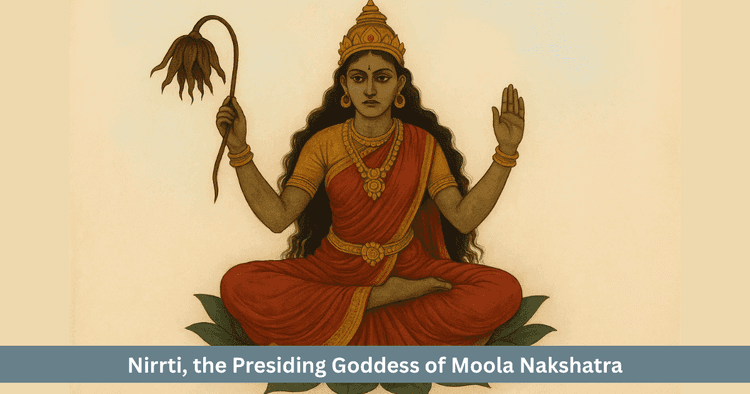
Table of Contents
From the wellspring of Vedic wisdom emerges the enigmatic goddess Nirrti, who presides as the powerful force behind dissolution, decay and profound transformation. Moola Nakshatra, her celestial domain, unfurls across 0°00’ to 13°20’ in Sagittarius, with Ketu as its governor-a planet embodying spiritual liberation and detachment. Within Moola Nakshatra’s embrace lies the secret: all dissolution is but preparation for new birth and realization. Without Nirrti, the cosmic journey of any soul remains incomplete, for she is the gateway through which latent transformation and ultimate moksha are unveiled.
The Profound Form and Essence of Goddess Nirrti
The Rigveda’s verses portray Nirrti as a formidable, awe-inspiring presence, a cosmic truth as inescapable as death itself. “Nihṛti,” literally “absence of rta (cosmic order),” signifies her role in breaking the chains of attachment, stagnant order and illusory comfort. Not merely a goddess of destruction, she governs the process of decay buried in nature’s very roots-inviting awakening that surfaces only after illusion is dispelled.
Vedic sages, with a mix of dread and reverence, often beseeched Nirrti to leave their midst, praying, “Depart, O Nirrti, to distant realms, carrying away our misfortune.” Her transparent role signified that enlightenment is impossible unless delusion is first destroyed.
The Upanishads echo her significance: just as Yama, the god of death, stands as gatekeeper to the highest truth, so does Nirrti test each seeker’s worth-demanding the courage to face loss, sorrow and dissolution. Through her, the seeker finds that the destruction of falsehood is a sacred gate to the soul’s ascent.
Mythological and Cosmic Role: Karma, Direction and Balance
Nirrti governs the southwest quadrant of the cosmos, known as “Nairṛtya,” described in ancient scriptures as the realm of disease, separation, loss, adversity and material hardship. Within Vedic cosmology, she presides over the dissolution of virtue, serving as a force that exposes human frailty and error.
Puranic narratives present her as Adharma’s consort, mother of Mrityu (death), Bhaya (fear) and Mahabhaya (great fear), further emphasizing her integral role in the karmic and evolutionary cycles of the universe. During the mythological churning of the ocean (Samudra Manthana)-a story found in the Bhagavata Purana and echoed throughout Indic tradition-Nirrti, along with other inauspicious forces, emerged before the nectar of immortality surfaced. This narrative illustrates a universal principle: before renewal or immortality can blossom, every soul must confront and purge the poisons within.
| Direction | Presiding Deity | Adverse Effects |
|---|---|---|
| Southwest | Nirrti | Disease, loss, adversity, inauspiciousness |
Through the lens of cosmology, Nirrti embodies the dissolution necessary for any creative act to endure. As Agni sparks creation and Varuna maintains order, Nirrti ensures cyclical renewal by uprooting decay and imbalance-the unseen offering at the heart of all existence.
Iconography, Symbols and Worship: Fear, Peace and Realization
Nirrti’s iconography is saturated with meaning. She appears in dark or ashen hues, standing for mystery, the unknown and the inevitability of change. Her form is often depicted as riding a donkey, her visage fearful and fierce, with garments in disarray and intense, penetrating eyes. In certain depictions, she wears garlands of black flowers or withered leaves-reminders of the fleetingness of life and the need to surrender what has withered in order for new growth to arise.
- Sword: Her ability to sever bonds of illusion and ignorance.
- Noose: The power to release the soul from karmic grasp.
- Donkey: Symbolizes endurance, detachment and equanimity in facing negativity.
- Dark attire: Signifies the mysterious, hidden truths and liberation beyond appearances.
| Symbol | Interpretation |
|---|---|
| Donkey | Endurance, detachment, grappling with negative energies |
| Sword or noose | Freedom from attachment, fear and delusion |
| Black flowers | Transience and decay as prerequisites for rebirth |
Rituals for Nirrti often reference desolate terrains, cremation grounds or wild places-signifying the abandonment of attachments. In Vedic ceremonies for housewarming, marriage or large rites, priests would invoke prayers for Nirrti’s peaceful departure to ensure her powers of disruption were properly honored and averted. For individuals born under Moola Nakshatra, special rituals known as Moola Shanti or Rudrabhishek are sometimes observed to harmonize her influence, safeguarding the lineage from inherited burdens.
The Symbolism of Moola Nakshatra: Bundle of Roots and the Seeker’s Journey
Moola Nakshatra bears the symbol of a “tied bundle of roots,” expressing karmic knots, ancestral ties and the deepest substrata of the soul’s journey. The word “Moola” denotes not only “root” but also the underlying motivation and primordial state of each being. These roots represent the soul’s quest-breaking free from surface illusions and delving into the substratum of existence.
Those born under Moola typically exhibit exceptional inquisitiveness, a readiness to confront risk and a persistent pull toward esoteric subjects and inner transformation. Their lives often unfold amidst unpredictable changes and profound losses, not as punishment but as sacred challenges that foster wisdom, resilience and self-discovery.
- Their journey is not merely outward but encompasses a deep exploration of their existential roots.
- These individuals may feel strong ancestral or familial ties, experiencing patterns or challenges passed through generations.
- Sometimes, they must address inherited burdens-hence the tradition of “Moola Dosha” remedies aimed at breaking cycles and offering spiritual clarity.
Spiritual Significance: Destruction, Fear and Bliss
The way of Nirrti is arduous, yet hidden within hardship burns the flame of liberation. Both the Upanishads and the core of Indic philosophy declare: “When there is destruction, there is new arising.” Under Nirrti’s shadow, Moola natives find a rare courage-a willingness to look darkness in the face, to transform fear into knowledge and sorrow into awakening.
Moola’s connection to Ketu intensifies this energy, conferring detachment, perseverance in spiritual austerities, abrupt enlightenment and the dissolution of old bonds. These qualities enable a soul to break its limitations, enter states of pure awareness and contribute profoundly to generational healing.
| Spiritual Lesson | Meaning |
|---|---|
| Breaking attachment | Destroying ties of illusion and ignorance |
| Embracing hardship | Transformative growth through loss and adversity |
| Renewal | Rebuilding the soul’s foundation after every ending |
Such individuals and their families, may perform rituals for ancestral healing, seeking to close cycles and restore equilibrium. This wisdom is woven through the fabric of time-the promise that destruction is not finality but the beginning of a new sacred order.
The Balance of Fear and Reverence: Nirrti’s Place in Vedic Ritual
No Vedic ceremony-be it fire rituals, marriages or home sanctifications-was complete without addressing Nirrti. Hymns for her “departure” abound in the Rigveda, wherein priests and householders seek her removal along with evil, loss and hardship. This double perspective lies at the heart of Vedic thought: even fearsome energies, when propitiated and honored, facilitate balance, safety and renewal.
In modern times, the tradition of “Moola Shanti” for those born under Moola Nakshatra continues. This ancient rite is a living reminder that every misfortune is also the seed of upliftment and that even powers most dreaded, when respected and given their due, become allies in the quest for wholeness.
Final Insights
Moola Nakshatra reveals, through its multilayered spiritual, mythic and psychological influences, the deepest truths of existence. Nirrti’s domain is where endings and beginnings are inseparable. The suffering borne under her shadow serves not as punishment but as sacred preparation for wisdom and rebirth.
To gaze only at surfaces is to remain in sorrow but those who search for their roots find the taste of liberation. Nirrti stands beside every soul’s journey-the mother of the light that is born from deepest shadow.
FAQs
Q1. Who is Goddess Nirrti?
Nirrti is the Vedic deity of destruction, dissolution and renewal, as well as the guardian of the southwest direction.
Q2. What are the principal features of Moola Nakshatra?
It extends from 0°00’ to 13°20’ of Sagittarius, bears the symbol of a bundle of roots, is ruled by Ketu and channels transformative powers of destruction and rebirth.
Q3. Why is the worship of Nirrti significant?
It is not merely to alleviate fear but to honor the essential need for balance-rituals propitiate her in ceremonies to enable success and protection.
Q4. Which challenges do natives of Moola Nakshatra often face?
They may encounter profound upheavals, losses and ancestral burdens, yet these too become catalysts for self-awareness and spiritual growth.
Q5. What is the practical significance of Nirrti and Moola Nakshatra’s symbolism?
Their greatest lesson is that only by seeking one’s roots, shedding illusion and transcending fear, does one find genuine enlightenment and peace.
What does Nakshatra reveal about me?
My NakshatraDid you like it?
Author

पं. नरेंद्र शर्मा (63)
Experience: 20
Consults About: Family Planning, Career
Clients In: Punjab, Haryana, Delhi
Share this article with friends and family
About ZODIAQ
ZODIAQ is an online Vedic Astrology platform. It connects clients seeking astrological advice to experienced astrologers with deep knowledge. Our users also generate kundali and perform kundali milan for free. ZODIAQ also offers services to the Astrologers. Astrologers utilize various offerings by ZODIAQ to serve their clients effectively.
If you are a User
Consult with experienced astrologers and seek their guidance. You can also order handwritten Janm Patrika report with life prediction prepared by experienced astrologers. Generate accurate Kundali, perform Kundali Matching and check horoscope and muhurat. Utilize our online library for all the necessary astrological and spiritual information.
If you are an Astrologer
Create accurate kundali for your clients and perform Kundali Matching for up to 5 people at a time. Write comprehensive Janm Patrika report for your clients with ZODIAQ. Check client details anytime by saving it in client directory. Become more productive by tracking how many clients you guide every day.
WELCOME TO
ZODIAQ
Right Decisions at the right time with ZODIAQ
