Swati Nakshatra and Vayu Deva: The Power of Freedom, Movement and Inner Independence
By Pt. Abhishek Sharma
The Divine Energy of Prana, Independent Growth and Self-Directed Movement
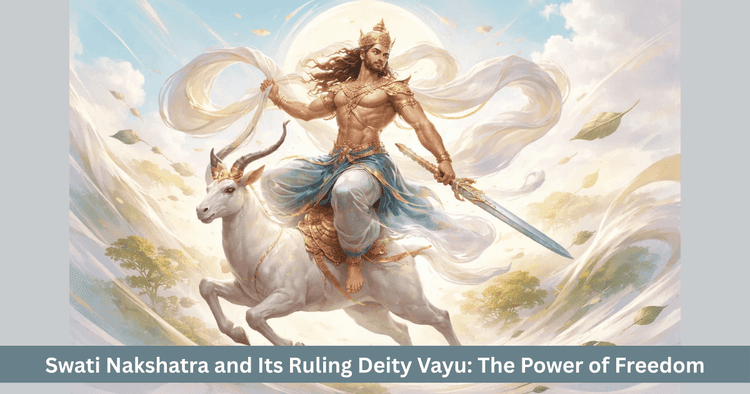
Table of Contents
The ruling deity of Swati Nakshatra is Vayu Deva, the Vedic god of wind and prana. Vayu is not merely air. He is the unseen force that carries movement, life, freedom and the constant flow of every moment. The word Swati can be linked with a sword and also with a tender sprout. When this nakshatra is ruled by Vayu, Swati becomes a symbol of independent growth, self chosen direction and the strength to stand on one’s own feet.
For this reason Swati Nakshatra can be seen as a stage where the soul learns that the real journey is hidden in the art of walking forward, even while standing alone.
Who Is Vayu in Vedic Philosophy
In Vedic philosophy Vayu is not only an element but prana, the life force that keeps both body and mind in motion. In Vedic mantras Vayu is described as the messenger between gods and humans, the power that carries offerings upward and the source behind all movement.
Vayu Deva can be understood in these forms.
- Carrier of breath and life force
- Invisible link that carries messages between humans and the divine
- Power that moves every leaf, thought and change
- Divine symbol of unattached freedom, present everywhere yet bound nowhere
When breath stops, life stops. In the same way without Vayu, no movement is possible. In Swati Nakshatra this Vayu principle appears as inner freedom and the capacity to learn through experiences.
Why Does Vayu Rule Swati Nakshatra
Swati Nakshatra lies completely in the sign Libra. Libra is associated with balance and partnership, yet the energy of Swati moves slightly away from Libra’s dependency and leans toward self reliance.
Vayu Deva rules Swati because this nakshatra
- values independence above dependency
- prefers constant motion and learning over stagnation
- moves toward knowledge gained through experience rather than control
The energy of Swati is light, mobile and continuously evolving. This nakshatra does not bind. It opens. It does not hold back. It moves forward, like air which does not stay in a closed pond but flows through open space.
Psychological Impact of Vayu on Natives of Swati
Under the rulership of Vayu Deva, natives born under Swati Nakshatra tend to carry a strong inner need for personal freedom.
- They feel a natural pull to make their own decisions
- Emotional or social control often makes them uncomfortable
- Their thinking remains independent original and able to shift with circumstances
- They adapt quickly when the environment changes, showing high adaptability
Swati natives bloom best when they receive space, time and opportunity to grow in their own way. Where there are rigid rules, heavy restrictions and constant monitoring, their energy gradually begins to feel tired.
Is Inner Freedom the Core Theme of Swati
The energy of Vayu leads Swati natives not only toward outer freedom but also toward inner independence.
- They cannot tolerate suffocating patterns in relationships
- They resist authority that appears unjust or one sided
- They prefer flexible roles in work environments
- They become naturally active in situations linked with travel, trade and communication
Like the wind, Swati natives move toward places where they see opportunity, learning and scope for growth. They avoid staying for long in places where only blockage and repetition are present.
Role of Vayu in Career and Direction of Swati
Vayu Deva points toward fields that involve movement, exchange and wide networks.
- Trade and commerce
- Travel, transport and aviation
- Communication, media and networking
- Research, innovation and new ideas
Natives of Swati often perform well in areas such as
- business, entrepreneurship and independent ventures
- marketing, sales and client based roles
- foreign trade, import export and multinational environments
- consulting, accounting and independent advisory positions
Their success usually arises not from force or pressure but from awareness of timing, smart movement and the ability to place themselves in the right flow of opportunity.
Spiritual Meaning of Vayu in Swati Nakshatra
On the spiritual level Vayu Deva teaches that
- one can remain detached and still remain sensitive
- motion is important, yet it need not become chaos
- freedom is healthy when it walks with awareness
For Swati souls this teaching is essential. Freedom does not mean running away. Freedom means choosing a path consciously where growth is possible and refusing to stay in places where one remains only due to fear or habit.
What Is the Shadow Side of Vayu’s Influence
When the energy of Vayu remains balanced, Swati natives appear capable, intelligent and highly adaptable. When the same energy loses balance, certain challenges may arise.
- Persistent restlessness and desire for constant change
- Emotional distance and avoidance of deep bonding
- Difficulty in settling down in one place or one role
- Fear of commitment in both relationships and career
In such a state freedom becomes an excuse to escape stability. The lesson of Swati is to seek rooted freedom rather than running freedom. Independence does not mean uprooting oneself. It means bending with the wind without snapping.
Relationships Under the Energy of Vayu
In the realm of relationships, the energy of Swati clearly demands space and respect.
- Swati natives prefer partners who allow them room to breathe
- Over attachment, constant control or suspicion gradually pushes them away
- They feel drawn to relationships in which both individuals maintain their own identity and open communication
They can love deeply, yet they remain committed when they feel that their independence is safe. Where their nature is repeatedly suppressed, they slowly begin to distance themselves, even if the relationship appears to continue outwardly.
Symbolic Message of Vayu for Swati Nakshatra
Vayu Deva offers simple yet deep messages for Swati natives.
- The wind cannot be caged. It can only be guided
- Movement is the natural state of life. Stillness is only one phase
- Freedom requires guidance from intelligence and awareness
Swati Nakshatra teaches the art of staying strong without becoming rigid and bending with time without breaking. It invites the soul to define its own path, yet to walk that path with wisdom, sensitivity and responsibility.
Core Essence of Swati Nakshatra and Vayu Deva
Swati Nakshatra does not stand for rebellion. It stands for self defined growth. Through Vayu Deva, Swati receives
- independence
- adaptability
- intelligence
- inner resilience and flexibility
The wind does not announce its arrival. It quietly changes direction, yet its presence is felt by everyone. Swati Nakshatra functions in the same way. It does not make loud claims, yet wherever the energy of Swati is strong, there is clear presence of independent thinking, movement and progress achieved through one’s own effort.
Frequently Asked Questions
Do Swati natives always run away from stability
Not always. They carry a strong need for freedom, yet with right understanding and environment they can live with stability, provided they receive space for expression and decision making.
Does the energy of Vayu draw Swati natives strongly toward travel and change
Yes. Swati natives usually do not fear change in place, work or ideas. They often view such changes as opportunities for learning and expansion.
Do Swati natives face more challenges in marriage
Challenges can arise when partners are overly controlling or suspicious. When relationships offer freedom, dialogue and mutual respect, Swati natives can remain loyal and supportive for a long time.
Which careers may suit Swati Nakshatra the most
Fields involving movement, communication, trade or flexible structures, such as business, marketing, foreign trade, media, travel related work and consulting, usually resonate well with the energy of Swati.
Is special worship of Vayu Deva necessary for all Swati natives
It is not necessary. Anyone who feels connected with this nakshatra can honour Vayu Deva by bringing responsibility into freedom, balance into movement and awareness into decisions. Living these principles is itself a true form of reverence.
What does Nakshatra reveal about me?
My NakshatraDid you like it?
Author

Pt. Abhishek Sharma (63)
Experience: 20
Consults About: Family Planning, Career
Clients In: Punjab, Haryana, Delhi
Share this article with friends and family
About ZODIAQ
ZODIAQ is an online Vedic Astrology platform. It connects clients seeking astrological advice to experienced astrologers with deep knowledge. Our users also generate kundali and perform kundali milan for free. ZODIAQ also offers services to the Astrologers. Astrologers utilize various offerings by ZODIAQ to serve their clients effectively.
If you are a User
Consult with experienced astrologers and seek their guidance. You can also order handwritten Janm Patrika report with life prediction prepared by experienced astrologers. Generate accurate Kundali, perform Kundali Matching and check horoscope and muhurat. Utilize our online library for all the necessary astrological and spiritual information.
If you are an Astrologer
Create accurate kundali for your clients and perform Kundali Matching for up to 5 people at a time. Write comprehensive Janm Patrika report for your clients with ZODIAQ. Check client details anytime by saving it in client directory. Become more productive by tracking how many clients you guide every day.
WELCOME TO
ZODIAQ
Right Decisions at the right time with ZODIAQ
