The Enduring Legend of the Chhataka Bird: Does Swati's Rain Hold the Secret of Patience?
By Aparna Patni
Chhataka Bird, Wind's Embrace, Saturn's Exaltation, Hanuman's Inspiration and Life's Teachings
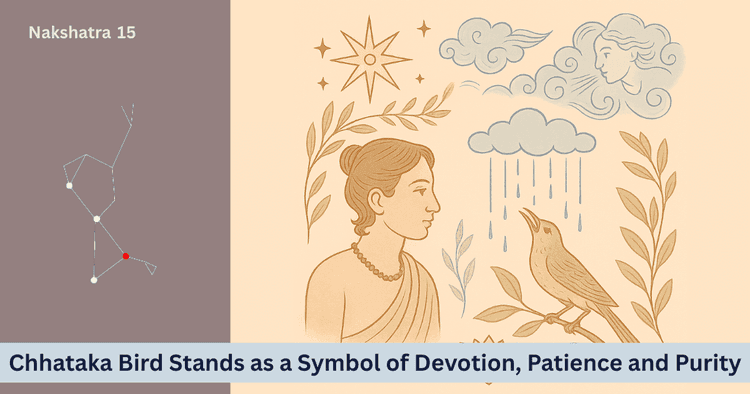
Table of Contents
In the ancient tales surrounding Swati Nakshatra, the legend of the Chhataka bird stands as a precious symbol of devotion, patience and purity. This extraordinary bird has a remarkable habit-it endures thirst throughout the entire year, refusing to drink from ponds, rivers or wells, waiting solely for the raindrops that fall during the period of Swati Nakshatra. This exceptional selectiveness represents not just patience but unwavering devotion to an ideal.
What Does the Chhataka Bird's Tale Teach About Patience and Purity?
The Puranas narrate that once a young Chhataka questioned his father-when all other creatures of the world quench their thirst with ordinary water, why do we endure such painful waiting? The father explained that Chhataka birds have a sacred duty-our calls invite the clouds, bringing life-giving rain to earth and saving the entire ecosystem from drought.
The young Chhataka wandered and tasted other water sources but ultimately understood that true bliss comes only to those who patiently wait for the purest drops. This tale symbolizes the fruits of spiritual discipline and unwavering faith.
Is the Chhataka's Wait Relevant in Modern Life?
In today's era of instant gratification, the Chhataka's message runs deep. It teaches that life's greatest gifts often come through patience, purity and waiting for the right moment. Rather than immediate conveniences, achievements earned through deep dedication and faithfulness prove more satisfying and enduring.
The Wind's Embrace-Symbol of Freedom, Balance and Flexibility
Swati Nakshatra's essential element is air, ruled by Vayu Deva-lord of life-breath and movement. This profoundly defines the characteristics of Swati natives and the spiritual teachings embedded in this constellation.
Why Is Wind the Supreme Teacher of Adaptability and Balance?
Like a tender sapling bending in the wind, Swati teaches that strength lies not in rigidity but in flexibility. Life's challenges demand balance-the art of swaying with circumstances without losing one's core principles.
Are Freedom and Dynamism Swati's Central Message?
Wind symbolizes the sacred value of freedom. Swati natives possess a restless spirit-they value personal space, intellectual exploration and the liberty to express their unique identity.
What Role Does Wind Play in Communication and Influence?
Wind spreads messages far and wide. Similarly, Swati natives possess the divine gift of communication-the art of negotiation, mediation and persuasion, infused with grace and courtesy.
This intricate relationship between wind and growth reveals that true resilience lies in the beautiful dance of flexibility combined with strong roots.
Saturn's Exalted Position-Does Swati Hold the Secret of Supreme Balance?
Astrologically, Swati Nakshatra represents Saturn's exaltation sign. This signifies the profound equilibrium Swati demonstrates.
How Does the Paradox Between Saturn and Wind Find Resolution?
Saturn represents discipline, karma and life's rigid lessons, while Swati's air element emphasizes freedom and movement. This exaltation symbolizes perfect harmony between contraction and expansion, patience and action.
Why Does Swati Contain the Formula for Life's Ideal Balance?
This balance represents existence's ideal state, where one controls desires and frustrations (contraction) while pursuing growth and freedom (expansion). Swati is a profound symbol of life's equilibrium-reminding us that true power emerges when one navigates between opposing forces with wisdom and grace.
Inner Strength and Divine Mentorship from Hanuman's Tale
A celebrated metaphor enriching Swati Nakshatra's understanding is Hanuman's story-the mighty divine monkey who once lost awareness of his sublime powers. Only through a mentor's guidance and gentle nudge did Hanuman rediscover his strength and soar to heroic heights.
Is This Story a Mirror for Swati Natives?
Despite possessing immense energy, Swati natives sometimes feel scattered or disconnected from their true potential. Rahu's influence grants them tremendous power but also imparts a restless, boundary-pushing nature.
Why Is a Guru or Guide's Presence Essential?
A wise mentor or guide's presence is crucial for Swati natives, helping center their dynamic energies, illuminate their path and accomplish great feats. This guidance enables them to offer their greatest gifts while maintaining balance and direction.
Life and Spiritual Lessons from Swati Nakshatra
What Is the Importance of Devotion and Patience?
The Chhataka bird's year-long wait teaches that blessings often arrive on their sacred schedule. True spiritual and material success comes with steadfast devotion and patience.
How Does Wind Teach Adaptability?
Life demands the grace to change when necessary. Strength flows from being flexible while remaining firmly anchored in one's principles.
What Is the Saturn-Swati Formula for Achieving Balance?
Saturn's exaltation in Swati symbolizes ideal equilibrium-balancing expansion with discipline, freedom with responsibility.
How Essential Is the Power of Guidance?
Just as Hanuman regained strength through mentorship, Swati natives significantly benefit from life coaches, teachers or spiritual guides who direct their fervent energies toward noble causes.
Embracing Swati's Spirit-Application in Modern Life
Swati Nakshatra is a timeless emblem of faith, balance and inner power. The Chhataka bird's story reminds us that life's deepest rewards require unwavering patience and purity of heart. Swati's sacred wind commands us to be flexible yet rooted, free yet responsible-a lesson for all who seek to live harmoniously amid life's inevitable changes.
How to Apply Swati's Principles in Personal Growth?
- Cultivate Patience: Don't expect immediate results; wait for quality outcomes
- Embrace Flexibility: Adapt to circumstances without getting trapped in rigid plans
- Accept Guidance: Don't hesitate to learn from experienced individuals
- Maintain Balance: Achieve equilibrium between freedom and responsibility
For those born under Swati's auspices, may Vayu Deva's blessings inspire a life of balanced strength, joyous freedom and profound spiritual awakening.
Frequently Asked Questions
What is the real basis of the Chhataka bird's tale?
It's a symbolic story from Vedic literature that teaches patience and purity.
Why is Saturn's exaltation in Swati significant?
It represents supreme balance between contradictory forces-freedom and discipline.
How does Hanuman's story inspire Swati natives?
It shows that hidden powers can be awakened through proper guidance.
How to apply Swati's principles in modern life?
By adopting the art of patience, flexibility, balance and accepting guidance.
What is the most important life lesson for Swati natives?
Balance between freedom and responsibility and patiently achieving one's goals.
What does Nakshatra reveal about me?
My NakshatraDid you like it?
Author

Aparna Patni (63)
Experience: 20
Consults About: Family Planning, Career
Clients In: Punjab, Haryana, Delhi
Share this article with friends and family
About ZODIAQ
ZODIAQ is an online Vedic Astrology platform. It connects clients seeking astrological advice to experienced astrologers with deep knowledge. Our users also generate kundali and perform kundali milan for free. ZODIAQ also offers services to the Astrologers. Astrologers utilize various offerings by ZODIAQ to serve their clients effectively.
If you are a User
Consult with experienced astrologers and seek their guidance. You can also order handwritten Janm Patrika report with life prediction prepared by experienced astrologers. Generate accurate Kundali, perform Kundali Matching and check horoscope and muhurat. Utilize our online library for all the necessary astrological and spiritual information.
If you are an Astrologer
Create accurate kundali for your clients and perform Kundali Matching for up to 5 people at a time. Write comprehensive Janm Patrika report for your clients with ZODIAQ. Check client details anytime by saving it in client directory. Become more productive by tracking how many clients you guide every day.
WELCOME TO
ZODIAQ
Right Decisions at the right time with ZODIAQ
