Uttara Ashadha Nakshatra Symbol: Elephant Tusk and the Vedic Meaning of Final Victory
By Pt. Sanjeev Sharma
Understand purposeful strength, lasting honour, Vishvedevas and dharma, responsibility, protection, self control and legacy through the elephant tusk symbol
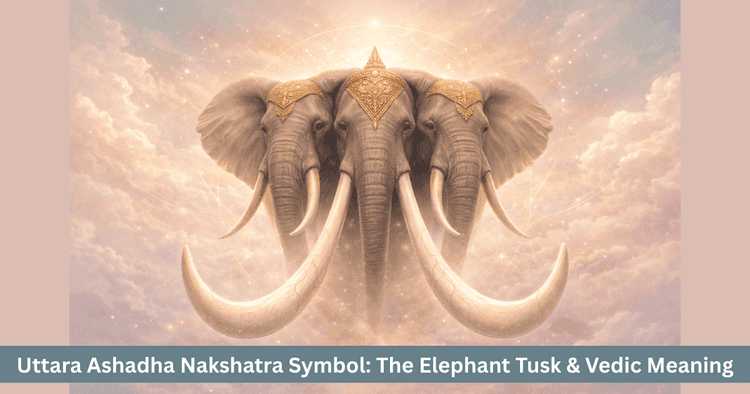
Table of Contents
In Vedic astrology, Uttara Ashadha Nakshatra symbolises that stage where victory is no longer only a struggle but has matured into a complete and stable result. If Purva Ashadha represents the fight for truth, Uttara Ashadha reflects the establishment of truth and its firm rooting in life. Its powerful emblem, the elephant tusk, does not stand for outward aggression. It conveys calm, righteous and enduring strength.
The name Uttara Ashadha means the later invincible one or final victory. This Nakshatra is associated with results that do not come quickly. They develop slowly with depth, then remain strong for a long time. In the nature of this Nakshatra there is very little haste and a great emphasis on patience, ripeness and achievements that can influence future generations.
The Elephant Tusk as a Symbol of Purposeful Strength
The tusk of an elephant is not merely a weapon used in anger. In nature it performs several important roles. It acts as a means of protection. It expresses the elephant’s authority and status. It helps in moving, clearing the way and even in survival. In Indian Vedic symbolism, the elephant tusk becomes an image of power that is not blind force but strength guided by wisdom.
From this angle, the energy of Uttara Ashadha teaches that real power must remain under the guidance of dharma, that is, righteous duty. Here strength is not meant to oppress. It is meant to support just decisions, safety and order. People influenced by Uttara Ashadha succeed not because they crush others but because they walk on a principled, steady and dharmic path and remain unmoved in their values.
Why the Elephant Represents Uttara Ashadha
In Indian tradition, the elephant is considered deeply sacred and auspicious. The elephant symbolises royal authority, memory, intelligence, patience and endurance. Its nature is not to run fast but to move slowly, firmly and with dignity. The elephant is recognised in a crowd not by fear but by its gravitas and stable presence.
When instead of the entire elephant, only its tusk is chosen as the symbol, it highlights not just power but focused power. The whole elephant represents broad capacity. The tusk shows that part of this capacity which has been directed with precision towards a purpose. Through this, the message of Uttara Ashadha becomes clear. Victory here is not just being powerful, it is being purposeful, accurate and aligned with dharma.
Symbol of Permanent Achievement and Respect
The tusk of an elephant does not break easily. It is hard, strong and endures over long periods. In a similar way, Uttara Ashadha is seen as a Nakshatra of lasting achievement rather than momentary success. Here success does not confine itself to a short competition or temporary gain. It becomes linked with recognition, honour, position and legacy that grow with time.
This Nakshatra is associated with people who move ahead step by step yet, once they reach a position, do not easily lose it. The respect they gain does not come from show but from years of effort, reliability and responsible conduct. The tusk indicates that the achievements of Uttara Ashadha do not break under ordinary pressure, just as the reputation of its natives does not collapse under small storms.
Victory Through Dharma and Cosmic Order
The presiding deities of Uttara Ashadha are the Vishvedevas, the universal gods who uphold righteous order and collective dharma. Their presence shows that the success of this Nakshatra is not driven by narrow personal gain. Victory here is considered complete only when it remains in harmony with society, principles and higher values.
The elephant tusk, connected with this divine energy, conveys that power must serve some greater purpose. Leadership in Uttara Ashadha is truly fulfilled when it becomes just, ethical, compassionate and beneficial for the community. Any success that is achieved by ignoring dharma does not belong to the true nature of Uttara Ashadha.
Psychological Meaning of the Elephant Tusk
On the mental level, the elephant tusk reflects strong willpower, discipline, self control and a natural sense of inner authority. Natives of Uttara Ashadha often feel within themselves that they have to carry more responsibility than many others. Quite early in life, they may find themselves becoming the support for family, groups or workplace.
Such individuals tend to take decisions from a place of duty consciousness. They do not wish to organise life merely around pleasure or ease. They feel that any role or responsibility given to them should be carried with respect and seriousness. At the same time, the tusk reminds them that along with firmness, compassion and understanding are also necessary, so that strength becomes a means of protection, not a burden.
The Tusk as a Symbol of Protection and Guardianship
In ancient times, elephants were closely linked with kingdoms, warfare, defence and the protection of forts and boundaries. The elephant’s tusk was not only an ornament, it was an emblem of kingdom protection, sacred limits and visible power. On this foundation, when the tusk is taken as the symbol of Uttara Ashadha, it naturally expresses the energy of guardianship.
Natives of this Nakshatra often become protectors of their family. They work like a shield for their loved ones. On social or professional levels, they may appear in positions where justice, law, policy making, management or guidance are central. Their success does not remain personal. It generates structure, security and stability for others as well.
Spiritual Meaning of the Elephant Tusk
Spiritually, the elephant tusk points to mastery over ego, controlled power and inner steadiness. A huge elephant walks slowly, yet wherever it places its feet, its presence is felt clearly. In the same way, Uttara Ashadha teaches that more important than restless running is to take measured, firm steps in life.
This Nakshatra guides that instead of chasing fate and results, one should focus on fulfilling duty with sincerity and accept the fruits of time with patience. The strong and stable form of the tusk suggests that a person who is steady at the core does not get shaken by external noise. Uttara Ashadha gives special blessings to those who respect time, responsibility and dharma.
Balanced and Imbalanced Expressions of the Symbol
Like every powerful symbol, the elephant tusk has both balanced and imbalanced expressions. In its balanced form, it becomes a sign of wise leadership, a strong moral compass, long lasting success and deep respect from society. Such people become steady and reliable pillars for those around them.
In its imbalanced form, the same energy may sometimes express as excessive rigidity, feeling constantly burdened by responsibility, a habit of suppressing emotions and fear of vulnerability. In such states the tusk reminds that true strength always includes sensitivity and openness. It is not enough to appear strong. One must also be able to recognise and accept inner feelings.
Why a Tusk and Not a Crown
If the symbol of Uttara Ashadha had been a crown, it would primarily stand for external rule, visible status and social position. A crown is placed on the head and can be removed at any time. In contrast, the tusk grows from within the body of the elephant. It is not a borrowed decoration but an extension of its inherent strength.
From this difference, the deep message of Uttara Ashadha emerges. The success of this Nakshatra is not considered borrowed or purely circumstantial. Victory is complete only when it arises from a person’s character, values, actions and inner maturity. The tusk points out that authority must grow from character, not only from a seat of power. Success that rests only on outer symbols may not stand the test of time.
Core Message of the Uttara Ashadha Nakshatra Symbol
The elephant tusk of Uttara Ashadha carries a clear and profound teaching. It says that by standing firmly in truth, fulfilling dharma with sincerity and walking with time as an ally, a person can attain a form of victory that time itself cannot erase. This Nakshatra inspires one to hold power with responsibility, move ahead with dignity and create not only achievement but a lasting legacy.
In the vision of Uttara Ashadha, the true victor is the one who remains humble while standing in truth, who unites authority with sensitivity and who does not limit success to personal gain but offers it as a guiding example for future generations. Such victory, rooted in character and dharma, becomes the kind that even time finds difficult to diminish.
Frequently Asked Questions
What is the main symbol of Uttara Ashadha Nakshatra
The main symbol of Uttara Ashadha Nakshatra is the elephant tusk, which represents calm yet firm strength, protection, authority and long term victory.
How does the elephant tusk differ from symbols of ordinary success
The tusk signifies lasting achievement, respect gained over time and a legacy that endures across years, not just brief or superficial success.
What does the connection between Vishvedevas and Uttara Ashadha teach
The Vishvedevas are guardians of collective dharma. Their link with Uttara Ashadha teaches that real success here aligns with justice, ethics and the welfare of society.
What are the key psychological traits of Uttara Ashadha natives
They usually show strong willpower, disciplined living, deep sense of duty and a natural tendency to act as supports and protectors for others.
When does the elephant tusk symbol show its challenging side
The challenging side appears when strength turns into rigidity, responsibility feels like a heavy burden, emotions are suppressed and there is fear of showing any weakness.
What does Nakshatra reveal about me?
My NakshatraDid you like it?
Author

Pt. Sanjeev Sharma (63)
Experience: 20
Consults About: Family Planning, Career
Clients In: Punjab, Haryana, Delhi
Share this article with friends and family
About ZODIAQ
ZODIAQ is an online Vedic Astrology platform. It connects clients seeking astrological advice to experienced astrologers with deep knowledge. Our users also generate kundali and perform kundali milan for free. ZODIAQ also offers services to the Astrologers. Astrologers utilize various offerings by ZODIAQ to serve their clients effectively.
If you are a User
Consult with experienced astrologers and seek their guidance. You can also order handwritten Janm Patrika report with life prediction prepared by experienced astrologers. Generate accurate Kundali, perform Kundali Matching and check horoscope and muhurat. Utilize our online library for all the necessary astrological and spiritual information.
If you are an Astrologer
Create accurate kundali for your clients and perform Kundali Matching for up to 5 people at a time. Write comprehensive Janm Patrika report for your clients with ZODIAQ. Check client details anytime by saving it in client directory. Become more productive by tracking how many clients you guide every day.
WELCOME TO
ZODIAQ
Right Decisions at the right time with ZODIAQ
