Chaitra Mas Ayambil Oli 2026: Dates, Navapada Worship, Siddha Chakra Meaning
By Aparna Patni
Nine-day austerity and inner purification in Jain tradition
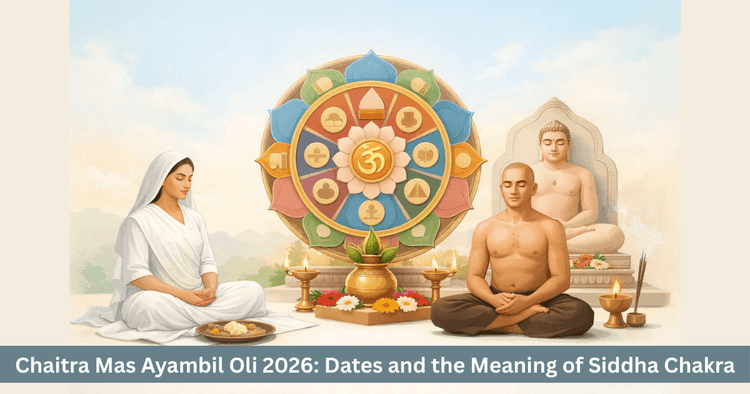
Table of Contents
Chaitra Mas Ayambil Oli is regarded in the Jain tradition as a profound nine day period of austerity, inner purification and Navapada worship. In 2026 this observance again offers a structured space in which a seeker can step back from restlessness and move towards restraint, quietness and faith. Through the discipline of Ayambil, the prayer to the Navapada and the contemplation of the Siddha Chakra, the aim is to lighten the burden of the mind and bring the soul closer to its own purity.
Dates and span of Chaitra Mas Ayambil Oli 2026
Ayambil Oli is observed twice in the year, in the months of Chaitra and Ashwina, from the seventh day of the bright fortnight to the full moon. For 2026 the Chaitra Mas Ayambil Oli will follow this span.
Chaitra Mas Ayambil Oli 2026 date summary
| Detail | Date and weekday | Observance window |
|---|---|---|
| Beginning of Ayambil Oli | Wednesday, 25 March 2026 | From around 08:30 AM the daily discipline is taken up |
| Completion of Ayambil Oli | Thursday, 2 April 2026 | Until around 01:30 AM, within the full moon phase |
In traditional terms this period is understood as Chaitra Sud Satam to Chaitra Sud Punam. Across these nine days the practitioner engages in Ayambil tapas, Navapada worship and sustained contemplation of the Siddha Chakra.
What is Chaitra Mas Ayambil Oli
Ayambil Oli is a nine day tapasya in which both food and daily behaviour are brought into a very simple, sattvic and disciplined frame. This observance recurs twice a year, during Chaitra and Ashwina.
During Chaitra Mas Ayambil Oli the practitioner takes only one simple meal suitable for Ayambil, prepared with minimal spices and without indulgence. The focus of the day is to avoid anger, greed and attachment as far as possible and to dedicate more time to svadhyaya, japa, meditation and puja. This practice is not meant only as a personal austerity. It is also seen as a way of bringing quietness and order into the atmosphere of the family and the wider community.
What is Navapada and why is it central
At the heart of Ayambil Oli lies the worship of Navapada. In Sanskrit and Prakrit, nava means nine and pada means seat or rank. Navapada therefore refers to nine supreme posts or positions in the universe.
These nine are
- Arihant
- Siddha
- Acharya
- Upadhyaya
- Sadhu
- Samyak Darshan right vision
- Samyak Gnan right knowledge
- Samyak Charitra right conduct
- Samyak Tapa right austerity
The first five belong to the group of Panch Parmeshthi and the remaining four describe states that the soul must cultivate on the path to liberation. The worship of Navapada holds up an ideal of inner growth, correct outlook and correct behaviour.
Connection between Navapada and the Navkar Mantra
In Jain practice the revered Navkar Mantra or Namaskar Mantra is understood as containing reverence to these Navapada in a subtle form. When the practitioner recites the Navkar Mantra, the offering is not to one deity alone but to all nine supreme posts that guide the soul towards freedom.
During Ayambil Oli, while worshipping the Navapada, the practitioner reflects that Arihant, Siddha, Acharya, Upadhyaya and Sadhu are not limited to any one community or era. They stand as guides for all beings. At the same time, Samyak Darshan, Samyak Gnan, Samyak Charitra and Samyak Tapa represent the inner states that every seeker is called to develop.
What is Siddha Chakra and how is it arranged
The Siddha Chakra is often described as the visible or yantra form of the Navapada. It is drawn as a circular mandala in which the Navapada are placed in a specific pattern.
In this Siddha Chakra, Siddha is usually placed at the top. At the centre is Arihant, who stands as the immediate guide and teacher. On the right side of Arihant is Acharya, below is Upadhyaya and on the left is Sadhu.
At the four corners, beginning from the upper right and moving clockwise, are Samyak Darshan, Samyak Gnan, Samyak Charitra and Samyak Tapa. In this way the Siddha Chakra shows Panch Parmeshthi at the heart of the mandala, framed by the four supports of right vision, right knowledge, right conduct and right austerity, with the Siddha state held above as the final goal.
During Ayambil Oli, this Siddha Chakra is worshipped with offerings, abhishek, arghya and quiet contemplation.
How is Navapada sadhana done during Ayambil Oli
Across the nine days of Ayambil Oli, Navapada sadhana may follow a simple and steady pattern.
- Each morning the practitioner bathes and wears clean, preferably plain or white clothes.
- A Siddha Chakra yantra or accepted representation of Navapada is installed in the Puja space.
- The Navkar Mantra is recited, followed by the remembrance of each of the Navapada in turn, with reflection on their qualities of compassion, renunciation and discipline.
- Once a day a very simple Ayambil meal is taken. The emphasis is on necessity, gratitude and restraint rather than taste and variety.
- In the evening or whenever time permits, a lamp and incense are offered before the Siddha Chakra and some time is given to svadhyaya, recitation and silent sitting.
The purpose of this discipline is not to prove strength to others but to gently turn the mind away from outer attractions and towards the qualities of the soul.
Inner effect of Ayambil tapas
The tapas of Ayambil during Oli is not limited to dietary rules. It serves as a training ground for a deeper inner balance.
When a person voluntarily accepts restraint in food, speech and activity over nine days, the hidden roots of anger, dissatisfaction and restlessness become more visible. At such a time, svadhyaya and contemplation of the Navapada help the practitioner to recognise that the real obstacles lie within, not outside.
For those who undertake Chaitra Mas Ayambil Oli 2026 with sincerity, this period can become a strong support for self observation, recognition of faults and a fresh resolve to reduce them gradually.
Life guidance offered by Chaitra Mas Ayambil Oli 2026
In a world that constantly pushes towards more consumption and stimulation, a disciplined space for simple food, measured speech and inner reflection becomes rare. Chaitra Mas Ayambil Oli 2026 offers a gentle reminder that peace and progress of the soul require deliberate pauses and conscious effort.
Navapada worship teaches that true success is defined not only by external achievements but by right vision, right knowledge, right conduct and right austerity. A practitioner who uses these nine days to combine Ayambil tapas, Navapada puja and contemplation of the Siddha Chakra with a little more humility, fewer expectations and a stronger wish to serve will find that this Oli becomes a clear step towards a calmer and more meaningful life.
Common questions
When will Chaitra Mas Ayambil Oli begin and end in 2026 Chaitra Mas Ayambil Oli 2026 will begin on Wednesday, 25 March 2026 and will continue until Thursday, 2 April 2026, covering the span from Chaitra Sud Satam to Chaitra Sud Punam.
Which nine posts are included in Navapada during Ayambil Oli The Navapada include Arihant, Siddha, Acharya, Upadhyaya, Sadhu, Samyak Darshan right vision, Samyak Gnan right knowledge, Samyak Charitra right conduct and Samyak Tapa right austerity.
How are the Navapada arranged within the Siddha Chakra In the Siddha Chakra, Siddha is placed at the top, Arihant in the centre, Acharya on the right, Upadhyaya below and Sadhu on the left, with Samyak Darshan, Samyak Gnan, Samyak Charitra and Samyak Tapa at the four corners in clockwise order.
What are the main precautions in food and daily routine during Ayambil Oli Generally one very simple Ayambil meal is taken in the day, with minimal spices and no indulgence. Care is taken to restrain speech, avoid unnecessary harm and give more time to svadhyaya and worship instead of restless activity.
How can Chaitra Mas Ayambil Oli 2026 be made more meaningful in daily life If during these nine days the practitioner combines dietary restraint with honest awareness of anger, jealousy and pride, reflects on the qualities of the Navapada and increases kindness and readiness to serve at home and in society, Chaitra Mas Ayambil Oli 2026 can become a powerful support for inner growth and lasting peace.
Get your accurate Kundali
Generate KundaliDid you like it?
Author

Aparna Patni (63)
Experience: 20
Consults About: Family Planning, Career
Clients In: Punjab, Haryana, Delhi
Share this article with friends and family
About ZODIAQ
ZODIAQ is an online Vedic Astrology platform. It connects clients seeking astrological advice to experienced astrologers with deep knowledge. Our users also generate kundali and perform kundali milan for free. ZODIAQ also offers services to the Astrologers. Astrologers utilize various offerings by ZODIAQ to serve their clients effectively.
If you are a User
Consult with experienced astrologers and seek their guidance. You can also order handwritten Janm Patrika report with life prediction prepared by experienced astrologers. Generate accurate Kundali, perform Kundali Matching and check horoscope and muhurat. Utilize our online library for all the necessary astrological and spiritual information.
If you are an Astrologer
Create accurate kundali for your clients and perform Kundali Matching for up to 5 people at a time. Write comprehensive Janm Patrika report for your clients with ZODIAQ. Check client details anytime by saving it in client directory. Become more productive by tracking how many clients you guide every day.
WELCOME TO
ZODIAQ
Right Decisions at the right time with ZODIAQ
