Gangaur 2026: Date, Puja Muhurat & Gauri Worship
By Pt. Amitabh Sharma
Gangaur 2026: Significance, Marital Harmony & Household Balance
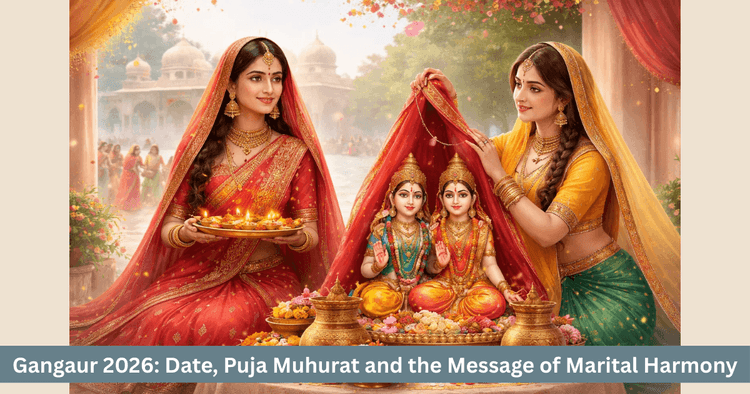
Table of Contents
Gangaur 2026 is counted among those festivals that symbolise marital happiness, good fortune and committed love in a very gentle yet powerful way. Colourful clothes, traditional songs and the adornment associated with married life make Gangaur not just a fast but a celebration of beauty as well as responsibility in family life. The festival reminds devotees of that form of Goddess Gauri who holds together love, patience and balance within the home. Gangaur is always observed on the Shukla Paksha Tritiya of the month of Chaitra. In the year 2026 Gangaur will be celebrated on Monday, 23 March 2026. On this day Chaitra Shukla Tritiya Tithi will be present during the daytime and during this period the main Gangaur fast, Gangaur Puja and public celebrations will be performed. For the blessings of Goddess Gauri, the early morning hours are treated as especially auspicious.
Gangaur Puja Muhurat 2026 and timing of worship
For Gangaur 2026 the most favourable time for Gangaur Puja is the morning period after sunrise, when the Tritiya Tithi is active and the environment is considered pure and spiritually receptive. At this time devotees sit before the image or idol of Goddess Gauri and pray with a quiet and focused mind.
Gangaur 2026 Puja Muhurat summary
| Detail | Time |
|---|---|
| Date of the Gangaur festival | Monday, 23 March 2026 |
| Tithi | Chaitra Shukla Tritiya, active during the day |
| Morning Puja Muhurat | From 06:18 AM to 08:42 AM |
The span from 06:18 AM to 08:42 AM is regarded as highly suitable for offering worship to Gauri, including flowers, sindoor, items of adornment and sweets. Women who are unable to perform Puja during this period may worship later during the day, as long as it is completed before sunset and care is taken to avoid Rahu Kalam and other inauspicious intervals according to the local Panchang.
Why is Gangaur Puja generally performed in daylight
Gangaur Puja is traditionally performed during daylight hours. On this festival Goddess Gauri is seen as the protector of the home, the guardian of marital happiness and the one who sustains family life with awareness. Because of this Gangaur is linked with light and consciousness, so the Puja is not usually kept for evening or night. In most regions married women and unmarried girls gather in small or large groups to perform the rituals together. They sit, sing folk songs dedicated to Gauri, express their feelings through traditional verses and jointly pray for blessings. In this way Gangaur becomes a space where devotion, companionship and mutual support among women are strengthened.
What is Gangaur and where is it especially celebrated
Gangaur is primarily known as a folk festival of Rajasthan but its influence also extends into parts of Madhya Pradesh, Gujarat and some regions of Uttar Pradesh. The festival is dedicated to Goddess Gauri, the consort of Lord Shiva, who is honoured as the giver of good fortune and happiness in married life. Gangaur holds special importance for married women, who observe fasts and perform Puja for the long life, health and well being of their husbands and families. Unmarried girls worship Gauri on this day and pray for a suitable, virtuous and loving life partner. The word Gangaur is formed from two elements. Gan refers to Lord Shiva and Gaur refers to Goddess Parvati. In this way Gangaur becomes a celebration of the divine union of Shiva and Parvati and of the dignity and strength of feminine devotion.
Gangaur 2026, the date and importance of Chaitra Shukla Tritiya
In 2026 Gangaur will be observed on Monday, 23 March 2026. It falls on Chaitra Shukla Tritiya, the third day of the bright fortnight of Chaitra month. At this time nature is moving towards the fullness of spring and the surroundings begin to reflect newness, greenery and a certain softness. For Gangaur it is understood that as long as Tritiya Tithi remains in effect during the daytime, the rituals and observances of the festival can be performed. For this reason, in deciding the date of Gangaur, it is especially important that Tritiya Tithi is present in the day.
When does the Gangaur observance begin
In many areas Gangaur does not remain confined to just one day of Puja. It often begins immediately after Holi. From the day following Holi, small idols or images of Gauri, made of clay, wood or metal, are set up in homes. For around sixteen to eighteen days lamps, water, flowers and sindoor are offered daily before these forms. During this period women sing Gangaur songs in the morning and evening and quietly pray for the well being of their homes and relationships. In this way Gangaur 2026 can become not only a single festival day but a continuous season of auspiciousness stretching from the days after Holi until Chaitra Shukla Tritiya, with a few steady moments kept aside for remembering Goddess Gauri each day.
Main rituals and fasting practices for Gangaur 2026
The Puja and fast of Gangaur 2026 can be elaborate in some homes and quite simple in others, yet sincere devotion is regarded as the essential element. On the day of Gangaur, after bathing in the morning, women wear clean or new clothes. In many regions red, green or yellow garments and traditional ornaments are chosen as they express joy and good fortune. The idol or picture of Goddess Gauri or a specially prepared form of Gangaur, is placed on a decorated seat in a clean place in the house or courtyard. The Goddess is offered sindoor, bindi, bangles, mehendi and other symbols of marital auspiciousness. Flowers, rice grains, turmeric, kumkum and sweets are also offered. Married women pray wholeheartedly for the long life of their husbands, for a stable and harmonious married life and for prosperity in the home. Unmarried girls pray sincerely that with the grace of Gauri they may be blessed with a partner who brings respect, affection and a sense of responsibility to the relationship. In many traditions women keep a fast on Gangaur, taking fruit or a simple meal once in the day and spending the remaining time in singing, devotion and quiet reflection.
Gangaur songs, women’s inner world and folk culture
One of the distinctive features of Gangaur 2026 will be that it is not limited to Puja alone. Through folk songs, informal dance and shared gatherings, the inner world of women finds a natural expression. In Rajasthan and neighbouring regions special songs are sung during Gangaur that speak of Gauri visiting her parental home, returning to her husband’s house, waiting for her beloved and living through the everyday realities of married life. These songs provide a shared space in which women can recognise their own experiences in the words of tradition. In many localities, on the day of Gangaur or during the final days of the observance, women walk together in groups, carrying pots or decorative vessels and sing from house to house. Sometimes clay idols of Gangaur are carried on the head in small processions, sometimes there is a collective farewell ceremony for the Goddess at a chosen spot. Through all this Gangaur 2026 becomes not just an individual fast but a celebration of community bonds and the honour of womanhood.
Gangaur 2026 processions and public celebrations
In several cities of Rajasthan, grand processions are organised on the day of Gangaur. Beautifully decorated idols of Goddess Gauri are placed on chariots, palanquins or special platforms and taken through important streets of the town. People gather on both sides to take darshan of the Goddess, while women and in some places men, perform traditional dances and folk movements. For visitors this becomes a vivid introduction to the culture of Rajasthan. For local residents it reinforces a sense of pride and emotional connection with their heritage. Public celebrations of Gangaur 2026 therefore express not only devotion but also social harmony and joy.
Inner and family message of Gangaur 2026
At the heart of Gangaur is that aspect of Goddess Gauri which manifests as strength, patience, gentleness and commitment. Gangaur 2026 reminds everyone that married life is not sustained by celebration and adornment alone. It rests on mutual dedication, understanding and endurance from both sides. When married women fast and pray on Gangaur for their husbands and families, they simultaneously strengthen the qualities of patience and responsibility within themselves. When unmarried girls worship Gauri, they are not only praying for a good husband. They are also learning that to welcome a noble partner into life it is important to cultivate compassion, balance and sincerity within oneself.
Life guidance offered by Gangaur 2026
Gangaur 2026 can become more than a festival if it is used as a moment to look freshly at one’s relationships. Those who use this day to reflect honestly on the state of their marriage, family and close bonds, alongside the Puja of Gauri, may find that it marks a calm and balanced new beginning. If on Gangaur 2026 a simple intention is set to strengthen communication, respect and cooperation within the home and to reduce unnecessary harshness or neglect in relationships, then with the grace of Goddess Gauri this festival can become a foundation for lasting stability, affection and prosperity.
Common questions
When will Gangaur be celebrated in 2026 and which Tithi is associated with it Gangaur in 2026 will be celebrated on Monday, 23 March 2026. It is linked to Chaitra Shukla Tritiya Tithi, which remains active during the daytime and provides the basis for the festival’s observance.
What will be the auspicious morning Puja Muhurat for Gangaur 2026 For Gangaur 2026 the morning interval from 06:18 AM to 08:42 AM is regarded as especially auspicious for worshipping Goddess Gauri. During this time flowers, sindoor, items of adornment and offerings may be placed before the Goddess, although Puja may also be performed later in the day before sunset if required.
Why is Gangaur Puja usually done in the daytime rather than in the evening or night Gangaur is associated with light, awareness and the active energy of household life, so its Puja is traditionally kept for daylight hours. During this festival women gather in groups for songs, fasting and worship and the bright hours of the day are seen as most supportive for such collective devotion and positivity.
What is the meaning of Gangaur Puja and fast for married and unmarried women in 2026 For married women the fast and Puja of Gangaur 2026 are ways of praying for the long life, health and happiness of their husbands and homes. For unmarried girls the worship is a prayer for a worthy, caring and responsible life partner. In both cases Gangaur becomes a festival that honours feminine strength, patience and devoted love.
How can Gangaur 2026 be made more meaningful in daily life Gangaur 2026 can be made more meaningful if, along with traditional Puja, women resolve to deepen communication, respect and cooperation in their relationships, to participate in shared songs and celebrations that awaken creativity and joy and to see the grace of Gauri as a call to bring balance into every area of family life. In this way the festival can leave a long lasting positive influence.
Get your accurate Kundali
Generate KundaliDid you like it?
Author
Pt. Amitabh Sharma (56 Years)
Experience: 20
Consults About: Family Planning, Career
Clients In: Punjab, Haryana, Delhi
Share this article with friends and family
About ZODIAQ
ZODIAQ is an online Vedic Astrology platform. It connects clients seeking astrological advice to experienced astrologers with deep knowledge. Our users also generate kundali and perform kundali milan for free. ZODIAQ also offers services to the Astrologers. Astrologers utilize various offerings by ZODIAQ to serve their clients effectively.
If you are a User
Consult with experienced astrologers and seek their guidance. You can also order handwritten Janm Patrika report with life prediction prepared by experienced astrologers. Generate accurate Kundali, perform Kundali Matching and check horoscope and muhurat. Utilize our online library for all the necessary astrological and spiritual information.
If you are an Astrologer
Create accurate kundali for your clients and perform Kundali Matching for up to 5 people at a time. Write comprehensive Janm Patrika report for your clients with ZODIAQ. Check client details anytime by saving it in client directory. Become more productive by tracking how many clients you guide every day.
WELCOME TO
ZODIAQ
Right Decisions at the right time with ZODIAQ
