Holi 2026: Date, Legends and the Deeper Message of the Festival of Colours
By Pt. Suvrat Sharma
Know the significance of Holi on 4 March 2026, including Holika Dahan and Rangwali Holi
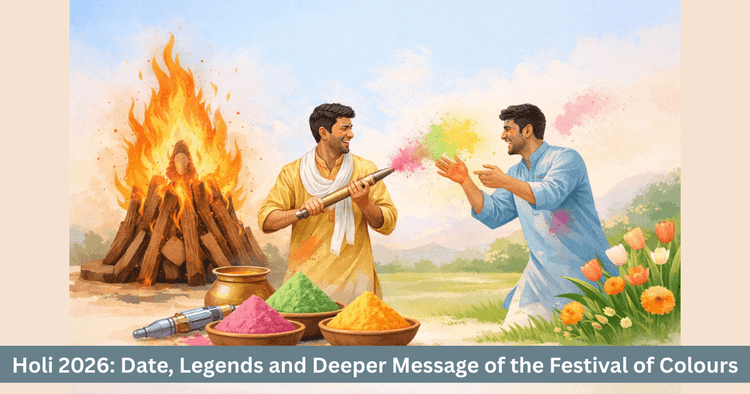
Table of Contents
The vibrant celebration of Holi 2026 is far more than a day of play and laughter. It is a festival that carries the deeper symbols of seasonal change, timeless legends and the victory of good over evil. The atmosphere of Holi lifts people beyond age, caste and status and brings them together in one shared colour of joy, forgiveness and openness.
In the year 2026 Holi will be observed on Wednesday, 4 March 2026. The festival will extend over two days, with Holika Dahan on the first day and Rangwali Holi on the second. It is regarded as a beautiful way of welcoming spring, when nature moves out of the dryness and heaviness of winter and begins to fill with blossoms, colours and fresh energy.
Date, weekday and form of Holi 2026
Holi holds a special place among ancient Hindu festivals. In March 2026 it falls at a time when the weather is becoming pleasant and people also begin to feel lighter in heart.
Holi 2026: date and main details
| Detail | Information |
|---|---|
| Date of Holi 2026 | Wednesday, 4 March 2026 |
| Form of the festival | Two day observance |
| First day | Holika Dahan |
| Second day | Rangwali Holi |
| Central themes | Welcome to spring, love and unity, victory of good over evil |
During Holi, villages, towns, streets and courtyards fill with colour, music and laughter. People of all ages express their affection by using gulal, coloured water and playful splashing, as if washing away distance and heaviness from the mind.
History of Holi and the story of Holika Dahan
What do the stories of Hiranyakashipu, Prahlada and Holika teach
The main legend behind Holi is connected with Hiranyakashipu, Prahlada and Holika. According to tradition Hiranyakashipu was a powerful asura king who gained immense strength through penance and special boons. Filled with pride he demanded that everyone in his kingdom should worship him alone.
His son Prahlada, however refused to obey this command and remained devoted to Lord Vishnu. This angered Hiranyakashipu and he tried many cruel punishments to break Prahlada’s faith, yet the boy’s devotion did not shake.
Finally the king called upon his sister Holika, who was believed to be protected from fire. The plan was that Holika would sit in a blazing pyre with Prahlada in her lap so that he would burn while she would walk out unharmed. What Holika ignored was that her protection worked only when she entered the fire alone.
When they both sat in the flames, the grace of Lord Vishnu safeguarded Prahlada and he emerged unharmed, while Holika herself was consumed by the fire. This event is remembered as Holika Dahan, symbolising that arrogance, injustice and cruelty are burnt away, while faith, truth and devotion remain protected.
For this reason Holi is closely associated with the victory of good over evil and the night of Holika Dahan reminds people that in the end it is dharma and trust in the Divine that truly endure.
Krishna, Radha and the colours of love
The playful side of Holi and the use of colours are linked with the beloved story of Krishna and Radha. Tradition narrates that in his infancy Krishna’s complexion turned dark blue due to the effect of poisoned milk given by a demoness. Later when he fell in love with Radha, he felt shy and anxious that she might reject him because of his dark skin.
In the story Krishna’s mother Yashoda gently suggested that he colour Radha’s face as part of play and remove his inner hesitation. Krishna happily applied colour on Radha’s face and through this playful gesture their bond of love became deeper and more natural.
Inspired by this feeling people throw colours on one another during Holi, so that hidden hesitation, differences and barriers of appearance may dissolve in shared joy.
How is Holi celebrated
Holika Dahan: ritual and inner meaning
On the first evening Holika Dahan is performed. People gather in an open space, collect wood, dried cow dung cakes and other materials and prepare a sacred fire.
- Before lighting the pyre, offerings such as coconut, grains or dry food are placed with prayers for the welfare of family and community.
- Once the fire is lit, people circumambulate the flames and inwardly resolve that their negativity, fear and unjust tendencies may be consumed in this fire.
- In many homes children are told the story of Prahlada so that they understand that Holika Dahan represents not just burning wood but the burning away of ego and wrongdoing.
Colours of Holi: celebration, play and closeness
On the second day Rangwali Holi is celebrated, devoted to simple joy, openness and bonding with others.
- In the morning people greet each other with gulal on the face and forehead and exchange blessings.
- Later wet colours, pichkaris and water filled balloons fill the atmosphere with playful excitement.
- Families, friends, children and elders all join in throwing colours to show that on this day distinctions of status and distance can give way to togetherness.
The famous saying “Bura na mano, Holi hai” reminds everyone that small pranks and jokes are best received with laughter and a forgiving heart, so that relationships grow lighter and warmer.
Special foods and the mention of bhang
Feasting is an important part of Holi celebrations.
- Many households prepare gujiya, a delicately crafted sweet filled with khoya and dry fruits.
- Various savoury dishes, sweets and festive drinks add further delight to the day.
- In traditional descriptions bhang, a drink prepared from cannabis leaves, is also mentioned as being consumed in some regions. Whenever it appears, elders usually stress the need for moderation, health awareness and dignity, keeping the focus on the spiritual joy of the festival.
Interesting facts about Holi
Holi carries many social and cultural layers that add depth to its colourful surface.
1. Symbol of unity and equality
On Holi people throw colours on one another regardless of age, background or skin tone. The scene expresses the truth that, like colours blending together, human hearts also find strength in unity.
2. “Bura na mano, Holi hai” and relaxed bonds
The popular phrase encourages people not to take small mischiefs too seriously on this day. It supports a culture of lightness and easy forgiveness, which can later benefit everyday relationships as well.
3. Preparing the skin with oil or moisturiser
Many people apply oil or moisturiser to the skin and hair before playing with colours so that gulal and other colours can be removed more easily afterwards. This simple care helps protect the skin while enjoying the celebration.
4. Showers of colour in royal courts
Historical accounts mention that in some royal courts special arrangements were made to shower participants with coloured water and powders. Such traditions show that Holi’s joyful spirit touched not only common streets but also palaces and gardens.
5. Foreign parallels to colour festivals
In some cultures outside India there are festivals with a playful spirit of throwing objects. For example in Spain, during La Tomatina, people throw tomatoes instead of colours. The context and meaning differ, yet the energy of collective celebration is a shared human expression.
Deeper message of Holi 2026
Holi 2026 offers more than a single day of enjoyment. It can become a gentle teacher for the entire year.
- With the arrival of spring it shows that after phases of dryness and cold in life, warmth, colour and opportunity return sooner or later.
- The story of Prahlada teaches that unwavering faith and alignment with truth eventually overcome oppression, even if the journey seems difficult for a time.
- The play of colours between Krishna and Radha reveals that in true love and friendship inner feeling matters more than outer appearance.
Those who approach Holi not only as a festival of colours but as a reminder of forgiveness, renewal and unity may find that Holi 2026 colours both mind and life in a more enduring way.
Common questions
On which day will Holi be celebrated in 2026
Holi in 2026 will be celebrated on Wednesday, 4 March 2026. Holika Dahan will be observed on the previous evening, followed by the main day of playing with colours, marking the welcome of spring.
Which main legend forms the basis of Holi
The central legend is that of Hiranyakashipu, Prahlada and Holika. Prahlada’s unwavering devotion to Lord Vishnu protects him in the fire, while Holika is burnt. This event is remembered as Holika Dahan and symbolises the victory of good over evil.
How is the tradition of playing with colours connected to Krishna and Radha
According to the story Krishna, feeling shy about his dark complexion, coloured Radha’s face on the advice of his mother Yashoda. This playful act deepened their bond. Inspired by this, people throw colours on one another during Holi to dissolve hesitation and enhance affection.
What are the main ways of celebrating Holi
On the first day people perform Holika Dahan and on the second they celebrate with gulal, colours and water, music, gatherings with family and friends, sweets such as gujiya and in some traditions limited intake of bhang. Together these elements create the full flavour of Holi.
What inner lesson can a seeker draw from Holi 2026
Holi 2026 can inspire seekers to leave behind old grudges, misunderstandings and negativity in the symbolic fire of Holika and to give more space to openness, forgiveness, love and unity. Celebrated with this intention Holi can bring lightness to the heart and depth to relationships.
Get your accurate Kundali
Generate KundaliDid you like it?
Author
Pt. Suvrat Sharma (63)
Experience: 20
Consults About: Family Planning, Career
Clients In: Punjab, Haryana, Delhi
Share this article with friends and family
About ZODIAQ
ZODIAQ is an online Vedic Astrology platform. It connects clients seeking astrological advice to experienced astrologers with deep knowledge. Our users also generate kundali and perform kundali milan for free. ZODIAQ also offers services to the Astrologers. Astrologers utilize various offerings by ZODIAQ to serve their clients effectively.
If you are a User
Consult with experienced astrologers and seek their guidance. You can also order handwritten Janm Patrika report with life prediction prepared by experienced astrologers. Generate accurate Kundali, perform Kundali Matching and check horoscope and muhurat. Utilize our online library for all the necessary astrological and spiritual information.
If you are an Astrologer
Create accurate kundali for your clients and perform Kundali Matching for up to 5 people at a time. Write comprehensive Janm Patrika report for your clients with ZODIAQ. Check client details anytime by saving it in client directory. Become more productive by tracking how many clients you guide every day.
WELCOME TO
ZODIAQ
Right Decisions at the right time with ZODIAQ
