Holi 2026: 3 or 4 March, the Clear Answer
By Pt. Sanjeev Sharma
Festival of Colours: Exact Dates and Muhurat of Holi 2026
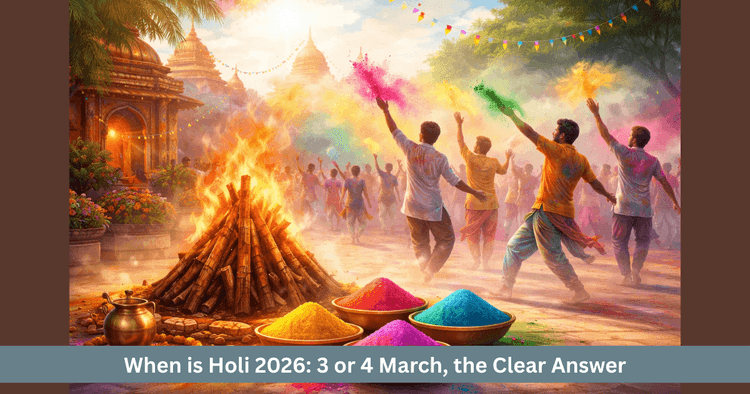
Table of Contents
Holi is celebrated as the festival of colours, yet every year there is some confusion about its exact date. In 2026 many people are again wondering whether Rangwali Holi will fall on 3 March or 4 March. This confusion is natural because the calculation of the Hindu Panchang is different from the ordinary calendar, although when this difference is understood calmly the entire picture becomes very clear.
First let us clarify the main point. Holi in 2026 will be celebrated over two days. Holika Dahan will take place on Tuesday, 3 March 2026 in the evening and Rangwali Holi or Dulhandi will be celebrated on Wednesday, 4 March 2026 in the morning. According to the Panchang Purnima Tithi will begin at 05:55 PM on 2 March 2026 and will end at 05:07 PM on 3 March 2026, therefore Holika Dahan will be performed on the evening of 3 March and the festival of colours will be celebrated on the morning of 4 March.
Date, Muhurat and Tithi Summary for Holi 2026
The date of Holi cannot be limited only to “3 and 4 March”. When Tithi, muhurat and the calculation of Panchang are seen together, the form of this festival becomes much clearer. For those who observe fasts, worship and festivals according to the Panchang this information becomes even more important.
Holi 2026: Date and time schedule
| Aspect | Date and Day | Time details |
|---|---|---|
| Holika Dahan | 3 March 2026, Tuesday | Evening period when Purnima Tithi is present |
| Rangwali Holi | 4 March 2026, Wednesday | From morning throughout the day |
| Purnima begins | 2 March 2026, 05:55 PM | Tithi starts as per Panchang |
| Purnima ends | 3 March 2026, 05:07 PM | Hence Holika Dahan is on 3 March evening |
From this schedule it is clear that because Purnima Tithi will remain till the evening of 3 March 2026 Holika Dahan will be performed that night and the next morning Dulhandi or Rangwali Holi will be celebrated on 4 March.
Why is there confusion: Is Holi in 2026 on 3 or 4 March
Most people look at the ordinary Gregorian calendar where the day changes at midnight 12 o clock. In the Hindu Panchang a day begins at sunrise and ends at the next sunrise. The decision about which day a festival will be celebrated does not depend on the date number but on which Tithi is present from one sunrise to the next and during which period of that day the festival related Tithi is operating.
Therefore in the case of Holi, when someone asks “3 or 4 March”, confusion is understandable. Holika Dahan is performed during the evening of Purnima Tithi, not only on the basis of the calendar date. In 2026 since Purnima Tithi will remain until the evening of 3 March, Holika Dahan will be performed on the evening or night of 3 March. By the next morning the Tithi will have changed, hence the celebration of colours comes on a separate day, 4 March 2026.
How is Holi 2026 connected with Tithi calculation
Most people know that Holi falls on Purnima but it is less understood how the end of Purnima Tithi and the evening period are linked. In Holi 2026 Purnima Tithi begins at 05:55 PM on 2 March 2026 and ends at 05:07 PM on 3 March 2026. This means that when people prepare for Holika Dahan on the evening of 3 March, Purnima Tithi will still be running according to the Panchang.
For this reason according to scriptural tradition, whenever the main ritual of a festival such as Holika Dahan is performed in the evening or night, it is ensured that the related Tithi is present at that time. On the evening of 3 March 2026 this condition is fulfilled, so the muhurat of Holika Dahan is taken on the evening of 3 March. By the next morning the Tithi changes, therefore the celebration of colours comes on a different day, that is 4 March.
Purnima Tithi details for Holi 2026
| Detail | Time |
|---|---|
| Purnima Tithi begins | 2 March 2026, 05:55 PM |
| Purnima Tithi ends | 3 March 2026, 05:07 PM |
| Basis for Holika Dahan | Presence of Purnima Tithi on the evening of 3 March |
Thus the key to understanding the date of Holi is to see on which day Purnima Tithi falls during the evening. In 2026 that day is 3 March, while the full colour celebration will be on 4 March.
Why is Holi celebrated for two days
Many people ask why Holi is celebrated for two days. In reality it is one festival with two forms. The first day is of Holika Dahan, which is also known as Chhoti Holi in many places. The second day is of Rangwali Holi, which in different regions is called Dulhandi, Dhulendi or Dhuleti.
In Hindu tradition the emphasis is not only on playing colours but also on the spiritual and social meaning behind the rituals. On the day of Holika Dahan a fire is lit at night to symbolise the burning away of negativity, ego and injustice. The next day through colours the message of joy, reconciliation and renewal of relationships is shared. In this way the two days together create a complete experience.
Holika Dahan 2026: When and why
Now let us see in detail when and how Holika Dahan will be observed in 2026. In the year 2026 Holika Dahan will be on Tuesday, 3 March 2026 in the evening, when Purnima Tithi is present. At this time people in localities, colonies and villages gather wood, dry branches and other items at one place and light a ritual fire.
The famous story connected with Holika Dahan is that of Prahlad and Holika. It is said that the arrogant king Hiranyakashipu planned to destroy his son Prahlad, a great devotee of Lord Vishnu, by making him sit on a fire along with his sister Holika. Holika had a boon that fire would not burn her. Yet when both sat in the fire the power of devotion protected Prahlad and Holika herself was burnt to ashes. This narrative symbolises that arrogance and oppression come to an end while faith and truth remain protected.
In many regions people circumambulate the fire of Holika Dahan, keep personal wishes in mind and take a resolve to leave behind old fears, hatred and negative emotions in that fire. Some families bring a little ash from that sacred fire to their homes and apply it at the doorway considering it auspicious and protective.
Rangwali Holi 2026: Which day is Dulhandi
The most iconic image of Holi is that of streets covered in colours and courtyards filled with laughter. In the year 2026 Rangwali Holi or Dulhandi will be celebrated on Wednesday, 4 March 2026. This is the day when people rejoice with gulal, colours and water. They visit the homes of friends, relatives and neighbours and greet each other with Holi wishes and colours.
In many households the day begins with a light touch of dry gulal as a tilak and then the more playful use of colours and water follows. During the day one can feel the fragrance of festive dishes, gujiya, snacks and sweets spread across homes. The environment on this day becomes more relaxed, with less formality and more openness, warmth and laughter. At some places community singing, drum beats or traditional music with dance can also be seen.
What does Rangwali Holi signify
Many people limit Holi to the enjoyment of colours, while at a deeper level Rangwali Holi becomes an opportunity for emotional and social cleansing. With every splash of colour there is a subtle invitation to release old grievances and distances. On this day people often say “it is Holi, forget old issues today”. This sentence is not just a joke, it is a kind of invitation to begin relationships afresh.
In several families it is customary that if there is tension with someone, the first step towards reconciliation is taken on Holi by applying colour and giving a warm hug. This melts the frozen layers in relationships and increases harmony within family, friends and community. Thus Rangwali Holi is not only enthusiasm but also a symbol of renewal, togetherness and inner clearing.
Why is Braj ki Holi especially renowned in 2026
When speaking of Holi it is almost impossible to ignore Braj ki Holi. The Braj region which includes sacred places like Mathura, Vrindavan, Barsana, Nandgaon, Gokul and Govardhan is renowned far and wide for its Holi celebrations. At these places the festival of Holi does not remain limited to two days, it continues for several days in various forms.
The Lathmar Holi of Barsana is especially famous for its unique tradition. Women take sticks in their hands and symbolically strike men, while the men defend themselves with shields. All of this takes place amidst love, laughter and folk tradition. In Mathura and Vrindavan temple courtyards fill with flower Holi, colour Holi and continuous kirtan, connecting the mind simultaneously with devotion and joy. In 2026 also those who travel to witness Braj ki Holi will experience the festival as something much more alive than simple calendar dates.
If there is still doubt about Holi 2026
Sometimes even after hearing the explanation the mind repeats the question “is Holi on 3 or 4 March this year”. The aim of this article is to settle this doubt gently. In brief the situation is that Holika Dahan will be on Tuesday, 3 March 2026 in the evening because at that time Purnima Tithi will be present. On the next day Wednesday, 4 March 2026 Rangwali Holi or Dulhandi will be celebrated with full joy.
So if anyone asks whether Holi is on 3 or 4 March, the answer is that Holi comes on both days. The first day is Holika Dahan and the second day is the festival of colours. From the perspective of the calendar they are two different dates, yet from the perspective of the festival they are the two steps of one celebration.
What can be learnt from Holi 2026
Many people see Holi mainly as a time of colour, leisure and holiday, yet its inner message is deeper than that. Holika Dahan reminds that it is important to identify and offer to the fire the ego, anger and bitterness that are no longer needed in life. If old jealousy or comparison remains stuck in the heart, the source of joy starts drying up. Standing before the fire of Holika one can take a quiet resolve to leave there what is no longer healthy for the journey ahead.
On the other hand Rangwali Holi teaches how essential simplicity, playfulness and warmth are in life. When people forget rigid formality and apply colours to one another with a warm hug, the experience reminds that the highest identity of a human being is in relationships. Holi of the year 2026 may appear on the calendar as 3 and 4 March, yet inwardly it offers an opportunity to make life a little lighter, relationships a little sweeter and the heart a little freer.
Common Questions
What is appropriate to do on 3 March during Holi 2026
On Tuesday, 3 March 2026 Holika Dahan will be performed. In the evening when Purnima Tithi is present it is considered auspicious to light the ritual fire in an open area, remember the story of Prahlad and Holika, resolve to let go of negativity and circumambulate the fire along with family.
On which day and how will Rangwali Holi be celebrated in 2026
Rangwali Holi or Dulhandi will be celebrated on Wednesday, 4 March 2026. On this day from morning people visit friends, relatives and neighbours with abir and gulal, offer festive dishes and sweets and celebrate the festival in an atmosphere of joy and mutual goodwill.
What is the main reason behind Holi being celebrated for two days
Holi is celebrated in two forms. The first day is Holika Dahan, in which through fire there is a symbolic expression of burning away negativity and ego. The second day is Rangwali Holi, where colours and water express joy, harmony and affection, so although the dates differ the two days together represent the completeness of one festival.
Why is Braj ki Holi regarded as special
The Braj region especially Mathura, Vrindavan, Barsana, Nandgaon, Gokul and Govardhan is highly renowned for Holi celebrations. The Lathmar Holi, flower Holi and temple festivities there blend devotion with folk tradition and create an atmosphere that feels far deeper and more heartfelt than ordinary colour play.
If someone still feels confused about the dates what should be remembered
If confusion remains about whether “Holi is on 3 or 4 March” it is enough to remember that Holika Dahan is on 3 March 2026 and Rangwali Holi is on 4 March 2026. Rather than seeing them as two unrelated days it is helpful to see them as two steps of the same celebration, which naturally clears the doubt about dates.
Get your accurate Kundali
Generate KundaliDid you like it?
Author

Pt. Sanjeev Sharma (63)
Experience: 20
Consults About: Family Planning, Career
Clients In: Punjab, Haryana, Delhi
Share this article with friends and family
About ZODIAQ
ZODIAQ is an online Vedic Astrology platform. It connects clients seeking astrological advice to experienced astrologers with deep knowledge. Our users also generate kundali and perform kundali milan for free. ZODIAQ also offers services to the Astrologers. Astrologers utilize various offerings by ZODIAQ to serve their clients effectively.
If you are a User
Consult with experienced astrologers and seek their guidance. You can also order handwritten Janm Patrika report with life prediction prepared by experienced astrologers. Generate accurate Kundali, perform Kundali Matching and check horoscope and muhurat. Utilize our online library for all the necessary astrological and spiritual information.
If you are an Astrologer
Create accurate kundali for your clients and perform Kundali Matching for up to 5 people at a time. Write comprehensive Janm Patrika report for your clients with ZODIAQ. Check client details anytime by saving it in client directory. Become more productive by tracking how many clients you guide every day.
WELCOME TO
ZODIAQ
Right Decisions at the right time with ZODIAQ
