Papmochani Ekadashi 2026: Date, Vrat Significance, Katha and Detailed Puja Method
By Pt. Amitabh Sharma
Know the exact date of Papmochani Ekadashi 2026, its significance, Vishnu Puja method and spiritual benefits of the Katha
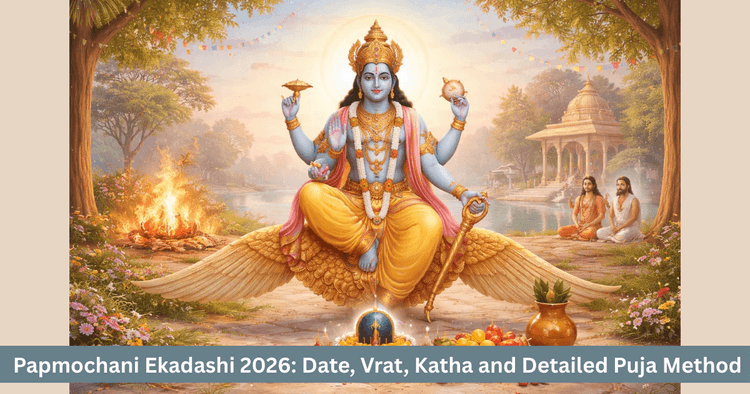
Table of Contents
Within the Vaishnava tradition Papmochani Ekadashi 2026 is regarded as a sacred day that opens the way for release from past and present sins, mental purification and spiritual progress. Ekadashi in general is especially dear to Lord Vishnu and among the many Ekadashis of the year Papmochani Ekadashi is described as particularly powerful for cleansing of negative karmic impressions.
According to the Hindu Panchang Papmochani Ekadashi falls in the Krishna Paksha of the month of Chaitra. It comes between Holika Dahan and Chaitra Navaratri, two important festivals that themselves symbolise burning of impurities and the rise of divine energy. In 2026 Papmochani Ekadashi will be observed on Sunday, 15 March 2026. Scriptures explain that observing the fast on this date with proper Puja, listening to or reading the Katha and offering sincere devotion to Lord Vishnu brings the fruit of relief from sin and deep peace of mind.
Papmochani Ekadashi 2026: date, lunar position and festival context
This Ekadashi carries a special character because it stands between the joy of Holi and the auspicious beginning of Chaitra Navaratri, forming a natural bridge of introspection and purification.
Papmochani Ekadashi 2026: date and basic details
| Detail | Information |
|---|---|
| Name of the fast | Papmochani Ekadashi 2026 |
| Date and weekday | 15 March 2026, Sunday |
| Paksha and month | Chaitra month, Krishna Paksha |
| Related major observances | Between Holika Dahan and Chaitra Navaratri |
| Presiding deity | Lord Vishnu |
| Main spiritual result | Release from sins, mental purification and upliftment |
The term Papmochani clearly expresses its inner purpose.
- Paap means sin, fault or actions that burden the heart.
- Mochani means that which frees or releases.
Therefore Papmochani Ekadashi is honoured as a special opportunity for the removal of sins and heaviness from the inner being.
What is Papmochani Ekadashi and what does its name indicate
Inner meaning of Papmochani Ekadashi
Papmochani Ekadashi is formed from the words Paap and Mochani. Paap represents those actions and tendencies that weigh down the conscience. Mochani represents the grace that cuts through those bonds and makes the soul lighter. The fast and worship of this day are offered to Lord Vishnu so that
- known and unknown sins,
- mental disturbances,
- and deep rooted negative patterns
may gradually lose their grip on the devotee.
Tradition holds that one who observes the Papmochani Ekadashi fast with faith, listens to or recites the Katha and follows the Puja Vidhi with care begins to feel greater clarity, calmness and a natural movement towards a positive direction.
Special connection between Ekadashi and Lord Vishnu
In the Hindu understanding Ekadashi Tithi is closely linked with Lord Vishnu as the preserver and protector. Every lunar month carries two Ekadashis, one in Shukla Paksha and one in Krishna Paksha. Each has its own character, yet the common thread is that
- control of the senses,
- moderation in food,
- and steady remembrance of Narayana
have the power to transform life.
Papmochani Ekadashi is considered unique among them because its very name is centred on release from sin and its Katha teaches that even when a seeker has fallen, sincere repentance and the right vow under the shelter of the Lord can restore the path.
Katha of Papmochani Ekadashi: which sins are removed
The narrative as told by Lomas Rishi to King Mandhata
According to scriptural accounts Lomasa Rishi narrated the story and fruit of this Ekadashi to King Mandhata. The Katha shows how even a serious fall from austerity can be healed through Papmochani Ekadashi when there is genuine remorse and devotion.
In ancient times there lived a sage named Medhavi Rishi. He was a dedicated devotee of Lord Shiva, deeply absorbed in penance and meditation. His place of austerity was the beautiful Chitraratha forest, a region known for its flowers, pleasing atmosphere and the frequent visits of Lord Indra and the celestial apsaras.
The episode of Medhavi Rishi and Manjughosha
When Indra noticed the intensity of Medhavi’s penance he felt concerned that such a sage might eventually attain a very high place in the heavens. A feeling of jealousy stirred within Indra and he decided to disturb the sage so that his tapasya would break.
Among the apsaras who accompanied Indra to the forest was Manjughosha, renowned for her beauty and melodious art. Indra requested her to distract Medhavi from his meditation. Manjughosha tried various ways through dance and charm, yet Medhavi remained absorbed and unmoved by her presence.
Realising that ordinary attempts were not working, Manjughosha created a small residence a short distance from the ashram of Medhavi. From there she began to sing continuously in a sweet and captivating voice. The atmosphere of the forest slowly filled with her music and an enchanting mood arose.
Intervention of Kamadeva and the fall from austerity
As the waves of Manjughosha’s song spread through the air Kamadeva appeared in that region. He decided to assist her by shooting a flower arrow of love towards Medhavi. Under the combined influence of the music and Kamadeva’s power, the sage’s concentration eventually wavered and his mind became attracted to Manjughosha.
Medhavi came out of his deep meditation and united with Manjughosha. They spent a long period together and the sage lost sense of how much time had passed. When Manjughosha felt that her purpose had been fulfilled and her interest had faded, she asked Medhavi for permission to leave.
The curse, repentance and path of Papmochani
As soon as Manjughosha expressed her desire to go, a deep shock awakened Medhavi. He realised that he had been diverted from his path, that he had abandoned his penance and purity and that his time had been wasted under illusion. Filled with anger and sorrow he cursed Manjughosha to become a dreadful and ugly witch.
After uttering the curse Medhavi himself was overtaken by regret and understood the depth of his fall. In that state he went to the ashram of his father Chyavana Rishi. Seeing his son distressed, Chyavana comforted him and explained that although a mistake had been made, there was still a way of purification. He instructed Medhavi to
- observe the fast of Papmochani Ekadashi,
- listen to and recite its Katha,
- and perform devoted worship of Lord Vishnu
so that his sins might be removed.
Meanwhile Manjughosha, who had been cursed into a terrifying form, also felt deep remorse. She sought guidance and was likewise directed to follow Papmochani Ekadashi with sincerity. Both Medhavi and Manjughosha eventually observed the fast, offered prayers to Lord Vishnu and honoured the Katha. Through the mercy of the Lord
- Medhavi was freed from the burden of his sin,
- and Manjughosha regained her previous beautiful form and was released from the curse.
This Katha underlines that
- even a grave fall from the path can be redeemed
when there is honest repentance, a proper vow and humble surrender to the Lord.
Papmochani Ekadashi Vrat Vidhi 2026: how to follow the observance
Inner attitude and prior preparation
The fast of Papmochani Ekadashi is not meant as a mere formality. It is a conscious discipline for inner cleansing and dedication to Lord Vishnu. It is helpful if the devotee prepares from the previous day by refining both routine and mindset.
In preparation a devotee may
- keep the food light, sattvic and free from excess,
- avoid anger, quarrels and harsh speech,
- and form a clear resolve that the coming Ekadashi will be spent as far as possible in remembrance, japa and service.
Stepwise Papmochani Ekadashi Puja and Vrat method
The following sequence can be used as a practical guideline for performing the fast and Puja at home in a simple yet respectful way.
- Wake as early as possible, ideally around the Brahma Muhurta and take a complete bath.
- If it is possible to bathe in a sacred river such as Ganga or Godavari this is considered highly purifying.
- When river bath is not feasible, a few drops of Ganga Jal may be added to the bath water at home as a symbolic connection with holy waters.
- After bathing wear clean, modest and sattvic clothes.
- Light a ghee lamp in the home temple and offer incense to create a pure atmosphere.
- Gently bathe the image or picture of Lord Vishnu with clean water or perform a simple symbolic abhisheka by offering a small amount of water.
- Sit calmly before the deity, bring the mind to focus and pray that the fast of Papmochani Ekadashi may be accepted for the removal of sin and purification of the heart.
- While chanting the mantra “Om Namo Bhagavate Vasudevaya”, offer water, sandal paste, flowers, incense, lamp and Naivedya to Lord Vishnu.
- Naivedya may include fruits or a simple sattvic preparation, which is received as Prasad only after being offered to the Lord.
- After the basic Puja, listen to or slowly read the Papmochani Ekadashi Katha, reflecting on its meaning.
- On completing the Katha it is beneficial to chant the holy names of the Lord or recite the Vishnu Sahasranama with devotion.
- Maintain the fast through the day according to capacity. Those who cannot remain completely without food may observe a fruit fast or take light sattvic items, while keeping the mind restrained and focused.
- During the day and towards evening try to engage in acts of charity and service, such as feeding those in need, offering clothes or useful items or supporting a worthy cause.
- At sunset or in the evening again light a lamp before Lord Vishnu, offer flowers and incense, sing the Aarti and mentally dedicate all the actions of the day to the Lord.
On the following morning, which is Dwadashi, the fast is broken after sunrise at an appropriate time. At the moment of Parana it is considered proper first to offer a simple sattvic meal or fruits to Lord Vishnu and only then partake of the food oneself.
Aarti and the devotional mood of Papmochani Ekadashi
On Papmochani Ekadashi devotees often complete the Puja by singing a well known Aarti of Lord Vishnu. The verses of this Aarti repeatedly affirm that Lord Vishnu
- removes the sorrows of devotees,
- protects those who seek shelter,
- and fills the home with peace and auspicious prosperity.
Through lines that describe the Lord as Purna Paramatma, Antaryami and Karuna ke Saagar, the Aarti reminds the devotee that the Lord is both transcendent and present within the heart as the inner witness and guide.
In several verses the devotee expresses that body, mind and wealth all truly belong to the Lord and are only being offered back. This perfectly reflects the spirit of Papmochani Ekadashi. As long as a person considers everything exclusively as “mine”, the weight of ego and sin remains strong. When one recognises that everything is a gift from the Lord and sincerely offers it back, the burden of sin begins to lift and life moves towards a clearer and more gracious direction.
Guidance from Papmochani Ekadashi 2026 for daily life
Papmochani Ekadashi 2026 is not only a date for fasting. It is also an invitation to examine the direction of one’s life. The story of Medhavi Rishi and Manjughosha teaches that
- even a serious practitioner can be shaken if vigilance is lost,
- yet the door of grace remains open through repentance, right vows and surrender to the Lord.
A devotee who approaches this Ekadashi with honesty may use the day to recognise
- patterns of anger, greed, uncontrolled desire and harmful habits,
and to make a quiet decision to move away from them. At the same time one can consciously cultivate - forgiveness, compassion, self control and devotion.
When Papmochani Ekadashi 2026 is lived in this spirit it becomes more than a ritual. It can mark the beginning of a new chapter, in which the heart feels lighter, faith becomes stronger and the path ahead appears more aligned with dharma.
Those who
- observe the fast with care,
- hear or read the Katha attentively,
- honour Lord Vishnu through Puja, japa and charity
can carry this Ekadashi as a living reminder that in the house of Lord Vishnu there is always room for forgiveness and a fresh start, provided the devotee turns with sincerity and humility.
Common questions
When is Papmochani Ekadashi in 2026 and on which lunar date does it fall
Papmochani Ekadashi in 2026 will be observed on Sunday, 15 March 2026. It falls on the Ekadashi Tithi of the Krishna Paksha in the month of Chaitra and lies between the observances of Holika Dahan and Chaitra Navaratri.
What is the meaning of Papmochani and how is it connected to the removal of sin
Papmochani is formed from the words Paap and Mochani. Paap refers to sin, fault or negative karmic impressions, while Mochani means that which grants release. Through fasting, Katha and worship on this Ekadashi devotees seek the grace of Lord Vishnu for lightening the load of sin and purifying the mind.
What is the main lesson of the Papmochani Ekadashi Katha of Medhavi Rishi and Manjughosha
The Katha shows that Medhavi Rishi, a great ascetic, was diverted from his penance through the influence of Manjughosha and Kamadeva. Later, with deep remorse and guidance from his father Chyavana Rishi, he observed the Papmochani Ekadashi fast and was freed from sin, along with Manjughosha who was released from a severe curse. The message is that sincere repentance and right observance can restore a fallen path.
Which key steps should be followed on the day of Papmochani Ekadashi
It is recommended to bathe early, wear clean clothes, light a ghee lamp, worship Lord Vishnu, chant “Om Namo Bhagavate Vasudevaya” while offering water, sandal paste, flowers, incense, lamp and Naivedya, listen to or read the Papmochani Ekadashi Katha, recite the Vishnu Sahasranama or perform nama japa, observe the fast according to capacity and engage in acts of charity and service.
How and when should the fast be broken on Dwadashi and is a complete foodless fast necessary for everyone
The fast is broken on Dwadashi after sunrise at an appropriate time by first offering simple sattvic food or fruits to Lord Vishnu and then accepting the meal as Prasad. A complete foodless fast is not compulsory for everyone. Depending on health and capacity, a devotee may observe a fruit fast or take light sattvic food while keeping the mind restrained and focused on the Lord’s remembrance.
Get your accurate Kundali
Generate KundaliDid you like it?
Author
Pt. Amitabh Sharma (56 Years)
Experience: 20
Consults About: Family Planning, Career
Clients In: Punjab, Haryana, Delhi
Share this article with friends and family
About ZODIAQ
ZODIAQ is an online Vedic Astrology platform. It connects clients seeking astrological advice to experienced astrologers with deep knowledge. Our users also generate kundali and perform kundali milan for free. ZODIAQ also offers services to the Astrologers. Astrologers utilize various offerings by ZODIAQ to serve their clients effectively.
If you are a User
Consult with experienced astrologers and seek their guidance. You can also order handwritten Janm Patrika report with life prediction prepared by experienced astrologers. Generate accurate Kundali, perform Kundali Matching and check horoscope and muhurat. Utilize our online library for all the necessary astrological and spiritual information.
If you are an Astrologer
Create accurate kundali for your clients and perform Kundali Matching for up to 5 people at a time. Write comprehensive Janm Patrika report for your clients with ZODIAQ. Check client details anytime by saving it in client directory. Become more productive by tracking how many clients you guide every day.
WELCOME TO
ZODIAQ
Right Decisions at the right time with ZODIAQ
