Purnima Shradh 2026: Date, Significance and Complete Rituals
By Pt. Narendra Sharma
Importance of Purnima Shradh, Date, and Pinda Daan Rituals
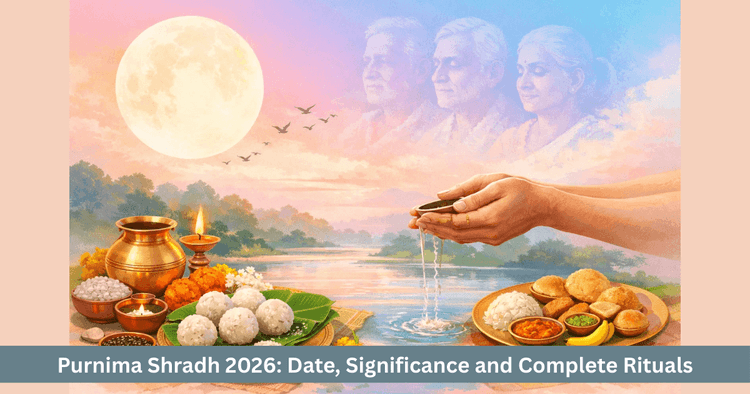
Table of Contents
Purnima Shradh 2026 is the day on which the sacred current of Pitru Paksha first touches the household. This Shradh is observed on the full moon of the bright fortnight of Bhadrapada and marks the opening doorway of the fortnight devoted to ancestors. In 2026 Purnima Shradh will be observed on Saturday 26 September 2026. The Bhadrapada Shukla Purnima tithi begins on the evening of 25 September and continues through the daytime of 26 September, therefore 26 September becomes the prescribed date for Shradh, Tarpan and Pind daan.
Scriptures describe specific auspicious windows for ancestral rites. For North India the approximate Kutup muhurat is 11:44 AM to 12:31 PM, Rohina muhurat is 12:31 PM to 1:17 PM and the broader Aparahna kala extends from 1:17 PM to 3:35 PM. The Vedic view is clear that the central acts of Shradh, especially Pinda offerings, Tarpan and Brahmin bhoj, should be completed in these afternoon periods when the ancestral realm is believed to be particularly receptive. Morning is used for bathing and sankalpa, while the core offerings are reserved for the above muhurats.
What is Purnima Shradh and why is it so special
Purnima Shradh is also known as Bhadrapada Purnima Shradh, Shraddhi Purnima or Proshthapadi Purnima Shradh. It is the Shradh that stands at the entrance of Pitru Paksha and offers the first salutations to Pitru Loka. Technically the day falls in Bhadrapada Shukla Paksha, while most of Pitru Paksha lies in the Krishna Paksha that follows, yet it holds the status of an opening rite for the entire ancestral fortnight.
Texts such as Garuda Purana explain that souls who depart on a Purnima tithi remain in a refined state in the realm of Pitru Loka and depend upon their descendants for yearly sustenance through Shradh. When the rite is performed on that same Purnima tithi it creates a special lunar harmony between the date of departure and the date of offering. This alignment is said to make the Shradh highly effective and pleasing to the ancestors.
For those who left their body on Purnima tithi this day within Pitru Paksha is regarded as their principal Shradh date. If due to genuine difficulty one cannot perform on this day, then Mahalaya Shradh on Sarvapitri Amavasya covers those souls as well. Nevertheless the primary preference in dharma texts is clearly in favour of Purnima Shradh itself.
Purnima Shradh 2026: date, tithi span and auspicious periods
In the year 2026, Pitru Paksha effectively opens with Purnima Shradh. The important timing details can be seen together in a simple table.
| Detail | Time and date |
|---|---|
| Shradh day | Saturday, 26 September 2026 |
| Purnima tithi begins | Evening of 25 September 2026 |
| Purnima tithi predominance | Most of the daytime of 26 September |
| Kutup muhurat | Approximately 11:44 AM to 12:31 PM |
| Rohina muhurat | Approximately 12:31 PM to 1:17 PM |
| Aparahna kala | Approximately 1:17 PM to 3:35 PM |
According to Vedic injunctions the Aparahna kala is the ideal period for Shradh. During this time the energies of the ancestral world are considered particularly sensitive and receptive to earthly offerings. Bathing, sankalpa and preliminary devata puja may be done earlier in the morning but Tarpan, Pind daan and Brahmin bhoj gain full fruit only when completed inside these afternoon windows. Since exact timings vary slightly by region, devotees are advised to confirm with local panchang or a learned pandit.
Who should perform Shradh on Purnima
Authoritative guides such as Dharmasindhu and Nirnayasindhu specify that Purnima Shradh is especially suited in the following situations.
- Ancestors who passed away on any Purnima tithi in any month.
- Departed souls whose exact death tithi is unknown, only month or year being remembered.
- Married women who died while their husband was living, who are honoured especially on this Purnima in some traditions.
- Maternal ancestors, since many families treat Purnima as so auspicious that both paternal and maternal lines are remembered together.
Purnima Shradh becomes a special help for families who could not perform regular Shradh in previous years due to circumstances. They may treat this day as a form of Kumari Shradh or combined Shradh covering many missed years and a wider circle of ancestors with one heartfelt rite.
Those who are unable to travel to Prayagraj, Varanasi, Gaya or other pilgrim centres can still benefit deeply from Purnima Shradh. Performing Tarpan with sesame mixed water at any river, pond or even at home, with concentration and devotion, is understood to reach Pitru Loka. Sacred sites simply intensify the merit and spiritual depth of the rite.
Step by step procedure of Purnima Shradh
The procedure of Purnima Shradh follows a well defined sequence in the Vedic tradition. Each step carries its own symbolism and purpose.
1. Purifying bath and mental preparation
The performer begins before sunrise or at sunrise with a ritual bath. Bathing in a river or pond is ideal when possible. At pilgrimage towns a dip at a confluence such as Triveni is considered especially meritorious. After bathing, one wears clean simple clothes, preferably white or light coloured, to maintain a sattvic mood.
2. How sankalpa is taken
At the place of worship or Pind daan altar the performer sits facing the appropriate direction and takes a sankalpa. In this vow
- The gotra, name, place and date are mentioned.
- The names and relationships of the ancestors being honoured are spoken.
- The intention is declared clearly that the Shradh is for their satisfaction and for self purification, not merely for formality.
Through the sankalpa the coordinates and focus of the ritual are fixed, much like properly addressing a letter before sending it.
3. Tarpan procedure
Next follows Tarpan. Water mixed with black sesame, kusha grass and flowers is offered from the hand. For paternal ancestors usually the right hand is used and for maternal lines certain procedures vary by tradition. With each libation the names, gotras and relationships of the ancestors are pronounced and they are lovingly invited to accept the offering.
The word Tarpan itself means to satisfy or to refresh. The mixture of water, sesame and mantra creates a subtle channel whereby nourishment reaches the ancestors in their own realms.
4. Pind daan in proper order
The heart of the rite is Pind daan. For this, rice along with barley flour, sesame, ghee and honey is shaped into round balls called pindas. The number of pindas may vary, commonly three, five or more are prepared depending on custom.
Each pinda is taken in the hands, dedicated to a particular ancestor by name and then placed at the chosen spot with the appropriate mantra. The pinda is seen as a representation of the subtle body of that ancestor. The inner spirit behind Pind daan is that descendants offer the purest part of their food, prepared with effort, to their forebears in gratitude.
5. Feeding and honouring Brahmins
After Pind daan comes Brahmin bhoj. Shastras regard the invited Brahmins as manifestations of Vishwadevas, the universal gods who carry offerings to Pitru Loka. The meal usually includes rice, dal, vegetables, puri or roti, kheer and fruits.
The atmosphere during the meal is one of respect and humility. The family offers what they can with care, keeping the focus on devotion rather than display.
6. Charity and dakshina
After the meal suitable daan is given. This may include cloth, grains, black sesame, jaggery and some monetary dakshina. Traditional sources speak highly of cow donation related to Purnima Shradh, though in present times this is often done symbolically through support for goshala or similar service.
7. Closing prayers and request for blessings
The rite ends with prayers to the Pitru devatas to accept the day offerings, remove disease, debt and sorrow and bless the family with harmony and wisdom. In this way the Shradh becomes a collective request for ancestral grace upon all present and future members of the lineage.
Scriptural significance of Purnima Shradh
Texts like the Vishnu Purana, Matsya Purana and the Anushasana Parva of Mahabharata describe the larger framework of Pitru Paksha. They explain that during this period Yama allows the ancestors to come closer to the earthly plane to receive food and water offerings from their descendants.
A famous statement in Matsya Purana conveys that Shradh performed on the opening Purnima of Pitru Paksha satisfies ancestors up to seven generations. Narratives in Mahabharata, including accounts of King Yayati, illustrate how Shradh performed earnestly at sacred tirthas can uplift entire lineages.
The underlying teaching is that ancestors are not only past, they are a living link between past and future. Those who remember and honour them experience protection, stability and inner strength in their family life.
Do and do not guidelines for Purnima Shradh
The daily conduct on Shradh day is also carefully guided in tradition to keep the atmosphere pure, calm and sattvic.
Recommended practices
- Maintain self restraint and, as far as possible, celibacy from the previous night until the Shradh completes.
- Use fresh ingredients, especially black sesame, barley, kusha grass and pure ghee.
- Perform the central rites within Kutup, Rohina or Aparahna periods.
- Offer water at the Tulsi plant and light a lamp in the evening for the ancestors.
- Listen to passages from Garuda Purana, Pitru stotras or verses of the Gita.
- Maintain a respectful and quiet attitude throughout the day.
Things to avoid
- Avoid non vegetarian food, alcohol, onion and garlic on the Shradh day.
- Do not cut hair or nails and avoid unnecessary adornment.
- Do not schedule Shradh rites in the night since Shradh is a daytime observance.
- Keep away from quarrels, harsh speech and anger, which disturb the subtle atmosphere of the home.
These disciplines are not mere restrictions. They help the mind remain focused and peaceful, so that the remembrance of ancestors is deep and heartfelt.
Spiritual benefits of Purnima Shradh
Purnima Shradh is not only a yearly duty but an expression of love and gratitude across generations. Families who observe it with sincerity often notice inward changes.
- The sense of burden related to ancestral obligations becomes lighter.
- Repeated obstacles and strange hindrances gradually reduce over time.
- Respect for parents and elders increases naturally in the younger generation.
- Children grow up with a living connection to their roots and family history.
When elders demonstrate through action that Shradh matters, younger members receive subtle values of responsibility and sensitivity. These values later become the foundation of a stable character and balanced outlook.
Common questions about Purnima Shradh 2026
On which date will Purnima Shradh be observed in 2026?
It will be observed on Saturday 26 September 2026, when Bhadrapada Shukla Purnima prevails during the daytime.
For which ancestors is Purnima Shradh especially meant?
For those who passed on any Purnima tithi, for ancestors whose death tithi is uncertain and, in many traditions, for married women and maternal ancestors as well.
What is the main time window for performing Purnima Shradh?
The central acts of Shradh should be done in the afternoon, preferably within Kutup, Rohina or Aparahna muhurats on that day.
If Shradh cannot be done on Purnima, what is the alternative?
In that case one may perform Mahalaya Shradh on Sarvapitri Amavasya with the intention of including those ancestors, though returning to Purnima Shradh in future years is ideal.
Can Purnima Shradh be performed at home instead of at a tirtha?
Yes. If travel is not possible, one can arrange Tarpan, Pind daan and Brahmin bhoj at home or near a local water body and still gain the blessings of sincere Purnima Shradh.
Get your accurate Kundali
Generate KundaliDid you like it?
Author
Pt. Narendra Sharma (63)
Experience: 20
Consults About: Family Planning, Career
Clients In: Punjab, Haryana, Delhi
Share this article with friends and family
About ZODIAQ
ZODIAQ is an online Vedic Astrology platform. It connects clients seeking astrological advice to experienced astrologers with deep knowledge. Our users also generate kundali and perform kundali milan for free. ZODIAQ also offers services to the Astrologers. Astrologers utilize various offerings by ZODIAQ to serve their clients effectively.
If you are a User
Consult with experienced astrologers and seek their guidance. You can also order handwritten Janm Patrika report with life prediction prepared by experienced astrologers. Generate accurate Kundali, perform Kundali Matching and check horoscope and muhurat. Utilize our online library for all the necessary astrological and spiritual information.
If you are an Astrologer
Create accurate kundali for your clients and perform Kundali Matching for up to 5 people at a time. Write comprehensive Janm Patrika report for your clients with ZODIAQ. Check client details anytime by saving it in client directory. Become more productive by tracking how many clients you guide every day.
WELCOME TO
ZODIAQ
Right Decisions at the right time with ZODIAQ
