Skanda Sashti Vrat March 2026: Date, Vrat Vidhi, Katha
By Pt. Suvrat Sharma
Special vrat and worship to seek Lord Murugan’s grace and courage
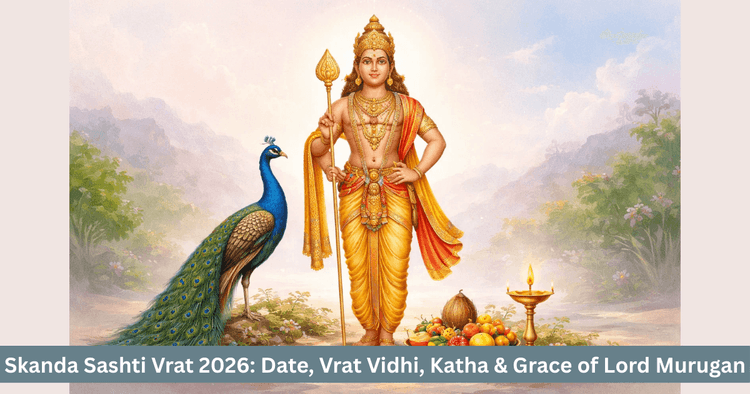
Table of Contents
Skanda Sashti is a day of special importance for devotees who seek the protection, courage and grace of Lord Murugan in their lives. According to the Tamil lunar calendar it falls on the sixth day of the month and the observance is linked with the remembrance of Lord Skanda, the war deity who overcame powerful asuras and restored harmony. In 2026 many devotees wish to plan their worship in advance so that they can keep the Skanda Sashti fast and related rituals on the correct date with full attention.
Skanda Sashti Vrat date in March 2026
For March 2026, the principal date observed for Skanda Sashti Vrat is as follows.
Skanda Sashti Vrat date March 2026
| Detail | Date | Weekday |
|---|---|---|
| Skanda Sashti Vrat March 2026 | 23 March 2026 | Monday |
In the Tamil calendar this corresponds to the lunar Shashti Tithi of the month. On this day devotees worship Lord Skanda, known also as Lord Murugan or Kartikeya and dedicate the day to fasting, prayer and remembrance of his qualities of valour and compassion.
What is Skanda Sashti and why is it regarded as special
Skanda Sashti, also written as Kanda Shashti, is observed with great devotion in Tamil Nadu and many parts of South India. It belongs to the family of Shashti fasts since it is observed on the sixth lunar day.
The day is dedicated to Lord Murugan, the divine commander of the forces of dharma. He is the son of Lord Shiva and Goddess Parvati and is revered as the destroyer of hostile forces and a guardian of devotees. The Skanda Sashti fast is associated with the victory of Lord Skanda over the demon Surapadma and his armies. For this reason, the day is taken as a symbol of the victory of dharma over adharma, the triumph of courage over fear and the emergence of light over darkness. Devotees believe that worship on Skanda Sashti brings prosperity, happiness and respect along with inner strength to face challenges.
The story of Lord Skanda and the six day battle
Traditional accounts describe the origin of Lord Skanda as deeply connected with the tapas of Lord Shiva.
The demon kings Tarakasura, Simhamukha and Surapadma are described as having built powerful armies and having disturbed the peace of the heavenly realms. Their influence grew so strong that the devas were forced to leave their positions in heaven. Although they fought many times, the gods were unable to defeat these asuras. At last the devas approached Lord Shiva and prayed for a way to end the suffering.
Lord Shiva then emerged from his deep samadhi and from his third eye a blazing divine flame arose. From this sacred fire Lord Skanda was brought forth. After his manifestation, Goddess Parvati and the devas blessed him with weapons, powers and boons, equipping him for the coming battle.
A fierce war followed for six days. Each day Lord Skanda overcame a different leader of the demon forces and gradually destroyed their strength. In the final encounter he defeated Surapadma and freed the heavenly worlds from their oppression. To remember this six day victory, Skanda Sashti is observed as a day of gratitude and alignment with the same spirit of courage in the life of the devotee.
How to observe Skanda Sashti Vrat
Skanda Sashti Vrat can be observed in a formal or simple manner but certain steps are widely followed in many traditions.
- The day begins with an early bath and wearing of clean, modest clothes.
- After sunrise, the devotee makes a sankalp, resolving to dedicate the day to Lord Skanda.
- In many traditions the fast is kept from sunrise to sunset. Some devotees take neither food nor water during this time, while others follow a lighter fast with fruits and milk.
- Where possible, it is considered very auspicious to visit a temple of Lord Murugan, participate in abhishek, puja and related rituals. If this is not practical, a picture or idol of Lord Skanda can be installed at home for worship.
- Throughout the day, hymns such as Skanda Sashti Kavacham are recited and the mantra Om Sharavana Bhava is repeated using a mala. Many devotees aim to complete 108 repetitions of this mantra.
- After sunset or at the appointed closing time, the fast is ended. Devotees first offer naivedya and perform aarti to Lord Skanda and only then partake of the prasad.
In this way, Skanda Sashti Vrat becomes not only a matter of giving up certain foods but also a conscious attempt to purify thoughts, speech and actions under the protective gaze of Lord Murugan.
Benefits of fasting on Skanda Sashti
Various spiritual and astrological benefits are associated with the observance of Skanda Sashti.
At the worldly level, the fast is seen as supportive of growth, prosperity and recognition. When a devotee disciplines the mind and restrains negative tendencies, Lord Skanda is believed to grant strength, clarity and determination.
From an astrological perspective, Skanda Sashti Vrat is especially recommended for those who feel troubled by the influence of Rahu, Ketu, Kala Sarpa dosha or Sarpa Shrapa configurations. Worship of Lord Skanda on this day, with fast, stotra recitation and sincere prayer, is believed to soften the harshness of such patterns and to open new, more positive pathways for the person.
Recitation of Skanda Sashti Kavacham
Skanda Sashti Kavacham is a revered hymn composed in Tamil in honour of Lord Skanda. The word Kavacham points to its role as a spiritual armour for the devotee who takes shelter in the Lord.
The hymn is traditionally recited over the six days linked with Skanda Sashti and many teachers advise reciting it at least 36 times a day during this period. Such sustained recitation is said to bring about freedom from fear and insecurity, while strengthening faith and surrender to Lord Skanda.
The hymn is associated with a disciple from the lineage of Meenakshi Sundaram Pillai in the 16th century. The opening lines are called Kaappu and the following verses are known as Kavacham. While chanting, devotees focus less on technical meaning and more on heartfelt connection and trust.
Rudraksha, Mangal Yantra and related supports
Certain sacred tools are sometimes used along with the worship of Lord Skanda as part of a broader spiritual discipline.
The six faced Rudraksha is traditionally linked with Lord Skanda. It may be worn as a bracelet or pendant. This bead is regarded as calming to the fiery energy of Mars and as a support for willpower, courage and focus. Wearing such a Rudraksha during the Skanda Sashti period is considered particularly beneficial.
For those who struggle with anger, strained relationships, business losses or a sense of repeated failure, the worship of a Shri Mangal Yantra is also suggested in some traditions. This yantra is usually kept in a respectful place such as a cash box or altar in the southern area of the home. It is believed to harmonise the influence of Mars and to help the person manage anger, make better decisions and invite auspicious movement in life.
These supports are not meant as shortcuts. They are most effective when combined with sincere effort to refine character, improve actions and place deeper trust in Lord Skanda.
Message of Skanda Sashti 2026 for daily life
The Skanda Sashti of March 2026 can be seen as a gentle reminder for all those who face their own battles in life. The story of Lord Skanda shows that even when situations seem difficult, a clear purpose, divine guidance and brave action can overcome entrenched negativity.
Devotees who use the Skanda Sashti of 23 March 2026 as a day of fast, prayer and honest self reflection may find that it marks a turning point. When inner laziness, fear and doubt are seen as the true enemies and when the qualities of Lord Skanda are invited into the heart, the path ahead can become steadier and more meaningful. With his grace, success, prosperity and prestige can grow together with inner balance and a stronger sense of duty.
Common questions
When will the Skanda Sashti Vrat be observed in March 2026 In March 2026, Skanda Sashti Vrat will be observed on Monday, 23 March 2026, which corresponds to the lunar Shashti Tithi in the Tamil calendar.
To which deity is Skanda Sashti dedicated and by what names is he known Skanda Sashti is dedicated to Lord Skanda, who is also known as Lord Murugan, Kartikeya and Kanda. He is the son of Lord Shiva and Goddess Parvati and is honoured as the commander of the divine hosts.
How is the Skanda Sashti fast usually observed and what food rules are followed Devotees bathe early, wear clean clothes and keep a fast from sunrise to sunset. Some take no food or water at all, while others take only fruits and milk. The day is spent in worship and mantra chanting.
Why is Skanda Sashti considered important for those affected by Rahu, Ketu or Kala Sarpa dosha From an astrological viewpoint, special worship of Lord Skanda can ease the difficulties linked with these patterns. Those troubled by Rahu, Ketu, Kala Sarpa dosha or Sarpa Shrapa often observe Skanda Sashti for relief and peace of mind.
How do Skanda Sashti Kavacham and the mantra Om Sharavana Bhava support the devotee Regular recitation of Skanda Sashti Kavacham and chanting of Om Sharavana Bhava strengthen faith, courage and concentration. On Skanda Sashti, these practices can help reduce fear and negative thoughts and deepen the felt presence of Lord Skanda in daily life.
Get your accurate Kundali
Generate KundaliDid you like it?
Author
Pt. Suvrat Sharma (63)
Experience: 20
Consults About: Family Planning, Career
Clients In: Punjab, Haryana, Delhi
Share this article with friends and family
About ZODIAQ
ZODIAQ is an online Vedic Astrology platform. It connects clients seeking astrological advice to experienced astrologers with deep knowledge. Our users also generate kundali and perform kundali milan for free. ZODIAQ also offers services to the Astrologers. Astrologers utilize various offerings by ZODIAQ to serve their clients effectively.
If you are a User
Consult with experienced astrologers and seek their guidance. You can also order handwritten Janm Patrika report with life prediction prepared by experienced astrologers. Generate accurate Kundali, perform Kundali Matching and check horoscope and muhurat. Utilize our online library for all the necessary astrological and spiritual information.
If you are an Astrologer
Create accurate kundali for your clients and perform Kundali Matching for up to 5 people at a time. Write comprehensive Janm Patrika report for your clients with ZODIAQ. Check client details anytime by saving it in client directory. Become more productive by tracking how many clients you guide every day.
WELCOME TO
ZODIAQ
Right Decisions at the right time with ZODIAQ
