Holi Bhai Dooj Vrat Katha and Deeper Meaning of This Festival
By Pt. Sanjeev Sharma
Festival of Unbreakable Sibling Bond, Protection, and Blessings
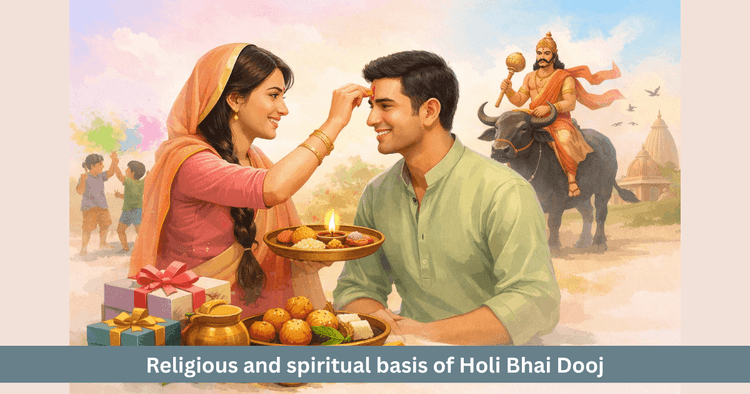
Table of Contents
Amid the colours and celebration of Holi there comes a day that deepens the sacred bond between brother and sister. This is the day of Holi Bhai Dooj, also known in some regions as Bhaiya Dooj or Bhratri Dwitiya. The festival is observed on the second lunar day of the bright fortnight of Chaitra, that is, on the day after Holi and it is regarded as a special occasion of unbreakable affection, promise of protection and blessings for long life between siblings.
On Chaitra Shukla Dwitiya, sisters invite their brothers to their homes, apply tilak on their foreheads and offer them lovingly prepared food. In return, the brother takes a vow to protect his sister and offers her gifts, affection and blessings. Religious belief holds that a brother who visits his sister on this day, receives tilak and eats at her house, becomes free from the torments of hell and is freed from the fear of Yama, the lord of death.
Religious and spiritual basis of Holi Bhai Dooj
According to sacred tradition, on the day of Bhai Dooj Yamraj, the lord of death, visited the house of his sister Yamuna. Yamuna welcomed him with great love, performed tilak, served him food and offered heartfelt hospitality. Pleased by her affection, Yamraj gave her a boon that any brother who comes to his sister’s home on this tithi, receives tilak and partakes of food there, will be freed from the tortures of hell and will not be troubled by the fear of Yama.
From this incident the tradition of Holi Bhai Dooj is believed to have begun. The tilak applied by a sister on this day is not a mere formality. It is regarded as a symbol of long life, protection and freedom from sin. The brother’s promise of protection is also not limited to physical safety. It is a pledge of lifelong support, respect and emotional strength for his sister.
How is Holi Bhai Dooj observed
It is believed that on Holi Bhai Dooj the rituals begin with the worship of Vighnaharta Bhagavan Ganesh. After Ganesh, devotees remember Yamdev and the story associated with him.
The main points of the puja on this day are usually understood in this way.
- Taking a bath early in the morning and wearing clean clothes.
- Establishing the image of Bhagavan Ganesh at the place of worship and performing his puja.
- Remembering Yamraj and Yamuna and reading or listening to the vrat katha of Holi Bhai Dooj.
- Without the recitation of the katha and the final aarti, the observance of this vrat is not considered complete.
- After this, the sister applies tilak to her brother, performs aarti, feeds him and prays for his long life, happiness and good health.
Through this sequence, on one side the worship of deities awakens the feeling of dharma and divine blessing and on the other side, the tilak and meal strengthen the bond between brother and sister.
Why is the Holi Bhai Dooj vrat katha recited
On Holi Bhai Dooj a special vrat katha is narrated which explains the importance of this day in a simple and vivid manner. Listening to the story not only supports observance of dharma, it also teaches both brother and sister that even in difficult situations love, wisdom and sacrifice can avert grave dangers.
Without the katha, the puja is considered incomplete, because the story reveals the spiritual background of the festival. It also shows that merely following rituals is not enough. What truly matters are the feelings and intentions behind them.
Holi Bhai Dooj vrat katha in detail
In a certain town lived an old woman. She had two children, a son and a daughter. The daughter was married and lived at her husband’s home. Holi had just passed. Some days later a strong desire arose in the son’s heart to meet his sister. He told his mother that he wanted to go to his sister’s house, receive tilak from her and eat the food cooked by her hands.
At first the mother hesitated but when the son repeatedly requested her, she finally gave him permission to go. She blessed him and sent him on his way. The son started his journey happily with the thought of seeing his sister again.
The river appearing as the lord of his fate
On the way he reached the bank of a river. The river seemed to speak and told him that she was his fate and if he stepped into her waters, he would drown and lose his life. Hearing this, the young man was scared, yet his wish to meet his sister remained firm. He pleaded with the river to allow him to visit his sister first, receive her tilak and then, on his return, he would accept whatever was written in his destiny.
The river listened to his request and allowed him to go ahead. This part of the story shows that even when signs of death appear on the path, love and duty can give one the courage to move forward.
Encounter with the lion and then the snake
After walking some distance through a dense forest he came across a ferocious lion that blocked his way. The young man humbly repeated the same request to the lion that he had made to the river. He said that he was ready to face whatever might come after he had met his sister. The lion too allowed him to pass for the time being.
A little further on he felt his leg gripped by a snake. Although frightened, he again made the same request and told the snake that he wished to see his sister first and would then accept his destiny. The snake released him as well.
These events indicate that in life death, danger and fear may appear one after another. Yet if the purpose is pure and the heart is sincere, the way forward keeps opening.
Sister’s affection and brother’s sadness
At last the young man reached his sister’s house. As soon as she saw her brother at the door, her joy knew no bounds. She embraced him warmly and brought him inside with great respect. Following sacred custom, she applied tilak to his forehead, performed aarti and served him a lovingly prepared meal.
While he was eating, the sister noticed that her brother looked sad. His face showed worry and his heart seemed weighed down. She repeatedly asked him why he was unhappy. At first he remained silent but moved by her concern he finally told her all the events that had occurred on the way. Hearing about the river, the lion and the snake, the sister became very anxious and deeply troubled for her brother’s future.
Guidance from the wise old woman
After hearing her brother, the sister decided that she would not allow him to return alone. She agreed to accompany him. On their way back they came to a pond, where they met an old woman. The sister, full of anxiety, told this old woman everything and asked why such danger had come upon her brother’s life and how it could be avoided.
The old woman calmly replied that all this was the result of karma from previous lives, whose fruits were now appearing and which the brother was about to endure. Yet she also said that if the sister was sincerely willing, she could divert each coming danger away from her brother through her own effort and intelligence.
These words brought new hope to the sister. She was ready to do everything possible to save her brother.
The sister’s sacrifice and the removal of dangers
Following the old woman’s advice, before returning the sister made some preparations. She took
- meat for the lion
- milk for the snake
- and a veil or cloth for the river
When they entered the forest again, the lion appeared. The sister immediately placed the meat before the lion. Its attention turned to the food and it calmed down. In this way the first danger was averted.
A little further on the same snake appeared and began to hiss. The sister poured out the milk in front of it. After drinking the milk, its poison cooled and it allowed them to move on.
Finally they reached the river bank. Seeing the young man, the river increased its flow as if to pull him in. The sister at once offered her veil to the river, as if covering it with respect. The current began to settle and both of them crossed safely.
Thus, with love, presence of mind and sacrifice, the sister turned away every danger that was destined for her brother. The three forces that had been seen as agents of death became calm and harmless.
How this story established the festival of Holi Bhai Dooj
According to the story, this was the day when the sister saved her brother from the mouth of death. It is said that from that time onward, every year on Chaitra Shukla Dwitiya, the day after Holi, the festival of Bhai Dooj began to be observed.
On this day the brother goes to his sister’s home for tilak, the sister prays for his long life and in return the brother promises to protect her. In this way, after the colours of Holi, the day of Bhai Dooj adds a new layer of security, trust and affection to their relationship.
Life lessons from Holi Bhai Dooj
The vrat katha of Holi Bhai Dooj is not only a traditional tale. It offers deep guidance for life.
- The sister’s dedication shows that true love expresses itself through sacrifice, not only through words.
- The brother’s resolve illustrates that relationships may require walking through difficult paths with courage.
- The symbols of river, lion and snake teach that we cannot escape the results of past karma but with right guidance and good actions their impact can be softened.
The observance of this vrat and the recitation of the story remind us that caring for family and honouring relationships is itself a sacred form of dharma.
Common questions about Holi Bhai Dooj
When and how is Holi Bhai Dooj celebrated
Holi Bhai Dooj is celebrated every year on Chaitra Shukla Dwitiya, the day after Holi. On this day the sister applies tilak to her brother, performs aarti, offers him food and prays for his long life, happiness and good health.
Why is the story of Yamraj and Yamuna remembered on this day
The story is remembered because Yamraj promised Yamuna that any brother who visits his sister on Bhai Dooj, receives tilak and eats at her house will be freed from the torments of hell. Thus this festival is associated with freedom from suffering and divine protection.
What does the story of the old woman and her son teach
The story teaches that the fruits of past lives must be faced, yet sincere love, sacrifice and wise action can transform the way those results manifest. The sister’s devotion shows that she is ready to bear hardship to save her brother.
Why are Ganesh and Yamdev worshipped on Holi Bhai Dooj
Ganesh is worshipped to remove obstacles so that the vrat and puja proceed smoothly. Yamdev is worshipped with the feeling that he may bless the brother with long life and safety and lighten the burden of difficult karmic results.
How can brothers and sisters make this festival more meaningful
They can make it more meaningful by going beyond formal tilak, honestly clearing misunderstandings, speaking openly and resolving to stand by each other throughout life. In this way Holi Bhai Dooj becomes truly auspicious and nurturing for their bond.
Get your accurate Kundali
Generate KundaliDid you like it?
Author
Pt. Sanjeev Sharma (63)
Experience: 20
Consults About: Family Planning, Career
Clients In: Punjab, Haryana, Delhi
Share this article with friends and family
About ZODIAQ
ZODIAQ is an online Vedic Astrology platform. It connects clients seeking astrological advice to experienced astrologers with deep knowledge. Our users also generate kundali and perform kundali milan for free. ZODIAQ also offers services to the Astrologers. Astrologers utilize various offerings by ZODIAQ to serve their clients effectively.
If you are a User
Consult with experienced astrologers and seek their guidance. You can also order handwritten Janm Patrika report with life prediction prepared by experienced astrologers. Generate accurate Kundali, perform Kundali Matching and check horoscope and muhurat. Utilize our online library for all the necessary astrological and spiritual information.
If you are an Astrologer
Create accurate kundali for your clients and perform Kundali Matching for up to 5 people at a time. Write comprehensive Janm Patrika report for your clients with ZODIAQ. Check client details anytime by saving it in client directory. Become more productive by tracking how many clients you guide every day.
WELCOME TO
ZODIAQ
Right Decisions at the right time with ZODIAQ
