Why Holi Is Celebrated and the Real Story
By Pt. Suvrat Sharma
The Story of Prahlada, Holika, and Holika Dahan
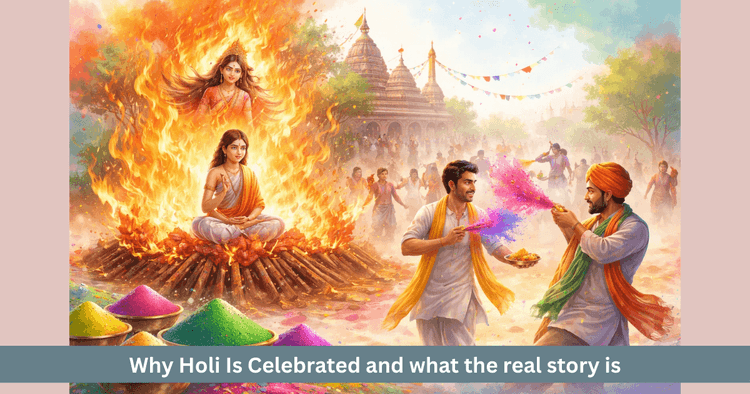
Table of Contents
Whenever Holi is mentioned the first images that arise are those of colours, laughter and enthusiasm. From the outside Holi appears to be a festival of colours and fun, yet at its heart it is connected with a deep story of devotion, dharma and inner transformation. For anyone who truly wishes to understand why Holi is celebrated it is important to know the story of Prahlada, Holika and Holika Dahan.
In most regions of India Holi is celebrated over two days. On the night of the Full Moon in the month of Phalguna people observe Holika Dahan and on the following morning till midday they celebrate Rangwali Holi. Although the Gregorian date changes every year according to the lunar calendar, the basic structure remains the same. On the Full Moon night a bonfire is lit to symbolically burn ego and negativity and the next day colours are used to welcome joy, harmony and a new beginning. It is considered wise to check the exact date in the local panchanga, because in some places there can be slight regional variations in timing.
What is the real story behind Holi
The most well known story of Holi is that of Prahlada and Holika. This legend is the main basis of Holika Dahan and the reason Holi is regarded as a festival that celebrates the victory of truth over untruth.
Who was Hiranyakashipu
In ancient times there lived a powerful asura king named Hiranyakashipu. Through intense austerity he had obtained boons that made normal death almost impossible for him. As his power grew his pride and self importance also grew. He began to see himself as God. He ordered people in his kingdom to worship him alone and to repeat his name as if it were a sacred mantra. Anyone who disobeyed his commands was considered an enemy.
Who was Prahlada and what was his devotion like
The same Hiranyakashipu had a son named Prahlada. His nature was gentle, kind and inclined towards dharma. From early childhood he had been taught that his father was divine, yet within him a different sensitivity was waiting to awaken.
One day Prahlada saw a woman kneeling on the ground with tears in her eyes, praying with deep emotion. She was saying, “He Bhagavan Vishnu, who removes fear, I surrender at your feet.” Prahlada became angry. He thought that when the king was regarded as God in the kingdom, how could this woman call out to someone else.
The woman explained that her kittens had fallen into the well. She felt helpless and was praying to Lord Vishnu to protect her little ones. At that very moment a faint meow came from the well. Prahlada looked and saw a tiny paw on the inner wall. The woman carefully bent down and lifted the kitten out. After that each kitten came out in turn and gathered safely around their mother. The woman looked up with gratitude and said that her Lord had heard her prayer.
This incident planted a question in Prahlada’s heart. He began to ask what true divine power really is. He reflected that if his father were truly God, then why had this prayer gone elsewhere. From that day his heart turned towards Lord Vishnu as the real protector and he resolved to worship Vishnu as the true Lord, even if this displeased his father.
When Hiranyakashipu came to know of Prahlada’s devotion
When Hiranyakashipu heard that his own son had stopped worshipping him and was devoted to Lord Vishnu, his pride was deeply hurt. He thought that if his own child did not accept his godhood then his authority over the kingdom would weaken.
In anger he declared that Prahlada would be punished severely. He ordered his soldiers to seize Prahlada and throw him from the highest cliff in the land. The soldiers obeyed. As Prahlada fell from the great height he kept repeating only one name, Lord Vishnu. The story says that an unseen power slowed his fall and he landed safely on the ground.
When the king heard that nothing had happened to Prahlada, his anger increased. He planned a second trial and ordered that Prahlada be thrown into a pit of serpents, full of hissing poisonous snakes.
Prahlada was pushed into the midst of the coiled snakes but inwardly he remained absorbed in the remembrance of Vishnu. The serpents moved around him and brushed against his body yet none of them bit him. It was as if some higher command had restrained their poison.
Hiranyakashipu then tried a third time. He ordered Prahlada to be placed before a herd of enraged elephants. The elephants were provoked and driven towards him so that they would trample him. As the elephants charged, Prahlada again repeated the name of his chosen Lord. The elephants suddenly became calm, lowered their trunks and touched him gently, as if they were showing affection instead of anger.
Through all these events it became clear that Prahlada was protected not by external power but by his unwavering faith.
Who was Holika and what was her boon
After all these attempts failed the king turned to his sister Holika for advice. Holika also carried jealousy and dislike towards Prahlada. She possessed a special divine boon related to fire. In some versions it is said that she was immune to burning when she sat in fire. In others she is given a magical cloth which, when worn, protected her from flames.
Holika suggested a new plan. A large bonfire would be prepared. She would sit in the fire with Prahlada in her lap. Because of her boon or protective cloth she expected to remain unharmed while Prahlada would be burnt.
The king accepted this plan. He felt confident that this time Prahlada would not survive.
How the event of Holika Dahan took place
On the following morning people gathered in the open ground in front of the palace. Large amounts of dry wood, grass and cow dung cakes were piled up. Soon a tall pyre was ready. A torch was put to it and the dry wood caught fire quickly. Flames rose high into the sky and the heat was so intense that people had to stand at a distance.
Holika called Prahlada and challenged him to sit with her in the fire so that it could be seen who was truly brave. Prahlada stood at a crossroads. Either he could surrender to fear and obey his father or he could hold firmly to his devotion to Vishnu and stand by truth. He chose the path of devotion.
Holika took her seat in the flames, relying on her boon or on the magical cloth and placed Prahlada in her lap. Prahlada closed his eyes and remembered Vishnu with a calm heart.
According to the legend, as the fire grew stronger the situation began to change. If she had a magical shawl, then a gust of wind blew the cloth from Holika onto Prahlada. If her boon worked only when she entered the fire alone, then by misusing it to harm a devotee she lost its protection. The result was that Holika was consumed by the fire and turned to ashes, while Prahlada remained unharmed in the midst of the flames.
From this event the tradition of Holika Dahan is said to have begun. The bonfire on Phalguna Full Moon night is a symbol of the burning of Holika’s arrogance and the protection of Prahlada’s devotion. Even today people stand around the fire and remember that one who stands firmly on the side of truth is ultimately safeguarded.
What is the spiritual meaning of Holika Dahan
Holika Dahan is not only an outer ritual. It is also a psychological and spiritual symbol.
The fire of the bonfire can be seen as the inner flame which inspires one to burn
ego,
jealousy,
anger,
fear,
old pain
and other heavy burdens.
Many people during Holika Dahan quietly imagine that just as the dry wood and branches are turning to ash, in the same way their inner negative tendencies are also slowly losing their grip. In this sense Holi is not just an external celebration. It becomes an opportunity for inner journey and cleansing.
Why is Holi called the festival of colours
A natural question arises. If Holika Dahan is a ritual of fire, why is Holi famous as the festival of colours. The answer lies in the second day, the day of Rangwali Holi.
After the night of Holika Dahan the next day becomes a day of joy and celebration. People gradually began to use colours as a way of expressing this joy. Through colours people come closer to one another.
- Colours express that life is not merely black and white. It is filled with many shades and emotions.
- When someone applies colour to another person’s face on Holi it carries a subtle message of lightening past grievances and renewing relationships.
- Social distance and stiffness become softer, at least for some time, under the playful cover of colours.
For this reason Holi is also regarded as a festival of social togetherness, forgiveness and renewed connection.
What is the spiritual meaning of Holi in Hindu tradition
In the Hindu way of life the meaning of Holi goes beyond being a cultural festival. It can be understood as a time of spiritual and psychological resetting.
-
Victory of good over harmful tendencies
The story of Prahlada and Holika clearly shows that harmful forces, no matter how powerful they may appear, cannot stand forever against truth and dharma. The pride of Hiranyakashipu, the deceit of Holika and the devotion of Prahlada together form a very instructive picture. -
Burning of ego
Holika Dahan symbolises not only an outer fire but also the fire that burns ego. When a person looks within honestly and accepts that there is a trace of Hiranyakashipu inside, a tendency to control and to see oneself as superior, then real change can begin. -
Seasonal shift and freshness
Holi arrives when winter departs and spring begins. Nature itself seems to take a new birth. Fresh leaves on the trees, new crops in the fields and a new fragrance in the air all indicate that it is time to release old burdens and adopt a fresh outlook. The fire and colours of Holi can carry this sense of renewal into the inner life as well.
Other cultural layers in the history of Holi
Those who explore holi festival history or search for the legend of Holi festival find that in different parts of India Holi is associated with additional stories and local traditions. In some regions it is linked with the play of Radha and Krishna, where colours become a medium of love and acceptance. In other places, regional folk tales and community memories are woven into the celebrations.
Even so, the story of Prahlada and Holika remains the primary narrative that connects Holi across the country. The regional traditions enrich the central feeling that Holi is a festival of community, joy and positivity.
How to apply Holi’s teachings in daily life
Merely reading the story of Holi is not enough. Its true value emerges when its lessons are applied in daily life.
- Pride breaks relationships. The story of Hiranyakashipu shows that when a person tries to impose his own supposed divinity upon others, he ends up losing even his closest bonds.
- Devotion and courage protect. The calm faith of Prahlada reveals that real strength lies in inner steadiness, not in outward displays of fear.
- Forgiveness and new beginnings. Holi offers people a convenient moment to set aside old conflicts, embrace each other and carry within at least a small resolve to keep future interactions more balanced.
In this way the Holi festival importance is not limited to entertainment. It is also significant for emotional and spiritual wellbeing.
What does Holi symbolize
If one asks what does Holi symbolize, Holi can be seen as a two step process.
On the night of Holika Dahan the message is
Let go and burn what has become heavy.
On the next day of colours the message is
Begin again and celebrate what is alive.
In this sense Holi becomes a movement of inner cleansing followed by returning to joy. In the first step one recognises and releases negative feelings. In the second step one invites back colour, happiness and belonging into life.
How to understand the Holi 2026 date
Every year many people look up Holi 2026 date or Holika Dahan 2026 while planning travel, puja or family gatherings. The date of Holi is based on the Hindu lunar calendar, which is why the exact Gregorian date changes every year.
What remains unchanged is the structure.
- Holika Dahan is performed on the Full Moon night of the bright half of Phalguna.
- Rangwali Holi is celebrated the next day.
Anyone planning rituals or events is advised to confirm the date using the local panchanga or temple calendar, which aligns with regional traditions.
Why does Holi feel so personal in India
Many people ask why is Holi celebrated in India and why it feels so close to the heart. The reason is that Holi has become an integral part of community life, not just a religious observance.
- After a long and tiring winter people get an opportunity to laugh and celebrate openly.
- Streets and neighbourhoods become shared spaces where everyone comes together.
- On this day strangers can feel like friends, at least for a while.
Holi touches universal human needs such as the
need to celebrate after hard times,
need to reconnect,
need to laugh freely,
and need to forgive and start again.
Because of this Holi has grown beyond the boundaries of any single community and is now widely observed as a cultural festival as well.
Why is Holi important in the Hindu tradition
People often search why do Hindus celebrate Holi. The answer is rooted in the story of Prahlada and Holika. This story is a clear example of devotion to Vishnu and the protection of dharma. The downfall of Hiranyakashipu begins with his pride and the safety of Prahlada rests upon his steadfast faith.
For Hindu society Holi is a reminder that dharma is not only about ritual forms of worship. It is also about the way one lives. Truth, fairness, compassion and devotion all come together in this legend. Even though many people today enjoy Holi as a cultural festival, the core inspiration still arises from dharma and bhakti.
How to explain Holi to children
Children are naturally drawn to Holi because it includes colour, water and play. At the same time it provides a valuable chance to teach them important values in a simple manner.
- Truth ultimately prevails.
- Kindness has value.
- Ego wounds relationships.
- Joy helps the mind to heal.
If someone wishes to explain why is Holi celebrated for kids, there is no need to go into too much detail.
One can tell them in simple words that long ago there was a child named Prahlada who trusted in goodness and in God. A cruel king tried many times to frighten and destroy him, yet Prahlada remained safe. The king’s sister Holika tried to harm him with fire but the fire protected Prahlada and Holika was destroyed. To remember this, people light a bonfire and celebrate with colours the next day.
Five simple lines about Holi for children
For students or short notes, here are five easy sentences about Holi.
- Holi is a festival of colours celebrated in India and in many parts of the world.
- It reminds us of the victory of good over harmful forces.
- On the night before Holi people perform Holika Dahan by lighting a bonfire.
- The next day they play with colours, sing, dance and share sweets.
- Holi teaches joy, togetherness and a fresh start in life.
How Holi can guide life in a new direction
When the story of Holi and all its meanings are seen together, the festival appears not just as an outer celebration but as a message for life.
- It teaches that ego can disturb relationships and inner balance.
- It shows that calm and firm faith is stronger than fear.
- It encourages us to leave behind old hurts and look at life with a renewed mind.
Anyone who spends a little time during Holi reflecting on what needs to be released and what needs to be strengthened can experience this festival as an important turning point. The fire and colours of Holi together remind us that it is always possible to choose truth, devotion and joy, whatever the outer circumstances may be.
Common questions about Holi and Holika Dahan
Why is Holi truly celebrated
Holi is celebrated to remember through the story of Prahlada and Holika that arrogance, cruelty and deceit are ultimately destroyed, while devotion, truth and simplicity are protected. At the same time the festival marks seasonal change, social bonding and the welcoming of new beginnings.
What is Holika Dahan and why is it done
Holika Dahan is the ritual performed on the night of the Full Moon of Phalguna in which a bonfire is lit and the story of Holika and Prahlada is remembered. The fire symbolises the burning of ego, negativity and old pain and the protection of devotion and faith like that of Prahlada.
Why is Holi called the festival of colours
The day after Holika Dahan people play with colours as a sign that heavy feelings have been set aside and that joy, forgiveness and closeness are being welcomed back. Colours help to reduce social distance and allow people to feel closer to one another.
What is the spiritual message of Holi
The spiritual message of Holi is that one needs to recognise the Hiranyakashipu and Holika within, let go of their pride and deceit and cultivate the qualities of Prahlada such as devotion, humility and truthfulness. Holika Dahan and the play of colours together can bring an experience of cleansing and renewed energy both outwardly and inwardly.
How can the story of Holi be explained simply to children
Children can be told that a child named Prahlada always did good and trusted God. A cruel king and his sister Holika tried very hard to harm him but in the end Prahlada was saved and Holika was destroyed. To remember this, people light a bonfire on one night and play with colours the next day, so that everyone remembers that in the end goodness wins.
Get your accurate Kundali
Generate KundaliDid you like it?
Author
Pt. Suvrat Sharma (63)
Experience: 20
Consults About: Family Planning, Career
Clients In: Punjab, Haryana, Delhi
Share this article with friends and family
About ZODIAQ
ZODIAQ is an online Vedic Astrology platform. It connects clients seeking astrological advice to experienced astrologers with deep knowledge. Our users also generate kundali and perform kundali milan for free. ZODIAQ also offers services to the Astrologers. Astrologers utilize various offerings by ZODIAQ to serve their clients effectively.
If you are a User
Consult with experienced astrologers and seek their guidance. You can also order handwritten Janm Patrika report with life prediction prepared by experienced astrologers. Generate accurate Kundali, perform Kundali Matching and check horoscope and muhurat. Utilize our online library for all the necessary astrological and spiritual information.
If you are an Astrologer
Create accurate kundali for your clients and perform Kundali Matching for up to 5 people at a time. Write comprehensive Janm Patrika report for your clients with ZODIAQ. Check client details anytime by saving it in client directory. Become more productive by tracking how many clients you guide every day.
WELCOME TO
ZODIAQ
Right Decisions at the right time with ZODIAQ
