Why Holi is Celebrated: The Real Meaning Behind Colours
By Pt. Abhishek Sharma
The Festival of Prahlada-Holika, Krishna-Radha, and Seasonal Change
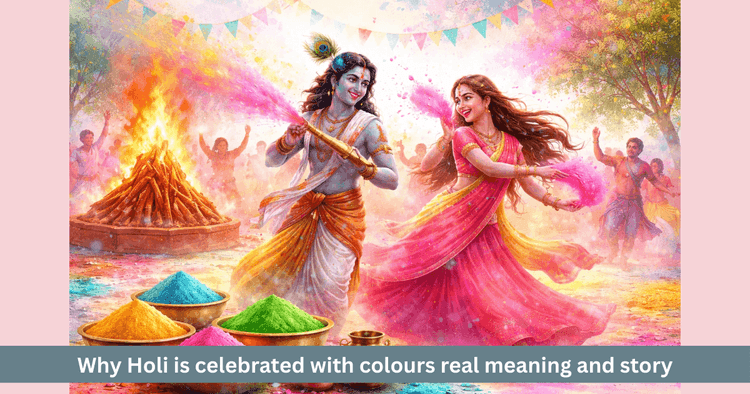
Table of Contents
Every year, when the colours of spring rise like clouds of gulal in the sky, a quiet question appears in many hearts about why Holi is celebrated specifically with colours. This festival is not limited to fun, water sprays and bright powders. Behind it stand the story of Prahlada and Holika, the play of Krishna and Radha, the change of season and the inner cleansing of the heart. This is why Holi is known as the main festival of colours in India and is now embraced in many other countries as well.
The main time of Holi begins on the Full Moon of Phalguna and continues till the next day’s play of colours. On the first night Holika Dahan is observed as a symbolic offering of negativity into the fire and the next day Rangwali Holi becomes a celebration of joy, love and forgiveness. These two stages indicate that one must first release inner darkness and then fill life with new colours.
What is the real meaning of Holi
The basic meaning of Holi is linked not only with a popular festival but with new beginnings, forgiveness and inner cleansing. This festival arrives between the end of winter and the beginning of spring, when new crops appear in the fields and fresh leaves emerge on trees.
The complete form of Holi can be understood as two connected parts.
| Stage | What happens | Symbolic meaning |
|---|---|---|
| Holika Dahan | Bonfire, circumambulation, prayers | Burning of ego, negative thoughts and fear |
| Rangwali Holi | Colours, water, laughter, togetherness | Love, forgiveness, bonding and renewal of ties |
For one who asks why Holi is celebrated, the answer is not a single event. It is a combined feeling of devotion, love and cleansing of the mind.
The true story of Prahlada and Holika
At the root of Holi stands the well known story of Prahlada and Holika. This legend shows that when pride tries to rise above dharma, it is ultimately defeated.
In ancient times there was an asura king named Hiranyakashipu. Through severe penance he had obtained boons that made ordinary death almost impossible for him. As his power grew, his arrogance also increased. He ordered that all subjects regard him as God and worship only him.
That same Hiranyakashipu had a son named Prahlada, who inwardly was a devotee of Lord Vishnu. He believed that true strength rests not in fear but in truth and devotion. In spite of warnings from his father, Prahlada did not give up the remembrance of Vishnu.
Hiranyakashipu tried many ways to kill him but each attempt failed, as some unseen protection saved Prahlada. Finally he called his sister Holika, who had a boon that protected her from fire or owned a divine garment that shielded her in flames. The plan was that Holika would sit in the fire with Prahlada on her lap.
A great pyre was lit, Holika sat in the midst of the flames, holding Prahlada. The story says that either her boon worked only when she entered the fire alone or the protective garment slipped away in the wind and covered Prahlada. The result was that Holika was burnt to ashes and Prahlada emerged safely from the fire.
This event is regarded as the origin of Holika Dahan. It clearly conveys that the celebration of Holi is linked with the victory of good over harmful tendencies, the protection of devotion and the burning of pride.
Why is Rangwali Holi celebrated after Holika Dahan
It is natural to ask why the main play of colours takes place on the day after Holika Dahan. The answer lies in the depth of Holi.
Holika Dahan symbolises a time when one offers to the fire his or her
ego,
hatred,
deceit,
fear
and similar burdens of the heart.
Once this inner burning has taken place, the next day’s Rangwali Holi demonstrates that the mind has become lighter. Now there is space for love, joy and belonging. For this reason it is said that first comes the burning of negativity and then the acceptance of positivity soaked in colour. This sequence is at the heart of Holi.
The story of Krishna and the tradition of colours
Another beloved source of the colour tradition in Holi is the play of Krishna and Radha.
The legend tells that in childhood Krishna had a dark complexion, whereas Radha had a fair complexion. Sometimes a question would arise in Krishna’s mind whether someone as fair as Radha would show equal affection to one of dark complexion. His mother Yashoda gently suggested that if this bothered him, he could apply colour on Radha’s face and then there would be no difference.
Krishna did exactly that. In this playful act he applied colour on Radha and with that, a sweet form of Rangwali Holi is believed to have begun. This story carries the message that through colours, differences such as fair and dark, high and low, caste and status step back for a while. Radha Krishna Holi becomes a symbol of love, equality and affection.
This is why, when people ask why Holi is celebrated with colours, the underlying feeling is often that love does not need colour, yet colours make the celebration of love more natural and free.
Why is Holi called the festival of colours
Holi is called the festival of colours because colours represent life itself. Each shade carries a feeling, a mood and an energy.
Some main colours can be understood in this way.
| Colour | Indicated meaning |
|---|---|
| Red | Love, enthusiasm, life force |
| Yellow | Turmeric, good fortune, health |
| Green | New beginnings, growth, hope |
| Blue | Divine energy, depth and steadiness |
| Pink | Joy, sweetness and harmony |
When these colours are applied on one another during Holi, it is not just an outer game. It becomes a sign that life needs all these qualities. Holi colours seem to remind the mind that it should maintain shades of love, health, hope and joy within as well.
Why do people throw colours on Holi
Throwing gulal, splashing colours on one another and sharing light hearted teasing have become identifiers of Holi. There is a deep social message behind this.
On the day of Holi, distinctions of
age,
wealth,
position and status
tend to soften for a while.
When someone places colour on another person’s face, it silently suggests that old bitterness and conflicts can now be left behind in favour of forgiveness and closeness. Faces become hard to recognise beneath layers of colour, so one recognises others more by their heart and behaviour than by outer appearance. This is why Holi is regarded as one of the most inclusive and open hearted festivals.
What is the spiritual meaning of Holi colours
The colours of Holi are not only symbols of laughter, they are linked with the journey of the soul as well.
During Holika Dahan the message is
Leave pride behind and offer anger and resentment into the fire.
During Rangwali Holi the message is
Accept new beginnings, return to joy and embrace life.
In spiritual thought colours are sometimes connected with inner centres and emotional energies. From this angle, Holi can be seen as a practice where inner negativity is released and replaced with gratitude and cheerful acceptance.
How do Holi traditions vary across India
In different regions of India, the form of Holi changes slightly because of devotion, folk songs and local customs.
- In Mathura and Vrindavan, Holi is celebrated with devotional songs of Krishna and festive processions.
- In Barsana, the famous Lathmar Holi is observed, in which women playfully strike men with sticks in an atmosphere of humour and affection.
- In parts of Punjab, Hola Mohalla is observed with displays of courage, physical discipline and group events.
- In West Bengal, Dol Yatra is celebrated with processions of Radha and Krishna and the gentle use of coloured powders.
Ancient Sanskrit texts also mention spring festivals and use of colours. Traditionally, colours were prepared from flowers and medicinal plants, which were considered friendly to both the body and the environment.
Why is Holi important in religion and daily life
The importance of Holi goes beyond its role as a social festival. It reaches into religion, ethics and daily living.
- The story of Prahlada presents an ideal of devotion and unshaken faith.
- The play of Radha and Krishna points towards divine love and equality.
- At the time of seasonal change Holi is linked with the welcome of harvest and new growth.
- In the language of dharma, Holi stands as a symbol of dharma overcoming adharma.
Thus Holi invites each person to look at life and ask in which aspects there is a pull towards injustice or imbalance and how they can return to truth, fairness and compassion.
Why are water and colours used together in Holi
In many places Holi is celebrated not only with dry powders but also with coloured water. This has both a social and a practical angle.
Traditionally, at the beginning of warmer days the body needs a bit of cooling. The touch of light coloured water combined with the warmth of the sun gives a balanced sensation to the body.
Symbolically
water represents purity and cleansing,
colours represent expression of emotions.
Together they create a celebration where laughter is joined by the melting of inner barriers.
What does Rangwali Holi signify
Rangwali Holi, often considered the main day, comes after Holika Dahan and represents a stage where
- joy follows purification,
- unity follows the fall of ego,
- and celebration follows inner cleansing.
This day is not only for enjoyment. It shows that a step has been taken in the inner journey. For such a person, adopting forgiveness, dialogue and love becomes a little easier.
Simple Holi story for students
To explain Holi to children and students, the story is often given in a simple form.
Long ago, there was a boy named Prahlada who always did good and trusted God. His father Hiranyakashipu was cruel and wanted everyone to consider him as God. He tried many ways to harm Prahlada but the boy was protected each time. His sister Holika decided to sit in a blazing fire with Prahlada on her lap so that he would burn. Instead, Holika herself was burnt and Prahlada remained safe. To remember this, people light a bonfire one night and play with colours the next day, so that all may remember that goodness wins in the end.
Holi’s message in the present time
In the present age Holi is as meaningful as it was in earlier times.
- It teaches that holding on to old conflicts makes the mind heavy, so it is better to forgive and move forward.
- It encourages the welcoming of diversity and the ability to meet people from different backgrounds with ease.
- It offers an opportunity to refresh relationships with family, friends and society.
- It reminds that joy arises not only from outer events but also from the attitude of the mind.
When someone asks, why is Holi celebrated with colours, the answer that emerges is that colours symbolise life, love, equality and new beginnings. From the story of Prahlada and Holika to the play of Krishna and Radha, Holi brings together devotion, affection and celebration on one shared ground.
Common questions about Holi and colours
Why is Holi celebrated with colours
Holi is celebrated with colours because they symbolise life, love and new beginnings. The story of Prahlada and Holika conveys the burning of harmful tendencies and the story of Krishna and Radha connects colours with love and equality. Together they show that after negativity is removed, life can be filled with colour.
Why is Holi called the festival of colours
Holi is called the festival of colours because people express love, forgiveness and closeness through gulal and coloured powders. Red, yellow, green and other shades indicate health, enthusiasm and fresh starts, so the festival uses the language of colour to express the feelings of life.
What is the significance of Holika Dahan
Holika Dahan is performed in remembrance of the story of Prahlada and Holika. It symbolises the burning of pride, anger and negative tendencies. As wood and dry objects are offered to the flames, one also holds the intention that inner negativity should come to an end.
What do Holi colours symbolise
Holi colours symbolise different qualities. Red stands for life force and love, yellow for turmeric and good fortune, green for new beginnings and hope, blue for divine energy and depth. Applying these shades on one another expresses a wish to fill each other’s lives with positive qualities.
Why do we celebrate Holi in India
In India Holi is celebrated because it brings together the devotion of Prahlada, the burning of negativity through Holika Dahan, the love of Krishna and Radha and the arrival of spring. This festival binds religion, culture, family and society into one thread and reminds people that in the end goodness, love and truth remain.
Get your accurate Kundali
Generate KundaliDid you like it?
Author

Pt. Abhishek Sharma (63)
Experience: 20
Consults About: Family Planning, Career
Clients In: Punjab, Haryana, Delhi
Share this article with friends and family
About ZODIAQ
ZODIAQ is an online Vedic Astrology platform. It connects clients seeking astrological advice to experienced astrologers with deep knowledge. Our users also generate kundali and perform kundali milan for free. ZODIAQ also offers services to the Astrologers. Astrologers utilize various offerings by ZODIAQ to serve their clients effectively.
If you are a User
Consult with experienced astrologers and seek their guidance. You can also order handwritten Janm Patrika report with life prediction prepared by experienced astrologers. Generate accurate Kundali, perform Kundali Matching and check horoscope and muhurat. Utilize our online library for all the necessary astrological and spiritual information.
If you are an Astrologer
Create accurate kundali for your clients and perform Kundali Matching for up to 5 people at a time. Write comprehensive Janm Patrika report for your clients with ZODIAQ. Check client details anytime by saving it in client directory. Become more productive by tracking how many clients you guide every day.
WELCOME TO
ZODIAQ
Right Decisions at the right time with ZODIAQ
