Cultural, Spiritual, and Social Significance of Holi
By Pt. Narendra Sharma
Holi is not just about colors, but a message of new beginnings, forgiveness, and inner cleansing
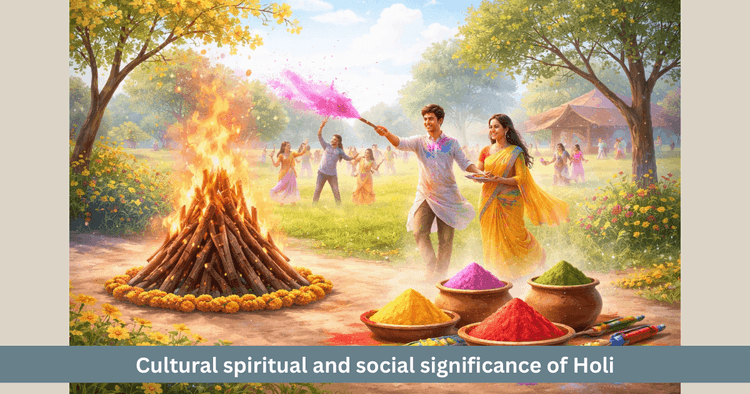
Table of Contents
Whenever Holi is mentioned, the first image that appears in the mind is that of colours, laughter and moments spent with friends and family. Outwardly it looks like a simple play of colours, yet inwardly Holi is a deep celebration of seasonal change, karma, dharma and inner transformation. On the Full Moon of Phalguna, when the moon shines in its fullness, Holika Dahan is performed at night and the next day Rangwali Holi is celebrated with great joy. Between these two days lies the complete cultural, spiritual and social meaning of Holi.
On the day of Phalguna Full Moon the season is moving from winter towards the welcome of spring. Crops are ripening in the fields, new leaves appear on trees and a fresh energy begins to shape the atmosphere. Holi arrives with this energy and carries a message of new beginnings, forgiveness and inner cleansing for the human heart.
What is the cultural meaning of Holi
In the cultural structure of India, Holi is not just a festival. It is a living celebration of folk life and tradition. This festival is observed in different ways from north to south and east to west, yet its fundamental feeling remains the same.
In the region of Braj, Holi is celebrated in remembrance of the playful pastimes of Radha and Krishna. In some places people play Holi with flowers, in some with the famous Lathmar Holi filled with humour and joy. In Rajasthan royal families celebrate with grandeur and elegance. In Bengal, Holi takes the form of Dol Jatra, a gentle and devotional festival.
Holi is not only a festival of colours. It is
a welcome to the harvest and spring,
an opportunity to wash away bitterness in relationships,
and an invitation to sit and play together beyond social divisions.
On this day, walls of caste, age and status soften for a while. People meet one another, apply colours, embrace, laugh and experience that the human being within is the same everywhere.
Why is the spiritual significance of Holi special
The spiritual side of Holi becomes deeper when joined with the story of Prahlada and Holika. This is not only an old tale, it is a living message of the ongoing interplay between dharma and adharma.
According to the story, the asura king Hiranyakashipu obtained such boons through intense penance that normal forms of death were no longer a threat to him. With power came arrogance and oppression. He declared that in his kingdom only he must be worshipped and no one should take the names of the gods.
His son Prahlada held in his heart only Bhagavan Vishnu as his Lord. He did not place his father’s command above dharma. Hiranyakashipu subjected him to many forms of suffering, yet every time Prahlada was saved by his faith and devotion.
Finally, when Holika took Prahlada on her lap and entered the fire, the boon’s effect shifted in his favour. Holika was burnt and Prahlada survived. From this incident the tradition of Holika Dahan began.
Spiritually, this event teaches that
- arrogance and oppression have a certain end
- devotion and innocence receive protection
- fire, when used for a harmful purpose, destroys the very one who misuses it
The fire of Holika Dahan can be seen as the inner fire that burns ego, fear, jealousy and anger. When a person stands before this fire with the feeling that inner negativity should also slowly dissolve, the spiritual essence of Holi truly awakens.
Why is the social significance of Holi increasing
Amid growing busyness, distance and tension in society, Holi has become an important means of social unity.
The practice of applying colour is not merely a playful act. It is a gentle way to melt the ice that may have formed in relationships. By placing a little colour on another’s forehead or cheek, one silently suggests that old complaints may now be left behind.
- Within families this is a chance to breathe life into relationships that may have become formal
- Among friends it offers a moment to soften misunderstandings through conversation and laughter
- At the level of neighbourhood and community it allows people to recognise one another and reduce distance
On Holi, even strangers often greet each other warmly. This reminds us that warmth and belonging are still alive in society and they simply need occasions like this to awaken.
What do Holi colours symbolise
Holi is called the festival of colours because each colour carries a specific emotion and energy.
| Colour | Indicated feeling and meaning |
|---|---|
| Red | Love, enthusiasm, life force |
| Yellow | Turmeric, good fortune, health |
| Green | New beginnings, balance, growth |
| Blue | Divine power, depth, trust |
| Pink | Sweetness, softness, friendship |
When these colours are applied to one another, it is not mere decoration. It symbolises that life needs all these qualities. The blending of colours also conveys that people of different temperaments can create a beautiful harmony, just as varied shades together form a beautiful painting.
Holika Dahan and the symbolic meaning of fire
On the Full Moon night of Phalguna, when bonfires are lit in streets and courtyards, it is more than just a reminder of Holika. This fire symbolises purification and transformation.
People go around the fire, praying silently that
- the errors, faults and negative feelings of the past year may end here
- they may receive inspiration to live with greater discipline, balance and awareness in the coming time
Fire consumes what is dry, old and no longer useful. In the same way the ritual of Holika Dahan suggests that we must gather the courage to leave behind thoughts, relationships or habits that do not allow us to grow. Only then can a new perspective on life sprout like a fresh plant.
Why does Holi bring psychological relief
After winter both body and mind often experience sluggishness and heaviness. Short days and low energy seem to reflect inside as well. Holi is a celebration that breaks this state.
Colours, music, dancing and the company of friends signal to the mind that it is time
- to set aside old worries for a while
- to laugh freely and speak openly
- to release inner tightness and become more natural
In the pressure of routine life, the mind receives a day when it does not have to hold a specific role or mask. Psychologically, Holi acts like a reset button which refreshes emotional energy.
How can Holi be made more meaningful today
In modern life the value of Holi can increase if it is not limited to noise and display.
A few simple steps can deepen its meaning.
- During Holika Dahan, recognising at least one personal fault and resolving to work on it
- Talking with those with whom there has been conflict, either before or after Holi
- Choosing colours that are gentle on both body and environment
- Maintaining dignity in jokes and behaviour so that no one’s self respect is hurt
When Holi is celebrated with this awareness, it becomes clear that the festival holds not only outer colours but also the power to change the colours of our outlook.
Holi’s message for balance in life
Ultimately Holi reminds us that
- light follows darkness
- love can return even after conflict
- trees grow new leaves even after losing the old ones
Through Holika Dahan, the feeling of burning inner negativity is awakened. Through the colours of Rangwali Holi, the welcome of joy, togetherness and new beginnings is expressed. For anyone who views Holi in this way, the festival becomes more than a single day of enjoyment. It turns into a guide for the entire year.
Common questions about Holi’s significance
Why is Holi considered so important culturally
Holi is considered culturally important because it is celebrated across India in different forms yet holds a shared feeling at its core. Traditions of Braj, Rajasthan and Bengal connect Holi with folk songs, dance and devotion, making the festival deeply rooted in culture.
What does Holi teach from a spiritual perspective
From a spiritual perspective Holi teaches that arrogance and adharma come to an end and that devotion and truth are protected. Holika Dahan inspires people to recognise and release inner faults, while Rangwali Holi offers a chance to embrace love and forgiveness.
What is Holi’s contribution at the social level
At the social level Holi brings people closer, reduces distance in relationships and strengthens the sense of community. The simple act of applying colour opens the way for forgiveness, conversation and fresh beginnings, making the social fabric more connected.
What is the symbolic meaning of the Holika Dahan fire
The Holika Dahan fire symbolises the burning of negativity, ego and injustice. It suggests that just as dry wood is turned to ash, inner faults can also gradually disappear if a person is willing to let them go, making space for new energy.
How can Holi be celebrated in a balanced and meaningful way
To celebrate Holi in a balanced and meaningful way, it is important to combine joy with restraint. Using safe and gentle colours, respecting others’ comfort before applying colour, avoiding excessive noise and aggressive jokes and standing quietly in prayer during Holika Dahan all help make the festival more sacred and life giving.
Get your accurate Kundali
Generate KundaliDid you like it?
Author

Pt. Narendra Sharma (63)
Experience: 20
Consults About: Family Planning, Career
Clients In: Punjab, Haryana, Delhi
Share this article with friends and family
About ZODIAQ
ZODIAQ is an online Vedic Astrology platform. It connects clients seeking astrological advice to experienced astrologers with deep knowledge. Our users also generate kundali and perform kundali milan for free. ZODIAQ also offers services to the Astrologers. Astrologers utilize various offerings by ZODIAQ to serve their clients effectively.
If you are a User
Consult with experienced astrologers and seek their guidance. You can also order handwritten Janm Patrika report with life prediction prepared by experienced astrologers. Generate accurate Kundali, perform Kundali Matching and check horoscope and muhurat. Utilize our online library for all the necessary astrological and spiritual information.
If you are an Astrologer
Create accurate kundali for your clients and perform Kundali Matching for up to 5 people at a time. Write comprehensive Janm Patrika report for your clients with ZODIAQ. Check client details anytime by saving it in client directory. Become more productive by tracking how many clients you guide every day.
WELCOME TO
ZODIAQ
Right Decisions at the right time with ZODIAQ
