History of Holi and Legends of Holika Dahan
By Pt. Nilesh Sharma
Spiritual and Cultural Significance of Holi Festival
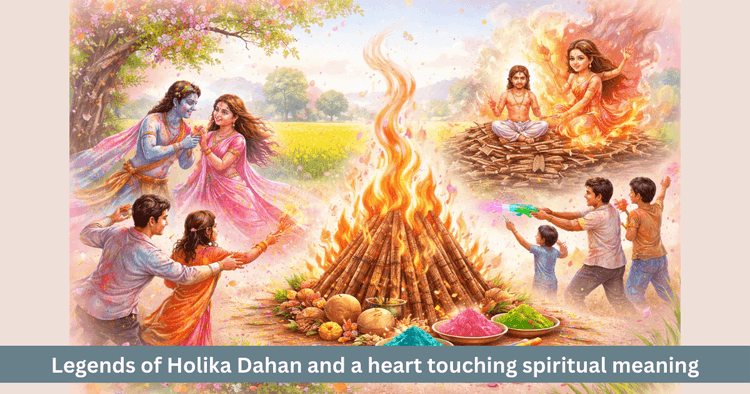
Table of Contents
In Indian culture Holi is that festival where fire is lit, colours fly through the air and hearts feel lighter on the same occasion. Falling on the Full Moon of Phalguna, this date marks the end of winter and the welcome of spring. On the first evening people perform Holika Dahan and on the next day from morning until midday they celebrate Rangwali Holi with colours. Outwardly it looks like a day of pure festivity, yet inwardly it can become an opportunity for the soul to drop old burdens and begin afresh.
The Holi of Phalguna Purnima is associated with several sacred legends, folk tales and regional traditions. In some stories it recalls the unshaken devotion of Prahlada, in others the loving play of Radha and Krishna, in another the burning of Kamadeva that hints at the transformation of desire and in yet another the tale of demoness Dhundhi that highlights the strength of children’s laughter. Alongside these, farmers stand near the Holika fire with their new harvest, expressing gratitude to nature for another cycle of grain.
When and how is Holi celebrated
Astrologically the time of Holi is linked to Shukla Purnima of Phalguna. Two main observances are connected with this day.
- In the evening neighbourhoods and villages light the fire of Holika Dahan.
- The next morning faces bloom with gulal, abir and gentle natural colours and the atmosphere of Rangwali Holi continues until around midday.
In most regions the auspicious muhurta for Holika Dahan is chosen carefully with the help of the local panchanga so that the lighting of the fire takes place under the favourable influence of the Full Moon. People bathe, wear clean clothes and go with their families to the Holika site, where they walk around the fire and offer their quiet prayers.
Prahlada and Holika, the deepest foundation of Holi
The root legend of Holi begins with Prahlada, Holika and Hiranyakashipu. The asura king Hiranyakashipu had gained powerful boons through intense austerity, which made him feel almost invincible. His pride grew to such an extent that he declared that everyone in his kingdom should worship him as God. His young son Prahlada remained devoted to Lord Vishnu and refused to obey this unrighteous command.
Blinded by anger, Hiranyakashipu tried many times to kill Prahlada. He had him thrown from a high mountain, given poison and even attempted to have him trampled by elephants. Each time Prahlada survived through the grace of Lord Vishnu. Finally he called upon his sister Holika, who had received a boon that fire would not burn her. Their plan was that she would sit on a blazing pyre holding Prahlada in her lap so that the boy would be consumed by the flames.
Holika sat with Prahlada on the burning wood. Prahlada’s eyes were closed, his lips were softly repeating the name of Vishnu and there was not a trace of fear in his mind. The fire rose higher, yet in a short while the scene completely changed. Holika was burnt to ashes and Prahlada emerged unharmed from the flames. A subtle detail often mentioned in traditional explanations is that Holika’s boon protected her only when she entered the fire alone, not when she misused it to harm a devotee.
This episode forms the core symbol of Holika Dahan. In it arrogance, oppression and adharma are burnt, while devotion, truth and innocent faith remain untouched. On the night of Holi, as the fire rises, many seekers silently pray that the Hiranyakashipu like pride hidden within their own hearts may also gradually be reduced to ashes.
The Holi of Braj, a colourful story of Radha and Krishna
In the lanes of Braj, Holi does not feel like just a festival. It becomes a living play of Radha and Krishna. The story says that the dark complexioned Krishna once wondered whether fair complexioned Radha would accept him. With a shy heart he shared this thought with his mother Yashoda. Yashoda smiled and gave a simple answer that if Krishna wished, he could apply colour on Radha’s cheeks and then she would appear coloured like him.
Taking this playful suggestion, Krishna coloured Radha’s face and sprinkled abir on her companions as well. People of Braj saw that moment as a sign of loving acceptance. Slowly this small act grew into a rich tradition of Phag songs, dance, teasing exchanges and showers of colours. Even today in Barsana, Nandgaon, Vrindavan and Mathura the mood can be felt that colours are not only for fun. They become symbols of love, belonging and a sense of equality. When every face is covered in one another’s colours, lines of caste, status and display soften on their own.
Shiva and Kamadeva, the journey from desire to energy
Another explanation of Holi is linked to the story of Lord Shiva and Kamadeva. After Sati left her body, Shiva turned away from the world and entered deep meditation and samadhi. The gods feared that if Shiva remained so detached, his divine union with Parvati would never take place and the balance of creation would be disturbed.
They requested Kamadeva, the god of love, to awaken Shiva slightly from his absorption with his arrows of desire. In the gentle season of spring, Kamadeva chose his moment and shot his arrow of love at Shiva. Shiva’s meditation was broken, he became intensely angry and opened his third eye. From that blazing eye Kamadeva was burnt to ashes. Later, moved by the sorrow and devotion of Kamadeva’s wife Rati, Shiva restored him again but now in a formless and invisible manner.
Many seekers understand this story to mean that when desire runs wild it burns a person, yet the same power, when guided with wisdom and discipline, can be transformed into spiritual energy. Sitting before the fire of Holika Dahan, many quietly resolve to offer tendencies such as lust, anger, greed and attachment into the flames and to redirect that inner power towards mantra, meditation and service.
Demoness Dhundhi, children’s laughter and the end of negativity
In some regions a charming folk story about demoness Dhundhi is linked with Holi. It is said that Dhundhi used to trouble children and fill the village atmosphere with fear. She had received boons that made her difficult to defeat through normal weapons or force, yet she had one weakness that she could not tolerate the fearless laughter, loud shouting and playful mischief of children.
When the elders of the village understood this, they encouraged the children to gather on Holi and sing, shout and make noise together. Children formed groups, moved through the streets, beat metal plates and sang songs. Dhundhi, disturbed by this joyful sound, fled from the village. Even today the playful noise of children, the rhythm of drums and the songs of Phag during Holi are seen as symbols that drive away negative influences and lighten the collective mood.
Is Holi only a festival of colours or also a harvest celebration
Holi is connected not only with stories but also with the farmer’s field and grain. By the end of Phalguna the rabi crops ripen. Wheat, barley and chickpea fields sway with full ears. For the farmer this is a time of relief, gratitude and the beginning of a new economic year.
In many villages there is a custom that on the evening of Holika Dahan the farmer brings some fresh ears of wheat or barley from his field. He roasts them near the Holika fire and shares them as prasad with his family. In some places chickpeas or corn are also roasted and distributed. This simple ritual says that the struggles, anxieties and fatigue of the past year are being left behind in the fire and the new harvest, new income and new hopes are being welcomed. Holi thus becomes a festival of gratitude for crops and a wish for prosperity.
The deeper meaning of Holika Dahan
Holika Dahan is not only the burning of wood. It is a collective resolve and an act of inner cleansing. In an open space of the locality people gather wood, dry branches, leaves and cow dung cakes. At the chosen auspicious time the fire is lit. People walk around the flames, some stretching out their hands towards the fire and mentally offering their burdens to it.
The meaning of Holika Dahan can be seen on three levels.
- It shows the victory of dharma over adharma.
- It affirms faith over fear.
- It symbolises purification over negativity and bitterness.
In many households a simple practice is followed. A few grains of wheat or barley, some chickpeas or a piece of old dry wood are offered to the fire with the inner thought that illnesses, quarrels and heaviness in the family may also become lighter. The gesture is small, yet the feeling behind it brings comfort.
The spiritual message of Holi colours
When colours are thrown into the air, it seems from the outside like mere play but the message hidden inside is gentle and deep. Colours paint a picture of both diversity and unity among human beings. When people of different caste, age and background get covered in one another’s colours, outer labels become less visible and inner closeness becomes easier to feel.
Colours can be understood in this way. Colours express joy, acceptance and openness. The fire of Holika encourages the burning of faults and the courage to begin anew. The spring season, with its fresh leaves, flowers and fragrance, announces renewal and rebirth in life. Through all these elements devotion and faith act as threads that tie every story together. When someone plays Holi gently, with respect and a light heart, that person is in fact living this spiritual message, even while laughing and colouring others.
Different forms of Holi across India
In different parts of India Holi takes many distinct forms, though the inner essence remains the same.
- In Barsana’s Lathmar Holi women playfully strike men with symbolic sticks while men defend themselves with shields. People see in this the echo of Radha’s mock anger and Krishna’s playful teasing.
- In Vrindavan Phoolon ki Holi is celebrated, especially in temples, where flowers such as rose and marigold are showered on devotees instead of coloured powders.
- In some cities of Rajasthan Royal Holi is observed with processions, traditional dress, palace decorations and classical music.
- In Bengal Holi appears as Dol Jatra or Dol Yatra, where the deities of Radha and Krishna are placed on a beautifully decorated swing and taken out in procession with kirtan, dance and colours.
The forms differ, yet everywhere the message is that Holi is a celebration of love, enthusiasm and the victory of dharma.
Key points of Holi in a table
| Topic | Details |
|---|---|
| Time of celebration | Phalguna Shukla Purnima, Holika Dahan first evening, colours next day |
| Main mythological basis | Prahlada, Holika and Hiranyakashipu, protection of Prahlada, burning of Holika |
| Love and playful aspect | Radha Krishna in Braj, message of love and acceptance through colours |
| From desire to sadhana | Story of Shiva and Kamadeva, burning of desire and rise of spiritual energy |
| Folk tale | Demoness Dhundhi driven away by children’s laughter and noise |
| Harvest connection | New rabi harvest, roasted ears as prasad, release from last year’s fatigue |
| Meaning of Holika Dahan | Burning of pride, fear and adharma, triumph of faith and devotion |
| Spiritual sense of colours | Unity in diversity, open heart, reconciliation and forgiveness in relationships |
| Regional forms | Lathmar Holi, Phoolon ki Holi, Royal Holi, Dol Jatra and others |
How Holi guides a seeker’s life
Holi is not only a date on the calendar, it is a gentle message to life. It suggests that each year there comes a chance to pause and notice how much bitterness, fear and tiredness has gathered within over the last twelve months. Sitting before the fire of Holika, if a person honestly recognises these and mentally offers them to the flames, a sense of lightness naturally arises.
Through the play of colours distances in relationships can be reduced. Many choose Holi as the day to let go of old grievances, embrace each other and say without words that the story from here will be new. The story of Prahlada teaches steadfast faith, the play of Radha and Krishna teaches the tenderness of love and the episode of Shiva and Kamadeva gives direction towards discipline and transformation. For a seeker who reads these stories not as mere tales but as guiding signs, Holi can become an occasion for new resolutions, a fresh vision and inner cleansing.
Common questions about Holi and Holika Dahan
What inner attitude is most appropriate during Holika Dahan
It is helpful to hold the thought that pride, anger, jealousy, harmful habits, unnecessary fears and household disputes are being offered to the fire. Along with this offering one may pray that peace, health and harmony grow in the family and in society as the new season begins.
How can the spiritual feeling of Holi be preserved while playing with colours
One can remember that colours are meant to express love, acceptance and equality, not to trouble or insult anyone. Seeking consent before applying colour, respecting the other person’s comfort and health and playing gently keeps Holi aligned with its true spiritual intent.
Is it suitable to put grain or old items into the Holika fire
Many families place a few ears of wheat or barley, some chickpeas or dry twigs into the Holika fire. This practice is fine as long as the materials do not cause undue harm to the environment. The purpose is to symbolically leave behind fatigue, scarcity and mental burdens and to welcome the new period with a lighter heart.
How can Holi stories be explained simply to children
Children can be told the story of Prahlada in simple language, highlighting that love for God, truth and good actions protect a person in the long run. Through the Holi of Radha and Krishna they can also be guided to value friendship, share their joy, include others and avoid forcing colours on anyone.
What practical form can Holi take for a spiritual seeker
A seeker may choose to spend some quiet time on Holika Dahan day in self reflection, honestly listing inner weaknesses and resolving to rise above them. On Phalguna Purnima one can take a mindful bath, perform some mantra japa, share food or clothing with someone in need and participate in colours in a limited, respectful and loving way so that the festival becomes a support for inner awakening rather than only an outer celebration.
Get your accurate Kundali
Generate KundaliDid you like it?
Author

Pt. Nilesh Sharma (63)
Experience: 20
Consults About: Family Planning, Career
Clients In: Punjab, Haryana, Delhi
Share this article with friends and family
About ZODIAQ
ZODIAQ is an online Vedic Astrology platform. It connects clients seeking astrological advice to experienced astrologers with deep knowledge. Our users also generate kundali and perform kundali milan for free. ZODIAQ also offers services to the Astrologers. Astrologers utilize various offerings by ZODIAQ to serve their clients effectively.
If you are a User
Consult with experienced astrologers and seek their guidance. You can also order handwritten Janm Patrika report with life prediction prepared by experienced astrologers. Generate accurate Kundali, perform Kundali Matching and check horoscope and muhurat. Utilize our online library for all the necessary astrological and spiritual information.
If you are an Astrologer
Create accurate kundali for your clients and perform Kundali Matching for up to 5 people at a time. Write comprehensive Janm Patrika report for your clients with ZODIAQ. Check client details anytime by saving it in client directory. Become more productive by tracking how many clients you guide every day.
WELCOME TO
ZODIAQ
Right Decisions at the right time with ZODIAQ
