Holi: The Story of Holika and Prahlada and Their Deeper Meaning
By Pt. Sanjeev Sharma
Not just a festival of colors, Holi symbolizes victory of goodness and the power of devotion
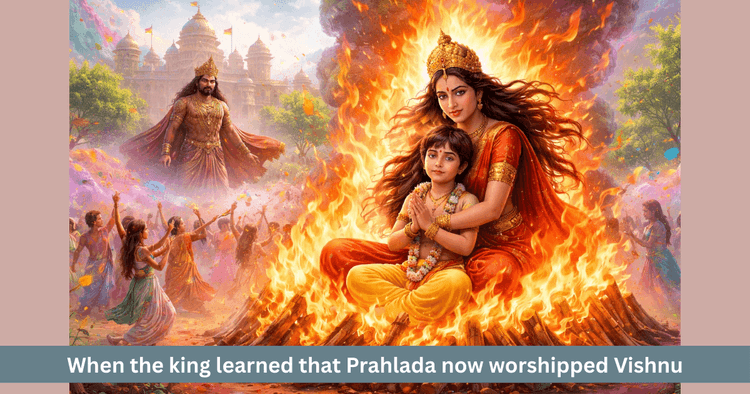
Table of Contents
In the Indian tradition Holi is not seen as just a festival of colours. It is regarded as a symbol of the victory of goodness, the strength of devotion and the burning away of arrogance. On the night of Phalguna Purnima people observe Holika Dahan and the next day they celebrate Holi with colours. In the flames of Holika Dahan people are not merely burning wood. With a quiet intention they offer their inner fears, anger and pride to the fire.
The most popular and inspiring story behind Holi is the legend of Holika and Prahlada. This is not a distant fairy tale. It is a reminder that no matter how imposing power, authority and oppression may appear, in the end it is devotion, truth and compassion that truly endure.
The king, his pride and the gentle devotion of Prahlada
Long ago in the land of India there ruled a powerful king. Outwardly he was strong, yet inwardly he was proud, selfish and cruel. He ordered his subjects to obey him in every way, even proclaimed himself to be God and demanded that people worship him alone.
In the same palace a son was born to him whose heart was completely different from that of his father. The child was named Prahlada. Where the king’s nature was harsh, the nature of Prahlada was naturally kind and tender. At first he too believed that his father was like a god, because that was what he had been taught from childhood. But one small incident changed the direction of his life.
Prahlada and the woman who prayed to Lord Vishnu
One day Prahlada left the palace and walked along the fields and narrow pathways around the village. In the distance he saw a woman who was kneeling on the ground, hands folded and head bowed, praying with deep feeling. On her lips were the words,
“He Bhagavan Vishnu, who removes fear, I surrender at your feet.”
Prahlada felt anger arise. He had been taught that his father was God. He asked sternly why she was praying to some Lord Vishnu when everyone knew that the king was the true god.
The woman lifted her face. Tears shone in her eyes but along with the tears there was trust. She explained that her tiny kittens had fallen into the well and that she was helpless, so she called out to Lord Vishnu to protect them.
Just then a soft meow came from the well. Prahlada looked inside and saw a little paw clinging to the edge. The woman went gently to the well, bent down and lifted the kitten out, placing it safely on the ground. A moment later another meow was heard, then another. One by one all the kittens crawled up and out of the well and gathered around their mother.
The woman fell to her knees with joy and said that her prayer had been answered. As Prahlada walked back home he went deep into thought. If his father were truly God then why had this prayer reached someone else. Slowly a new understanding arose within him that the real God is the one who hears prayer and removes fear. From that day his heart turned towards Lord Vishnu.
When the king learned that Prahlada now worshipped Vishnu
When the king came to know that his son had stopped worshipping him and had become a devotee of Lord Vishnu, his anger knew no bounds. For him this was not just disobedience. It struck directly at his pride. He declared that Prahlada must be punished so severely that no other child would dare to disobey the king.
He summoned his guards and ordered them to take Prahlada and throw him from the highest mountain cliff in the land. The guards, bound to obey, carried Prahlada up the steep rock and pushed him over the edge. As he fell, Prahlada kept repeating only one name, Lord Vishnu. It seemed as if an unseen hand held him. His fall became gentle and he reached the ground unharmed, without even a scratch.
When the king heard that Prahlada had survived, he could not believe it. He devised a second test. This time he ordered that Prahlada be thrown into a pit full of snakes.
Snakes, elephants and the repeated protection of Prahlada
The guards brought Prahlada to a deep snake pit. Looking inside, one could see hundreds of coiled serpents. Their bodies were thick and strong, a frightening sight for any ordinary person. For Prahlada there was just one support, the name of Vishnu. He was pushed into the pit.
The snakes slithered around him, their bodies curling near his feet and shoulders. They hissed, yet not one of them bit him. It was as if an invisible command had restrained their poison. After some time Prahlada was brought out again, completely safe.
The king’s anger increased further. He planned a third trial. Now he ordered that Prahlada be placed before a herd of enraged elephants. The elephants were to be provoked and whipped so that they would trample him underfoot.
As soon as the elephants saw Prahlada they raised their trunks and trumpeted. Their steps made the ground shake. Prahlada once more remembered Lord Vishnu within his heart. When the elephants reached him something unexpected happened. They stopped. Their trumpeting softened. They lowered their trunks and gently touched Prahlada, as if they were blessing a beloved child.
Each time Prahlada returned unharmed. For the king this was no longer just anger, it was a humiliation of his false claim of divinity.
The entry of Holika and the plan of fire
That night the king sat with his sister Holika and shared his frustration that all his efforts had failed. Holika too harboured anger towards Prahlada. She wished to see the end of his devotion so that her brother’s power would remain unquestioned. She said that one plan still remained.
Holika possessed a special divine boon. In one version of the story she had been granted protection from fire. In another version she owned a magical cloth or shawl which, when worn, shielded her from flames. Holika proposed that in the morning she would have a huge bonfire built in front of the palace, walk into it herself and challenge Prahlada to follow her.
At first the king was startled but when Holika explained her boon he began to see hope. He became convinced that with this plan Prahlada would finally be destroyed.
The great fire, Holika’s deceit and the protection of Prahlada
In the morning people were called to the open ground before the palace. Holika ordered her servants to gather large quantities of dry wood, grass and cow dung cakes. Soon a huge pile of fuel stood ready. A burning torch was touched to the base. The wood caught quickly and the flames rose high. The heat became so intense that ordinary people could not stand near it.
Holika then called Prahlada and said, come with me. Today we will see who is truly brave. She invited him to walk into the fire after her. For Prahlada this was not just a test of courage. It was the moment of testing his devotion.
Holika stepped into the flames, trusting her boon or the power of her magical cloth. Prahlada followed her with the remembrance of Vishnu in his heart. The gathered crowd watched in deep silence.
The story tells that as the flames rose higher and higher, Lord Vishnu intervened. If Holika had a protective cloth, a gust of wind blew it from her shoulders onto Prahlada. If her immunity was in the form of a boon, then because she misused it to harm an innocent devotee, its power left her and moved to Prahlada. Within moments Holika was engulfed in fire and reduced to ashes, while Prahlada stood amidst the blazing flames, calm and unharmed.
When the fire subsided, there remained only the ashes of Holika, whereas Prahlada stood like a lamp of faith in the middle of the charred ground. It is this moment that people recall when they perform Holika Dahan on the Full Moon night of Phalguna.
How the story of Holika and Prahlada connects with Holi today
When bonfires are lit on the eve of Holi in towns and villages, people are not just burning dry branches. They silently remember that Hiranyakashipu, Holika and Prahlada are not only characters of an old tale. They represent three states within every human heart.
- Hiranyakashipu is the inner pride, the urge to control others and the insistence that one’s own word must always prevail.
- Holika is the inner cunning nature that wishes to use its strength for harming the innocent.
- Prahlada is that tender, sincere and trusting space within which does not abandon faith even under pressure.
Into the fire of Holika Dahan people offer dry twigs, cow dung cakes and sometimes grains, imagining that just as these are turning into ashes, in the same way inner arrogance, anger, bitterness and fear may also slowly melt. The next day, when Holi is played with colours, it can then become a celebration of the inner victory of Prahlada.
Key points of the story of Holika and Prahlada
| Event | Description |
|---|---|
| Nature of the king | Proud, cruel, claimed to be God |
| Turning point for Prahlada | Seeing kittens saved after the woman prayed to Vishnu |
| First trial | Thrown from a high mountain, saved by Vishnu’s grace |
| Second trial | Cast into a pit of snakes, not bitten or harmed |
| Third trial | Placed among enraged elephants, they became gentle |
| Boon of Holika | Protection from fire or a magical fire proof cloth |
| Entering the bonfire | Holika first, Prahlada following her into the flames |
| Final outcome | Holika burnt to ashes, Prahlada safe in the fire |
| Symbolic meaning | Burning of arrogance and deceit, protection of devotion |
What this story of Holi teaches to a seeker
Seen carefully, this story is not just for children. It offers subtle guidance for life. In times when circumstances are harsh and outer injustice seems powerful, the first lesson is to hold on to inner faith like Prahlada, without bending towards what is clearly wrong.
The second lesson is that any form of arrogance, oppression and deceit, even if it appears successful for a while, ultimately leads to destruction, just as in the case of Holika. A third insight is that trust in a higher power is not meant to remain only in words. It needs to be expressed in one’s choices and actions as well.
Even today, if someone spends a few quiet moments around the Holika fire and asks honestly, who is the Hiranyakashipu within, which tendencies are like Holika and where the childlike trust of Prahlada is hiding, then Holi can become much more than a festival of colours. It can turn into a gentle opportunity for self reflection and a renewed beginning.
Common questions about the story of Holika and Prahlada
What is the main message of Holika Dahan in this story
The central message of Holika Dahan is that arrogance, cruelty and deceit are ultimately destroyed, while genuine devotion, truth and innocence are protected. The bonfire symbolically shows that although evil may seem strong for some time, it does not last.
How can Prahlada’s devotion be linked to daily life
Prahlada’s devotion means that even when situations are difficult, a person continues to uphold truth and faith instead of yielding to wrongdoing. In practice this means not compromising with injustice and quietly standing by what is right.
What does Holika’s boon teach us
Holika’s boon reminds us that power and special gifts are not wrong by themselves. What matters is their direction. When strength is used to harm an innocent devotee, that very protection fails and shifts to the side of the one who is aligned with dharma.
What inner attitude can a householder keep during Holika Dahan
A householder can stand before the Holika fire with the thought that quarrels, harsh words, bad habits and all tendencies that blocked growth in the past year are being offered to the flames. Along with this, one can pray for a coming year that walks more steadily on the path of truth, like the devotion of Prahlada.
Can the colours of Holi also be connected with this story
Yes, after the fire of Holika Dahan has cooled and the next day is celebrated with colours, it can be seen as the outward celebration of Prahlada’s inner victory. Colours then become a sign that a life earlier overshadowed by fear and oppression can now be filled with the colours of devotion, joy and belonging.
Get your accurate Kundali
Generate KundaliDid you like it?
Author
Pt. Sanjeev Sharma (63)
Experience: 20
Consults About: Family Planning, Career
Clients In: Punjab, Haryana, Delhi
Share this article with friends and family
About ZODIAQ
ZODIAQ is an online Vedic Astrology platform. It connects clients seeking astrological advice to experienced astrologers with deep knowledge. Our users also generate kundali and perform kundali milan for free. ZODIAQ also offers services to the Astrologers. Astrologers utilize various offerings by ZODIAQ to serve their clients effectively.
If you are a User
Consult with experienced astrologers and seek their guidance. You can also order handwritten Janm Patrika report with life prediction prepared by experienced astrologers. Generate accurate Kundali, perform Kundali Matching and check horoscope and muhurat. Utilize our online library for all the necessary astrological and spiritual information.
If you are an Astrologer
Create accurate kundali for your clients and perform Kundali Matching for up to 5 people at a time. Write comprehensive Janm Patrika report for your clients with ZODIAQ. Check client details anytime by saving it in client directory. Become more productive by tracking how many clients you guide every day.
WELCOME TO
ZODIAQ
Right Decisions at the right time with ZODIAQ
