Moral Lessons from Holika Dahan Story
By Pt. Amitabh Sharma
Learn Ethics, Devotion, and Dharma from Holika Dahan
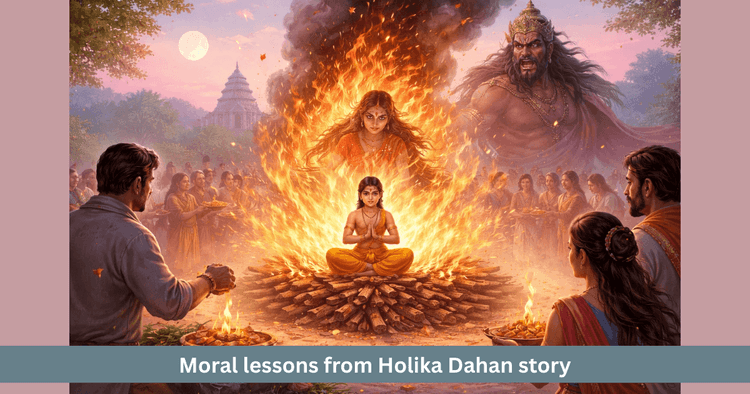
Table of Contents
Holi is generally seen as a festival of colours and joy, yet the event that begins it is Holika Dahan. This is not only a ritual of lighting a fire, it is a symbol of deep ethical, spiritual and karmic messages for human life. On the night of Holika Dahan people gather around the fire, perform circumambulation and prayers and silently awaken the feeling that just as Holika’s wickedness was burnt, their own negative tendencies should also become quiet.
Holika Dahan is observed on the Full Moon night of the month of Phalguna. The next day people celebrate the play of colours but the true beginning is from the bonfire where the story of Prahlada, Holika and Hiranyakashipu is remembered. In this one narrative appear the fall of pride, the victory of devotion, the protection of the innocent and the establishment of dharma. One who thinks of Holi as only a festival of colours can, by understanding these signals within Holika Dahan, find guidance for life.
What does the story of Holika Dahan show
The main story of Holika Dahan is connected with sacred tradition and forms the base of the festival of Holi. It is not just a tale, it is a subtle picture of the meeting of dharma and adharma.
The complete story of Hiranyakashipu, Prahlada and Holika
According to the legend, in ancient times there was an asura king named Hiranyakashipu. Through severe penance he obtained such boons that ordinary death almost became impossible for him. This power planted deep roots of pride and tyranny in his heart. He declared that in his kingdom only he would be worshipped and no one would take the names of the gods.
His son was Prahlada, who from childhood was inclined towards righteousness and truth. Prahlada clearly said that he would worship only Bhagavan Vishnu as his chosen deity. In spite of the anger, threats and punishments of his father, he did not abandon his faith.
Hiranyakashipu made many attempts to kill him. He had him thrown from high peaks, cast among poisonous serpents, surrounded by soldiers and weapons, yet each time an unseen protection saved Prahlada. When all efforts failed, the king called his sister Holika, who possessed a boon that could save her from fire or a divine garment that prevented her from burning in flames.
The plan was to build a great fire. Holika would sit in it with Prahlada on her lap. Because of the boon, she would remain safe while Prahlada would be destroyed. The pyre was prepared, the fire lit and Holika sat in it holding Prahlada.
The story narrates that as the flames rose, the effect of her boon did not stay on her side. If it was a divine cloth, the wind blew it away so that it covered the body of Prahlada. If the boon had the condition that it would work only when used for a righteous purpose, misusing it made it ineffective.
The result was clear. Holika was burnt in the fire and Prahlada remained safe even amidst the flames. This sight became a living symbol of karmic law and the victory of dharma. This same event is remembered today as Holika Dahan, when on the night of Phalguna Full Moon an effigy or symbolic structure of Holika is burnt before Holi.
Life values we learn from Holi and Holika Dahan
The story of Holika Dahan is not only for children. It is guidance for every stage of life. From this one event many important lessons appear in a simple manner.
How does the victory of good over harmful actions appear
The first and strongest message is that good ultimately overcomes harmful forces. Hiranyakashipu and Holika both possessed power, authority and outer strength but their actions were based on adharma and cruelty. Prahlada, on the other hand, had no army and no worldly support. He had only firm faith.
When Prahlada survived the fire and Holika was destroyed, it became clear that actions driven by adharma eventually lead to destruction, even if they appear successful for a while. Standing around the Holika fire people remember that no matter how difficult the situation may be, truth and virtue should not be abandoned.
What is the strength of devotion and faith
The story of Prahlada also teaches the strength of true faith. He was told repeatedly that if he gave up the name of Bhagavan Vishnu and worshipped his father, his life would be spared. Yet he did not change his inner decision.
In every crisis he chose trust instead of fear. When a person sincerely supports dharma and truth, the subtle forces of the universe come forward to protect such a seeker. Prahlada emerging unharmed from the Holika fire indicates that unwavering devotion is stronger than harmful plans.
Why does arrogance lead to destruction
At the root of the fall of both Hiranyakashipu and Holika was arrogance. The king considered himself higher than the gods. He forgot that any power granted to him was still under divine law. Holika regarded her boon as permanent protection and believed that she could never be harmed by fire.
When pride makes one feel above all rules, that very pride becomes the staircase towards downfall. The story of Holika Dahan reminds that no matter how powerful a person becomes, his strength should be used only for dharma and compassion. Otherwise even a boon can turn into a curse.
What is the result of standing firmly on dharma and truth
Prahlada faced pressure from all sides. His father’s commands, the fear of punishment and the authority of the kingdom all stood against him. Many would have compromised in such a situation, yet Prahlada did not leave the path of dharma and truth.
His life shows that when a person stands by what is right even in difficult times, the fruits may not appear immediately but they become very meaningful in the future. In Holika Dahan, Prahlada not only saves his life. He also proves that decisions founded on truth ultimately become a source of welfare.
How are the innocent protected
Prahlada was a child, innocent and simple. Holika used her power with the intention to harm him. Yet she herself was destroyed and he was unharmed. This gives confidence that the innocent, gentle and straightforward heart receives a special form of protection.
This encourages us to maintain simplicity, kindness and fairness in our actions. When a person does not commit injustice towards others, an invisible protection walks with him in some form.
How does Holika Dahan invite us to look within
Holika Dahan is not limited to burning pieces of wood or an effigy. When the fire is lit, it becomes an opportunity to look within honestly and recognise where Hiranyakashipu and Holika may be hiding inside.
- A need to control others
- Anger and hatred
- Pride in always being right
- A belief that power allows us to do anything
By noticing these tendencies, one can inwardly decide to offer them to the fire. In this way Holika Dahan can become an occasion for a personal resolve to change.
Limits of seeing Holi only as a festival of colours
For many people today Holi means only colours, water and amusement. Joy is important and Holi certainly brings it. Yet if the story of Holika Dahan is forgotten, half the meaning of Holi disappears.
Holika Dahan reminds that Holi is not only a day to colour the faces of others but also a time to clean one’s own character. When a person understands that whatever represents Holika within must be offered to the flames, the play of colours on the next day becomes far more meaningful.
Messages for students and children from Holika Dahan
When explaining Holi and Holika Dahan to children, certain points can help them understand the depth of the story.
1. Never compromise with truth
2. Respect does not come by frightening or hurting others
3. Excessive pride always brings harm
4. Devotion and faith give inner strength
5. Those who are innocent and fair are protected in the long run
Understanding these points, a child can gradually learn that Holi is not only a day to play but also a chance to refine behaviour.
Holika Dahan and value based education
When the story of Holika Dahan is discussed in schools or homes, it can serve as a key part of value based education rather than remaining only a religious tale.
- The example of Prahlada shows children the importance of standing by what is right.
- The example of Holika and Hiranyakashipu shows how misuse of power leads to downfall.
- Circumambulation of the fire indicates that society as a whole resolves not to support adharma.
If families and schools together convey that education is not limited to marks and positions but includes character, discipline and clear thinking, festivals like Holi can enrich the awareness of the next generation.
Conduct to adopt during Holi
By drawing inspiration from Holika Dahan, a few small efforts during Holi can make the festival more pure and balanced.
- Reflect on people with whom there is conflict and, if possible, awaken a feeling of forgiveness.
- Avoid insulting or hurting anyone in the name of colours, because Holi carries a message of joy with respect.
- Maintain moderation in jokes, speech and behaviour so that the day does not become painful for anyone.
In this way Holi can become not only external celebration but also a means of inner growth.
Common questions about Holika Dahan
What is the main teaching of Holika Dahan
The main teaching of Holika Dahan is that pride, injustice and cruelty are eventually destroyed, while devotion, truth and simplicity are protected. The survival of Prahlada and the destruction of Holika express this message repeatedly.
What does the devotion of Prahlada teach us
The devotion of Prahlada shows that when a person maintains faith in God and in truth even in difficulty, it gives deep courage and a sense of protection. His unwavering faith was his real shield in every crisis.
What caused the downfall of Hiranyakashipu and Holika
The root cause of their downfall was arrogance and misuse of power. Hiranyakashipu considered himself greater than the gods and Holika used her boon to harm an innocent child. Because of this both met a painful end.
How can Holika Dahan be linked with personal life
During Holika Dahan one can resolve to gradually let go of anger, hatred, pride and harmful habits. Standing before the fire and consciously deciding to leave these tendencies behind can be very effective.
How can Holi be celebrated in harmony with values
To celebrate Holi with values, it is important to keep respect, kindness and restraint alongside colours. People should not be forced to accept colours, harsh substances should be avoided and the day should be seen as a chance to strengthen relationships with family, friends and society.
Get your accurate Kundali
Generate KundaliDid you like it?
Author
Pt. Amitabh Sharma (56 Years)
Experience: 20
Consults About: Family Planning, Career
Clients In: Punjab, Haryana, Delhi
Share this article with friends and family
About ZODIAQ
ZODIAQ is an online Vedic Astrology platform. It connects clients seeking astrological advice to experienced astrologers with deep knowledge. Our users also generate kundali and perform kundali milan for free. ZODIAQ also offers services to the Astrologers. Astrologers utilize various offerings by ZODIAQ to serve their clients effectively.
If you are a User
Consult with experienced astrologers and seek their guidance. You can also order handwritten Janm Patrika report with life prediction prepared by experienced astrologers. Generate accurate Kundali, perform Kundali Matching and check horoscope and muhurat. Utilize our online library for all the necessary astrological and spiritual information.
If you are an Astrologer
Create accurate kundali for your clients and perform Kundali Matching for up to 5 people at a time. Write comprehensive Janm Patrika report for your clients with ZODIAQ. Check client details anytime by saving it in client directory. Become more productive by tracking how many clients you guide every day.
WELCOME TO
ZODIAQ
Right Decisions at the right time with ZODIAQ
