Bhishma Pitamah’s moral dilemma and the real chances to stop the war
By Pt. Suvrat Sharma
A deep study of Bhishma’s role across vow, institutional loyalty and justice
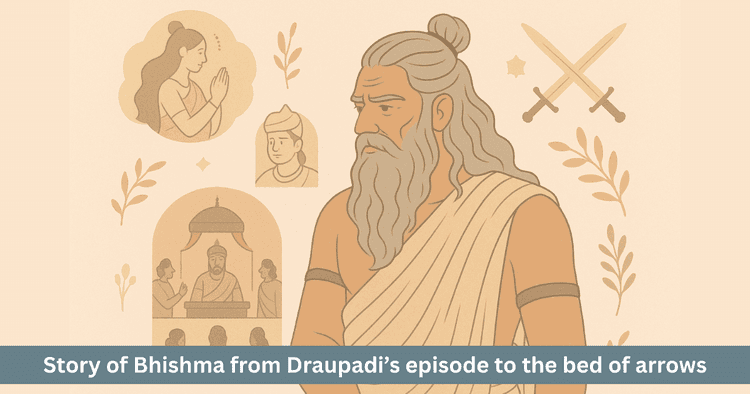
Table of Contents
In the Mahabharata the figure of Bhishma invites reverence and discomfort together. He stands for wisdom, valor and restraint. The same person steps back from decisive moral intervention when injustice rises in the court and on the field. This tension raises a hard question. Did the senior guardian place the essence of dharma below institutional loyalty. Could he have doused the fire of war in time yet remained quiet in the name of vows and order. This extended study places his vow, mental frame, sense of statecraft, courtroom episodes, choices in war, astrological tones and teachings from the Shanti Parva in one frame so that a clear view can emerge.
Why a balanced lens is needed
Bhishma is neither a perfect hero nor a simple offender. He must be seen with human limits and human heights. Lifelong vows gave him austerity. The same hardness limited flexibility in changing times. He had power. He used that power more to save the institution and less to save justice. The difference is not small. The outcome writes the fate of generations.
The vow that turned the course of a life
For Satyavati, Devavrata surrendered the throne and took a vow of lifelong celibacy. This severe promise gave him the name Bhishma and the boon to choose the time of death. The purpose was to prevent a quarrel of succession. The long result turned opposite. The royal house became weak at the center. A vacuum of rule opened space for the ambition of Duryodhana. A vow meant to secure peace became the chain that later kept courage tied.
A perspective table on the vow
| Axis | Immediate gain | Long loss |
|---|---|---|
| Joy of the father | Marriage of Satyavati | Weak chain of succession |
| Politics | Calm in the court | Loose center of power |
| Moral image | Fame of renunciation | Risk of rigidity and stasis |
| Willful death | Gift of restraint | Long witness with remorse |
The episode of the Kashi princesses and the curse of Amba
For the marriage of Vichitravirya, Bhishma brought three princesses from Kashi. The heart of Amba belonged to Shalva. Tradition and protocol could not find a compassionate solution. Amba sought justice from Parashurama. Parashurama and Bhishma fought a fierce duel. The outcome did not change. Amba took penance and in the next birth became Shikhandi. Bhishma took a vow that he would not raise arms against Shikhandi. The same vow became the manner of his fall. The chain shows a truth. An early hard choice can claim a distant moral and strategic price.
The paradox of power, influence and passivity
Bhishma was the strongest warrior. He was the chief guide of policy and order. Respect was so deep that few would speak above a gentle tone before him. Yet when open wrong took place in the court he pointed to formal limits. He held the dignity of the throne as the first duty. Even when the person on the throne fell below the standard of justice. This institution centered view carried outcomes in a wrong direction again and again.
A comparative frame of institution and justice
| Measure | Institution centered | Justice centered |
|---|---|---|
| Loyalty | Guard the throne | Guard dharma and people |
| Choice | Procedure above all | Outcome and compassion above all |
| Risk | Low challenge to order | Open risk of dissent from power |
| Result | Wrong stays covered | Wrong is stopped |
Bhishma during the outrage against Draupadi
After the dice game Draupadi was dragged into the court. She asked a precise question. If Yudhishthira had already lost himself how could he stake his wife. All eyes turned to Bhishma. He spoke about legal doubt and the binding of royal command. The answer showed a technical dilemma. The hour demanded courage for decorum. That courage did not appear. Silence gave wrong a sense of validity and hardened the seed of war.
A detailed table of the decorum test
| Question | If decisive intervention came | If silence remained |
|---|---|---|
| Honor of a woman | Immediate stop, punishment of the guilty | The offense looks lawful in a false way |
| Raj dharma | Clear order, annulment of the game | Tangle of process and confusion |
| Family reconciliation | Space for dialogue | Firm resolve for revenge |
| Flow of history | Path of reform and talk | War and devastation |
The difference between Bhishma and Vidura
Vidura speaks with clarity and fearless tone. Wrong receives a direct challenge. The language of Bhishma is gentle and often unclear. Vidura is a justice centered counsellor. Bhishma is an institution centered guardian. Both carry depth of thought. On the bend of courage they choose different roads.
Mental frame and decision psychology
Comfort zone and status quo bias can freeze a person under pressure. Role becomes identity. Change of identity produces fear. Under layered pressures the mind keeps the present state. Bhishma did the same. The triangle of vow, office and tradition pulled him away from hard courage. He sided with the stability of the system rather than the justice of the person.
Astrological tones and the Saturn color in Bhishma
The archetype of Bhishma matches the discipline of Capricorn and the long duty of Saturn. Saturn teaches penance, restraint and responsibility. The same planet gives hardness, fear of change and love of rule. The boon of willful death let him wait for Uttarayana. The passage of the Sun to the north is linked with the hope of release. If the same care for cosmic timing moved down into the courtroom when wrong stood in the open, the decision would differ.
Practical meaning of Saturn’s sign
| Trait | Light side | Shadow side | Expression in Bhishma |
|---|---|---|---|
| Restraint | Penance, code, long service | Rigidity | Vow keeping at the highest edge |
| Duty | Guard of state | Loss of justice for the person | Loyalty centered on the throne |
| Patience | Planned steadiness | Delay in decision | Silence in hard hours |
Parashurama and Bhishma in duel
In the matter of Amba a duel rose between Parashurama and Bhishma. It was not only a clash of weapons. It was a clash of vow, code and compassion. Bhishma stood firm on the side of the promise. Flexibility did not arrive on the side of kindness. The political surface looked stable for the moment. In the long line that hardness returned as the blow of Shikhandi.
What Bhishma could do before the war
- Mark formal dissent when the favoritism of Dhritarashtra became clear
- Declare the dice game against raj dharma and annul it
- Intervene for the honor of Draupadi and warn that weapons would be raised if needed
- Withdraw military support after repeated plots by Duryodhana
- Choose neutrality or openly stand for the side of justice
Each step carried risk. Bhishma held social capital and moral authority that could absorb the risk. He chose the safer road. History paid a heavy price.
Bhishma’s command in war and his code of conduct
Bhishma led the Kaurava army for ten days. He defeated many commanders. He kept a code of war. He declared that he would not raise arms against Shikhandi so that the Pandavas knew the point of weakness. The choice reveals a divided mind. He honored the vow and at the same time pointed to the way to end the war. The balance shows moral awareness. It does not wash away the earlier silence.
War craft and limits
| Side | Strength of Bhishma | Self set limit | Effect |
|---|---|---|---|
| Strategy | Formations and patience | War tied to a code | Respect with delay in decision |
| Leadership | Inspiring presence | No open dissent from the policy of Duryodhana | Wrong side becomes strong |
| Moral message | Respect for a foe | No arms against Shikhandi | Chosen route of fall |
Teachings of the Shanti Parva and the irony
After the war Bhishma taught Yudhishthira on raj dharma, aapad dharma and the way of charity. He spoke on rule, justice, mercy, revenue and conduct with enemies. The learning remains a classic of policy. The irony is sharp. The court needed the same wisdom when Draupadi stood alone. The later instruction is priceless. The earlier silence is heavier for history.
A detailed timeline
| Period | Major events | Posture of Bhishma |
|---|---|---|
| Time of Shantanu and Satyavati | Vow and renunciation | Guard of institution |
| Princesses of Kashi | Dispute of Amba, duel with Parashurama | Decision led by vow |
| Dice and court | Outrage against Draupadi | Legal doubt and silence |
| Exile and plots | Repeated strikes on the Pandavas | Advice with limits, no decisive act |
| Days of war | Commander of Kauravas, ten days | Leadership within a strict code |
| After the field | Bed of arrows, Shanti Parva | Atonement and counsel |
| Uttarayana | Willful death | Spiritual sense of time |
A compact frame for modern leadership
- Primacy of truth. An institution remains sacred while it serves justice
- Compassion in policy. Rules without compassion can grant false legality to wrong
- Wisdom for vows. A vow is a means. Justice is the goal
- Acceptance of risk. The right side asks for a price. That price saves the future
- Intervention in time. Advice after the crisis cannot replace courage before the crisis
Frequently asked questions
Could Bhishma stop the war
Yes. With political weight, moral authority and military influence, firm steps could avoid war or shorten it.
What was the right act in the case of Draupadi
Immediate intervention, punishment of the guilty and annulment of the game. It would guard raj dharma and the honor of a woman.
Is breaking a vow against dharma
When a vow produces wrong, wise correction stands closer to dharma. A vow is the means. Justice is the end.
Why does Saturn appear in his astrological reading
Because Saturn grants long duty, penance and love of rule. The same planet can give hardness and fear of change. Bhishma shows both sides.
Can the teaching of the Shanti Parva be seen as atonement
The teaching is valuable. It does not erase the original silence. It guides the future. It could not rescue the court of the past.
Closing section
The life of Bhishma shows that strength and knowledge remain incomplete without courage. Institutions stay worthy while they serve justice. When institutions begin to cover wrong, hard choices become the guard of dharma. Bhishma teaches through ideal and through error. The lesson is plain. A timely word and a timely act carry the power to turn the course away from ruin.
Find out what your Lagna says
What is my Lagna?Did you like it?
Author

Pt. Suvrat Sharma (63)
Experience: 20
Consults About: Family Planning, Career
Clients In: Punjab, Haryana, Delhi
Share this article with friends and family
About ZODIAQ
ZODIAQ is an online Vedic Astrology platform. It connects clients seeking astrological advice to experienced astrologers with deep knowledge. Our users also generate kundali and perform kundali milan for free. ZODIAQ also offers services to the Astrologers. Astrologers utilize various offerings by ZODIAQ to serve their clients effectively.
If you are a User
Consult with experienced astrologers and seek their guidance. You can also order handwritten Janm Patrika report with life prediction prepared by experienced astrologers. Generate accurate Kundali, perform Kundali Matching and check horoscope and muhurat. Utilize our online library for all the necessary astrological and spiritual information.
If you are an Astrologer
Create accurate kundali for your clients and perform Kundali Matching for up to 5 people at a time. Write comprehensive Janm Patrika report for your clients with ZODIAQ. Check client details anytime by saving it in client directory. Become more productive by tracking how many clients you guide every day.
WELCOME TO
ZODIAQ
Right Decisions at the right time with ZODIAQ
