Could Bhishma have averted the war by choosing differently at five junctures
By Aparna Patni
An analytical reflection on Bhishma’s five critical choices between dharma, power, and silence
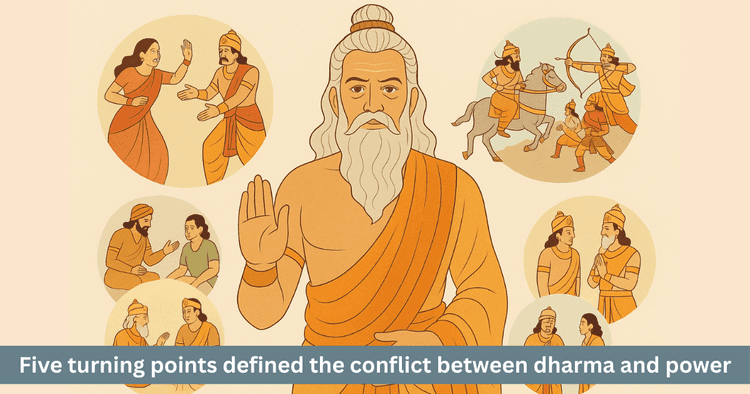
Table of Contents
The figure of the son of Shantanu shines with valor and restraint. When that radiance does not join hands with courage at the right moment, history bends away from harmony. The narrative of the Mahabharata shows how great lives can be confined within walls of procedure. Readers who walk through these turns begin to see the fine threads of dharma with greater clarity.
Summary Of The Five Critical Turns
| No. | Situation | Possible Action By Bhishma | Likely Outcome |
|---|---|---|---|
| 1 | Assembly during the affront to Draupadi | Firm prohibition in clear words, physical interposition if needed | The dignity of Draupadi remains safe, the flame of vengeance cools, the court accepts limits of justice |
| 2 | Supreme command of the Kaurava army | Refusal to lead an unjust war with an offer to mediate | Legitimacy of the Kaurava side weakens, ground for settlement appears |
| 3 | Just claim of the Pandavas before the war | Open advocacy for rightful share or five villages, withdrawal of support if denied | Dhritarashtra is compelled to act, a political solution emerges |
| 4 | Neutralizing the schemes of Shakuni | Charge of treason, push for exile or punishment | Dice game does not occur, humiliation and exile are averted, the machine of malice breaks |
| 5 | Public alignment with the Pandavas | Formal break from Kaurava support, declaration for the side of justice | Coalition on the Kaurava side fragments, war becomes unlikely or very brief |
What Was Lost At The Moment Of Draupadi’s Affront
The highest seat of dharma in a royal hall cannot stay silent. If Bhishma had stated that injustice could not happen in his presence, the courage of offenders would have dissolved. If required he could have stood as a wall between Duryodhana and Dushasana. The honor of Draupadi would have stayed intact. The minds of the Pandavas would have cooled. The court would have learned that royal power must remain within the line of justice. That single moment turned politics into personal revenge. The ground of war was prepared there.
Why A Principled Refusal To Command The Army Was Decisive
When Duryodhana placed a request that sounded like an order, one response was possible. An unjust war cannot be won by righteous means. Refusal to lead would have cracked the spine of Kaurava morale. Spirits would fall. Krishna and the Pandavas would present stronger terms for peace. Elders like Drona might also step aside. Even if battle occurred, it would end quickly. The state could be saved from long ruin. Here the name of Bhishma gave a cloak of dignity to a cause that lacked justice.
Would A Public Endorsement Of The Pandavas’ Claim Have Changed The Field
Indecision often serves injustice. If Bhishma had declared that the claim of the Pandavas was rightful, at least five villages must be given, Duryodhana would have found refusal difficult. On refusal he could have withdrawn public support. Dhritarashtra would be forced to intervene. The Pandavas would strengthen their position through policy. A path of peace could open. The future of the state would move forward without rivers of blood.
How Could The Designs Of Shakuni Have Been Stopped In Time
The game of dice gave a plan to resentment. Bhishma could have used royal authority to brand Shakuni as a plotter. Exile or punishment could be proposed. The mind that shaped Duryodhana’s ambition would fade from the court. The affront to Draupadi would not happen. Exile would be avoided. If a future conflict rose, time and context would be different. There were limits since formal penalty needed royal assent, yet moral pressure and public voice could still open a way.
Would An Open Stand With The Pandavas Have Made War Impossible
A public statement that the side of dharma stood with the Pandavas would reverse the balance. Many warriors who stayed with the Kauravas for the sake of Bhishma would change faith. The strategic brilliance of Bhishma would move to the side of justice. Duryodhana would bend toward settlement or resistance would collapse. If war still came, it would close in a short span. Civilian loss would be much smaller. History would remember a guardian of dharma.
Then Why Did Bhishma Avoid These Paths
| Cause | Explanation |
|---|---|
| Attachment to role | The center of life became the protection of the throne. To step away felt like a loss of self. |
| Institutional loyalty | The structure of state was placed above justice. Rules covered the need for moral courage. |
| Love of stability | It felt uneasy to leave familiar ground of prestige and influence. Risk of change stayed unwelcome. |
| Fatalistic outlook | Events were accepted as ordained. This became a convenient excuse to avoid action. |
Hard Questions In The Name Of Dharma
Dharma is not only obedience to rules. It is the living courage to stop injustice. When power turns unfair, silence becomes a form of partnership. The epic teaches that a cloak of legality does not create righteousness. When strong voices stay quiet, small voices are crushed. This is the point where morality conducts the real test.
A Practical Frame For Readers
| Context | Right Question | Guidance |
|---|---|---|
| Power and justice | Are rules placed above justice | Rules must serve justice to hold meaning |
| Family loyalty | Do ties come before dharma | Bonds endure when justice is kept safe |
| Policy and statecraft | Is legality equal to morality | Legality grows from morality to bear fruit |
Frequently Asked Questions
Q1. Could firm intervention during the affront to Draupadi have stopped the war
A1. Yes. That event became the center of retribution. If honor stayed safe, minds would change and settlement would be closer.
Q2. What would change if Bhishma refused to command the army
A2. The Kaurava side would lose moral ground. Morale would fall. Mediation would grow stronger. War could be short or avoided.
Q3. What real impact would public advocacy for the Pandavas’ claim create
A3. Pressure on Duryodhana would rise. Dhritarashtra would need to act. A political solution would take form and violence would reduce.
Q4. How would neutralizing Shakuni alter the story
A4. The stage for the dice game would vanish. Affront and exile would be averted. The machine of hostility would break and time would flow differently.
Q5. What follows if Bhishma stood openly with the Pandavas
A5. The Kaurava coalition would fracture. Strategy of Bhishma would strengthen the just side. War would shrink and loss of life would be smaller.
A Last Look
The lesson of the Mahabharata shows that the union of power and silence costs history dearly. At the moment of decision, moral courage becomes the true face of dharma. When great figures speak, many lives are saved. When they remain quiet, an age receives wounds that take long to heal.
Find out what your Lagna says
What is my Lagna?Did you like it?
Author

Aparna Patni (63)
Experience: 20
Consults About: Family Planning, Career
Clients In: Punjab, Haryana, Delhi
Share this article with friends and family
About ZODIAQ
ZODIAQ is an online Vedic Astrology platform. It connects clients seeking astrological advice to experienced astrologers with deep knowledge. Our users also generate kundali and perform kundali milan for free. ZODIAQ also offers services to the Astrologers. Astrologers utilize various offerings by ZODIAQ to serve their clients effectively.
If you are a User
Consult with experienced astrologers and seek their guidance. You can also order handwritten Janm Patrika report with life prediction prepared by experienced astrologers. Generate accurate Kundali, perform Kundali Matching and check horoscope and muhurat. Utilize our online library for all the necessary astrological and spiritual information.
If you are an Astrologer
Create accurate kundali for your clients and perform Kundali Matching for up to 5 people at a time. Write comprehensive Janm Patrika report for your clients with ZODIAQ. Check client details anytime by saving it in client directory. Become more productive by tracking how many clients you guide every day.
WELCOME TO
ZODIAQ
Right Decisions at the right time with ZODIAQ
