Is Dhritarashtra's Moral Weakness and Leadership Failure the Greatest Tragedy of the Mahabharata?
By Pt. Narendra Sharma
In-depth analysis of Dhritarashtra’s character, leadership lapses and their catastrophic consequences in the Mahabharata context
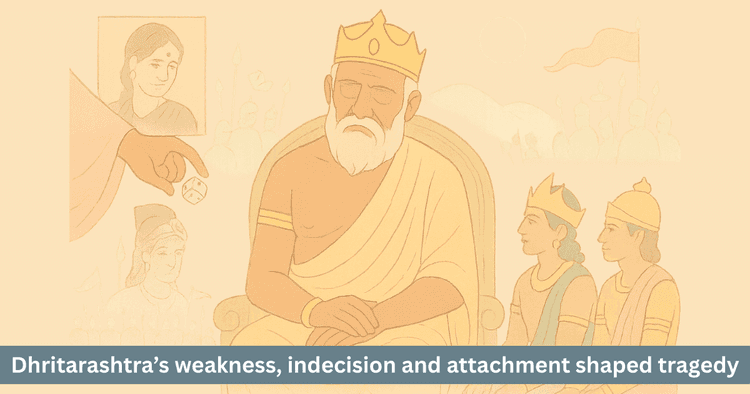
Table of Contents
An Initial Perspective on the Role of Dhritarashtra
The ethical landscape of the Mahabharata is filled with many layers and among these, Dhritarashtra’s position is especially sorrowful and thought-provoking. He was neither openly evil nor merely a product of circumstances. His most tragic aspect was rooted in his weak will, emotional blindness and absence of moral authority. When human flaws combine with power and authority, history reveals a path to extraordinary destruction.
The Contradiction at the Heart of Dhritarashtra’s Character
Dhritarashtra was not a wicked man. He displayed affection, understood dharma and loved the Pandavas as well as his sons. He experienced regret over his actions and ultimately sought spiritual peace. Yet, this very emotional sensitivity deepened his failure. Though he always understood right from wrong, he did not take brave decisions. He knew the dice game was unjust, recognised the wrongdoing in Draupadi’s humiliation and grasped that the war was disastrous and avoidable, yet he remained silent. It is in this contradiction that his tragedy lies. There is a stark difference between having good personal qualities and possessing the attributes of a capable leader. Dhritarashtra had the first but sorely lacked the latter.
Physical Blindness: Symbol of Deeper Moral Reality
His physical loss of sight was not only a biological condition but also a marker of his spiritual reality. He was blind from birth due to his mother’s involuntary reaction to Sage Vyasa’s presence. This loss denied him the throne and left a wound in his heart. Yet there are many characters in the Mahabharata who, despite lacking physical sight, possessed ethical vision. Dhritarashtra’s blindness was far deeper, psychological and moral. When Vyasa offered him divya drishti (divine sight), Dhritarashtra refused because he did not want to see his sons die. In this manner, he remained responsible for his own ignorance; he did not have the courage to face the truth.
The Bifurcation of the Kingdom: The First Major Error
When Dhritarashtra divided the kingdom, it was a critical moment that sowed the seeds of disaster. He thought that having two kingdoms would prevent conflict but it was a misunderstanding of his true kingly duty, which was to make clear, just decisions. Splitting the kingdom resulted in an uneven distribution of power, wealth and authority. This laid the foundation for conflict and gave Duryodhana unjust courage.
Outcomes of Kingdom Division
| Decision | Result |
|---|---|
| Kingdom divided | Encouraged struggle for power |
| Support to Duryodhana | Indirectly legitimised false claims |
| Lack of clear judgment | Created instability in the empire |
The Dice Game: Silent Endorsement of Fraud
The dice game was one of the most decisive events in the Mahabharata. Dhritarashtra was aware of Shakuni's cunning, yet failed to ensure fairness. He, directly or indirectly, benefited from the results. When Draupadi was humiliated, he did not intervene immediately. Thus, Dhritarashtra became complicit in the deceit.
Draupadi’s Humiliation: The Peak of Moral Decay
Dhritarashtra’s silence during Draupadi’s humiliation was the gravest moral lapse. When Draupadi demanded justice, it was Dhritarashtra’s duty to enforce it. His silence amounted to tacit approval. Even when he provided limited relief after Gandhari’s encouragement, it was insufficient. The psychological pain Draupadi endured became the driving force for the Pandavas’ fight.
Key Facts About Draupadi’s Humiliation
| Subject | Brief Information |
|---|---|
| Legal question | Draupadi cited dharma |
| Dhritarashtra’s role | Delayed and inadequate intervention |
| Result | Enduring psychological trauma |
The Pattern of Indecision
Throughout his life, Dhritarashtra displayed a consistent pattern of indecision. This was not limited to individual incidents. He suffered from unresolved hurt, excessive blind affection for Duryodhana, weak will and self-deception. Being denied the throne left him wounded. His attachment to Duryodhana interfered with his kingly duties. He remained in denial, unable to confront the reality.
Was Dhritarashtra ‘Evil’?
The question arises: Was Dhritarashtra evil or wicked? The answer is not simple. He did not possess malice or deliberate intent to harm but his weakness and inaction rendered him responsible for leadership failure. Even without bad intention, a person who abandons duty becomes culpable. The Mahabharata depicts him as culpable but also capable of atonement.
Impacts of Dhritarashtra’s Failings
- Unjust seizing of the Pandavas’ property
- Draupadi’s humiliation, leading to Pandavas’ vow of vengeance
- Thirteen years of unfair exile for the Pandavas
- Inevitability of war and mass destruction
The Concept of Moral Blindness
Dhritarashtra’s character is a powerful illustration of ‘moral blindness’ in the Mahabharata. His spiritual and psychological blindness diminished his leadership. Every time he had a chance to recognise the truth or heed wise counsel, he looked away.
Comparison with Other Failed Leaders
Comparison Table
| Character | Reason for Failure |
|---|---|
| Bhishma | Vows and institutional duty |
| Karna | Social status, deep attachment |
| Yudhishthira | Instability arising from his mind |
| Dhritarashtra | Weak willpower, attachment to son |
Lessons to Learn from Dhritarashtra’s Story
All high offices of leadership require strong moral force. The Mahabharata teaches that only courageous leadership can establish justice. Dhritarashtra descended because of simple human weaknesses, placing personal comfort, hesitation or family affection above public duty. His story is a warning that blindness, willful ignorance, from those in power can devastate society.
Frequently Asked Questions (FAQs)
1. Was Dhritarashtra completely blameless?
Dhritarashtra had good values and love but his indecisiveness and his blind affection for his son made him responsible for grave consequences.
2. Why is his role in the dice game seen as questionable?
He knowingly did not prevent the fraudulent game, resulting in the Pandavas’ loss. Intervention by him could have averted disaster.
3. Was he directly responsible for Draupadi’s humiliation?
His silence was effectively a crime, because as ruler, it was his responsibility to guarantee justice.
4. Does his atonement absolve him?
The Mahabharata accepts his penance but it cannot erase his earlier failings.
5. How was his failure different from that of other major characters?
Other figures had external constraints and vows. Dhritarashtra failed due to his inner weakness alone.
Find out what your Lagna says
What is my Lagna?Did you like it?
Author
Pt. Narendra Sharma (63)
Experience: 20
Consults About: Family Planning, Career
Clients In: Punjab, Haryana, Delhi
Share this article with friends and family
About ZODIAQ
ZODIAQ is an online Vedic Astrology platform. It connects clients seeking astrological advice to experienced astrologers with deep knowledge. Our users also generate kundali and perform kundali milan for free. ZODIAQ also offers services to the Astrologers. Astrologers utilize various offerings by ZODIAQ to serve their clients effectively.
If you are a User
Consult with experienced astrologers and seek their guidance. You can also order handwritten Janm Patrika report with life prediction prepared by experienced astrologers. Generate accurate Kundali, perform Kundali Matching and check horoscope and muhurat. Utilize our online library for all the necessary astrological and spiritual information.
If you are an Astrologer
Create accurate kundali for your clients and perform Kundali Matching for up to 5 people at a time. Write comprehensive Janm Patrika report for your clients with ZODIAQ. Check client details anytime by saving it in client directory. Become more productive by tracking how many clients you guide every day.
WELCOME TO
ZODIAQ
Right Decisions at the right time with ZODIAQ
