The Five Critical Junctures Where Dhritarashtra Could Have Made Different Choices
By Pt. Nilesh Sharma
Analytical discussion of five pivotal moments when Dhritarashtra could have averted catastrophe
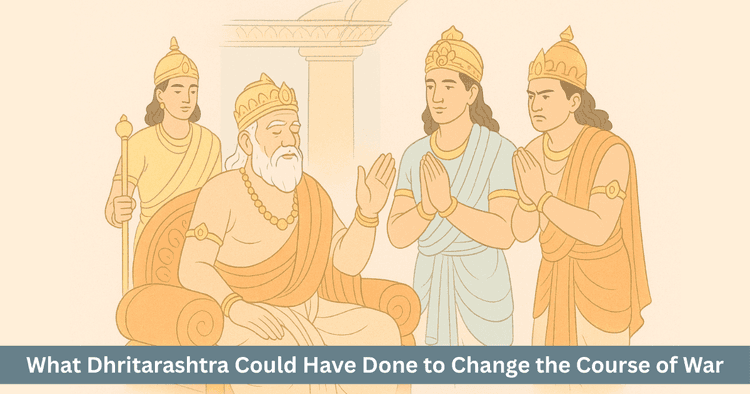
Table of Contents
Dhritarashtra's life was marked by multiple pivotal moments where his royal authority and wisdom could have been deployed decisively to prevent catastrophe. Unlike other characters in the Mahabharata whose power was constrained by circumstances, Dhritarashtra possessed supreme authority as king yet systematically failed to exercise it. Here are the five most consequential alternatives he might have pursued:
1. Asserting His Authority to Confirm Yudhishthira as Rightful Heir
What Dhritarashtra Could Have Done:
After Pandu's death, when the question of succession arose, Dhritarashtra could have made a decisive pronouncement confirming Yudhishthira as the rightful heir to the throne of Hastinapur. As the reigning king, Dhritarashtra possessed the absolute authority to settle this matter definitively through a formal proclamation before the assembled court, elders and representatives of allied kingdoms.
He could have said openly: "Yudhishthira, son of Pandu and grandson of Pandu through legitimate lineage, is the rightful heir to the throne of Hastinapur. This inheritance passes not to my own son Duryodhana but to the rightful heir. This is the law of succession, this is dharma and this is my binding decree as king. All shall accept this or face consequences."
Such a proclamation issued during the time of uncertainty immediately after Pandu's death (before Duryodhana consolidated power or felt entitled) would have settled the issue once and for all, enforcing the foundational principle of legitimate succession.
Why This Mattered:
- The entire conflict grew out of uncertainty about succession.
- Duryodhana’s sense of entitlement expanded because the issue was never settled.
- If Dhritarashtra had decided clearly and publicly, Duryodhana would have been forced to accept Yudhishthira’s supremacy.
- Further events like the division of the kingdom, the gambling game and the exile might never have happened.
2. Refusing to Participate in or Endorse the Bifurcation of the Kingdom
What Dhritarashtra Could Have Done:
When Bhishma and others suggested dividing the kingdom as a solution, Dhritarashtra could have refused. He could have established that Hastinapur has only one throne and it is inherited according to dharma, regardless of personal feelings.
He could have offered Duryodhana a senior administrative or military position but not sovereignty based on an illegitimate claim.
Why This Mattered:
- Creating two kingdoms validated Duryodhana's claim and sent a message that stubbornness is rewarded.
- The unified kingdom would have remained stronger and more stable.
- The main causes of conflict would have been removed at the outset.
3. Immediately Voiding the Fraudulent Dice Game and Establishing Consequences
What Dhritarashtra Could Have Done:
Upon recognizing the fraud in the dice game, Dhritarashtra could have declared it null and void. He could have restored all lost wealth and status to the Pandavas and imposed significant punishment on Shakuni and Duryodhana for deception.
Why This Mattered:
- Allowing the fraudulent outcome enabled every subsequent tragedy.
- Immediate action could have protected Pandava rights, prevented exile and foiled Duryodhana and Shakuni’s reputation and credibility.
4. Intervening During Draupadi's Disrobing with Full Authority
What Dhritarashtra Could Have Done:
Dhritarashtra could have stood up and announced, “This will not happen. A woman's honor is sacred and must not be violated. Anyone attempting this will be severely punished.” He could have had Dushyasana arrested, declared Duryodhana guilty of orchestrating the outrage and fully restored the Pandavas' freedom and property.
Why This Mattered:
- Draupadi’s humiliation was the psychological wound which drove the Pandavas to war.
- Public and immediate justice would have restored order and preserved not only Draupadi’s dignity but also the kingdom's moral foundation.
5. Making a Definitive Choice About War
What Dhritarashtra Could Have Done:
Dhritarashtra could have taken one of two decisive paths before war:
Option A: Enforcing Peace Through Royal Authority
He could have declared, “The Pandavas’ demands are just. Duryodhana will accept peace or face the consequences as a rebel.” This could have united the royal court and prevented war.
Option B: Preparing for War Responsibly
If war was inevitable, he could have accepted it and prepared the kingdom with honesty, gathering strength and allies rather than drifting toward conflict in denial.
Why This Mattered:
- Dhritarashtra’s indecision enabled the destructive course and left the kingdom divided and unprepared.
The Pattern of Dhritarashtra's Failures
Reviewing these five alternatives reveals that his central failing was refusing to make decisions. Again and again, with full authority and opportunity, he avoided tough choices. He hoped challenges would resolve themselves, deferred to others or delayed until intervention was ineffective.
A powerful king would have:
- Resolved the succession
- Refused to split the kingdom
- Voided the fraudulent game and punished wrongdoing
- Protected Draupadi and enforced penalties
- Made a clear decision about war
Dhritarashtra failed at each key juncture, enabling unprecedented tragedy and loss despite having the authority to prevent it.
The Final Lesson: Authority Without Will
Dhritarashtra’s tragedy is the tale of authority without will and of the disaster that follows when power is separated from the courage to exercise it. With different decisions at even one of these five moments, the entire course of the Mahabharata may have changed, potentially averting the war or, at the very least, changing its terms. Instead, his repeated refusal to act transformed his kingdom into a battlefield and led an entire generation to destruction. His weakness enabled the ambitions and schemes of others and in refusing to choose, Dhritarashtra chose the path of catastrophe.
Frequently Asked Questions (FAQs)
1. Did Dhritarashtra really have the power to resolve the succession dispute?
Yes. As king, he could have ended it by naming Yudhishthira the only legitimate heir, stripping Duryodhana of his base.
2. What if he refused to divide the kingdom?
Duryodhana could never have gathered enough support; the very split of the kingdom created two houses and lasting rivalry.
3. Annulment of the dice game would have achieved what?
Pandavas would neither be exiled nor dishonored, eliminating the seeds of bitterness and revenge altogether.
4. What would forceful intervention during Draupadi’s disrobing have meant?
It would preserve Pandavas' morale, restore faith in justice and almost certainly prevented an emotionally-fueled war.
5. What was the result of not making a clear pre-war decision?
The kingdom lost all unity, alliances faltered and the way to ruin was paved by ambiguity at the very top.
Know your Janm Nakshatra
What is my Nakshatra?Did you like it?
Author

Pt. Nilesh Sharma (63)
Experience: 20
Consults About: Family Planning, Career
Clients In: Punjab, Haryana, Delhi
Share this article with friends and family
About ZODIAQ
ZODIAQ is an online Vedic Astrology platform. It connects clients seeking astrological advice to experienced astrologers with deep knowledge. Our users also generate kundali and perform kundali milan for free. ZODIAQ also offers services to the Astrologers. Astrologers utilize various offerings by ZODIAQ to serve their clients effectively.
If you are a User
Consult with experienced astrologers and seek their guidance. You can also order handwritten Janm Patrika report with life prediction prepared by experienced astrologers. Generate accurate Kundali, perform Kundali Matching and check horoscope and muhurat. Utilize our online library for all the necessary astrological and spiritual information.
If you are an Astrologer
Create accurate kundali for your clients and perform Kundali Matching for up to 5 people at a time. Write comprehensive Janm Patrika report for your clients with ZODIAQ. Check client details anytime by saving it in client directory. Become more productive by tracking how many clients you guide every day.
WELCOME TO
ZODIAQ
Right Decisions at the right time with ZODIAQ
