Five Critical Actions Duryodhana Should Have Taken: Impact Analysis
By Pt. Abhishek Sharma
Which five choices could have averted war and destruction, a detailed impact analysis
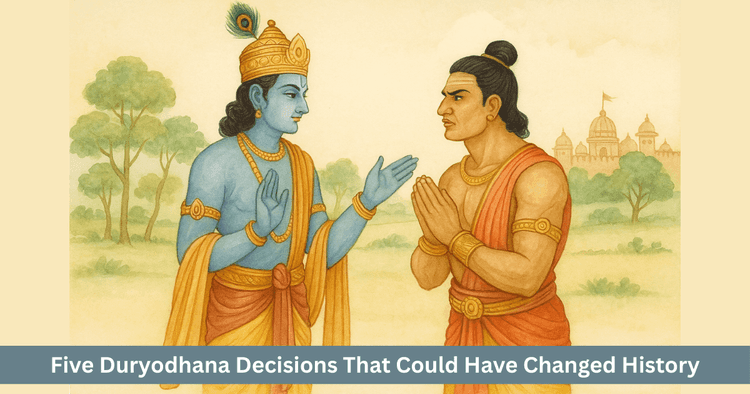
Table of Contents
Throughout the Mahabharata, there were five decisive turning points where Duryodhana could have chosen differently, radically altering his destiny and that of his dynasty. Here is a detailed impact assessment for each:
1. Seeking Krishna's Guidance and Embracing Dharma (Early Life)
What he should have done:
Instead of isolating himself with toxic guidance from Shakuni, Duryodhana ought to have sought out Krishna's wisdom as a guide, especially after his humiliation at Indraprastha. He needed to see Krishna as a spiritual mentor, not as a rival.
Why this mattered:
Krishna told Duryodhana that he had equal potential as Yudhishthira. The only difference was that Yudhishthira transformed through adversity, while Duryodhana let pride fester.
Impact:
- Personal transformation: Duryodhana could have experienced the kind of inner change Arjuna did, gaining humility and wisdom.
- Dynasty preserved: His relatives, followers and kingdom would have survived, sparing his family from destruction.
- Widespread peace: Embracing dharma as Hastinapur’s heir would have instituted a ripple effect of virtue throughout the empire.
- Enduring legacy: He would be remembered as a model prince overcoming adversity with insight, not a tragic anti-hero.
2. Rejecting Shakuni's Counsel and Avoiding Early Crimes (Childhood/Youth)
What he should have done:
When Shakuni began inciting hatred and scheming, Duryodhana should have declined to be manipulated, seeking wisdom from Vidura, Bhishma or Drona instead.
Why this mattered:
Every cruel plot, poisoning Bhima, burning Lakshagraha, fixing the dice, stemmed from Shakuni’s vendetta channelled through Duryodhana’s insecurity.
Impact:
- Solid moral foundation: Refusing Shakuni’s ways would have kept Duryodhana’s heart uncorrupted and relationships healthy.
- Unified family: Relationships with Pandavas would rest on respect, not rivalry; trust could grow within the royal house.
- Better mentors: Bhishma or Vidura would have nurtured his virtues, not his hatred.
- No war trigger: The attempts to murder the Pandavas would never have happened, preventing decades of vengeance and eventual war.
3. Accepting the Rajasuya Defeat and Kingdom Division with Grace
What he should have done:
After his public embarrassment at Indraprastha, Duryodhana should have accepted the Pandavas’ rise and focused on governing Khandavaprastha well.
Why this mattered:
His humiliation didn't demand revenge; it was a test of maturity that he failed, leading to the disastrous dice game, Draupadi’s humiliation and the exile.
Impact:
- No dice game: Yudhishthira keeps his kingdom, Draupadi isn’t shamed, Bhima never swears vengeance.
- No war catalyst: Without the humiliation, vengeance and exile, there was no reason for war.
- Two strong kingdoms: Coexistence, trade and alliances could have woven a lasting peace.
- Healed relations: Wounds would have closed over time and the Pandavas and Kauravas might eventually have become allies.
4. Accepting Sage Maitreya's Counsel (Exile Period)
What he should have done:
When Maitreya warned Duryodhana that disaster was certain if he persisted on the path of war, Duryodhana should have shown humility, recalled the Pandavas and negotiated peace.
Why this mattered:
This was his final chance to avert the war, Maitreya’s curse directly prophesied his defeat due to stubborn pride.
Impact:
- Curse averted: Bhima never brings down his thigh and Duryodhana survives the war.
- Vast lives saved: Millions would not perish; Hastinapur’s legacy would have endured.
- Shared power: New models of leadership, like co-regency, could have emerged.
- Enduring peace: The kingdom would inherit his maturity rather than his destruction.
5. Choosing Krishna Over the Army (On the Eve of War)
What he should have done:
Offered the choice between Krishna or his army, Duryodhana should have recognized the value of divine guidance and picked Krishna himself.
Why this mattered:
The Mahabharata establishes Krishna as the personification of dharma; aligning with Krishna meant aligning with cosmic order and righteousness.
Impact:
- Divine counsel: Krishna’s wisdom could have softened Duryodhana’s pride and inspired compromise or peace.
- Moral authority: By choosing Krishna, Duryodhana would have signaled humility to his court and the world.
- War averted: Krishna’s presence with Duryodhana (had he accepted it) could have turned the tide toward peace and reconciliation.
- Redemption: Duryodhana could have transformed from villain to sage king, remembered for dharmic leadership.
Comparative Impact Table
| Action | Primary Outcome | Broader Impact |
|---|---|---|
| Seek Krishna’s guidance | Spiritual/character transformation | Civilizational |
| Reject Shakuni | Strong moral foundation, unity | Family, kingdom |
| Accept Rajasuya division | No war catalyst, peace | Kingdom, regional |
| Accept Maitreya's advice | Avert prophecy, save dynasty | Continental |
| Choose Krishna, not army | Divine wisdom, moral legitimacy | Universal/cosmic |
Interconnected Consequences
Each action would have smoothed the next. Seeking Krishna’s wisdom would naturally distance him from Shakuni’s influence; accepting the kingdom’s division would have prevented humiliation and resentment; heeding Maitreya would short-circuit the curse and the war. Had Duryodhana chosen even one, it would have marked a turning point for good.
Frequently Asked Questions (FAQs)
1. Which lost opportunity was Duryodhana’s greatest mistake?
Failing to heed Krishna’s counsel, time and again, locked him into a tragic destiny.
2. If he had chosen Krishna instead of the army, would the war have happened?
Unlikely. Krishna’s presence and advice would likely have led to compromise and peace.
3. Did Duryodhana have the capacity to change?
Absolutely, had he set aside pride, sought wise counsel and opened himself to transformative wisdom.
4. Was the influence of Shakuni more important than Duryodhana’s personal failings?
No. Shakuni opened the door but Duryodhana chose to walk through it, personal accountability remained paramount.
5. What is the biggest lesson from Duryodhana’s critical choices?
That it is never too late to choose wisdom, humility and peace and one right decision can change the fate of generations.
What does moon sign reveal about me?
My Moon SignDid you like it?
Author

Pt. Abhishek Sharma (63)
Experience: 20
Consults About: Family Planning, Career
Clients In: Punjab, Haryana, Delhi
Share this article with friends and family
About ZODIAQ
ZODIAQ is an online Vedic Astrology platform. It connects clients seeking astrological advice to experienced astrologers with deep knowledge. Our users also generate kundali and perform kundali milan for free. ZODIAQ also offers services to the Astrologers. Astrologers utilize various offerings by ZODIAQ to serve their clients effectively.
If you are a User
Consult with experienced astrologers and seek their guidance. You can also order handwritten Janm Patrika report with life prediction prepared by experienced astrologers. Generate accurate Kundali, perform Kundali Matching and check horoscope and muhurat. Utilize our online library for all the necessary astrological and spiritual information.
If you are an Astrologer
Create accurate kundali for your clients and perform Kundali Matching for up to 5 people at a time. Write comprehensive Janm Patrika report for your clients with ZODIAQ. Check client details anytime by saving it in client directory. Become more productive by tracking how many clients you guide every day.
WELCOME TO
ZODIAQ
Right Decisions at the right time with ZODIAQ
