The five decisive junctures where Karna could have changed history
By Pt. Sanjeev Sharma
A deep reading of Karna’s choices between loyalty, honor and dharma
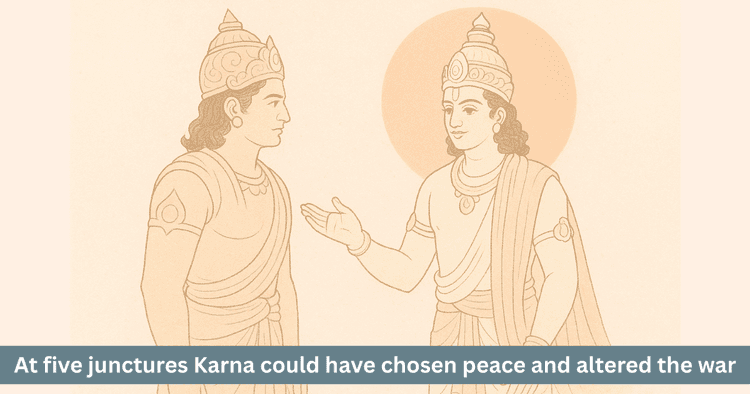
Table of Contents
In the Mahabharata the figure of Karna blends radiance, compassion and a complex ethic. The search for honor binds him to the debt of friendship. Many hours arrived when a different path could have turned violence into peace. The study below explains five such junctures where Karna’s choices shaped fate with final force.
Why this framework matters
Karna’s position was unlike Bhishma. There was little institutional authority yet there was immense influence. Between psychological attachment, hunger for recognition and an understanding of dharma he stood in repeated dilemma. At each turn it helps to keep policy, morality and outcome in one frame. The reader does not see only if and but. Clear options, likely outcomes and lessons become visible.
Synopsis table of the five junctures
| No. | Juncture | Better choice available | Likely strategic outcome | Likely ethical outcome |
|---|---|---|---|---|
| 1 | Krishna’s offer before war | Accept the offer | War avoided or shortened | Honor with peace as the rightful eldest |
| 2 | Outrage against Draupadi | Resist and speak for decorum | Dignity restored in the court | Restraint as a norm on the Kaurava side |
| 3 | Counsel to Duryodhana | Accept the five villages | Exile avoided and anger reduced | Relations preserved on principle |
| 4 | After injustice became plain | Withdraw from service | Kaurava strength weakened | Self respect and guard of dharma |
| 5 | Final duel with Arjuna | Keep the full warrior code | Honorable victory or noble end | Partial atonement for earlier wrongs |
1. Could Karna have accepted Krishna’s offer
Krishna gave a real opening to stop war. As the eldest Pandava Karna could claim a rightful place and a legitimate crown. This was recognition of succession, not temptation. If he accepted, the claim of Duryodhana would fall at once. The inward hesitation of Bhishma and Drona would lean toward peace. War could be avoided or reduced to a brief conflict.
What he chose
He declined in the name of loyalty. He held the love of a friend above blood and rank. For him honor meant keeping the promise made to the benefactor.
What acceptance would bring
- Morale of the Kaurava host collapses
- Krishna’s peace mission succeeds
- Crisis of legitimacy is resolved
- Karna receives lifelong honor through right and not through patronage
Psychological core
Status anxiety. A fearful guard of reputation. The emblem of loyalty stood so deep in his self image that the larger standard of dharma slipped from sight. Acceptance felt like betrayal even when it promised the larger good.
Decision analysis table
| Axis | Loyalty first | Dharma first |
|---|---|---|
| Personal honor | Stable in appearance | More stable in the long run |
| Social effect | Conflict continues | Violence reduces |
| Policy | Person centered | Principle centered |
| History | Destructive war | Settlement with minimal loss |
2. Should Karna have opposed the outrage against Draupadi
The scene after the dice game was not a passing episode. It was the wound that closed the door of reconciliation. If Karna had declared that the act was adharma, decorum would have returned. Boundaries would appear in the court. Even within Duryodhana a line would be drawn.
What he did
He added sharp words. He doubted the validity of her marriage and pushed the outrage. That hour weakened the moral ground of the Kaurava side.
If he opposed
- The dignity of Draupadi would stand
- The anger of the Pandavas would not harden beyond repair
- A tradition of restraint would be set
- Karna would rise as a moral voice within the court
Cause at the root
New rank covered compassion. The inner acceptance of social hierarchy ran deep. A person who had tasted insult could not stand beside another victim. The same complexity harms his image more than any other act.
Decorum versus attachment
| Side | Choice of decorum | Choice of attachment |
|---|---|---|
| Immediate effect | Outrage stops | Outrage grows |
| Long effect | Space for reunion | Revenge gets sealed |
| Public image | Moral leader | Aggressive helper |
3. Could Karna have steered Duryodhana toward peace and justice
Karna was the most influential companion of Duryodhana. If he had urged again and again that the five villages be accepted, peace would have been possible. The dice game could be stopped. Exile would not occur. In counsel he chose confrontation over restraint. The desire to defeat Arjuna covered strategy.
If he gave counsel of restraint
- A compact of peace could take shape
- The fracture between houses would lessen
- Duryodhana would receive an honorable route
- The psychological fuel of war would thin
Why counsel failed
A burning zeal to face Arjuna. A contest for prestige. The need to look fearless before a friend. A fear that mild counsel would make him appear weak.
Map of influence of counsel
| Element | Counsel for conflict | Counsel for peace |
|---|---|---|
| Mind of Duryodhana | Harsh | Soft |
| External mediation | Fails | Finds an opening |
| Mind of the Pandavas | Furious | Open to talk |
| Image of Karna | Only a warrior | Guide of policy |
4. Should Karna have stepped away once injustice stood plain
After the dice game, the public outrage and the exile, adharma stood in the open. At this point Karna could retire from service. He could go to the forest or choose neutrality. The decision would weaken the Kaurava force and add pressure for peace.
What he chose
He tied the knot of his vow even tighter. The same side. The same road. In the effort to prove that he is loyal, he crossed the threshold of dharma.
If he withdrew
- The balance of the Kaurava host would break
- The hesitation of Bhishma and Drona would become decisive
- The war would end early
- His self image would stand firm and his life might be saved
Why he did not
The fear of losing acceptance. The friendship that gave identity could not be left. Separation felt like a death of the self. The sense of self fused with the idea of loyalty.
Decision tree of withdrawal
| Question | Yes | No |
|---|---|---|
| Is injustice plain | Leave to preserve dharma | Place personal favor above justice |
| Public good | Violence will reduce | Violence will rise |
| Self image | Discerning loyalty | Rigid loyalty |
5. Should Karna have kept the full warrior code in the final duel
On the seventeenth day the meeting with Arjuna defined the course. A strict guard of the warrior code could rebuild the moral frame of Karna. A warrior does not strike an unready foe. The very honor he had sought through life could be secured here.
What occurred
Accounts differ. The readiness to strike a helpless foe shows a slip from the code. Krishna reminded him of former offenses and his courage wavered. The same inner hour led to the end.
If he kept the code
- A victory may have come
- If not, a spotless end would remain
- Earlier wrongs would meet partial atonement
- Memory of Karna would shine for moral firmness
Brief code of combat
| Rule | Meaning | Meaning for Karna |
|---|---|---|
| Do not strike the helpless | Honor of the field | Lasting repute over short gain |
| Vow must walk with wisdom | A vow bound to dharma | Tie loyalty to justice |
| Respect for the foe | Measure of valor | Enduring source of self respect |
The psychological axis beneath the five turns
The main thread is status anxiety and a false understanding of honor. Karna treated the look of honor as the substance of honor. Loyalty to a person outweighed loyalty to principle. Hence he declined Krishna’s offer. Compassion went quiet in the scene of Draupadi. The zeal for war rose above the counsel for peace. Withdrawal felt impossible. In the last hour the self image shattered and the will broke.
Balance between mindset and dharma
| Axis | Mindset first | Dharma first |
|---|---|---|
| Loyalty | Person centered | Principle centered |
| Honor | Display of power | Essence of decorum |
| Decision | Impulse and fear | Discernment and compassion |
| Result | Long pain | Wider good |
Notes for the present age
- Loyalty becomes lasting when joined with justice
- Power means a duty of compassion and decorum
- Strategy without moral direction is hollow
- A self image needs testing by truth
- At a hard bend one step toward peace can change a century
Frequently asked questions
Would acceptance of Krishna’s offer align with dharma
Yes. To accept a rightful claim as the eldest son was a step toward justice and would have reduced violence.
Why did the outrage against Draupadi make war almost certain
Because that insult left a wound on the mind and closed the door to reconciliation. When honor breaks, dialogue breaks.
Could Karna have turned Duryodhana toward peace
His influence was strong. Gentle and repeated counsel could soften the prince. Outcomes could change in full.
Was withdrawal from service the right moral route
Yes. When injustice is plain, stepping back guards dharma. Personal gratitude remains honored while the support of adharma ends.
How would keeping the code in the final duel change his image
By keeping the code he would find partial atonement. Even a defeat would carry the fragrance of decorum.
Find out what your Lagna says
What is my Nakshatra?Did you like it?
Author
Pt. Sanjeev Sharma (63)
Experience: 20
Consults About: Family Planning, Career
Clients In: Punjab, Haryana, Delhi
Share this article with friends and family
About ZODIAQ
ZODIAQ is an online Vedic Astrology platform. It connects clients seeking astrological advice to experienced astrologers with deep knowledge. Our users also generate kundali and perform kundali milan for free. ZODIAQ also offers services to the Astrologers. Astrologers utilize various offerings by ZODIAQ to serve their clients effectively.
If you are a User
Consult with experienced astrologers and seek their guidance. You can also order handwritten Janm Patrika report with life prediction prepared by experienced astrologers. Generate accurate Kundali, perform Kundali Matching and check horoscope and muhurat. Utilize our online library for all the necessary astrological and spiritual information.
If you are an Astrologer
Create accurate kundali for your clients and perform Kundali Matching for up to 5 people at a time. Write comprehensive Janm Patrika report for your clients with ZODIAQ. Check client details anytime by saving it in client directory. Become more productive by tracking how many clients you guide every day.
WELCOME TO
ZODIAQ
Right Decisions at the right time with ZODIAQ
