What does astrology reveal about Karna and why is he neither hero nor villain
By Pt. Nilesh Sharma
Sun principle, Magha nakshatra, signs of Saturn, Rahu, Ketu and the human dilemma of Karna
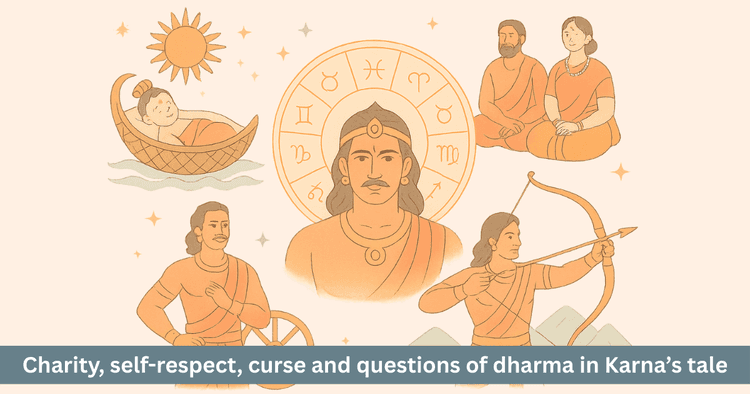
Table of Contents
The saga of Karna is a human journey that pulses at the center of the Mahabharata. Divine grace touched his birth yet society hid that light. The tale moves between rejection, struggle and glory. A reader walks into a world where dharma and human bonds move together and collide at many turns. No single line verdict can hold him because every layer becomes more complex in his presence.
At the entrance of the story two poles appear. One pole is the stain of birth and social exclusion. The other pole is the honor that came through the friendship of Duryodhana. Between these poles his choices, his valor and his ethical questions take shape. This tension is the thread that guides the long discussion here.
Birth, celestial sign and the hardness of society
Kunti received a boon from Surya and that boon appeared as the infant Karna. Grace arrived and the order of the age put severe conditions. To protect honor the child floated on a river in a wicker cradle. Adhiratha and Radha embraced him. The guild of charioteers was essential to war craft, yet the social ladder placed the guild low. That identity walked with him like a shadow.
In boyhood and youth he met refusal at each step. When he wished to study under Dronacharya the question of lineage rose as the barrier. The matter was not talent. The matter was the system. That experience became a fire within. The same fire turned into the resolve to prove worth. The resolve reached the hermitage of Parashurama.
Learning, curse and the rise of mastery
To receive instruction from Parashurama, Karna wore the form of a Brahmin. Initiation completed. The master gave the lore of weapons. When truth emerged the curse followed that knowledge would fail at the most fragile hour. The episode is not a mere fable. It points to the price that a person pays when access is denied. He changed the path, he trained without pause and finally he stood as a great archer. Many assessments place his skill beside Arjuna. The lesson is clear. Birth sets direction, not the final decree.
Structured digest of his prowess
| Dimension | Instance | Effect |
|---|---|---|
| Relentless practice | Deep discipline of weapons | Unmatched growth of skill |
| Alternate route | Initiation under Parashurama | Courage to learn beyond formal gate |
| Psychological cost | Disguise and the curse | Fear of lapse in the hour of trial |
| War craft | Strategy and marksmanship | Standing with the finest archers |
Friendship with Duryodhana and the question of dharma
When taunts on lineage rose in a royal gathering, Duryodhana gave the charge of Anga and offered social legitimacy. It was not mere favor. It was the restoration of human dignity. Among old refusals this friendship became a support. Gratitude shaped a pledge. The pledge became the base of moral puzzles on the field. The law of the throne of Hastinapura rests on succession and justice. The policy of Duryodhana moved away from those anchors. Karna’s loyalty placed him on a side that wrestled with the core standards of dharma.
There is also a human layer. Leaving one who gave recognition to a rejected soul is not easy. For this reason he did not break his word even after Kunti revealed the truth. The decision evokes compassion at a human level. On the axis of state dharma the same decision draws criticism.
Karna through the lens of Vedic astrology
In Vedic astrology the Sun signifies soul force, honor and dharmic will. The tale of Karna carries a strong solar tone. The Leonine color gives leadership, generosity and self respect. The tone rises again and again. The gift of armor and earrings, the guard of dignity in adverse hours and the insistence on self respect even in loss reflect the same color.
Saturn shows hardship, delay and karmic debt. Rahu expresses struggle for name and a haze of temptation. Ketu reflects detachment and the softening of ego. These three move through his life. Entry refusal, reversal of opportunities, the curse, the lapse in memory at a decisive instant, the excess of giving and the final sinking of the wheel. All of this gives meaning to the combinations.
A planetary map for Karna
| Marker | Possible astrological ground | Echo in the story |
|---|---|---|
| Radiance and dignity | Solar dominance and Leonine hue | Charity, self respect, command |
| Lineage and ancestral debt | Magha nakshatra | Honor of tradition and its weight |
| Trial and restraint | Saturn’s stern glance | Refusal, delay, hard tests |
| Dilemma of reputation | Rahu’s haze | Search for status, standing with a wrongful side |
| Renunciation and loss | Ketu’s sign | Erosion of ego, gift of armor, parting |
The light of the great donor and the mist of ethics
His charity is timeless. The surrender of armor and earrings proves that giving is central to his nature. The same act is bright and also risky. In the law of war self protection is a duty. Charity weakened that duty. During the humiliation of Draupadi his words fell beyond the line of decorum. The episode of the young Abhimanyu shows another slip from the warrior code. Light and mist stand together. Hence the need for discernment appears at once.
Dharma, choice and the fruit of karma
Astrology does not hand down the final judgment of life. It speaks the language of signals. From his episodes a reader learns that effort can take a person very far. If loyalty stands with a wrongful side, karmic fruit turns harsh. The lesson is not limited to one person. It matters to every person who holds power in any decision.
Questions that frame the dharma debate
- Can private gratitude stand above justice
- Is there a simple rule between devotion and discernment
- Can the summit of charity remain in harmony with strategy
- Can an identity at birth obstruct merit permanently
Omens before war and the reading of Karna
Classical tellings state that motion of planets, lunar mansions and eclipses were observed before war. The pace of Mars and the sign of an eclipse announced large ruin. He foresaw destruction and still ranked his pledge above safety. The scene shows how an astrological caution and a human promise can face each other. Even when signs are present decisions do not arise only from signs. Human loyalty and discernment are equally decisive.
A forum on identity and justice
His journey raises sharp questions about the rigidity of inherited identity. Structural bias does not melt even in the presence of rare skill. The tale teaches that merit can challenge the order. The transformation of the order is not achieved by personal talent alone. For this reason a social name arrived through friendship and power and a price for that name had to be paid.
Comparative notes on identity
| Side | Positive sign | Challenge |
|---|---|---|
| Rise of merit | Respect through labor and valor | Gate of formal entry shut |
| Social legitimacy | Honor of Anga | Moral price of choice of side |
| Human bond | Friendship of Duryodhana | Risk of distance from justice |
| Public decorum | Charity and compassion | Loss of measure in moments of anger |
The curse, the sinking wheel and the turn of fate
The curse of Parashurama appeared as a lapse of memory. In the last duel the chariot’s wheel sank into the earth. The mantra that could shield him did not return to mind. The arrow of Arjuna closed the act. This line shows the confluence of karma and choice. Heat of the curse, planetary signs and human decisions write the result together.
Lessons for the present hour
- Merit needs a platform of policy and access
- Loyalty is priceless yet must not stand with injustice
- Power is responsibility for compassion and restraint
- Astrology offers signals and the decision must rest on ethics and discernment
- Charity is vital yet the need of strategy and self protection deserves respect
Comparative insights with other figures
The vow of Bhishma turns him into a monk of the state. Drona is an impartial teacher yet bound to the policy of the court. Arjuna’s focus is on perfect aim. Krishna stands on the side of dharma and wise policy. Karna among them is the person who seeks honor while standing in the field of old refusals. The comparison reveals that the world of the Mahabharata is not a field of black and white. Every figure searches for balance between purpose and limit.
A compact comparative table
| Figure | Signature trait | Central dilemma | Contrast with Karna |
|---|---|---|---|
| Bhishma | Vow and policy | Pledge versus justice | Honor from birth yet bound by his own word |
| Drona | Learning and discipline | Limits of royal command | Teacher who remains harsh on the question of caste |
| Arjuna | Practice and aim | A moment of doubt | Formal training and legitimacy |
| Karna | Charity and valor | Loyalty versus dharma | Self respect shaped by exclusion |
Classical reference and a meaningful verse
dānaṁ bhogo nāśas ti kiñcid dhanagato gatiḥ
tribhāgabhāji nṛṇāṁ dānam eva gariṣṭham
Meaning in simple words. Wealth moves in three ways. Giving, enjoyment and loss. Giving stands highest. Karna shines as the example of this teaching. The same tale shows that giving without prudence can weaken strategy. Dharma therefore holds a balance of charity and duty.
Practice and reflection for readers
- Keep a short daily review of actions and motives
- Ask before any step whether it stands with justice
- Fix the place of compassion within the use of power
- Search alternate routes when access is denied, yet do not drop the code of conduct
Extended questions and answers
Why is Karna linked to the Sun
Because the Sun signifies soul force, honor and command. His nature shows these traits with clarity.
What is the duty tone of Magha
Magha points to honor of forebears and the guard of tradition. His decisions carry that weight.
How did Saturn, Rahu and Ketu move in his life
Saturn arrived as delay and refusal. Rahu as the haze of name and standing. Ketu as parting, loss and the thinning of ego.
Why is the gift of armor and earrings seen as unwise
Giving is noble. In war self protection is also a duty. Gift without prudence can weaken the person and the side.
What is the deepest lesson from Karna
Loyalty has enduring worth only when it walks with justice. Power shines when joined with compassion and discernment.
Find out what your Lagna says
Know Your LagnaDid you like it?
Author

Pt. Nilesh Sharma (63)
Experience: 20
Consults About: Family Planning, Career
Clients In: Punjab, Haryana, Delhi
Share this article with friends and family
About ZODIAQ
ZODIAQ is an online Vedic Astrology platform. It connects clients seeking astrological advice to experienced astrologers with deep knowledge. Our users also generate kundali and perform kundali milan for free. ZODIAQ also offers services to the Astrologers. Astrologers utilize various offerings by ZODIAQ to serve their clients effectively.
If you are a User
Consult with experienced astrologers and seek their guidance. You can also order handwritten Janm Patrika report with life prediction prepared by experienced astrologers. Generate accurate Kundali, perform Kundali Matching and check horoscope and muhurat. Utilize our online library for all the necessary astrological and spiritual information.
If you are an Astrologer
Create accurate kundali for your clients and perform Kundali Matching for up to 5 people at a time. Write comprehensive Janm Patrika report for your clients with ZODIAQ. Check client details anytime by saving it in client directory. Become more productive by tracking how many clients you guide every day.
WELCOME TO
ZODIAQ
Right Decisions at the right time with ZODIAQ
