Why Krishna Gave Army To Duryodhan
By Pt. Nilesh Sharma
Deeper meaning of Krishna’s Narayani Sena decision in Mahabharata
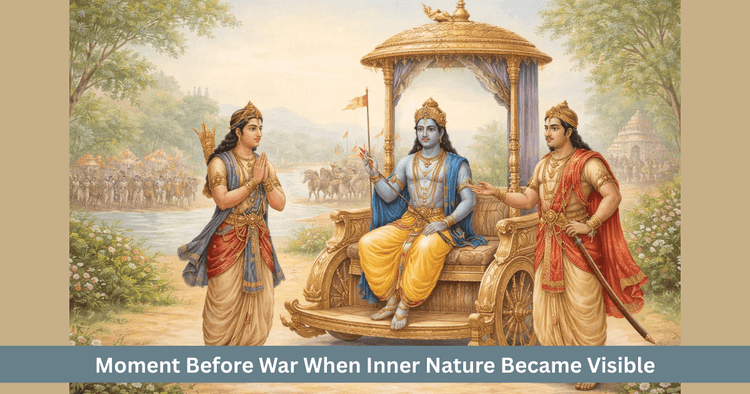
Table of Contents
The Moment Before War When Inner Nature Became Visible
In the well known event of the Mahabharata, when the war of Kurukshetra had been decided, both Arjun and Duryodhan went to Dwarka to seek the support of Krishna. Their intention was the same. Whoever gained Krishna’s support would gain a strong advantage in the coming war. Krishna placed a proposal that looked simple from the outside, yet was very profound within.
On one side he offered his entire Narayani Sena. On the other side he offered himself, with the clear condition that he would remain unarmed and would not fight directly. He would act only as a charioteer and guide. The order of choice was not decided by preference or argument. It was decided by a simple rule of who saw Krishna first and who spoke later. Within that small moment the inner tendencies of both men came to the surface in a very clear way.
Was Krishna’s Decision Really Strange
At first glance it seems natural to ask why Krishna, who stood with dharma, handed such a powerful army to Duryodhan. Why did the side that had followed injustice receive more numbers and more soldiers, while the side standing for justice had only the unarmed presence of Krishna. The question looks simple, yet the answer needs patient reflection.
From the perspective of Sanatan Dharma, Krishna did not push anyone into any corner. He only placed two paths in front of them. One path was the path of outer strength and material power. The other was the path of inner clarity and subtle support. Each person chose what he valued. That is why this episode is seen less as a divine imposition and more as a moment of self revelation, where the true direction of the mind becomes visible.
How Krishna Allowed Nature To Reveal Itself Instead Of Forcing Dharma
Krishna’s way was not to force dharma upon anyone. His approach was to create such a situation that a person’s real nature would express itself through the choices he made.
When he placed two options
- on one side a vast Narayani Sena filled with the finest warriors
- on the other side Krishna himself unarmed, ready only to guide and drive the chariot
he did not pressure either side. Each prince responded according to his own inner alignment.
Duryodhan’s mind remained fixed on numbers and outer power. He believed that victory belongs to those who possess more soldiers. Arjun’s attention went towards trust and direction. He felt that if Krishna stood on his side then the path would appear even if he himself held the weapons.
Here Krishna simply held up a mirror. In that mirror the attachment and maturity within both minds could be clearly seen. Dharma did not come through compulsion. It appeared through their own selection.
Two Choices Two Paths: Power Or Presence
To treat Krishna’s proposal as a mere political manoeuvre is to miss its depth. It became a symbol of two very different ways of living and deciding.
Path Of The Narayani Sena
- visible, measurable and external strength
- faith in immediate impact through force and pressure
- more importance to sheer numbers than to insight
Path Of Krishna’s Unarmed Presence
- subtle intellectual and spiritual support
- the capacity to see beyond surface events
- a focus on dharma, patience and right decision
On the battlefield both kinds of strengths were present. What differed was the angle from which each side looked at the situation. This is why the story still raises a question for every reader. At turning points of life, does one choose only resources or does one choose the right guide.
Table: Inner Meaning Of Krishna’s Two Offers
| Option | Outer form | Inner indication |
|---|---|---|
| Narayani Sena | huge army, excellent warriors | trust in external strength and in numbers |
| Krishna unarmed | only charioteer and guide | trust in inner wisdom and in the side of dharma |
Why Krishna Separated Strength From Strategy
On the level of physical power and training, the Narayani Sena was unmatched. A side supported by such warriors would naturally look almost invincible. Krishna however knew that the number of soldiers is not the last truth in a war.
Krishna himself stood for a very different force, the force that
- can assess time and situation accurately
- can suggest the right step at the right moment
- can understand the changing pattern of events
- and above all can keep the focus fixed on dharma
When he placed the army on one side and his own presence on the other, he hinted that
- outer strength is one type of capital
- yet vision, patience and policy form a deeper capital
Because of this separation, the war did not remain a mere clash of weapons. It became a test of purpose and clarity. Victory would not be determined by arms alone but also by the quality of thought and the purity of intention.
Did Krishna Choose Not To Interfere With The Flow Of Karma
The Mahabharata is built around the principle of karma and its fruits. For many years injustice had taken place
- deceit in the game of dice
- the public insult of Draupadi
- denial of rightful share in the kingdom
- and a repeated pattern of humiliation
All these actions had created a strong field of consequences that had to find expression. If Krishna had given both his army and his guidance to the Pandavas, the war might have ended before that field could fully unfold.
Krishna maintained balance in a very refined way. He
- allowed the side burdened with the weight of injustice to gather outer strength
- and gave his personal presence and dharmic policy to the side that had suffered
After that, the chain of events became the natural result of earlier deeds. The collapse of the Kauravas did not arise from Krishna’s favouritism. It arose from their own actions meeting the right time.
Why A War Of Dharma Must Not Look Biased
If a victory is to be remembered as a victory of dharma, it must not carry the appearance of unfair advantage. Had Krishna stood as a warrior with the Pandavas and also placed his entire army on their side, then future generations might have said that the result came only through direct divine overpowering.
To preserve the pure nature of a dharma yuddha it was important that
- both sides receive support that matched their own orientation
- no one could claim that victory was delivered by an imbalanced force from above
- the final outcome could be clearly traced to conduct and policy
By handing over his army yet remaining personally unarmed, Krishna kept both fairness and guidance intact. The battlefield stayed even in appearance. The deeper tilt came from character and action.
Why The Birth Of The Gita Needed Krishna To Be Unarmed
On the ground of Kurukshetra another event besides war was destined to take place. That event was the inner collapse of Arjun and the revelation of the teachings that later became known as the Bhagavad Gita.
If Krishna had taken up weapons as a fighter then
- his attention would have been consumed by attack and defence
- Arjun’s doubts would have found no quiet space for expression
- the delicate flow of question and answer would have been broken by the urgency of battle
The Gita’s message on duty, detachment, devotion and steady mind arose from a long and concentrated dialogue between the charioteer and the warrior. For that dialogue to unfold, Krishna had to remain in the position of guide rather than of armed commander. In this sense, his unarmed choice was a conscious preparation for the gift of timeless instruction.
How The Choice Exposed Ego And Maturity
The moment of choice in Krishna’s court also revealed a constant pattern in human psychology.
- When a person is led by ego, he tends to choose what is bigger and more visible
- When a person trusts inner guidance, he gives more weight to presence and insight
For Duryodhan, the formula of victory was simple. More soldiers would mean a higher chance of success. For Arjun, the core question was different. He asked who could guide him through confusion and fear. The situation was the same. The reading was entirely different.
Because of this, the episode acts as a mirror for every age. It asks whether one is drawn more towards the size of resources or towards the depth of guidance. The decisions taken before struggle often shape the result more than what happens during the struggle itself.
Can An Army Alone Secure Victory
From the viewpoint of anger and pride it often appears that
- more wealth
- more tools
- more allies
are enough to guarantee success. The event of the Narayani Sena shows another side. When outer resources are not aligned with dharma, their hold becomes weak.
Krishna’s army stood beside Duryodhan in form, yet its deeper alignment remained with the values of Krishna. The flow of power finally settles in the direction where dharma moves. Any large force that fights for an unjust cause begins to crack from inside, even if it seems strong for a time.
Table: Relationship Between Strength, Dharma And Outcome
| Combination | Likely pattern |
|---|---|
| Only external strength | strong beginning but unstable end |
| Only guidance | slow start but deep and lasting influence |
| Strength with dharma | balanced, clear and long term victory |
What This Episode Teaches A Modern Reader
For someone living in today’s world, this episode is much more than an old story. It offers a lens for examining decisions in work, family and society.
At many points in life one stands before choices such as
- career change or partnership
- business expansion or compromise
- family decisions that involve fairness and duty
In each case one path appears easy because it brings quick gain or visible support. The other path appears demanding because it requires standing with values and patient judgement. Krishna’s sharing of his army and his presence reminds us that
- decisions based only on numbers may not hold in the long run
- decisions rooted in dharma and clear thinking create stable success
The deeper teaching is to ask at each serious choice whether one is chasing only strength or also seeking the right guide.
Frequently Asked Questions
1. Why did Krishna give his Narayani Sena to Duryodhan
Krishna placed two very different forms of support on the table and allowed each side to choose according to its own nature. Duryodhan valued numbers and force, so he chose the army. Krishna maintained balance by giving physical strength to one side and his own guidance to the other.
2. Could Krishna have stopped the war completely
On the level of divine power anything is possible, yet the Mahabharata is a field where karma must reveal its full result. Krishna did not force a halt. Instead he ensured that the war unfolded as a fair dharma yuddha in which past actions of each side brought their natural consequences.
3. Why did Arjun prefer Krishna over the army
Arjun understood that right guidance in a critical moment can outweigh the help of many soldiers. He trusted that with Krishna by his side he would not lose the path of dharma, even under intense pressure. This trust led him to choose presence over numbers.
4. Did Krishna’s army on Duryodhan’s side make the war unfair
From the outside it may appear that the Kauravas had an extra advantage. The inner balance came from Krishna’s own presence with the Pandavas. One side had greater numbers, the other had deeper clarity. In this way the contest remained even and the final result pointed to conduct and character.
5. What is the main message of this episode for daily life
The central message is to look beyond immediate gain when making important decisions. It encourages the seeker to value right counsel, ethical alignment and long term impact over short term power. In any field, success built on dharma and wisdom remains far more stable than success built only on strength.
Get your accurate Kundali
Generate KundaliDid you like it?
Author
Pt. Nilesh Sharma (63)
Experience: 20
Consults About: Family Planning, Career
Clients In: Punjab, Haryana, Delhi
Share this article with friends and family
About ZODIAQ
ZODIAQ is an online Vedic Astrology platform. It connects clients seeking astrological advice to experienced astrologers with deep knowledge. Our users also generate kundali and perform kundali milan for free. ZODIAQ also offers services to the Astrologers. Astrologers utilize various offerings by ZODIAQ to serve their clients effectively.
If you are a User
Consult with experienced astrologers and seek their guidance. You can also order handwritten Janm Patrika report with life prediction prepared by experienced astrologers. Generate accurate Kundali, perform Kundali Matching and check horoscope and muhurat. Utilize our online library for all the necessary astrological and spiritual information.
If you are an Astrologer
Create accurate kundali for your clients and perform Kundali Matching for up to 5 people at a time. Write comprehensive Janm Patrika report for your clients with ZODIAQ. Check client details anytime by saving it in client directory. Become more productive by tracking how many clients you guide every day.
WELCOME TO
ZODIAQ
Right Decisions at the right time with ZODIAQ
