Why Ram Left Sita: And What It Teaches Us About Today’s Relationships
By Pt. Suvrat Sharma
A deep look at Ram and Sita’s separation and what it reveals about modern love
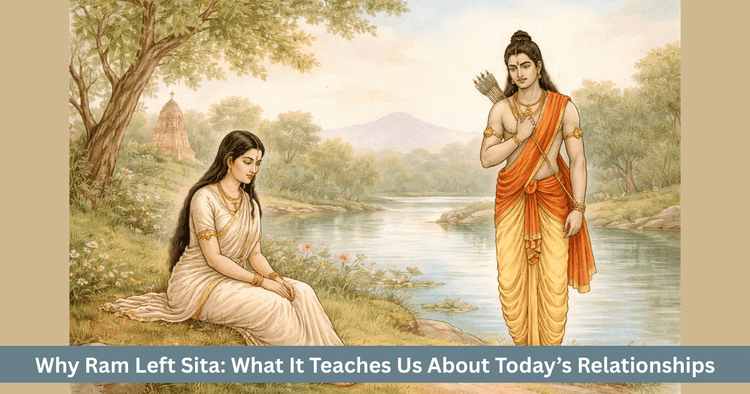
Table of Contents
Few love stories feel as sacred - and as haunting - as that of Ram and Sita. Their loyalty is celebrated, their devotion worshipped. Yet there is one moment that refuses to sit quietly in the heart - the moment Ram chose to send Sita away, after fighting a war to bring her back, after she had already proved her purity.
Why would someone who loved her so deeply let her go so painfully. Was he cruel. Was it just duty. Or was something more complex happening beneath the surface.
Seen through emotional and psychological lenses, this ancient episode becomes less about judging Ram and more about understanding the eternal tension between love, responsibility, image and self‑respect.
What Really Happened: The Story Behind the Separation
After defeating Ravana and rescuing Sita, Ram returned to Ayodhya. There was joy, celebration, coronation - the perfect ending or so it seemed. But over time, whispers began to rise among some citizens:
“Was Sita truly pure after staying in another man’s kingdom for so long.”
Even though she had already undergone the Agni Pariksha and emerged untouched, doubt refused to die. As king, Ram stood between two fires - on one side, his absolute faith and love for Sita; on the other, his duty to maintain the moral trust of his kingdom.
In the end, he chose his duty as king over his desire as a husband. He sent Sita away to the forest, not because he doubted her but because he believed that a ruler’s life was no longer entirely his own.
It was not a lack of love. It was a conflict of roles - and a decision that cost him his own happiness.
1. Love Is Real but Not Always Enough
Ram and Sita did not separate because their love died. They separated while their love was still alive. That is what makes the story so piercing.
In modern life too:
- Many couples still love each other but part ways due to family pressure, caste, religion, location or career
- Some marriages end not because the heart has dried up but because the weight of circumstances becomes too heavy
We like to believe that “If love is true, it will conquer everything.” Their story shows a harder truth - love is powerful but it does not live in a vacuum. It lives inside society, family, culture and expectations.
2. Public Image Versus Private Truth
Ram knew who Sita was. He had seen her courage, purity and loyalty at every step. But as king, his life was lived under constant public scrutiny. The accusations against Sita, though unfair, threatened the trust people had in their ruler.
In today’s world:
- Social media, relatives and community gossip act like a digital Ayodhya, always watching and judging
- Couples feel pressure to “look happy” even when something is broken inside
- Decisions are driven by “What will people say” rather than “What do we truly feel”
Ram’s choice was extreme and it is fair to question it. Yet the pattern is familiar - when we protect our public image at the cost of our private truth, some part of us quietly shatters.
3. Boundaries Are Not Always Betrayal
Sita crossed every limit for Ram - she left her palace, chose exile, faced danger and even walked into fire. But when the dignity of the kingdom seemed at stake, Ram drew a line. He did not doubt her character but he refused to risk the throne’s moral authority.
In healthy relationships:
- Boundaries are not a sign of less love
- Saying “No” to what hurts your integrity is not disloyal
- Refusing to compromise on core values protects both partners in the long run
In modern terms, boundaries look like:
- Not accepting emotional or verbal abuse in the name of “adjustment”
- Saying no to constant suspicion, loyalty tests or control
- Guarding one’s mental, financial and emotional space, even inside love
Ram’s boundary was painful and its fairness can be debated. But the deeper lesson remains - love needs limits to remain respectful.
4. How Easily Trust Gets Shaken by Others
Ram’s trust in Sita did not collapse. But his confidence in keeping her in Ayodhya collapsed under public pressure. The problem lay less between husband and wife and more between king and subjects.
In our lives:
- A single rumor, message or half‑seen story can damage a partner’s image
- Families, friends and outsiders plant seeds of doubt that grow into full‑blown mistrust
- Instead of talking to each other, many couples talk about each other - to everyone else
The Ram-Sita story warns: If we let third‑party voices sit between two hearts, even strong bonds become fragile.
5. Sita: Not Just a Victim but a Woman of Fierce Self‑Respect
When Lakshman left Sita in the forest, she was pregnant, shocked and devastated. Yet she did not beg to return. She did not plead with Ram in public. She chose dignity over desperation.
She accepted shelter in Valmiki’s ashram, raised Luv and Kush with strength and values and built a life not defined solely by being “the abandoned queen.”
In today’s language, Sita was:
- A survivor of deep emotional trauma
- A single mother who rebuilt life from the ground up
- A woman who chose self‑respect over endlessly proving herself
- Someone who knew when to stop standing in the courtroom of public opinion
Her final act - asking Mother Earth to receive her - was not an escape. It was a statement: “My journey is complete. I will not be tested anymore.”
6. The Clash Between Heart and Duty
Ram’s inner pain is easy to overlook. He did not rejoice in Sita’s exile. He lived with it like an open wound. He chose the role of king over the role of husband and accepted the lifelong sorrow that came with that choice.
In our own lives:
- Someone may choose family duty over a relationship and secretly grieve for years
- A person might stay in a job they dislike because others depend on their income
- Parents often sacrifice their desires for their children’s stability
The point is not that every sacrifice is noble. It is that real decisions are often made between two painful options, not between simple right and wrong.
Sita’s Power: Grace, Fire and Inner Wholeness
Sita is not only the woman who suffered; she is the woman who:
- Entered fire with her head held high and emerged untouched
- Endured exile more than once without losing her inner compass
- Raised her sons without poisoning their hearts against their father
- Chose the final moment of her story on her own terms
For modern women and men:
- She shows that you can walk through fire and still not lose your essence
- She reminds you that losing a relationship is not the same as losing yourself
- She proves that worth is measured by how true you remain to your inner dharma, not by who stands beside you in the end
Her strength is quiet but it is immovable.
When Letting Go Is Also a Form of Love
Nothing about Ram sending Sita away feels easy or romantic. And it should not be made to feel that way. Yet, viewed from another angle, it was also a form of sacrifice. He gave up the woman he loved to uphold the standard he believed his role demanded.
In real life:
- Sometimes a partner leaves not because they do not care but because they know they cannot give what the other truly deserves
- Sometimes recognizing your own limitations is itself an act of honesty
- Sometimes love chooses distance rather than staying and causing deeper harm
Letting go is not always the absence of love. Sometimes, it is love without possession, love that refuses to hold someone hostage to your weakness or confusion.
Ancient Moments, Modern Reflections
| Ancient Moment | Modern Reflection |
|---|---|
| Sita’s Agni Pariksha | Being asked again and again to “prove” loyalty - phone checks, passwords, tracking |
| Ram choosing kingdom over marriage | Choosing career, status or family expectations over personal love |
| Sita leaving with quiet dignity | Handling breakup or divorce without revenge, drama or character assassination |
| Gossip in Ayodhya | Social media, relatives and friends shaping how we see our partner |
| Ram’s silent suffering | Especially men hiding emotions to appear “strong” and “in control” |
| Sita’s life in exile | Single parents rebuilding life, identity and home after separation |
Frequently Asked Questions
1. Did Ram actually doubt Sita’s purity
Most traditional interpretations suggest that Ram did not personally doubt Sita. His inner conflict was between his faith in her and his role as a king bound by public perception.
2. Was Ram’s decision right or wrong
From a modern emotional standpoint, many see it as deeply unfair to Sita. From a dharmic standpoint, some see it as a painful sacrifice made for rajdharma. The episode is meant more to provoke reflection than provide a simple verdict.
3. What is the main relationship lesson from their separation
That love alone is not always enough. Trust, boundaries, courage against social pressure and self‑respect are equally important. And that losing a relationship does not mean the love was fake - or that you were unworthy.
4. Should we see Sita only as a victim in this story
No. She is also a symbol of strength, dignity and spiritual maturity. She endured suffering without losing herself and chose her final step on her own terms.
5. How can this story help someone going through a breakup today
It can remind them that:
- A breakup does not erase the love or the value of what was shared
- Walking away with dignity can be healthier than staying in pain to “prove” something
- Your worth is not decided by who stays with you but by how honestly you live with yourself.
Get your accurate Kundali
Generate KundaliDid you like it?
Author
Pt. Suvrat Sharma (63)
Experience: 20
Consults About: Family Planning, Career
Clients In: Punjab, Haryana, Delhi
Share this article with friends and family
About ZODIAQ
ZODIAQ is an online Vedic Astrology platform. It connects clients seeking astrological advice to experienced astrologers with deep knowledge. Our users also generate kundali and perform kundali milan for free. ZODIAQ also offers services to the Astrologers. Astrologers utilize various offerings by ZODIAQ to serve their clients effectively.
If you are a User
Consult with experienced astrologers and seek their guidance. You can also order handwritten Janm Patrika report with life prediction prepared by experienced astrologers. Generate accurate Kundali, perform Kundali Matching and check horoscope and muhurat. Utilize our online library for all the necessary astrological and spiritual information.
If you are an Astrologer
Create accurate kundali for your clients and perform Kundali Matching for up to 5 people at a time. Write comprehensive Janm Patrika report for your clients with ZODIAQ. Check client details anytime by saving it in client directory. Become more productive by tracking how many clients you guide every day.
WELCOME TO
ZODIAQ
Right Decisions at the right time with ZODIAQ
