What Is the Truth About Ram and Sita's Age at Marriage?
By Pt. Amitabh Sharma
Scholarly interpretations, textual contradictions and balanced perspective
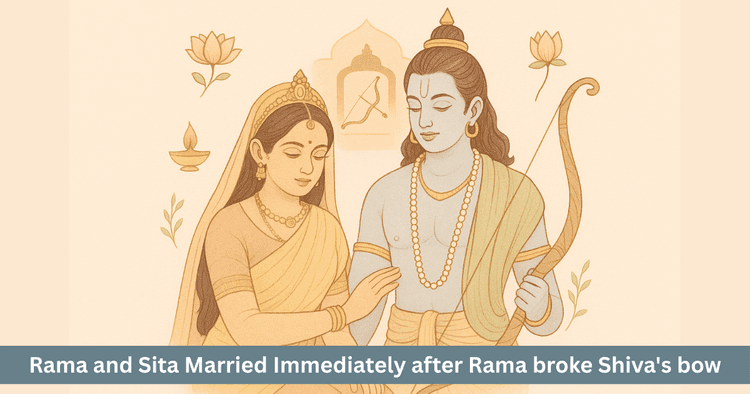
Table of Contents
Marriage in Sanatan Dharma represents not merely the union of two souls but a sacred convergence of destinies and values. The wedding of Lord Rama and Mother Sita stands as the most revered marital ideal in Hindu tradition. However a contentious question arises in modern times: What were the actual ages of Rama and Sita at marriage?
Dispelling Common Myths: The Swayamvara and Bow-Breaking
A popular belief maintains that Rama and Sita married immediately after Rama broke Shiva's bow (Pinaka) at Sita's swayamvara. however this narrative, though found in many retellings, differs from the original Valmiki Ramayana.
According to Valmiki, Rama and Sita had already married when King Janaka took them to worship Lord Shiva's relics in a temple. There, Rama accidentally broke the bow while handling it. Thus, the story of winning Sita by breaking the bow is symbolic, while the actual marriage occurred earlier.
Clues from Rama's Upanayana
In the Ayodhya Kanda of Valmiki's Ramayana, Mother Kaushalya reveals:
"Dasha sapta cha varshani jatasya tava Raghava,
Atitani prakaankshantya maya dukha parikshayam."
Kaushalya states that Rama was 17 years old at his upanayana (sacred thread ceremony). The Ramayana describes Rama as 27 at exile, indicating a decade between these events.
Scholarly Disagreements and Interpretations
Traditional Calculations
Tulsidas writes in Ramcharitmanas:
"Varsha attharah ki Siya, sattaiis ke Ram,
Kinho man abhilash tab, karno hai sur kaam."
This verse clarifies that at exile, Sita was 18 and Rama was 27.
Sita's Statement to Ravana
In Aranya Kanda, Sita tells Ravana:
"Mama bharta mahateja vayasa panchavimshakah.
Ashtadasha hi varshani mama janmani ganyate."
Here Sita explicitly states:
- My illustrious husband Rama is over 25 years old
- I am 18 years old
She adds that she lived in Ayodhya for 12 years after marriage.
The Mathematical Problem
Taking these verses literally:
- At exile: Rama 27, Sita 18
- Years in Ayodhya after marriage: 12
- Ages at marriage: Rama 15, Sita 6
Modern Scholarly Challenges and Reinterpretations
Sanskrit Scholars' Perspective
Many Sanskrit scholars reject this calculation:
- Youth Indication: When Janaka saw Rama-Lakshmana, he called them "samupasthitayauvnau" (having attained youth), appropriate for 25-year-olds, not teenagers.
- Marriage Eligibility: Sita told Anasuya she was at "pati sanyoga sulabham" (suitable age for union with husband), impossible for a 6-year-old.
- Ayurvedic Standards: Sushruta Samhita prescribes 25 years for men and 16 for women as minimum marriage age.
Dvija Age Calculation Theory
Some scholars propose that in ancient times, the age of dvijas (Brahmin, Kshatriya, Vaishya) was calculated from upanayana, not birth. Thus, Rama's "17 years" at exile means post-upanayana years.
Cultural and Historical Context
Ancient Marriage Practices
In ancient India:
- Marriage ceremony occurred at young age
- Actual marital life began at appropriate maturity
- This system protected girls and maintained social order
Modern Misunderstandings
Many contemporary interpreters misunderstand these verses, misusing them to either support or oppose child marriage.
Conclusion: A Balanced Perspective
Careful study of Valmiki Ramayana and other texts reveals:
- Textual Variations: Different Ramayana versions contain age-related contradictions
- Contextual Necessity: Numbers alone are insufficient, social and cultural context is essential
- Symbolic Significance: Rama-Sita's marriage symbolizes dharma, love and ideals, the message matters more than numerical age
Modern society should derive lessons of love, sacrifice, righteousness and ideal living from these narratives, rather than getting entangled in controversial calculations.
Frequently asked questions
Q1. What was the actual age of Rama and Sita at marriage?
A: Texts contain contradictions; scholars believe Rama was around 25 and Sita 16-18.
Q2. Was child marriage prevalent in ancient times?
A: Marriage ceremony and actual marital life were distinct; consummation occurred at appropriate age.
Q3. Why are there age contradictions in Valmiki Ramayana?
A: Different age calculation methods, textual corruption and interpolations cause confusion.
Q4. What's the problem with modern interpretations?
A: Ignoring Sanskrit language nuances, social context and symbolic meaning leads to misunderstanding.
Q5. What should we learn from Rama-Sita's marriage?
A: Messages of love, sacrifice, righteousness and ideal married life are most important.
Get accurate Kundali Matching result
Kundali MatchingDid you like it?
Author
Pt. Amitabh Sharma (56 Years)
Experience: 20
Consults About: Family Planning, Career
Clients In: Punjab, Haryana, Delhi
Share this article with friends and family
About ZODIAQ
ZODIAQ is an online Vedic Astrology platform. It connects clients seeking astrological advice to experienced astrologers with deep knowledge. Our users also generate kundali and perform kundali milan for free. ZODIAQ also offers services to the Astrologers. Astrologers utilize various offerings by ZODIAQ to serve their clients effectively.
If you are a User
Consult with experienced astrologers and seek their guidance. You can also order handwritten Janm Patrika report with life prediction prepared by experienced astrologers. Generate accurate Kundali, perform Kundali Matching and check horoscope and muhurat. Utilize our online library for all the necessary astrological and spiritual information.
If you are an Astrologer
Create accurate kundali for your clients and perform Kundali Matching for up to 5 people at a time. Write comprehensive Janm Patrika report for your clients with ZODIAQ. Check client details anytime by saving it in client directory. Become more productive by tracking how many clients you guide every day.
WELCOME TO
ZODIAQ
Right Decisions at the right time with ZODIAQ
