The Five Critical Junctures Where Yudhishthira Could Have Chosen Differently
By Pt. Amitabh Sharma
From refusing dice to time bound diplomacy, an analysis of Yudhishthira’s inner inertia and political options
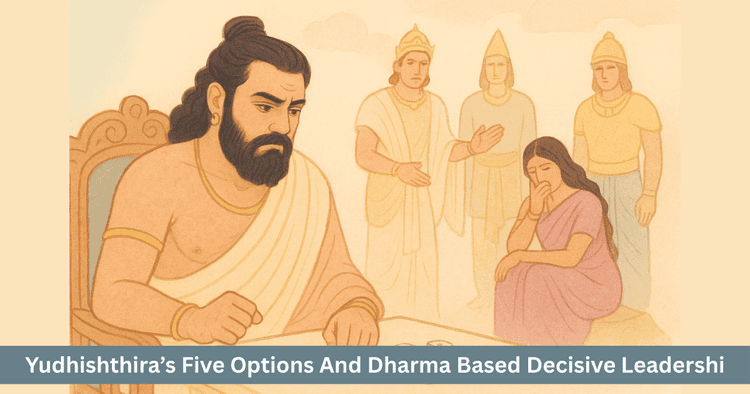
Table of Contents
The Mahabharata is not merely a war epic; it is also a psychological exploration of how an intelligent and virtuous individual, endowed with wisdom, legitimacy and divine counsel, can still succumb to inner conflict. Yudhishthira was not a victim of fate or circumstance but of his own divided nature. He understood dharma better than most, yet he often failed to live by it. He possessed the legitimacy of birth, the support of powerful allies and Krishna’s guidance. Yet, despite this power, he allowed indecision, over-rationalization and psychological paralysis to shape his destiny. At five key moments, firm choices could have completely altered the course of history.
A Detailed Overview Of The Five Alternatives
| No. | Situation | What Yudhishthira Could Have Done | What Actually Happened | Probable Outcome If He Acted Correctly |
|---|---|---|---|---|
| 1 | First invitation to the dice game | Firm refusal and assertion of rightful authority before Dhritarashtra | Accepted the invitation and played a rigged game | Humiliation, exile and vengeance cycle would not arise; reconciliation becomes possible |
| 2 | Asserting succession claim in youth | Convened formal succession with allies and Krishna as mediator | Accepted co-rule and remained passive | Dhritarashtra would be compelled to decide early; Pandava legitimacy becomes formal |
| 3 | After first defeat | Vow to abandon dice and rebuild inner discipline | Accepted second game and lost again | Thirteen-year exile avoided; regained moral and political strength |
| 4 | During Draupadi’s humiliation | Stand up in the court and intervene both physically and morally | Remained silent and rationalized inaction through codes | Draupadi’s dignity preserved; Pandava morale remains strong; war psychology defused |
| 5 | During pre-war diplomacy | Issue a time-bound ultimatum or demand public arbitration | Engaged in endless pleas and negotiations | Opponent forced to decide or negotiate; war, if inevitable, fought on Pandava terms |
1. Why The First Game Should Have Been Refused
Duryodhana’s invitation was not a gesture of goodwill but a trap. Yudhishthira could have declared that honor lies in fair combat, not in manipulation. By rejecting the invitation, he would have affirmed that true kingship requires discernment. He could have presented his claim to co-rule before Dhritarashtra and sought mediation through proper royal channels. A single act of refusal would have saved the Pandavas from humiliation and exile. The first domino of destruction would never have fallen.
Why This Moment Was Decisive
The refusal would symbolize the union of intellect and courage. It would prove that dharma is not submission to form but allegiance to justice. It was a chance to stabilize the psychological weakness his debilitated Moon reflected.
2. Early Assertion Of Royal Succession
Yudhishthira’s right to the throne was unquestionable. He was the legitimate heir of Pandu and morally superior to Duryodhana. He had allies in Virata, Drupada and Krishna. If he had convened a royal council early and demanded succession with Krishna as arbitrator, Dhritarashtra would have been forced to act before Duryodhana’s power matured. Even if Dhritarashtra denied him, Yudhishthira could have established an allied capital, creating a balance of power that forced negotiation.
Why This Alternative Was Crucial
It would have confronted his passive temperament. When one accepts marginalization, the rival grows bold. By taking initiative, Yudhishthira could have reshaped both perception and reality, converting moral authority into institutional power.
3. Renunciation Of Gambling After The First Defeat
The first dice game should have been enough to awaken him. Having lost everything, he had a chance to redefine himself. He could have transformed exile into an inner pilgrimage of renewal. Instead, he succumbed to compulsion again and played the second game, sealing the Pandavas’ fate. His relapse revealed the depth of his psychological dependency and the disintegration of willpower.
Why This Decision Would Have Been Transformative
Refusing the second game would have marked true self-mastery. It would demonstrate that he could learn from error and rebuild moral integrity. Without exile, the Pandavas could rebuild alliances, gain resources and return stronger. This would turn the narrative from defeat to evolution.
4. Intervention During Draupadi’s Humiliation
The assembly that witnessed Draupadi’s ordeal was a test of dharma itself. Yudhishthira’s silence, justified through the law of servitude, was a tragic distortion. If he had risen and said, “No code or vow can sanction injustice against a woman,” the entire court would have turned. He could have called on the elders to bear witness and remind the court that dharma lies in protection, not in technicality. A decisive stand would have protected Draupadi, preserved the moral dignity of the Pandavas and changed the political psychology of the era.
Why This Intervention Mattered Most
This moment defined the emotional landscape that led to war. The trauma of Draupadi’s humiliation became the fuel of revenge. Courage at that moment could have healed the wound that later destroyed kingdoms. Silence here became complicity.
5. Time-Bound Diplomacy With Moral Force
Yudhishthira’s quest for peace was noble but lacked structure. Endless negotiation without boundaries became a mask for indecision. A clear ultimatum , “Return our share by this date or face consequences” , would have forced action. Alternatively, he could have proposed public arbitration, binding both parties to a collective verdict. Such firmness would either secure peace or ensure that war occurred under fair and prepared conditions.
Why This Approach Was Sound
Peace needs backbone. Excessive humility erodes respect. When clarity of time and consequence is added to moral intent, diplomacy gains credibility. Without firmness, negotiation becomes a stage for manipulation.
The Inner Thread: Psychological Passivity Disguised As Virtue
Across these five alternatives, the same pattern appears. Yudhishthira repeatedly clothed his inner hesitation in the language of dharma. His debilitated Moon symbolized discomfort with confrontation, turning avoidance into moral reasoning. True dharma demands engagement with difficulty, not retreat from it. His failure was not ignorance but unwillingness to face inner conflict. Each missed opportunity shows the cost of confusing calmness with cowardice.
Lessons For Readers Today
- Dharma remains alive only when it defends justice, not when it hides behind rules.
- Peace requires firmness as its foundation, not endless persuasion.
- Discipline transforms intellect into action; without it, wisdom decays.
- Decisions need time frames; open-ended waiting drains strength.
- Chant peace mantras for the Moon, practice breath discipline, maintain honest companionship and reflect daily to align mind and action.
- Never confuse patience with inaction; righteous firmness is a spiritual duty.
Frequently Asked Questions
Q1. Would refusal of the first dice game really have changed everything
A1. Yes. It would have deprived the Kauravas of their excuse to humiliate and exile the Pandavas. The entire chain of vengeance would not begin.
Q2. Was an early claim to succession feasible at that time
A2. Absolutely. With Krishna and allied kings’ backing, Dhritarashtra would have faced political pressure and had to formalize Yudhishthira’s authority early.
**Q3. Could avoiding the second game have prevented the exile
Find out what your Lagna says
What is my Lagna?Did you like it?
Author
Pt. Amitabh Sharma (56 Years)
Experience: 20
Consults About: Family Planning, Career
Clients In: Punjab, Haryana, Delhi
Share this article with friends and family
About ZODIAQ
ZODIAQ is an online Vedic Astrology platform. It connects clients seeking astrological advice to experienced astrologers with deep knowledge. Our users also generate kundali and perform kundali milan for free. ZODIAQ also offers services to the Astrologers. Astrologers utilize various offerings by ZODIAQ to serve their clients effectively.
If you are a User
Consult with experienced astrologers and seek their guidance. You can also order handwritten Janm Patrika report with life prediction prepared by experienced astrologers. Generate accurate Kundali, perform Kundali Matching and check horoscope and muhurat. Utilize our online library for all the necessary astrological and spiritual information.
If you are an Astrologer
Create accurate kundali for your clients and perform Kundali Matching for up to 5 people at a time. Write comprehensive Janm Patrika report for your clients with ZODIAQ. Check client details anytime by saving it in client directory. Become more productive by tracking how many clients you guide every day.
WELCOME TO
ZODIAQ
Right Decisions at the right time with ZODIAQ
