5 Secret Shiva Mantras to Calm Your Mind and Heart
By Pt. Amitabh Sharma
Powerful Ancient Shiva Mantras for Emotional Balance and Spiritual Peace
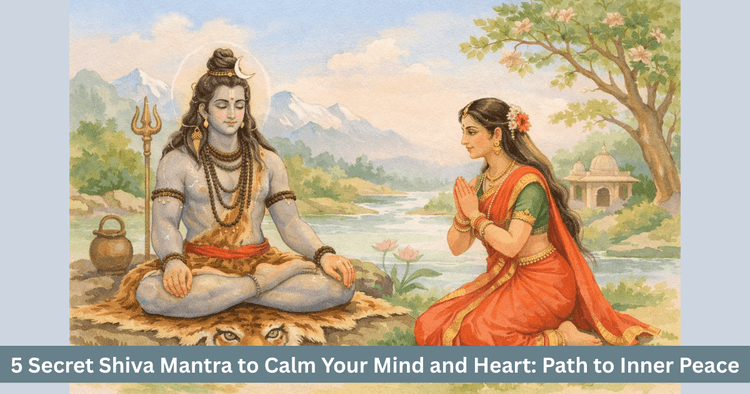
Table of Contents
There comes a point when the noise in your mind becomes louder than the world outside. You try to let go, you really do but pain has this strange loyalty. It keeps showing up, disguised as memory, as hope, as "maybe someday." That's when you stop trying to fix it. And instead, you rise above it.
That's where Shiva steps in not as a god sitting in the sky but as a presence within you that refuses to break even when everything else does. Shiva represents the consciousness that watches pain but doesn't become it. These five Shiva mantras aren't superstition. They are states of being. Each one carries an energy that untangles you from what you no longer need to hold. If you chant them with awareness, they don't just change how you feel they change who you are.
Panchakshari Mantra: The Gateway to Universal Peace
Mantra: Om Namah Shivaya
Translation: I bow to Shiva, the inner Self.
This is the simplest and yet the most profound mantra five syllables that hold the entire universe. "Om Namah Shivaya" is not about worship; it's about remembrance. It reminds you that peace isn't something you find after chaos. It's what's been sitting quietly behind your chaos all along.
The Hidden Meaning and Significance
Each syllable of the Panchakshari Mantra has deep symbolic meaning:
- Na - Represents the earth element and physical body
- Ma - Symbolizes the water element and emotional body
- Shi - Reflects the fire element and energetic will
- Va - Indicates the air element and mental realm
- Ya - Represents the space element and spiritual consciousness
Every time you repeat this mantra, you're not escaping life you're returning to yourself. You're bowing not to a deity but to that still, wise awareness inside you that says, "Even this storm will pass. And I will still be here."
Practice Method and Application
Chant this mantra daily in the early morning before sunrise or in the evening during sunset in a quiet place. You can chant it 108 times, 54 times or 27 times. The key is not how many times you chant but with how much presence and feeling.
Synchronize with your breath inhale on "Om Namah," exhale on "Shivaya." This technique anchors you in the present moment and reduces mental wandering.
Chant When: You're tired of reacting and ready to start responding. When you find yourself lost in others' expectations, past regrets or future worries.
Maha Mrityunjaya Mantra: Beyond Death and Fear
Mantra:
Om Tryambakam Yajamahe Sugandhim Pushtivardhanam।
Urvarukamiva Bandhanan Mrityor Mukshiya Maamritat॥
Translation: We worship the three-eyed One who nurtures all beings; may He liberate us from bondage to death, like a cucumber is severed from its stem.
The Spiritual Power of the Mantra
This mantra doesn't just heal the body; it heals the attachment to survival itself. Heartbreak, loss, betrayal they all share one thing in common: fear. Fear of ending. Fear of not being loved again. Fear that something precious is gone forever.
The Maha Mrityunjaya Mantra cuts through that illusion. It teaches you that endings aren't death they're transformation. You don't lose people; you lose illusions. You don't die; you evolve.
The Symbolism of Three Eyes
Shiva's three eyes represent three types of vision:
- Physical Eye - Seeing the external world
- Mental Eye - Seeing internal thoughts and emotions
- Spiritual Eye - Seeing the ultimate truth, beyond maya
When you chant this mantra, your pain doesn't vanish overnight but it stops defining you. It becomes just another wave in the ocean that you now realize... you are.
Practice for Healing and Rejuvenation
This mantra is especially powerful when you are:
- Facing a serious illness or health challenge
- Going through the loss of a loved one
- Experiencing a difficult transition or ending in life
- Feeling overwhelmed by fear and anxiety
After morning bath, sit facing east. Hold the image of Shiva in your mind third eye open, calm and compassionate. Chant the mantra at least 108 times, letting each word resonate in the depths of your being.
Chant When: You need to stop seeing pain as punishment and start seeing it as purification. When you're ready for transformation, not just relief.
Rudra Mantra: The Destruction of Fear
Mantra: Om Namo Bhagavate Rudraya
Translation: I bow to the fierce form of Shiva, Rudra.
Rudra: The Fire of Transformation
This is not a gentle chant. Rudra is the aspect of Shiva that destroys illusions with ruthless compassion. Chanting this mantra is like looking your fear in the eye and saying, "Do your worst. I'm not running anymore."
Rudra doesn't remove your storms; he makes you so vast that the storms fit inside you. This mantra burns away emotional dependency, toxic attachments and the false sense that peace lies in control. It leaves you raw, yes but in that rawness, you become real.
Understanding the Power of Rudra
Rudra means "the one who makes cry" or "the one who removes sorrow." This paradoxical name reflects Rudra's nature he first breaks your illusions (which can be painful) and then he leads you to true freedom.
When you chant the Rudra mantra, you're preparing to:
- Face the toxic elements in your life
- Leave false comfort zones
- Accept your shadow side
- Let old patterns and identities die
The Right Way to Practice
Rudra mantra chanting is intense. Don't take it lightly. It requires you to be genuinely ready for transformation. Avoid half-hearted chanting.
Monday is considered especially powerful (Shiva's day). In the early morning or late at night, when the world is quiet, find a peaceful place. Light a lamp, preferably of mustard oil. Sit with a straight spine, eyes closed.
Take a deep breath and pronounce the mantra. With each repetition, imagine a powerful fire burning away all fear, attachment and negativity from within you. Repeat the mantra at least 108 times.
Chant When: You're ready to stop being a victim of your own emotions. When you need to break old patterns and step into your true power.
Shiva Gayatri Mantra: Awakening the Inner Light
Mantra:
Om Tatpurushaya Vidmahe Mahadevaya Dhimahi।
Tanno Rudrah Prachodayat॥
Translation: We meditate upon the Supreme Being, Mahadeva. May that divine consciousness awaken our inner light.
The Mantra of Illumination
This is the mantra of illumination. It doesn't ask for strength or healing it gives clarity. The Shiva Gayatri doesn't numb you from emotions; it helps you see through them. It brings awareness so sharp that even grief feels sacred.
You begin to realize you were never meant to escape emotions. You were meant to witness them without drowning. This mantra is like the pause between two thoughts, the silence between two heartbeats, where peace quietly hides.
Working on Three Levels
The Shiva Gayatri Mantra works on three levels:
Intellectual Level: It clarifies the mind organizes thoughts and deepens understanding.
Emotional Level: It calms the heart, balances emotions and enhances compassion.
Spiritual Level: It awakens inner wisdom, opens intuition and strengthens connection with the divine.
Method of Meditation and Chanting
This mantra is most effective when chanted with meditation. In the morning or evening, sit in a quiet place. Keep your spine straight, hands in a meditative mudra.
First, spend a few minutes deep breathing. Let the mind settle. Then slowly begin chanting the mantra. Feel each word, let it resonate in your being.
Repeat the mantra 108 times. Then sit in silence for a few minutes, experiencing the resulting peace and clarity.
Chant When: You're seeking understanding, not escape. When you need to untangle confusion, make decisions or find clarity in life's challenges.
Shiva Dhyan Mantra: Merging into Completeness
Mantra: Om Shantaya Maheshwaraya Swastyananteya Te Namah
Translation: Salutations to the peaceful Shiva, the source of auspiciousness and bliss.
The Door to Ultimate Peace
If the other mantras are rivers, this one is the ocean. The Shiva Dhyan Mantra is for meditation, for dissolving identity, story and all the noise that makes you forget you're infinite. It brings you face to face with stillness and that stillness doesn't speak but somehow says everything.
You begin to see that emotional freedom isn't about being indifferent. It's about being complete. When you are full within yourself, nothing outside you can take or add anything.
The State of Deep Meditation
The Shiva Dhyan Mantra leads you toward samadhi the state where the seer, the seen and the act of seeing all become one. In this state:
- The sense of time dissolves
- The illusion of separation falls away
- Profound peace and bliss emerge
- You experience your true nature infinite consciousness
This doesn't happen instantly. It's the fruit of regular, dedicated practice. But with each chant, you move closer to that state.
Advanced Practice of Sadhana
For deep meditation practice with this mantra:
Preparation: Bathe, wear clean clothes. Light incense. Choose a quiet, clean space.
Posture: Sit in Padmasana or Sukhasana. Keep spine straight but comfortable.
Pranayama: Do Anulom-Vilom or Bhramari Pranayama for 5-10 minutes.
Mantra Japa: Slowly, clearly chant the mantra. Repeat 108 times. You can use a mala.
Silent Meditation: After completing the chant, sit in silence for 10-20 minutes. Just be, without effort, without goal.
Conclusion: Gradually bring awareness back. Before opening your eyes, express gratitude for the peace experienced.
Chant When: You want peace that doesn't depend on people, places or outcomes. When you want to know your true nature beyond limitations, beyond identity, even beyond personality.
Shiva Is the Calm Within You
Every mantra is a doorway, not a destination. You don't chant to please a god you chant to remember that you are made of the same silence that gods live in.
Shiva doesn't promise a life without pain. He promises awareness that survives it. And when you start living from that space where love doesn't make you weak, loss doesn't make you bitter and change doesn't make you fearful that's when emotional freedom stops being a concept... and becomes your natural state.
Because true detachment isn't walking away. It's staying but no longer suffering.
Practical Tips for Sadhana
General Guidelines
Regularity: Make mantra chanting a daily practice. Choose the same time and place.
Cleanliness: Maintain both physical and mental cleanliness. Chant after bathing.
Posture: Sit in a comfortable but alert position. Don't chant lying down as you may fall asleep.
Direction: Sit facing east or north. These directions are considered favorable for spiritual energy.
Mala: Use a Rudraksha mala of 108 beads. It helps keep count and enhances energy.
Pronunciation: Clear, pure pronunciation of words is important. If you're unsure, learn the correct pronunciation first.
Feeling: Don't just repeat mechanically. Feel and understand the meaning of each mantra.
Things to Avoid
- Chanting immediately after eating
- Chanting in noisy or distracting environments
- Chanting in haste or mindlessly
- Chanting with expectation of results (maintain detachment)
- Chanting in an impure or negative state of mind
Facing Challenges
Mind Wanders: This is normal. When you notice, gently return to the mantra. Don't blame yourself.
Boredom or Reluctance: This is a sign of resistance. Continue anyway. Often the biggest breakthroughs come after pushing through resistance.
No Immediate Effect: Mantras work subtly. Be patient. Changes will manifest over time.
Emotional Upheaval: Sometimes mantra chanting can bring suppressed emotions to the surface. This is part of purification. Allow it but don't get lost in it.
The Scientific Aspects of Mantras
Modern science is now understanding what ancient rishis knew millennia ago sound vibrations have transformative power.
Neuroscience and Mantras
Studies show that mantra chanting:
- Changes brain waves, increasing alpha and theta waves (associated with relaxation and meditation)
- Reduces the stress hormone cortisol
- Increases neurotransmitters serotonin and dopamine associated with happiness
- Calms the Default Mode Network (involved in anxiety and self-referential thoughts)
- Strengthens the prefrontal cortex (responsible for decision-making and emotional regulation)
Vibrational Therapy
Each mantra vibrates at a specific frequency. These vibrations:
- Affect every cell in the body
- Balance chakras (energy centers)
- Clear energy blockages
- Promote healing at the molecular level
The sound of Om specifically vibrates at 432 Hz resonating with the natural frequency of the universe.
Mantra Selection for Different Life Situations
For Acute Stress or Anxiety
Panchakshari Mantra - Its simplicity and universal nature make it ideal for quick relief.
For Health Challenges
Maha Mrityunjaya Mantra - Powerful for both physical and emotional healing.
For Major Life Changes
Rudra Mantra - Helps destroy the old and make space for the new.
For Decision Making and Clarity
Shiva Gayatri Mantra - Sharpens intellect and provides insight.
For Deep Spiritual Practice
Shiva Dhyan Mantra - Leads to ultimate peace and self-realization.
Combined Practice of Mantras
For a complete sadhana, you can chant all five mantras in sequence:
Panchakshari Mantra (108 times) - To center and stabilize Maha Mrityunjaya Mantra (21 times) - For healing and protection Rudra Mantra (11 times) - For purification and transformation Shiva Gayatri Mantra (27 times) - For enlightenment Shiva Dhyan Mantra (54 times) - For deep peace
This combined practice takes approximately 45-60 minutes and provides a deep, multi-dimensional spiritual experience.
Final Thoughts: The Path of Shiva
Shiva teaches us that real power is not in destruction it's in remaining unchanged. True peace is not the absence of noise it's the silence in the middle of the storm. The deepest love is not attachment it's freedom.
When you chant these mantras, you're not asking to become Shiva. You're remembering that you have always been Shiva indestructible, peaceful, complete.
The world may change or not change. People may stay or go. Circumstances will fluctuate. But that Shiva within you that consciousness, that awareness, that peace remains unbroken.
This is the ultimate freedom. This is coming home.
Frequently Asked Questions
Can I chant these mantras without initiation?
Yes. These mantras are universal and can be chanted by anyone with sincerity and respect. however receiving initiation from a guru can deepen the practice.
How long will it take to see results?
It depends on the individual, the intensity of their practice and their condition. Some feel peace immediately; for others, changes manifest gradually over weeks or months. Patience and consistency are key.
Should I chant all five mantras or just one?
You can start with one mantra that resonates most with you. As you become comfortable, you can add more. Quality is more important than quantity.
Can women chant these mantras during menstruation?
Yes. It's an old misconception that women cannot do spiritual practices during menstruation. Mantra chanting is an act of consciousness, unaffected by physical condition.
Can I chant the mantra mentally or do I have to say it aloud?
Both are effective. Chanting aloud (vachik japa) has physical vibration. Mental chanting (manasik japa) is more subtle and deep. You can choose according to your preference.
Get your accurate Kundali
Generate KundaliDid you like it?
Author
Pt. Amitabh Sharma (56 Years)
Experience: 20
Consults About: Family Planning, Career
Clients In: Punjab, Haryana, Delhi
Share this article with friends and family
About ZODIAQ
ZODIAQ is an online Vedic Astrology platform. It connects clients seeking astrological advice to experienced astrologers with deep knowledge. Our users also generate kundali and perform kundali milan for free. ZODIAQ also offers services to the Astrologers. Astrologers utilize various offerings by ZODIAQ to serve their clients effectively.
If you are a User
Consult with experienced astrologers and seek their guidance. You can also order handwritten Janm Patrika report with life prediction prepared by experienced astrologers. Generate accurate Kundali, perform Kundali Matching and check horoscope and muhurat. Utilize our online library for all the necessary astrological and spiritual information.
If you are an Astrologer
Create accurate kundali for your clients and perform Kundali Matching for up to 5 people at a time. Write comprehensive Janm Patrika report for your clients with ZODIAQ. Check client details anytime by saving it in client directory. Become more productive by tracking how many clients you guide every day.
WELCOME TO
ZODIAQ
Right Decisions at the right time with ZODIAQ
