The Maha Mrityunjaya Mantra: Ancient Prayer That Transforms Fear Into Liberation
By Pt. Narendra Sharma
When Ancient Prayer Meets Life's Greatest Challenge
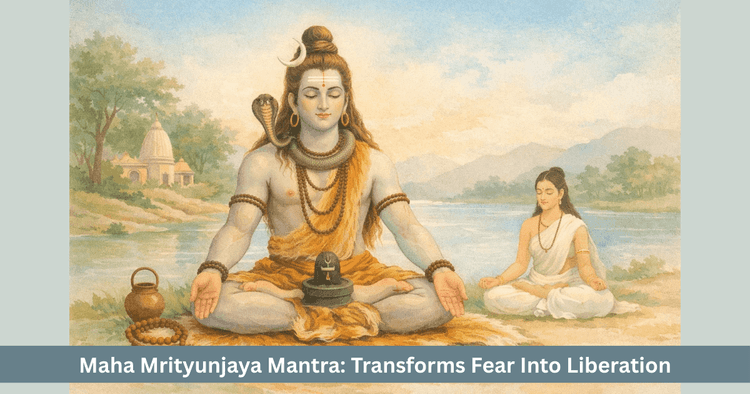
Table of Contents
Introduction: When Ancient Prayer Meets Life's Greatest Challenge
In moments of crisis, when illness strikes, when fear grips the heart, when death seems imminent, millions turn to the [Maha Mrityunjaya Mantra]. This sacred chant, preserved for over three thousand years in the ancient Vedas, continues to offer solace to those facing their deepest fears. Yet the power of this mantra extends far beyond crisis intervention. It addresses humanity's most fundamental challenge: the fear of death and the yearning for liberation. What makes this mantra extraordinary is not merely that it has survived millennia, many prayers have done that. Rather, it is that each generation rediscovers its relevance, finding in its ancient words precisely the spiritual medicine needed for contemporary suffering. In Sanskrit, this mantra is sometimes called the "Mantra of Liberation" or the "Death-Conquering Prayer", yet these translations barely capture its profound depth.
The [Maha Mrityunjaya Mantra] teaches something radical: death is not the ultimate enemy to be fought but a bondage to be transcended. True power lies not in prolonging life indefinitely but in achieving such spiritual liberation that even death loses its terror. The mantra represents not the denial of mortality but the transformation of consciousness itself. It shifts the fundamental relationship between the individual and death from one of fear and resistance to one of acceptance and transcendence. This transformation represents the ultimate victory, not over death but over the consciousness that fears it.
The Legend: When a Child Chanted to Escape Destiny
The Child Born Under a Death Sentence
Long before modern medicine, long before written horoscopes could be double-checked or disputed, the sage Mrikandu and his wife Marundevî received devastating news that would shape the spiritual destiny of their unborn child. A great sage had predicted that their son, if born, would live only sixteen years. He would die young, dramatically, in an encounter with death itself. This prophecy cast a shadow of doom over the contemplated conception of their child. Faced with this prophecy, most parents would despair, abandon hope or refuse to bring the child into existence. But Mrikandu possessed something deeper than pessimism or resignation, he possessed faith in the divine and understanding that human destiny could be transcended through spiritual practice.
He and his wife performed rigorous spiritual practices with unwavering dedication, praying to Lord Shiva for protection and wisdom. Their prayer was not a plea for miracle intervention but a sincere request for the spiritual tools to transcend fate itself. Their prayer was answered not with a change of fate but with a divine tool to transcend fate itself, a mantra of such power that it could free consciousness from bondage to time and death.
They received the [Maha Mrityunjaya Mantra], the secret knowledge of how to invoke protection and transformation through the power of sound, intention and devotion.
The Child's Unwavering Practice
Their son, [Markandeya], destined to become one of the greatest sages in Hindu tradition, learned this sacred mantra and began chanting it with absolute dedication that transcended ordinary spiritual practice. Unlike ordinary practice involving mechanical repetition and rote recitation, [Markandeya]]'s chanting was genuine communion with the divine consciousness the mantra invoked. His practice was not duty but love, not obligation but passionate engagement with truth itself.
Day after day, he chanted with increasing depth. Night after night, he meditated on the mantra's meaning, contemplating how each syllable connected to cosmic reality. His devotion was so complete that his entire being became an instrument through which the mantra could express itself. His individual consciousness began to dissolve into the mantra and the mantra began to work through him at levels he consciously could not control. This is the nature of authentic spiritual practice, the ego gradually surrenders to the sacred principle it invokes.
The Crisis and the Vision
As [Markandeya]] approached his sixteenth year, the year of prophesied death, the foreboding day drew near with inexorable certainty. The appointed time of death seemed to be approaching inevitably, despite all spiritual preparation. On the fateful day when death forces were said to arrive to claim the life promised to them, as he sat in deep meditation chanting the mantra, Lord Shiva appeared before him. Not as a distant deity confined to heavenly realms but as a tangible, protective presence that he could perceive directly.
What happened next exists at the intersection of mythology and spiritual truth: the death forces that had come to claim the boy encountered not a helpless child but the overwhelming presence of Shiva himself, who had been invoked through the mantra's power. The protective consciousness invoked through the mantra became palpable reality. The forces of death withdrew in the face of such divine presence. Shiva granted [Markandeya]] not merely extended life but immortality and eternal youth, not as endless bodily existence but as consciousness freed from time's dominion and death's terror.
The Teaching Embedded in the Legend
This ancient story encodes something essential about the nature of spiritual power: the mantra is not a magic charm that prevents death but a gateway to consciousness that transcends death's power. [Markandeya]] didn't survive because he avoided death but because he transcended the fear of it through unwavering devotion. His consciousness aligned so completely with the divine that death had no dominion over him. The legend teaches that true protection comes not from escaping what threatens us but from expanding consciousness to encompass what previously threatened it. This represents the ultimate transformation available to human consciousness.
The Text: Words That Bridge the Seen and Unseen
The Complete Mantra
[ॐ त्र्यम्बकं यजामहे सुगन्धिं पुष्टिवर्धनम्। उर्वारुकमिव बन्धनान् मृत्योर्मुक्षीय माऽमृतात्।।]
The Line-by-Line Architecture
Om ([ॐ]): The primordial sound, the vibration from which all existence emerges. More than a word, it is the cosmic frequency itself, chanting Om aligns individual consciousness with universal consciousness. This sacred syllable represents the totality of existence, containing within it all that was, is and will be. When chanted properly, the sound Om creates vibrational coherence between the individual nervous system and cosmic frequencies. It is the gateway through which all other mantras gain their power and efficacy. Scientists studying sound have noted that Om's frequency aligns remarkably with natural resonances in the human body and throughout nature.
Tryambakam ([त्र्यम्बकं]): The three-eyed one, referring to Shiva in his form as the supreme consciousness. The three eyes represent three dimensions of perception and three levels of cosmic function. The third eye represents spiritual vision that perceives beyond ordinary sight, the eye of destruction that sees through illusion to underlying reality and the eye of cosmic consciousness observing all existence simultaneously. These three eyes metaphorically represent the capacity to see the past (first eye), present (second eye) and future (third eye) with equal clarity. Invoking this three-eyed deity invokes comprehensive divine vision.
Yajamahe ([यजामहे]): We worship, we honor, we make offerings to. This is not submission but active engagement and relationship, establishing conscious dialogue with the divine. The word encompasses the entire spectrum of devotional engagement, from ritual offering to heartfelt prayer to complete surrender of individual will. By chanting this word, you enter into active relationship with Shiva rather than passively hoping for intervention from a distant deity. You become an active participant in sacred relationship.
Sugandhim ([सुगन्धिं]): The fragrant one, representing the essence of divine auspiciousness. Fragrance represents several interconnected qualities. First, it represents auspiciousness and purity, that which naturally attracts and uplifts consciousness. Second, it represents that which permeates everywhere without being visibly present. Fragrance travels through space without physical structure, penetrating all obstacles, symbolizing how divine consciousness pervades creation. Third, it represents the subtle nature of divinity itself, imperceptible to ordinary senses yet undeniably present. Finally, fragrance represents goodness that naturally attracts and elevates consciousness without force or coercion. This quality of the divine draws all beings toward it through natural affinity.
Pushtivardhanam ([पुष्टिवर्धनम्]): The nurturer of strength and well-being. [Pushti]] means growth, nourishment, abundance and flourishing. This term invokes the divine principle that sustains, strengthens and helps everything grow and flourish. It represents the nurturing dimension of the ultimate reality, not merely as destroyer or judge but as provider and sustainer of life. This divine principle supports the growth and development of all beings toward their fullest potential. Invoking this quality, you call upon divine support for your own growth and evolution.
Urvarukamiva ([उर्वारुकमिव]): Like a ripe cucumber, representing perhaps the most profound imagery in the entire mantra. This comparison encodes deep wisdom about death, separation and liberation. The ripe cucumber naturally separates from its vine when the time is right. It doesn't tear, struggle or resist separation. The separation occurs as a natural fruition, not violence or tragedy. The connection breaks easily and painlessly when the time is right and ripeness is complete. This imagery teaches that death, like fruit falling from the tree at ripeness, is a natural process aligned with cosmic order. When consciousness is "ripe" through spiritual development, separation from limited physical form occurs naturally and painlessly. This metaphor transforms death from dreaded calamity into natural fruition.
Bandhanan ([बन्धनान्]): From bondage, encompassing multiple interconnected forms of binding. We are bound to the cycle of birth and death through ignorance and karma. We are bound to karma and its consequences through accumulated actions. We are bound to ego and false identity through habitual misidentification with limited body and mind. We are bound to fear and attachment through evolutionary conditioning and psychological patterns. The mantra calls for liberation from all these interrelated forms of bondage. This is not physical escape but consciousness freedom.
Mrityor ([मृत्योः]): From death, representing more than physical mortality. This encompasses all forms of ending, loss, dissolution and the fundamental fear underlying all human anxiety. The terror of death represents the ultimate fear, all other fears derive from this primal fear of non-existence. By invoking liberation specifically from death, the mantra addresses the root fear from which all other suffering springs. Transcending death fear liberates consciousness from the pattern of fear itself.
Mukshiya ([मुक्षीय]): Liberate, free, release. This is not passive escape but active liberation through knowledge and grace. It encompasses freedom from the interior subjective experience of bondage. The goal is not to prevent death externally but to transform the interior consciousness so death holds no power. This liberation represents the ultimate freedom, freedom from the conditioning that creates suffering in relationship to inevitable universal processes.
Maamritat ([माऽमृतात्]): Grant me immortality. [Amrita]] literally means "without death" but not endless physical existence in time. Rather, consciousness freed from the fear of death, touching the eternal, that dimension of reality that transcends time. True immortality, in this context, means consciousness liberated from identification with that which dies, recognizing itself as the eternal witness to all change.
| Mantra Element | Sanskrit | Meaning | Spiritual Function |
|---|---|---|---|
| Om | ॐ | Primordial sound | Cosmic alignment |
| Tryambakam | त्र्यम्बकं | Three-eyed | Comprehensive vision |
| Yajamahe | यजामहे | We worship | Active engagement |
| Sugandhim | सुगन्धिं | Fragrant | Pervasive presence |
| Pushtivardhanam | पुष्टिवर्धनम् | Nourishing | Sustaining support |
The Paradox of the Entire Mantra
The genius of the [Maha Mrityunjaya Mantra]] lies in its paradoxical logic that transcends ordinary dualistic thinking. It doesn't deny death or promise escape from mortality through physical means. Rather, it says: "Just as the ripe cucumber naturally separates from its vine, may I be freed from the bondage of death into immortality." This teaches that death is not an enemy to fight but a natural separation to be welcomed when the time is ripe. The goal is not to prevent death but to transcend the fear and bondage surrounding it. The mantra embodies the principle that spiritual progress involves not the denial of reality but the transformation of consciousness in relationship to reality. What cannot be changed externally can be transcended internally. This represents the deepest wisdom about human freedom and possibility.
The Science and Spirituality of the Mechanism: Why This Mantra Works
The Vibration Theory
Modern research into sound and consciousness suggests several mechanisms through which the [Maha Mrityunjaya Mantra]] operates, validating ancient wisdom through contemporary understanding. The mantra's effectiveness derives from multiple interconnected dimensions of reality, physical, neurological, energetic and consciousness dimensions all working in concert.
Frequency and Brain States: The mantra, when chanted properly with appropriate rhythm and sustained attention, produces specific sound frequencies that affect the entire nervous system profoundly. These frequencies activate the parasympathetic nervous system, the "rest and digest" response that operates opposite to the stress-driven sympathetic nervous system. This activation induces a physiological state of deep relaxation and regeneration. The mantra reduces cortisol and stress hormones that damage health when chronically elevated. Simultaneously, the mantra increases alpha and theta brain waves associated with deep meditation and altered consciousness. These brain states create coherence between different brain regions that ordinarily operate in isolation from one another. The mantra essentially coordinates brain function into integrated wholes greater than their parts.
Vibrational Resonance: Everything in the universe vibrates at specific frequencies. Physics has demonstrated that matter itself is vibration in various forms. The mantra's syllables may resonate with chakras (energy centers in the subtle body) organs in the physical body and energy centers governing different aspects of consciousness. When you chant the mantra, you create sound frequencies that align with fundamental cosmic frequencies. This is not metaphorical but literal, different tissues and organs in your body have characteristic frequencies and matching these frequencies through mantra chanting creates resonance that optimizes function. This principle parallels established science like using ultrasound to break kidney stones or using specific frequencies to promote bone healing.
The Power of Repetition: Chanting the mantra 108 times, a sacred number in Hindu tradition for profound reasons, creates multiple physiological and psychological effects. The rhythmic repetition creates sustained physiological changes through rhythmic breathing and vagal stimulation. The repeated focus on a single object creates psychological integration and mental quiet. The sustained repetition activates specific neural pathways repeatedly until they become habitual, causing neurological rewiring. The repetition also creates energetic patterns through sustained vibrational resonance that persist beyond the chanting itself. Repetition is not mere mechanical recitation but a method for profound transformation through consistency and commitment.
The Consciousness Dimension
Beyond measurable physical effects, the mantra operates at the level of consciousness itself, at dimensions science has only begun to understand. This consciousness dimension represents perhaps the most significant transformational potential of the mantra.
Intent and Attention: By chanting the mantra, you direct your conscious attention toward liberation from death-fear rather than remaining trapped in unconscious anxiety. This redirection of attention represents a fundamental shift in how you organize your consciousness. Rather than being driven by autopilot patterns of death anxiety, you consciously choose to focus on the possibility of transcendence. This simple redirecting of attention has enormous implications because consciousness tends to create what it focuses upon. Focusing on death fear strengthens death fear. Focusing on liberation mobilizes consciousness toward liberation.
Identity Shift: Regular practice gradually shifts identity from "I am this limited body destined to die" to "I am consciousness itself, eternal and free." This shift is not intellectual realization but experiential transformation. Through sustained practice, you begin to experience yourself differently. The sense of identification with the mortal body gradually loosens while identification with aware consciousness that observes bodily processes strengthens. This shift represents the ultimate freedom, freedom from the misidentification that causes all suffering. As long as consciousness identifies with the limited, mortal body, death anxiety is inevitable. As consciousness recognizes itself as the eternal witness to all change, death loses its terror.
Divine Connection: The mantra is an invitation to experience direct relationship with Shiva, the principle of transformation and ultimate reality, rather than remaining isolated in ego-consciousness. Many traditions teach that the source of human suffering is the illusion of separation. The mantra reconnects individual consciousness with the universal consciousness from which it emerges and of which it is eternally a part. This reconnection represents not gaining something new but recognizing what has always been true. You are not separate from the divine, you are expressions of it. The mantra awakens you to this eternal truth.
Trauma Release: For many, the mantra serves as a tool for processing death anxiety, existential fear and spiritual trauma that ordinary therapy cannot reach. Trauma often involves disconnection from the present moment and regression into conditioned patterns. The mantra's power to focus attention and activate the parasympathetic nervous system facilitates reconnection with present safety and nervous system regulation. Held safely in the mantra's vibration, deep trauma can release naturally. This is not through cognitive understanding but through direct nervous system healing.
The Multiplicity of Benefits: Layers of Healing
Physical Healing
Practitioners and medical researchers have documented that regular chanting of the [Maha Mrityunjaya Mantra]] correlates with numerous measurable health improvements. These benefits are not limited to psychological placebo but represent genuine physiological changes.
- Immune System Strengthening: Reduced stress hormones allow immune function to optimize, improving the body's ability to fight infection and disease
- Lower Blood Pressure: The parasympathetic activation naturally reduces hypertension without medication
- Pain Reduction: Altered brain states can modulate pain perception, reducing suffering independent of the pain's physical cause
- Faster Recovery: Patients chanting the mantra report quicker recuperation from illness and more complete healing
- Enhanced Vitality: Increased energy and reduced fatigue, particularly notable in those with chronic fatigue conditions
Emotional and Psychological Benefits
At the mental and emotional level, the mantra addresses some of humanity's deepest struggles with remarkable effectiveness. These psychological benefits often exceed what conventional psychotherapy alone can achieve.
- Death Anxiety Reduction: Direct confrontation with mortality fears through the mantra gradually transforms them from overwhelming to manageable to transcended
- Grief Processing: The imagery of natural separation helps those grieving accept loss with greater peace
- Depression Relief: The mantra's focus on liberation and transcendence uplifts mood and counteracts depressive patterns
- Anxiety Dissolution: The meditative state induced by chanting naturally calms the nervous system and dissolves anxiety patterns
- Emotional Resilience: Regular practice builds capacity to face difficulties without being overwhelmed by emotional reactivity
Spiritual Transformation
Most profoundly, the mantra facilitates fundamental shifts in spiritual understanding that transcend both physical and psychological domains. These spiritual transformations represent the deepest and most lasting benefits of the practice.
- Liberation from Fear: The ultimate goal, freedom from the fundamental fear underlying all other fears
- Ego Dissolution: Repeated chanting gradually dissolves the sense of separate, limited self that generates all suffering
- Awakening to Eternity: Direct experience of consciousness that transcends time and death
- Alignment with Dharma: Spiritual attunement to cosmic order and one's rightful role within it
- Direct Experience of the Divine: For many practitioners, chanting leads to mystical experiences of unity consciousness and direct knowledge of ultimate reality
The Practice: Transforming Sacred Words Into Lived Experience
The Optimal Conditions
Timing: Traditionally, the mantra is chanted during specific times when the veil between ordinary and sacred dimensions is particularly thin and conducive to spiritual practice.
- [Brahma Muhurta]] (the sacred time ninety minutes before sunrise) when the veil between worlds is thin, the mind is naturally clear and cosmic energies support spiritual practice
- [Shivaratri]] (the cosmic night celebrating Shiva), typically observed monthly or annually on specific lunar dates
- Times of Crisis, when facing illness, fear or existential challenges, when the ordinary mind is sufficiently shaken to become receptive to extraordinary truth
Environment: Ideally, chant in locations and contexts that support the practice energetically.
- A quiet, clean space where external disturbances are minimized and your practice can proceed uninterrupted
- A temple or sacred location where accumulated devotion has created an energetically supportive atmosphere
- Nature, particularly near water or mountains, where natural energies are powerful and supportive
- Any place where you feel safe, focused and able to give your whole attention to the practice
Physical Posture: Traditional practice suggests specific physical positions that optimize energy flow and alertness.
- Sitting in meditation pose (lotus, half-lotus or comfortable cross-legged position) where the spine is naturally upright
- Spine upright to allow kundalini energy to flow freely through the central energy channel
- Eyes closed, turning attention inward rather than remaining drawn to external stimuli
- Hands in a receptive mudra or holding a mala (prayer beads), positioning the hands to support energy flow
The Mala Practice
The [mala]] (माला), a string of 108 beads, serves multiple important functions in the practice, integrating physical, energetic and consciousness dimensions.
The Number 108: This sacred number appears throughout Hindu tradition and cosmic geometry for profound reasons. There are 108 Upanishads, the sacred philosophical texts that form the foundation of Hindu wisdom. Major deities have 108 names. The diameter of the Sun is 108 times that of Earth. The distance from Earth to Sun is 108 times the Sun's diameter. Chakras (energy centers) intersect at 108 points in the body. This repetition of the number across diverse scales suggests fundamental cosmic proportions.
Tracking Without Distraction: Rather than counting mentally (which divides attention and strengthens the thinking mind), you use the beads, allowing the mind to focus purely on the mantra's vibration. This externalization of counting preserves mental energy for deepening the practice.
The Physical Practice:
- Hold the mala in your right hand (traditionally the receiving hand and the hand associated with giving outward)
- Touch one bead and chant the mantra once
- Move to the next bead with each repetition
- Continue for one complete round (108 repetitions) with continuous flow
- This takes approximately ten to twenty minutes depending on chanting speed and depth
Deepening Through Rounds: Many practitioners complete increasing numbers of rounds as their practice deepens.
- One round daily for continuous spiritual development
- Three rounds for intensified practice
- Eleven rounds for serious spiritual work during crisis
- 108 rounds for complete transformation and breakthrough
| Practice Level | Rounds | Duration | Purpose |
|---|---|---|---|
| Daily Practice | 1 round | 10-20 min | Maintenance |
| Intensive | 3 rounds | 30-60 min | Deepening |
| Crisis/Serious | 11 rounds | 2-3 hours | Breakthrough |
| Transformational | 108 rounds | Extended | Complete rebirth |
The Mantra Meditation
Beyond mechanical repetition, true power emerges through meditative integration where the mantra becomes a gateway to direct consciousness experience.
- Listening to the Mantra: Rather than focusing on speaking it, focus on hearing it, as if Shiva himself is chanting it through you. This shift from speaker to listener moves consciousness from active doing to receptive being
- Feeling the Vibration: Sense how the mantra's sound travels through your body, affecting different energy centers and organs
- Absorbing the Meaning: While chanting, hold the meaning in consciousness, not intellectually but as lived experience of what is being expressed
- Surrender to the Sound: Let the mantra work through you rather than forcing it. Allow it to flow naturally, becoming a channel rather than a controller
- Integration: After completing your practice, sit in silence, allowing the vibration to continue resonating in your being, integrating the practice into your consciousness
The Transformation: From Fear of Death to Freedom
The Progressive Stages
Practitioners who commit to regular mantra chanting typically experience a predictable progression through distinct stages of transformation. Understanding these stages helps you recognize your own progress and maintain commitment through all phases.
Stage One: Physical Relief (Weeks 1-4)
- Sleep improves as nervous system stress decreases
- Anxiety decreases and sense of calm develops
- Physical symptoms ease as body relaxes
- Sense of peace and grounding emerges
Stage Two: Emotional Opening (Weeks 4-12)
- Suppressed emotions surface for healing and release
- Grief and fear can intensify briefly before releasing
- Emotional reactivity decreases as patterns begin changing
- Peace deepens beneath the surface emotional work
Stage Three: Mental Clarity (Months 3-6)
- Obsessive thinking diminishes
- Mental chatter quiets as awareness simplifies
- Clarity about life direction emerges
- Perspective shifts on old problems and relationships
Stage Four: Spiritual Awakening (Months 6+)
- Direct experience of consciousness beyond mind and body
- Dissolution of fear surrounding death
- Sense of connection to something infinite and eternal
- Transformation of identity from limited self to cosmic consciousness
The Core Transformation
The ultimate transformation brought by the mantra is elegantly simple yet profoundly radical: the shift from seeing yourself as a limited body destined to die to experiencing yourself as consciousness itself, eternally free. This is not intellectual realization but lived experience, the knowledge that comes not from thinking but from direct encounter with reality as it truly is. You don't become different through the mantra's practice. Rather, you awaken to what you have always been beneath all conditioning, fear and false identity. The person you truly are has never been limited by birth or death, trapped by mortality or subject to time. The mantra awakens you to this eternal truth that transcends all change.
The Universal Relevance: Beyond Religious Boundaries
A Gift to All Humanity
What makes the [Maha Mrityunjaya Mantra]] exceptional and remarkable is that its power transcends religious, cultural and belief boundaries. You need not be Hindu to benefit from its profound effects. You need not believe in Shiva as a personal deity with form and attributes. You need not accept Vedic cosmology or any specific religious framework. The mantra works because it addresses universal truths that transcend cultural particularity.
Death anxiety is universal across all conscious beings. Every culture, every historical era, every individual consciousness faces the knowledge of mortality and the fear arising from it. The yearning for liberation from this fundamental fear is universal. Across cultures and historical times, humans seek freedom from the anxiety that prevents complete life engagement. The power of sound is universal and operates independent of cultural context. Vibration affects consciousness regardless of the listener's beliefs or cultural background. The principle of surrender is universal across all spiritual traditions. Letting go of resistance opens doors that force cannot, this principle appears in Christianity, Buddhism, Islam and secular wisdom traditions.
Documented Benefits Across Traditions
Those who have chanted the [Maha Mrityunjaya Mantra]] come from remarkably diverse backgrounds and belief systems. Terminal cancer patients from Christian backgrounds report profound peace and spiritual experiences. Grieving individuals from secular families find their sorrow transformed into acceptance. Anxiety disorder sufferers from Muslim families experience relief that medications alone didn't provide. Spiritual seekers of all traditions report accelerated awakening. Scientists and rational thinkers from atheistic backgrounds acknowledge benefits they cannot fully explain through materialistic frameworks. This cross-cultural, cross-traditional effectiveness demonstrates that the mantra addresses something fundamental in human consciousness that transcends cultural and religious packaging.
The Mechanism of Universal Effectiveness
The mantra's universality likely stems from several interconnected factors. It works at Pre-Linguistic Levels addressing consciousness before thoughts, beliefs and concepts arise. It addresses Fundamental Fears, the root fear underlying all others, rather than targeting specific culturally-conditioned concerns. It operates Through Natural Laws like gravity or electricity, existing independent of belief in it. The mantra Resonates With Truth, expressing fundamental truths about existence that resonate with reality itself. When a teaching aligns perfectly with how reality actually is, all conscious beings recognize that alignment regardless of their prior beliefs.
Modern Applications: Ancient Wisdom for Contemporary Crisis
In Healthcare Settings
Progressive hospitals and wellness centers are increasingly recognizing the mantra's value and incorporating it into patient care protocols. Palliative care units play recordings of the mantra for dying patients, reporting that patients die more peacefully with the mantra's vibration surrounding them. Chemotherapy centers offer chanting circles to support cancer patients, with patients reporting reduced side effects and improved treatment outcomes. Mental health clinics teach the mantra alongside conventional therapy, finding that clients' progress accelerates when combining psychotherapy with mantra practice. Integrated medicine practitioners prescribe mantra chanting for anxiety and depression, noting that many clients reduce or eliminate psychiatric medications through consistent practice.
In Psychological Practice
Mental health professionals are discovering remarkable applications of the mantra in therapeutic settings. The mantra reaches trauma stored below the conscious mind where talk therapy cannot penetrate. Regular practice reduces psychiatric medication needs in many cases as the nervous system heals at the root. The meditative state created by chanting facilitates deeper therapeutic work by calming the defensive patterns that normally protect traumatized consciousness. Existential anxiety, which traditional talk therapy struggles with because it addresses a valid reality, responds remarkably well to the mantra's direct approach. The mantra essentially says: "Yes, you will die. And yes, you can be free from the fear of that fact."
In Spiritual Communities
Across diverse spiritual traditions, the mantra finds home and application. Christian mystics chant the mantra, finding in it universal spiritual principles that align with their own deepest understanding. Buddhist practitioners recognize its similarity to their own chanting practices and the mantra's compatibility with Buddhist philosophy. Secular meditators use it as a focus for meditation without religious commitment, finding the sound's power operates independent of their beliefs. Interfaith communities find common ground in the mantra's universal message that transcends any single tradition's boundaries.
In Personal Crisis
Most importantly, individuals facing their deepest challenges find the mantra becomes a lifeline of support and transformation. People chanting the mantra during crisis report immediate psychological relief when accessing the practice at their moment of greatest need. A sense of divine protection emerges and the feeling of not being alone in the struggle strengthens. The practice creates empowerment rather than victimhood, the active engagement transforms passive suffering. The crisis itself transforms into spiritual opportunity as consciousness expands beyond the limitation of seeing only problem and difficulty.
Conclusion: The Eternal Prayer for Liberation
Why the Mantra Endures
The [Maha Mrityunjaya Mantra]] endures not because it promises escape from reality but because it offers transformation of our relationship to reality. It doesn't prevent death; it dissolves the fear of death. It doesn't prevent suffering; it reveals the liberation available within and beyond suffering. In the modern world of constant crisis, existential anxiety and spiritual seeking, this ancient prayer remains profoundly relevant. It addresses the question that defines the human condition: How can we live fully while knowing we will die? How can we find peace while facing mortality? How can we thrive in the face of the inevitable?
The Mantra's Answer
The mantra's answer is simple and revolutionary: Not by denying death but by transcending the consciousness that fears it. Not by prolonging life indefinitely but by awakening to the eternal life that has always been your true nature. Not by running from mortality but by stepping into it with such complete acceptance that its power over you dissolves. When you chant the [Maha Mrityunjaya Mantra]] with genuine devotion, you join the eternal lineage of seekers stretching back to [Markandeya]] and forward to all beings yet to come. You invoke not just Shiva's protection but your own deepest truth, the eternal, free, fearless consciousness that is your birthright.
In that chanting, fear transforms into freedom. Bondage becomes liberation. Death becomes the gateway to life eternal. [ॐ त्र्यम्बकं यजामहे।] Om, we worship the three-eyed Lord. The mantra continues its eternal work, waiting only for sincere hearts to receive its grace. Your willingness to chant begins the transformation. Your consistency deepens it. Your faith completes it. And in the end, you discover you were never separate from the liberation you sought.
Frequently Asked Questions
Question 1: Is it safe to chant the Maha Mrityunjaya Mantra regularly?
Yes, the [Maha Mrityunjaya Mantra]] is completely safe for daily chanting. It is not a toxic substance, medication or invasive practice. It has been practiced by millions of people over thousands of years across various religious and spiritual traditions. The mantra reduces stress and creates internal peace. however if you have specific health conditions or concerns, consulting with a qualified teacher or spiritual guide is advisable. The mantra has no known contraindications and works synergistically with conventional medicine and psychological therapy.
Question 2: Do I need to be Hindu to chant the Maha Mrityunjaya Mantra?
No. The mantra operates beyond religious boundaries. You need not believe in Hinduism, worship Shiva or accept any specific religious structure. Christians, Buddhists, Muslims and non-religious individuals have all reported benefits from this mantra. The power of sound, vibration and consciousness operates universally and independent of cultural belief systems. The mantra's effectiveness depends not on your religious affiliation but on your willingness to practice with attention and sincerity.
Question 3: How quickly should I expect results from chanting the Maha Mrityunjaya Mantra?
Results vary significantly between individuals and depend on your commitment level, mindset and inner readiness. Some people experience peace and relief on the first day of practice. Others experience gradual progressive changes over weeks or months. The mantra practice is a long-term spiritual path, not a quick fix remedy. Patience and consistency matter more than dramatic immediate results. The deepest transformations come to those who practice regularly without attachment to specific outcomes, allowing the mantra to work at its own pace through all levels of your being.
Question 4: Can the Maha Mrityunjaya Mantra prevent actual death?
This depends on what you mean by the question. No, the mantra does not prevent physical death. All embodied beings eventually face physical mortality. however the mantra eliminates the fear of death. It transforms consciousness so that death is no longer experienced as calamity or threat. In the legend, [Markandeya]] was granted immortality but spiritual immortality, not endless physical existence. True immortality means consciousness freed from identification with that which dies, recognizing itself as the eternal witness to all change. This represents the ultimate victory, not over death itself but over the consciousness that fears death.
Question 5: What if I don't know how to pronounce Sanskrit correctly?
Sanskrit pronunciation is ideally learned from a qualified teacher but it is not critical for the mantra's effectiveness. Your intention, attention and heart's openness matter more than perfect pronunciation. Many people chant the mantra in Romanized Sanskrit or their own language and report deep transformations. Ideally, seek to learn proper Sanskrit pronunciation from a qualified teacher but let imperfect pronunciation not prevent your practice. With authentic devotion and sincere intention, your chanting will be effective regardless of accent or minor pronunciation variations.
Get your accurate Kundali
Generate KundaliDid you like it?
Author
Pt. Narendra Sharma (63)
Experience: 20
Consults About: Family Planning, Career
Clients In: Punjab, Haryana, Delhi
Share this article with friends and family
About ZODIAQ
ZODIAQ is an online Vedic Astrology platform. It connects clients seeking astrological advice to experienced astrologers with deep knowledge. Our users also generate kundali and perform kundali milan for free. ZODIAQ also offers services to the Astrologers. Astrologers utilize various offerings by ZODIAQ to serve their clients effectively.
If you are a User
Consult with experienced astrologers and seek their guidance. You can also order handwritten Janm Patrika report with life prediction prepared by experienced astrologers. Generate accurate Kundali, perform Kundali Matching and check horoscope and muhurat. Utilize our online library for all the necessary astrological and spiritual information.
If you are an Astrologer
Create accurate kundali for your clients and perform Kundali Matching for up to 5 people at a time. Write comprehensive Janm Patrika report for your clients with ZODIAQ. Check client details anytime by saving it in client directory. Become more productive by tracking how many clients you guide every day.
WELCOME TO
ZODIAQ
Right Decisions at the right time with ZODIAQ
