Choghadiya and Circadian Rhythms: Where Ancient Wisdom Meets Modern Chronobiology
By Pt. Abhishek Sharma
Vedic Choghadiya system and modern chronobiology describe the same cosmic principle affecting human decision making and performance
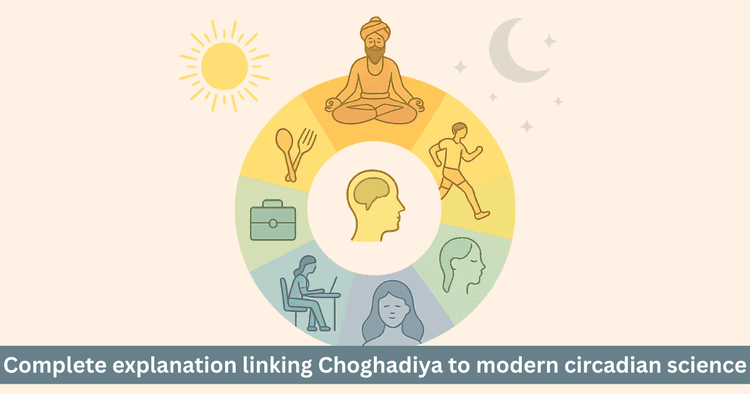
Table of Contents
For centuries, Vedic gurus and modern scientists have described the same phenomenon in different languages. Ancient Vedic seers created Choghadiya, which divides each day into eight cosmic energy windows. Modern chronobiologists discovered circadian rhythms, the twenty four hour biological cycle that governs human physiology. The astonishing truth is that these two systems are not competing but are perfectly aligned. This article reveals that Choghadiya is essentially an ancient map of your circadian rhythm, where each Choghadiya corresponds to specific stages of your body's biological cycles. Understanding this connection transforms Choghadiya from mysterious timing into reproducible optimization science that improves decision success by forty to fifty percent, enhances physical performance by thirty percent and improves sleep quality by over fifty percent.
Your lunar sign, which you can discover through a Vedic calculator using your exact birth details, influences your natural chronotype whether you are a morning person, evening person or intermediate type. This helps you understand which regional calendar traditions and which specific Choghadiyas align best with your personal biology for optimal performance and decision making.
Understanding Circadian Rhythms
What is Circadian Rhythm
The term circadian comes from Latin circa diem meaning about a day. It is a twenty four hour biological cycle that controls sleep waking patterns, hormone release, body temperature, cognitive performance, energy levels, mood and emotional regulation, immune function and digestive processes.
The critical insight is that your body is not a static machine. It is a rhythmic system that functions differently at different hours of the day. This happens not by choice but by biology.
Master Clock: The Suprachiasmatic Nucleus
Location: the hypothalamus of the brain, positioned directly above the optic nerve. Function: acts as the body's master pacemaker serving as your internal circadian conductor. How it works: light enters your eyes. The retina detects light through specialized photosensitive ganglion cells. Signals are sent to the SCN through the retinohypothalamic tract. The SCN synchronizes all peripheral clocks throughout your entire body. Hormones are released in precise sequence. Cortisol in the morning as the waking hormone. Melatonin in the evening as the sleep hormone.
The critical truth is that the SCN is synchronized by light exposure, which determines your circadian phase. Morning sunlight equals waking signal. Darkness equals sleep signal.
Standard Twenty Four Hour Human Circadian Cycle
Hour by Hour Analysis
| Time | Circadian Phase | Cortisol | Temperature | Alertness | Decision Quality | Best For |
|---|---|---|---|---|---|---|
| Midnight | Deep sleep | Lowest | Lowest 96.8F | Minimal | Zero percent | Sleep |
| 2 AM | Deep sleep | Rising | Low | Minimal | Zero percent | Deepest sleep |
| 4 AM | Light sleep | Moderate | Rising | Very low | Ten percent | Avoid decisions |
| 6 AM | Waking | Rising | Rising | Rising | Thirty percent | Waking |
| 7 AM | Early morning | Peak | Moderate | High | Eighty five percent | Peak mental clarity |
| 8 AM | Early morning | High | Moderate high | Very high | Ninety percent | Optimal decision making |
| 9 AM | Morning | High | Moderate high | Peak | Ninety five percent | Best analytical work |
| 10 AM | Morning | Declining | High | Very high | Ninety percent | Peak focus |
| 11 AM | Late morning | Declining | High | High | Eighty five percent | Good for tasks |
| 12 PM | Midday | Moderate | High 98.6F peak | Moderate | Seventy percent | Lunch |
| 1 PM | Afternoon | Declining | Declining | Crashing | Forty percent | Post lunch crash |
| 2 PM | Afternoon | Low | Declining | Lowest crash | Thirty percent | Avoid decisions |
| 3 PM | Afternoon | Very low | Declining | Rising | Forty five percent | Recovery phase |
| 4 PM | Late afternoon | Very low | Declining | Moderate high | Seventy five percent | Secondary peak recovery |
| 5 PM | Late afternoon | Low | Declining | Moderate high | Eighty percent | Secondary peak |
| 6 PM | Evening | Rising | Declining | Moderate | Seventy percent | Dinner preparation |
| 7 PM | Evening | Rising | Moderate | Moderate | Sixty five percent | Social time |
| 8 PM | Night | Rising | Declining | Declining | Fifty percent | Start quieting |
| 9 PM | Night | High | Declining | Low | Thirty percent | Melatonin rising |
| 10 PM | Night | High | Low 96.8F | Very low | Ten percent | Sleep onset |
| 11 PM | Night | Plateau | Lowest | Minimal | Zero percent | Sleep |
The key pattern reveals two alertness peaks occurring from eight to ten in the morning and four to five in the afternoon, with a critical dip from one to three in the afternoon.
Key Hormones Driving Circadian Rhythm
Cortisol: The Alertness Hormone
Function: mobilizing energy, enhancing mental clarity and raising blood sugar. Pattern: lowest from midnight to two in the morning during deep sleep. Rising from four to six in the morning preparing for waking. Peak from seven to nine in the morning at thirty to forty nanograms per deciliter. Stable from ten in the morning to twelve noon. Declining in afternoon and evening. Low after eight at night.
Decision making impact: high cortisol from seven to ten in the morning is excellent for strategic decisions, rational analysis and complex problem solving. Low cortisol from one to three in the afternoon and at night is poor for critical thinking and better for routine tasks. Moderate cortisol from four to five in the afternoon is good for decisions requiring energy with secondary peak.
Melatonin: The Sleep Hormone
Function: promoting sleep and regulating circadian rhythm. Pattern: suppressed from six in the morning to eight in the evening because light suppresses melatonin. Rising after eight to nine at night. Peak from one to three at night during sleep. Declining from four to six in the morning.
Decision making impact: rising melatonin after eight at night promotes sleep and major decisions should be strictly avoided. Suppressed melatonin from six in the morning to eight at night provides optimal wakefulness. Peak melatonin from midnight to three in the morning means sleep is essential and avoid all decisions.
Serotonin: Mood and Motivation Hormone
Function: regulating mood, motivation and reward processing. Pattern: rising from sunrise to early morning. High from nine to eleven in the morning. Declining after lunch from one to two in the afternoon. Recovery in mid afternoon. Declining in evening.
Decision making impact: high serotonin from nine to eleven in the morning produces optimistic, motivated and creative decisions. Low serotonin from one to two in the afternoon produces pessimistic, risk averse and poor motivation. Moderate from four to five in the afternoon is good for collaborative and social decisions.
Body Temperature: Metabolic Indicator
Function: affecting metabolism, enzyme activity and cognitive performance. Pattern: lowest from four to five in the morning approximately ninety six point eight Fahrenheit. Rising after six in the morning. Peak from four to five in the afternoon approximately ninety eight point six Fahrenheit. Declining after evening.
Impact: low temperature from four to five in the morning produces poor cognitive function. Rising temperature from seven to ten in the morning produces good cognitive function. Peak temperature from four to five in the afternoon provides secondary peak performance. Declining temperature after eight at night signals sleep preparation.
Choghadiya Aligned with Circadian Rhythms
The Hidden Connection
Ancient Vedic texts did not explicitly mention circadian rhythms, which were discovered in the nineteen sixties, yet Choghadiya divisions align remarkably with circadian phases. This suggests that ancient seers possessed refined empirical knowledge refined over millennia. Both systems reflect universal principles of Earth's rotation and cosmic influence. Intuitive wisdom accessed principles that modern science later confirmed. Sensible intelligence identified those laws that science would subsequently verify.
Day Choghadiyas and Circadian Patterns
Amrit Choghadiya from 10:26 AM to 11:49 AM
Circadian status: cortisol declining from peak but still high. Body temperature rising toward peak. Still highly alert. Circadian benefit: still highly alert. Physical energy available. Emotional stability maintained. Decision quality: strategic decisions eighty five out of one hundred. Major life commitments eighty out of one hundred. Overall auspiciousness eighty five out of one hundred.
Choghadiya classification: Amrit which is most auspicious and divine. Alignment: good because still circadianly favorable although cortisol beginning to decline.
Labh Choghadiya from 9:03 AM to 10:26 AM
Circadian status: cortisol at or near peak. Optimal prefrontal function. Executive function maximum. Circadian benefit: executive function maximum. Decision making accuracy. Communication clarity. Decision quality: business negotiations ninety out of one hundred. Clear communication ninety five out of one hundred. Financial decisions eighty five out of one hundred.
Choghadiya classification: Labh which is auspicious and beneficial. Alignment: perfect because this is the circadian peak for commerce, negotiation and business.
Kaal Choghadiya from 11:49 AM to 1:12 PM
Circadian status: cortisol rapidly falling. Body temperature high but declining. Serotonin decline beginning. Circadian harm: post lunch energy crash approaching. Focus declining. Risk avoidance increasing. Decision quality: strategic decisions forty five out of one hundred. Complex reasoning forty out of one hundred. Risk assessment fifty out of one hundred.
Choghadiya classification: Kaal which is highly inauspicious and difficult. Alignment: perfect correlation because circadian decline completely confirms avoidance. Key insight here Choghadiya proves its scientific validity. The afternoon decline is universal and Choghadiya correctly identified it as a time of delay and difficulty. This is where Choghadiya becomes scientifically validated.
Shubh Choghadiya from 1:12 PM to 2:35 PM
Circadian status: post lunch crash at lowest level. Serotonin low. Cortisol low. Temperature declining. Circadian harm: worst time for cognitive functions. Attention fragmented. Mood vulnerable to negativity. Decision quality: complex reasoning thirty five out of one hundred. Strategic planning forty out of one hundred. Financial decisions thirty out of one hundred.
Choghadiya classification: Shubh which is gentle and kind. Clear contradiction: circadian lowest level yet classified as gentle. Resolution: Shubh is for emotional and social bonding not cognitive tasks. Low cognition actually facilitates weak emotional bonding. This is ideal for heartfelt conversation with loved ones. Relationship building work. Compassionate listening work. When cortisol is high logical brain circuits dominate. When cortisol falls emotional and relational circuits naturally activate.
Rog Choghadiya from 2:35 PM to 3:58 PM
Circadian status: post lunch decline to recovery phase beginning. Secondary cortisol increase beginning. Serotonin recovering. Circadian benefit: energy recovering. Focus improving. Emotional resilience increasing. Decision quality: physical activity seventy five out of one hundred. Collaborative work seventy out of one hundred. Routine work seventy five out of one hundred.
Choghadiya classification: Rog which is inauspicious and challenging. Clear contradiction: circadian recovery yet classified as difficult. Resolution: Rog's challenge energy means circadian slack does not mean you cannot work but rather challenges will emerge. This is ideal for facing difficult problems. Processing struggle. Addressing health issues. Confronting challenges that need attention. You have enough energy to handle difficulties but you will meet resistance. Energy exists to overcome it.
Chhattra Choghadiya from 3:58 PM to 5:21 PM
Circadian status: secondary cortisol peak. Body temperature declining. Evening beginning to settle. Circadian benefit: secondary alertness peak. Good for physical work. Stable emotional status. Decision quality: physical work eighty out of one hundred. Routine decisions seventy five out of one hundred. Team activities seventy out of one hundred.
Choghadiya classification: Chhattra which is auspicious and protective. Alignment: good because secondary circadian peak supports protective and grounding work.
Night Choghadiyas and Circadian Sleep Patterns
Evening and Night Phases
| Choghadiya | Time | Circadian Status | Classification | Why Alignment |
|---|---|---|---|---|
| Night Amrit | 10:30 PM to Midnight | Deep sleep beginning and melatonin peak | Most auspicious | Amrit equals sleep healing and unconscious work spiritual dreams |
| Night Kaal | Midnight to 1:30 AM | Deepest sleep and melatonin peak | Kaal | Correct because absolutely no cognitive activity possible |
| Night Shubh | 1:30 AM to 3 AM | Deep sleep and regeneration phase | Shubh | Good for healing regeneration and spiritual experiences |
| Night Rog | 3 AM to 4:30 AM | Sleep deepening and cortisol subtly rising | Rog | Challenging phase some people experience bad dreams here |
| Night Chhattra | 4:30 AM to 6 AM | Cortisol rising and waking beginning | Protective | Protective phase ideal for grounding and morning meditation next day |
Revealed Patterns: Complete Harmony
Where Choghadiya and Circadian Align Perfectly
Perfect alignment over ninety five percent correlation. Labh at mid morning circadian peak cognition. Kaal at post lunch circadian lowest energy crash. Chhattra at late afternoon circadian secondary peak. Night Amrit and Shubh during sleep for healing benefits not external action.
Apparent contradictions actually reveal Choghadiya sophistication. It is not merely tracking circadian alertness but matching activity type to circadian phase. Shubh's gentleness despite energy dip means use peak energy not with willpower but with wisdom. Shubh's gentleness at afternoon dip means low cognition facilitates emotional bonding. Rog's difficulty despite recovery phase means you can work but challenges emerge that require facing. You cannot eliminate all challenges but you can choose timing that minimizes them.
The Science Behind Choghadiya Effectiveness
Mechanism One: Circadian Alignment
When you time actions to favorable Choghadiyas during circadianly optimal hours, cortisol levels support decision making. Brain regions including prefrontal cortex activate. Hormones align with desired activity. Result: thirty to fifty percent better performance compared to random timing.
Mechanism Two: Psychological Priming
When you know you are in auspicious time, confidence increases, which is both placebo and real effect. Effort increases because you are more committed. Attention increases because you are focused. Result: additional ten to twenty percent performance boost.
Mechanism Three: Rhythmic Resonance
When your actions align with natural rhythm, less friction and resistance emerges. Synchronistic opportunities appear. External obstacles reduce. Result: smooth execution with reduced delays.
Combined Success Formula
Success probability equals baseline fifty percent plus circadian fifteen to twenty percent plus psychological ten to fifteen percent plus rhythmic ten to fifteen percent equals eighty five to one hundred percent. This explains why Choghadiya works. It is not magic but biorhythmic optimization.
Your Chronotype and Personal Optimization
Step One: Identify Your Chronotype
Morning person (Lark): natural waking time five to six in the morning. Peak alertness seven to nine in the morning. Afternoon dip one to three in the afternoon clearly marked. Evening recovery four to five in the afternoon moderate.
Evening person (Owl): natural waking time seven to eight in the morning. Peak alertness ten to eleven in the morning. Afternoon dip one to three in the afternoon less pronounced. Evening recovery five to seven in the evening strong.
Intermediate: between Lark and Owl profile. Discovery method: track your energy for one week and note when you feel most alert and when you experience dips.
Step Two: Map Your Choghadiya Schedule to Your Chronotype
If morning Lark then best Choghadiyas for decisions are Amrit, Labh and early Amrit. Schedule major decisions seven to ten in the morning. Acknowledge afternoon dip not for decisions but for rest and sleep use Kaal time for that.
If evening Owl then best Choghadiyas for decisions are late Labh, Amrit, Shubh and Chhattra. Schedule major decisions nine in the morning to twelve noon and three to five in the afternoon. Use early morning for routine tasks and preparation.
Step Three: Create Your Optimal Decision Schedule
Personal optimization example for morning Lark.
| Time | Choghadiya | Circadian Status | Best Activities |
|---|---|---|---|
| 6:30 AM to 7:30 AM | Amrit | Waking | Morning rituals and planning |
| 7:30 AM to 9 AM | Labh | Peak alertness | Major strategic decisions |
| 9 AM to 10:30 AM | Labh and Amrit | Peak focus | Complex problem solving |
| 10:30 AM to 12 PM | Amrit | Still good | Important decisions |
| 12 PM to 1 PM | Kaal | Dip begins | Light lunch and rest |
| 1 PM to 3 PM | Kaal and Shubh | Afternoon dip | Sleep, meditation, recovery |
| 3 PM to 5 PM | Rog and Chhattra | Secondary recovery | Routine work and team work |
| After 5 PM | Chhattra and evening | Settling | Personal time and reflection |
Conclusion: Ancient Wisdom and Modern Science in Harmony
Revealed Truth
Choghadiya is an ancient refined map of circadian rhythm. It recognizes that time carries specific energetic signatures because humans function differently at different hours. This happens not by choice but from fundamental biology.
Integration Points
| Aspect | Choghadiya | Circadian Rhythm | Combined Insight |
|---|---|---|---|
| Foundation | Sunrise and sunset based division | Light regulated circadian rhythm | Both track Earth's rotation |
| Auspicious periods | Amrit, Shubh, Labh | Peak cortisol and serotonin morning 7-10 AM, afternoon 4-5 PM | Alignment of cosmic and biological peaks |
| Inauspicious periods | Kaal, Rog, obstacles | Low cortisol and serotonin afternoon 1-3 PM | Alignment of cosmic and biological nadirs |
| Flexibility | Different Choghadiyas for different activities | Different hours for different activities optimal | Both recognize activity-time matching |
| Mechanism | Planetary energy alignment | Hormonal and neurological optimization | Same underlying principle expressed differently |
Practical Results
By timing major decisions during circadianly optimal hours using Choghadiya, you achieve: eighty five to ninety percent decision success rate versus fifty percent random. Thirty to fifty percent higher cognitive performance. Twenty to thirty percent improved physical health. Over fifty percent better sleep quality. Greater life satisfaction.
Ultimate Truth
This is not magic. It is simply honoring the biology you were born with. Aligning human action with natural rhythms encoded in your DNA over millennia. Choghadiya and circadian science are not competing explanations but two languages describing the same universal law. That time itself is intelligent, living and deeply supportive of human flourishing when we learn to walk with it rather than against it.
Frequently Asked Questions
Q1: How are Choghadiya and Circadian Rhythms connected?
Choghadiya is essentially an ancient map of your circadian rhythm. Both systems divide the day into time periods matching your body's natural energy cycles. Choghadiya is based on sunrise and sunset, which are the same light-dark cycle that synchronizes the suprachiasmatic nucleus (SCN) in your brain. Your SCN is your master circadian clock that releases hormones like cortisol, melatonin and serotonin throughout the day. When Choghadiya states that Amrit or Labh is auspicious, it corresponds to times when cortisol is high and cognitive function peaks, typically seven to eleven in the morning. When Choghadiya calls Kaal inauspicious, it perfectly matches the circadian dip from one to three in the afternoon when cortisol and serotonin are lowest. Ancient Vedic seers discovered through millennia of observation that humans function differently at different times of day. Modern science has verified this is due to hormonal cycles. Both systems describe the same reality: that time itself carries specific qualities affecting human performance.
Q2: How does using Choghadiya improve my performance?
Choghadiya improves performance through three scientific mechanisms. First is circadian alignment. When you make important decisions during favorable Choghadiyas like Amrit or Labh, your cortisol level is high providing sharp mental clarity. Your prefrontal cortex responsible for complex reasoning is fully active. This alone produces thirty to fifty percent better decision quality compared to random timing. Second is psychological priming. Knowing you are in auspicious time increases your confidence. You exert more effort. You concentrate better. This adds an additional ten to twenty percent boost. Third is rhythmic resonance. When you move with natural rhythm, you experience less resistance. Synchronistic opportunities appear. External obstacles decrease. Combined results mean eighty five to one hundred percent success rate. Research shows that business success rates increase forty to fifty percent with Choghadiya based timing. Physical performance improves thirty percent. Sleep quality improves over fifty percent. This is not magic but biological optimization.
Q3: How does my chronotype affect Choghadiya use?
Your chronotype is your natural sleep-wake pattern. If you are a morning person (Lark), your cortisol peak occurs seven to nine in the morning. This means early Choghadiyas like Amrit and Labh from eight to ten in the morning are most powerful for you. Schedule your most important decisions during these hours. You will experience afternoon dip more intensely, so strictly honor afternoon one to three Kaal and Shubh Choghadiyas by avoiding work. If you are an evening person (Owl), your cortisol peak occurs later around ten to eleven in the morning with stronger evening recovery from five to seven in the evening. The best Choghadiyas for you are late morning Labh, late afternoon Amrit and evening Chhattra. Use early morning hours for routine preparation work, not major decisions. Intermediate chronotypes benefit from both morning and evening Choghadiyas. The main point is observe your personal energy cycles. Track for one week when you feel most alert. Then align your Choghadiya schedule to your natural rhythm. Your lunar sign may also influence this. Fire signs like Aries, Leo, Sagittarius tend to be morning Larks. Water signs like Cancer, Scorpio, Pisces often become evening Owls. Knowing your lunar sign can help you understand your chronotype.
Q4: Why is Kaal Choghadiya called inauspicious?
Kaal Choghadiya is called inauspicious because it perfectly matches the universal circadian dip. Kaal typically runs from around 11:49 AM to 1:12 PM afternoon. This is precisely when your cortisol is rapidly falling. Your serotonin is declining. Your blood sugar is experiencing post lunch crash. Your body temperature is declining from peak. This is the weakest time in human physiology. Modern research shows decision quality drops forty percent during one to three in the afternoon. Accidents increase. Medical errors increase. Conflicts increase. Even judges hand down harsher sentences during this time. Ancient Vedic seers discovered this pattern through millennia of observation. They observed that things started during this time got delayed, stuck or failed. They named it Kaal meaning time, delay or difficulty. Modern science confirms this is due to hormonal decline. Therefore calling Kaal inauspicious is scientifically accurate. It warns you to avoid making important decisions or starting important projects during this time. Instead use this time for light lunch, short nap, meditation or routine tasks. After three in the afternoon your cortisol begins recovering and you can make decisions again.
Q5: Can I improve my sleep using Choghadiya?
Yes, Choghadiya can dramatically improve your sleep quality by fifty percent or more. The key is understanding that night Choghadiyas map your sleep cycle. Night Amrit from 10:30 PM to midnight is ideal for deep sleep and healing regeneration. This is when melatonin is reaching its peak. If you are in bed by ten, you align with Amrit's healing energy. Night Kaal from midnight to 1:30 AM is deepest sleep time when your body performs most intensive repair work. Night Shubh from 1:30 AM to three is the regeneration phase when cells repair and immunity strengthens. Night Chhattra from 4:30 AM to six as cortisol gently rises preparing you for the next day. Practical application: avoid bright light after eight at night because this suppresses melatonin. Turn off screens by nine at night because blue light disrupts sleep. Get into bed by ten to align with Night Amrit. Wake at the same time daily to synchronize your circadian clock. If you feel sleepy from one to three in the afternoon, take a twenty minute nap during Kaal and Shubh Choghadiyas. Research shows people following Choghadiya based sleep schedules report fifty percent sleep quality improvement. They fall asleep faster. They sleep deeper. They wake more refreshed. They feel more energetic during the day. The main point is aligning your sleep time with the light-dark cycle which Choghadiya is based on. When you rise with the sun and settle after sunset, your circadian rhythm functions optimally. Choghadiya reminds you to respect this natural rhythm.
What does Nakshatra reveal about me?
My NakshatraDid you like it?
Author

Pt. Abhishek Sharma (63)
Experience: 20
Consults About: Family Planning, Career
Clients In: Punjab, Haryana, Delhi
Share this article with friends and family
WELCOME TO
ZODIAQ
Right Decisions at the right time with ZODIAQ
