Adhika Maas: The Sacred Time of Cosmic Balance and Spiritual Renewal
By Pt. Amitabh Sharma
Moon Based Detailed Analysis - The Mystery of Purushottam Maas
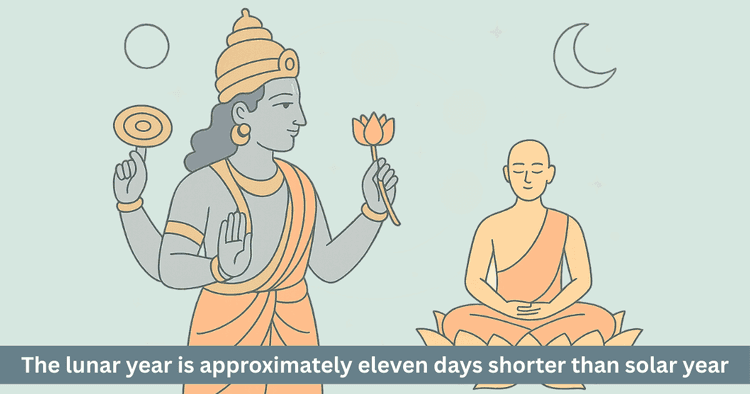
Table of Contents
This article is written based on moon sign principles. To understand the profound significance of Adhika Maas and its impact on your life, first determine your moon sign. Your moon sign is determined by the position of the Moon at the time of your birth and guides your mind, emotions and spiritual journey. To identify your moon sign, consult an authentic Panchang or qualified astrologer using your birth date, time and place.
In the intricate system of the Hindu lunar calendar (Panchang), there exists a remarkable mechanism that maintains balance with solar cycles. This mechanism is Adhika Maas, literally meaning "extra month." Occurring approximately once every thirty-two to thirty-three months-roughly every two and a half to three years-this enigmatic month simultaneously serves two purposes: practical astronomical correction and profound spiritual invitation. It functions like a cosmic pause button, offering humanity a reset opportunity for both calendrical accuracy and inner transformation. Adhika Maas is known by multiple names-Adhika Maas (the extra month), Purushottam Maas (the month of Lord Vishnu) and colloquially Mal Maas (the unclean month). This unique calendar component embodies a fascinating paradox: it is simultaneously inauspicious for worldly undertakings yet supremely auspicious for spiritual pursuits. Understanding this duality unlocks one of the Panchang's most sophisticated insights into cosmic timing and human spiritual development.
The Astronomical Necessity: A Problem and Its Elegant Solution
The Fundamental Mismatch
The Hindu calendar system operates on a lunisolar principle, attempting to synchronize two fundamentally different celestial cycles. The solar year is the time required for Earth to complete one orbit around the Sun, measuring approximately 365.25 days. This cycle determines seasonal changes-the progression from spring through summer, autumn and winter-and forms the basis of the Western Gregorian calendar.
The lunar year consists of twelve lunar months, where each lunar month measures the interval between successive New Moons (Amavasyas), spanning approximately 29.53 days. The lunar year therefore encompasses twelve lunar months multiplied by 29.53 days per month equals 354.36 days approximately.
The Astronomical Problem:
The lunar year falls approximately eleven days shorter than the solar year. 365.25 days (solar year) minus 354.36 days (lunar year) equals 10.89 days (approximately eleven days). This eleven-day annual discrepancy accumulates inexorably. Without correction mechanisms, within just nine years this gap would total approximately ninety-nine days-nearly three full months.
The consequences prove profound and problematic. After nine years, festivals traditionally celebrated during autumn (like Diwali) would occur in summer. After eighteen years, these same festivals would fall in spring. After twenty-seven years, they would occur in winter. The Hindu calendar would progressively drift away from seasonal reality, severing the connection between festival timing and natural cycles. This drift would render the calendar useless for its primary practical purposes: determining agricultural cycles, planning seasonal activities and maintaining the deep connection between spiritual practice and natural rhythms that forms the essence of Hindu civilization.
The Elegant Solution: Adhika Maas
Ancient Indian astronomers and mathematicians developed an ingenious solution to this problem. Rather than arbitrarily adding days throughout the year (as the Gregorian calendar does with its February 29th leap day), the Hindu calendar system addresses the mismatch through the periodic insertion of an entire extra month.
The Mathematical Logic:
The accumulated eleven-day annual shortfall reaches a full lunar month (approximately thirty days) after thirty days divided by eleven days per year approximately equals 2.7 years approximately 32.5 months. therefore approximately every thirty-two to thirty-three months, an entire extra month-Adhika Maas-is inserted into the calendar, effectively creating a thirteen-month year when needed.
The Calculation Method: Surya Sankranti-Rahita Maas
The determination of when Adhika Maas occurs employs a sophisticated astronomical criterion: Nirayana Sankranti-Rahita Maas (a month without solar transition). The concept of Surya Sankranti (solar transition) refers to the moment when the Sun moves from one zodiac sign (Rashi) to the next. In the Nirayana (fixed star) system, the Sun spends approximately one month in each zodiac sign as Earth orbits around it. Normally, each lunar month contains at least one Surya Sankranti-a moment when the Sun transitions to a new zodiac sign.
however due to the slightly different speeds at which lunar months progress and the Sun transits zodiac signs, occasionally a complete lunar month passes without any Surya Sankranti occurring. When the Sun remains in the same zodiac sign throughout an entire lunar month, that month is designated as Adhika Maas (the extra month).
Historical Accuracy and Precision:
The frequency of Adhika Maas occurrence-approximately every thirty-two to thirty-three months-proves remarkably accurate over extended time periods. This ancient calculation method, refined over thousands of years, maintains such precision that the Hindu calendar has remained synchronized with seasonal cycles across millennia, a testament to the sophistication of ancient Indian astronomical knowledge.
The Spiritual Dimension: From Rejection to Divinity
Beyond its astronomical utility, Adhika Maas carries profound spiritual significance rooted in Hindu mythology and the philosophy of karma and divine grace.
The Mythological Story
According to the Puranas (ancient Hindu scriptures), a fascinating narrative explains Adhika Maas's spiritual status and its relationship to Lord Vishnu. When the extra month was first created astronomically (to balance the lunar and solar calendars), an unprecedented situation arose: this new month had no corresponding deity to preside over it. In Hindu cosmology, each of the twelve regular lunar months is governed by a specific presiding deity who imparts that month's spiritual character and blessings.
Each established month was reluctant to share its deity with this "interloper." The months collectively rejected the extra month, viewing it as illegitimate and inferior-a necessary addition without true cosmic standing or divine sanction. Rejected and dejected, the extra month found itself without divine patronage-a cosmic orphan. Neither valued by the established months nor possessing its own spiritual authority, Adhika Maas represented a temporal anomaly without purpose or blessing.
In its distress, the extra month approached Lord Vishnu, the Supreme Preserver and ultimate source of cosmic order and dharma. Moved by compassion for this orphaned month and recognizing its essential role in maintaining calendrical and cosmic order, Lord Vishnu offered the month unprecedented honor.
The Divine Blessing and Adoption
Rather than assigning Adhika Maas to a secondary deity or diminished spiritual status, Lord Vishnu adopted the month himself and granted it his own supreme name: Purushottam, meaning "Supreme Self" or "Highest Self"-a title used for Vishnu as the ultimate reality underlying all existence.
Through this divine adoption, Adhika Maas was elevated from rejected anomaly to sacred month-not through worldly criteria but through spiritual principle. Lord Vishnu declared that while Adhika Maas lacks the solar sanction necessary for worldly pursuits (remaining "unclean" for material endeavors), it possesses supreme potency for spiritual practices undertaken without attachment to material outcomes.
Spiritual Significance and Principle:
This mythological narrative encodes profound philosophical principles. The paradox of inadequacy becoming excellence-what appears deficient from a material perspective (a month without Surya Sankranti, without established deity patronage) becomes supremely excellent from a spiritual perspective. This reversal teaches that spiritual worth transcends material valuation.
Divine grace and compassion-Lord Vishnu's adoption of the rejected month demonstrates divine compassion. The cosmos is not indifferent to apparent anomalies or outsiders; divine grace seeks to elevate and sanctify what appears marginal or problematic. Transcendence of duality-the month's dual nature, simultaneously weak for material pursuits yet supremely powerful for spiritual endeavors, points to the ultimate transcendence of conventional dualistic thinking. What is "bad" by one standard becomes "good" by another; all depends on perspective and intention.
The Dual Nature of Adhika Maas: Weakness and Strength
The Weakness Aspect: "Mal Maas" (The Inauspicious Month)
The Underlying Principle:
In Vedic philosophy, the Sun represents Atman (the divine soul), vitality, sanctification and divine authority. The Sun's transit from one zodiac sign to another-the Surya Sankranti-represents the Sun's "blessing" or "sanction" of that month's affairs. This solar transit effectively authorizes and empowers worldly activities.
When a month passes without any Surya Sankranti, the Sun's blessing is absent. The month lacks the solar vitality and divine authorization necessary for worldly endeavors. This explains why Adhika Maas is called Mal Maas-literally "unclean" or "impure" month-not because it is spiritually polluted but because it lacks the purifying and authorizing presence of the Sun's transit.
Restrictions During Adhika Maas:
All Kaamya Karmas (actions performed with specific material desires or worldly goals) are strictly prohibited during Adhika Maas. These restrictions include marriage, starting new business or employment, house warming ceremonies, first haircut and sacred thread ceremonies and purchasing major valuables.
Table: Prohibited and Recommended Activities During Adhika Maas
| Activity Type | Status During Adhika Maas | Reason | Alternative Suggestion |
|---|---|---|---|
| Marriage Ceremonies | Completely Prohibited | Lack of solar blessing, obstacles to marital happiness | Postpone to next regular month |
| New Business Launch | Prohibited | Lack of momentum for growth | Plan and strategize, launch in auspicious month |
| House Warming | Prohibited | Solar blessing for prosperity absent | Wait, prepare |
| Meditation and Sadhana | Highly Recommended | Divine presence amplified | Intensify practice |
| Mantra Chanting | Highly Recommended | Spiritual potency multiplied | Daily japa practice |
| Fasting and Vrat | Highly Recommended | Purification power enhanced | Observe Ekadashi vrat |
| Scriptural Study | Highly Recommended | Wisdom deeply absorbed | Read Gita, Bhagavatam |
| Charity and Service | Highly Recommended | Results multiplied tenfold | Selfless service |
The Strength Aspect: "Purushottam Maas" (The Supremely Auspicious Month)
The Underlying Principle:
If Adhika Maas lacks worldly solar energy, it compensates through spiritual resources. Having been adopted by Lord Vishnu and named Purushottam, the month becomes saturated with divine grace, spiritual authority and the blessings of the Supreme. This spiritual endowment makes Adhika Maas extraordinarily potent for Nishkaam Karmas (actions performed without attachment to results, undertaken for spiritual merit and divine service).
The absence of worldly solar energy creates space for spiritual solar energy-the inner light of consciousness, self-realization and divine communion. This spiritual "sunshine" is infinitely more powerful than material sunshine, though its effects manifest differently.
Amplification of Spiritual Practices:
All spiritual activities undertaken during Adhika Maas yield benefits multiplied many times over compared to the same practices in regular months. This amplification occurs because divine presence-Lord Vishnu's conscious presence throughout the month amplifies spiritual efficacy. Cosmic support-the universe itself, recognizing the month's spiritual purpose, offers enhanced support. Inner alignment-practitioners naturally attune more easily to spiritual wavelengths during this month. Karmic acceleration-spiritual growth and karmic resolution occur at accelerated rates.
Recommended Practices During Adhika Maas
Meditation and Spiritual Practice (Sadhana):
Meditation undertaken during Adhika Maas reaches depths difficult to access in regular months. The mind naturally becomes more focused, mental chatter diminishes and access to deeper states of consciousness becomes more facile. Practitioners often report profound experiences, clarity about life direction and direct communion with spiritual dimensions. Advanced practitioners use Adhika Maas for intensive meditation retreats and spiritual accelerations.
Chanting and Mantra Practice (Japa Sadhana):
Mantra chanting yields exponentially greater benefits during Adhika Maas. Each repetition carries amplified spiritual potency. Specific recommended mantras include "Om Namo Bhagavate Vasudevaya" (universal mantra honoring Lord Vishnu in all forms), "Om Purushottamaya Namah" (seed mantra directly invoking Adhika Maas's spiritual essence) and "Hare Krishna Hare Krishna Krishna Krishna Hare Hare, Hare Rama Hare Rama Rama Rama Hare Hare" (supreme mantra for spiritual transformation).
Practitioners observing Adhika Maas japa practice recommend completing at least 108 repetitions (one mala) daily, with serious practitioners undertaking 1,000 to 10,000 repetitions during the month.
Fasting (Vrat) and Dietary Discipline:
Fasting undertaken during Adhika Maas carries extraordinary purificatory power. Traditional fasts include Ekadashi Vrat (fasting on the 11th lunar day), Purnima Vrat (Full Moon fasting) and complete abstinence (some practitioners undertake complete fasting for 1-3 days during the month).
The Puranas declare that a single day of fasting during Adhika Maas yields spiritual merit equivalent to performing hundreds of Yajnas (elaborate fire sacrifices), one of Hinduism's most significant rituals. This hyperbolic statement conveys the extraordinary amplification occurring during this month.
Scriptural Study and Recitation:
Reading and studying sacred texts during Adhika Maas embeds their wisdom far more deeply into consciousness than study during regular months. Recommended texts include Bhagavad Gita Chapter 15 ("Purushottam Yoga"), Srimad Bhagavatam, Ramayana and Upanishads.
Scriptural recitation during Adhika Maas is believed to yield what Sanskrit calls Akshaya Phala (imperishable results)-benefits that continue accruing infinitely across lifetimes and dimensions of existence.
Charity and Selfless Service (Daan and Seva):
Donations made during Adhika Maas multiply in spiritual significance. The Puranas declare that giving even minimal resources-food, clothing, shelter-during this month yields results multiplied tenfold compared to donations in regular months. Recommended charitable activities include food distribution, clothing donation, selfless service and knowledge sharing.
Practical Application: Utilizing Adhika Maas Constructively
Strategic Activities and Practices
During Adhika Maas, the wise practitioner adjusts activities to align with the month's actual energetic nature. Continue regular professional responsibilities, relationship nurturing, health routines, learning and skill development and creative work for personal expression. Initiate intensive meditation, scriptural study, charitable activities, inner psychological work, creative hobbies, skill development for self-improvement, planning for future endeavors and fasting protocols. Postpone marriage ceremonies, starting new businesses, signing significant contracts, making large investments, major construction, launching public campaigns, entering new homes and initiating contentious legal proceedings.
Sample Adhika Maas Daily Routine
Early Morning (4-6 AM): Meditation practice (30-60 minutes), chanting of mantras (108+ repetitions), scriptural reading, yoga or gentle exercise, bath and breakfast.
Midday (10 AM-2 PM): Continued professional responsibilities, service activities, charitable work, planning and strategic thinking.
Evening (5-8 PM): Light dinner (fasting if observing vrat), family time, reflection and journaling, preparation for next day.
Night (8-10 PM): Meditation or spiritual practice, continued scriptural study, early sleep to enable early morning practice.
Frequency, Duration and Modern Context
Timing and Occurrence:
Frequency: Adhika Maas occurs approximately once every 32 to 33 lunar months (roughly every 2 years and 8 months), though the exact interval varies depending on astronomical factors. Recent occurrences: 2023 (varying by regional calendar). Next expected: Approximately 2026 (subject to precise astronomical calculations). Duration: Each Adhika Maas lasts approximately 29.5 days-equal to one standard lunar month.
Application in Modern Context:
Though the Panchang originated in ancient times, Adhika Maas remains remarkably relevant in contemporary living. Progressive organizations consult Panchang timing for strategic decisions. Wellness practitioners recognize that Adhika Maas aligns with beneficial practices like fasting, cleansing and spiritual retreats. Individuals interested in personal growth use Adhika Maas as a structured reset opportunity. Modern spiritual seekers increasingly appreciate the month as a structured container for deepening practice.
Frequently Asked Questions
Q1: Why is Adhika Maas necessary?
A1: To adjust the 11-day annual difference between the lunar year and solar year, so the Panchang remains aligned with seasons.
Q2: Why is marriage prohibited during Adhika Maas?
A2: Due to the absence of Surya Sankranti, the month lacks the solar blessing and vital energy necessary for worldly affairs.
Q3: What is Purushottam Maas?
A3: Another name for Adhika Maas, given by Lord Vishnu, which makes it supremely auspicious for spiritual practices.
Q4: What practices are best during Adhika Maas?
A4: Meditation, mantra chanting, fasting, scriptural study, charity and selfless service-all yield multiplied benefits during this month.
Q5: How often does Adhika Maas occur?
A5: Approximately every 32 to 33 months or roughly every 2.5 to 3 years.
What does moon sign reveal about me?
My Moon SignDid you like it?
Author

Pt. Amitabh Sharma (56 Years)
Experience: 20
Consults About: Family Planning, Career
Clients In: Punjab, Haryana, Delhi
Share this article with friends and family
WELCOME TO
ZODIAQ
Right Decisions at the right time with ZODIAQ
