Krishi Panchang and Climate Change - Ancient Wisdom Meets Modern Challenges
By Aparna Patni
Integrating Traditional Knowledge and Modern Science for Climate-Resilient Agriculture
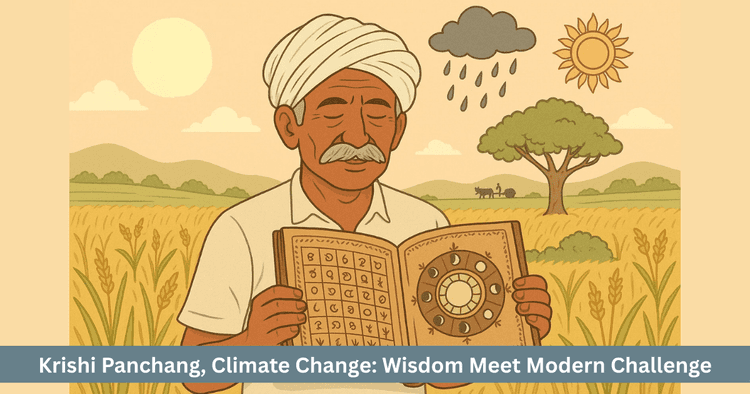
Table of Contents
This article is based on moon sign in Vedic astrology. The moon sign represents your mind and emotions. To know your moon sign, you need your birth date, exact time and place of birth. The zodiac sign in which the Moon is placed at the time of your birth is called your moon sign or Chandra Rashi.
In the face of mounting climate challenges, the Krishi Panchang or traditional Indian agricultural almanac is being re-examined as a vital tool for building climate resilience. By integrating ancient ecological wisdom with modern scientific data, a new generation of climate-smart Panchangs is emerging to help farmers navigate the uncertainties of a changing climate. This synthesis of ancient wisdom and modern science represents a powerful approach to addressing 21st-century agricultural challenges while preserving cultural continuity.
The Wisdom of the Krishi Panchang
For centuries, the Krishi Panchang has been the cornerstone of Indian agriculture, providing a detailed calendar of auspicious timings for sowing, planting and harvesting based on the positions of celestial bodies. This system is not merely astrological; it is a sophisticated framework that synchronizes agricultural activities with the rhythms of the cosmos and the seasons. The Panchang guides farmers on which crops to plant based on the prevailing season meaning Ritu and the phase of the moon, promoting a form of agriculture that is deeply attuned to the natural environment. This agricultural knowledge accumulated over generations represents practical wisdom derived from centuries of observation and experience.
Modern Challenges, Ancient Solutions
Climate change has disrupted the predictable weather patterns on which traditional agriculture depends. Monsoons have become more erratic, droughts and floods more frequent and temperatures are rising all of which pose a significant threat to food security in India. In response there is a growing movement to adapt the Krishi Panchang to these new realities. The goal is not to abandon the ancient wisdom but to enhance it with modern scientific insights.
Key Aspects of Climate-Smart Panchang Adaptation
Integrating Modern Weather Forecasting
By incorporating data from modern climate models and historical weather databases, the Krishi Panchang can provide more accurate and region-specific advisories. This allows farmers to align their cropping patterns with predictions of an early or delayed monsoon or below-normal rainfall. Modern meteorological systems employ climate models enabling seasonal rainfall predictions with substantial accuracy.
The 2022 Southwest monsoon forecast achieved 99 percent of Long-Term Average prediction with a model error margin of only plus or minus 5 percent precision formerly impossible. By integrating these advanced meteorological forecasts the Krishi Panchang can transform from being historically oriented to future oriented.
Promoting Climate-Resilient Crops
The updated almanacs can guide farmers in selecting crops that are better suited to changing conditions. In regions with declining rainfall this may mean promoting drought-tolerant millets and pulses over water-intensive crops like paddy rice. Similarly in areas with rising winter temperatures heat-tolerant wheat varieties can be recommended.
Drought-Resilient Crop Promotion:
Eastern and Northeastern India recorded 17 percent rainfall deficiency meaning 375.3 millimeters actual versus 454 millimeters normal in 2023. Climate-smart Krishi Panchang guidance would guide farmers in such regions toward pulses meaning pigeonpea chickpea mung bean, oilseeds meaning groundnut soybean and millets meaning finger millet sorghum pearl millet. These crops require substantially less water than conventional paddy reducing vulnerability to rainfall variability while maintaining nutritional output.
Heat-Tolerant Crop Variety Selection:
Systematic temperature increases demand crop variety adjustment. Conventional wheat varieties become increasingly vulnerable to heat stress during grain-filling stages producing shriveled low-quality grains. Climate-smart Krishi Panchang guidance would transition farmers toward heat-tolerant wheat varieties specifically developed for elevated temperature scenarios.
Emphasizing Climate Risk Management
The new climate-smart Panchangs are expanding beyond auspicious timings to include guidance on climate risk management. This includes information on crop insurance, rainwater harvesting, groundwater recharge and strategies for protecting crops from extreme weather events like floods and heatwaves. This holistic approach transforms Krishi Panchang from a timing-only system to a comprehensive climate adaptation platform.
A Participatory Approach
The development of these new calendars is often a collaborative process bringing together farmers, agricultural scientists and climate experts. The Wayanad Agricultural Calendar developed by farmers in Kerala demonstrates how participatory approaches ensure calendars are both scientifically robust and practically relevant. This participatory approach respects traditional knowledge while incorporating farmer expertise and scientific rigor.
Climate Change Challenges to Traditional Krishi Panchang
Contemporary Rainfall Instability
Weather patterns have transformed dramatically over the past 50 years fundamentally undermining the predictive premises on which traditional Krishi Panchang operates. According to 2023 Indian Meteorological Department data the country-wide monsoon was 94 percent of Long-Term Average meaning LPA.
However distribution across subdivisions was dramatically uneven:
- Nine percent of total area: Excess rainfall
- 73 percent of total area: Normal rainfall
- 18 percent of total area: Deficient rainfall
This spatial fragmentation creates critical vulnerability. Regions with deficient rainfall experience genuine agricultural stress even when national averages appear normal requiring region-specific rather than state-level or national guidance. Traditional Krishi Panchangs operating at regional levels fail to capture this granular climatic variation.
Temperature Trend Shifts
Beyond rainfall variability systematic temperature increases compound agricultural stress. Indian Meteorological Department temperature trend data spanning 1901 to 2023 reveals that the majority of India is experiencing sustained upward temperature trends fundamentally altering growing conditions established when traditional agricultural practices developed.
Winter Rabi Crop Impact: Increased average temperatures during India's winter cropping season directly threaten conventional wheat varieties vulnerable to heat stress during grain-filling stages causing shriveled grains and reduced yields a phenomenon traditional Krishi Panchang was never designed to anticipate or mitigate.
Limitations of Traditional Krishi Panchang for Climate Change Contexts
Historical Data Bias
The critical limitation is that traditional Krishi Panchangs were calibrated for historical climate conditions with astronomical and agricultural recommendations based on climatic stability spanning centuries. This creates a systematic historical bias: the Panchang assumes that historical relationships between celestial phenomena and agricultural outcomes will persist indefinitely. When climate change fundamentally alters those relationships the Panchang's astronomical framework remains unchanged even though its agricultural applicability deteriorates.
Generalized Regional Guidance
Traditional Krishi Panchangs provide generalized advisories at regional or state levels treating vast geographical areas as homogeneous units. This approach fails to capture modern climate reality where precipitation and temperature now vary dramatically within regions with some subdivisions receiving excess rainfall while neighboring areas experience deficiency within the same season.
Absence of Climate Risk Management
Historically the traditional Krishi Panchang emphasized auspicious timings and ritualistic significance for farm practices. It provides minimal guidance on climate risk management including insurance strategies, rainwater harvesting, supplemental irrigation infrastructure or stress preparedness measures which now demand equal agricultural attention alongside auspicious timing considerations.
Technology-Enabled Hyper-Local Customization
Beyond Regional Generalization
A fundamental limitation of traditional Krishi Panchang is its inability to provide farm-level precision guidance. Modern technology enables overcoming this constraint through satellite imagery tracking soil moisture vegetation health and local weather patterns, IoT weather sensors providing hyperlocal precipitation and temperature data, artificial intelligence processing satellite and sensor data for predictive analytics and mobile applications delivering customized advisories to individual farmers in real-time.
Practical Integration Blueprint
Pre-Season
- Map farm to micro-zone
- Assemble a nakshatra calendar aligned to local monsoon normals
- Pre-select normal delayed deficit crop variety sets with input and labor plans
In-Season
- Every fortnight publish taluk-wise sowing and transplanting advisories gated by forecasts
- Stagger operations across nakshatra blocks to spread risk
- Shift 24 to 72 hours when models flag washouts or heat spikes
Post-Season
- Revise calendar with observed extremes yield outcomes and farmer notes
- Update risk protocols and recommended varieties for next year
Policy and Platforms
National and state programs can fund climate-resilient agricultural calendars under adaptation missions marrying indigenous knowledge with climate services and digital dissemination to every village council. Open API-driven advisories allow local organizations and farmer producer organizations to print vernacular Krishi Panchangs that are climate-aware region-specific and iteratively improved each year.
Frequently Asked Questions
What is Krishi Panchang?
Krishi Panchang is the traditional Indian agricultural almanac providing information on auspicious timings for farming activities based on celestial positions.
How has climate change affected Krishi Panchang accuracy?
Climate change has disrupted predictable weather patterns that Krishi Panchang recommendations relied upon causing measurable accuracy reduction.
What is a climate-smart Krishi Panchang?
It integrates modern weather forecasts and climate data with traditional Krishi Panchang frameworks to provide future-oriented guidance based on predicted climate conditions.
Which crops does climate-smart Krishi Panchang promote?
In drought-prone areas it promotes pulses millets and oilseeds. In heat-prone areas it recommends heat-tolerant crop varieties.
How does participatory approach improve Krishi Panchang?
Farmer feedback integrated with scientific data creates calendars that are both scientifically accurate and practically relevant for local conditions.
Get your accurate Kundali
Generate KundaliDid you like it?
Author

Aparna Patni (63)
Experience: 20
Consults About: Family Planning, Career
Clients In: Punjab, Haryana, Delhi
Share this article with friends and family
WELCOME TO
ZODIAQ
Right Decisions at the right time with ZODIAQ
