Panchang Organic Farming: Tuning Nature's Rhythms
By Pt. Amitabh Sharma
Lunar Cycles Nakshatras Seasonal Agriculture Alignment
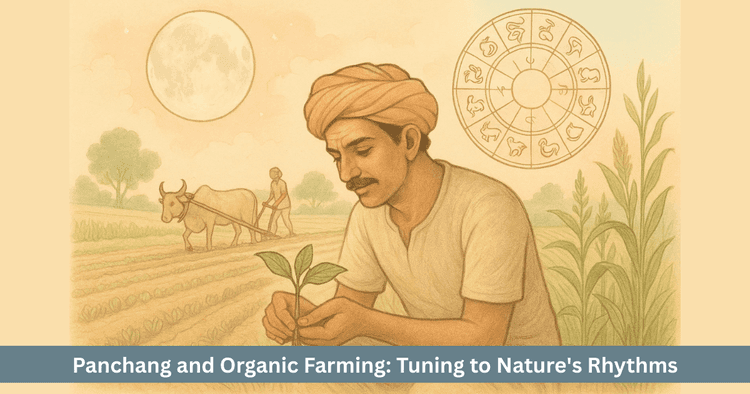
Table of Contents
This article is based on the Moon sign. To find your Moon sign, check the position of the Moon in your birth chart. The zodiac sign in which the Moon is placed is your Moon sign. It represents your mental and emotional nature.
The Hindu Panchang serves as a foundational guide for organic and biodynamic farming, offering a sophisticated framework for aligning agricultural practices with the natural rhythms of the cosmos. This ancient wisdom, rooted in the principles of Vedic science, provides a holistic approach to farming that enhances soil health, plant vitality and crop yields by working in harmony with celestial cycles, particularly those of the moon.
The Core Principle: Farming in Tune with Nature
At its heart organic farming is about creating a balanced and self-sustaining ecosystem. The Panchang provides the blueprint for this by mapping out the subtle energies and influences of the cosmos, allowing farmers to time their activities for maximum effectiveness. This approach, often referred to as Krishi Panchang (agricultural almanac), is a form of biodynamic farming that has been practiced in India for centuries.
The central idea is that just as the moon's gravitational pull affects the tides, it also influences the water content in soil and plants, as well as seed germination and growth rates. By timing activities like sowing, planting and harvesting to coincide with favorable lunar and cosmic patterns, farmers can boost the natural vitality of their crops, reducing the need for external inputs like chemical fertilizers and pesticides.
The Lunar Cycle: The Engine of Organic Farming
The most critical element of the Panchang for organic farming is the lunar cycle, which is divided into the waxing phase (Shukla Paksha) and the waning phase (Krishna Paksha).
Waxing Moon: Shukla Paksha
This is the period from the new moon to the full moon, when moonlight is increasing. During this time, the gravitational pull of the moon is believed to draw water and energy upwards, promoting leaf and stem growth. This makes it the ideal time for:
- Sowing seeds, especially for leafy greens and fruiting plants
- Applying liquid manures and foliar sprays, as plants are more receptive to absorbing nutrients through their leaves
- Grafting plants
- All leaf and stem-focused activities
Waning Moon: Krishna Paksha
This is the period from the full moon to the new moon, when moonlight is decreasing. The cosmic energy is said to be directed downwards, into the soil, encouraging root development. This is the optimal time for:
- Planting root crops like carrots, potatoes and turmeric
- Weeding and pruning, as the reduced sap flow in plants minimizes stress and bleeding
- Harvesting crops for storage, as they are believed to have lower water content and longer shelf life
- Applying compost and solid manure to enrich the soil
| Phase | Duration | Main Activities | Benefits |
|---|---|---|---|
| Waxing | New Moon to Full Moon | Sowing, liquid manures, grafting | Upper growth, leafy vegetables |
| Waning | Full Moon to New Moon | Root crops, weeding, harvest | Root development, shelf life |
| New Moon | Dark phase | Seed collection, storage | Seed preservation |
| Full Moon | Bright phase | Liquid nutrients, preparations | Disease prevention, growth |
Nakshatras: A Deeper Layer of Precision
For even greater precision, the Panchang uses the 27 nakshatras (lunar mansions) to guide planting decisions. Each nakshatra has a specific elemental nature (earth, water, fire, air or ether) and is considered suitable for different types of crops and activities.
Nakshatra and Crop Classification
| Zodiac Element | Nakshatras | Optimal Crops | Agricultural Timing |
|---|---|---|---|
| Earth | Rohini, Uttara Phalguni, Uttara Ashadha | Root vegetables: beet root, carrot, turmeric, ginger | When Moon transits Earth signs |
| Water | Pushya, Ashlesha, Anuradha | Leafy greens: curry leaf, cabbage, greens, sugarcane | When Moon transits Water signs |
| Fire | Krittika, Magha, Purva Phalguni | Fruiting crops: banana orange, mango, millets, pulses | When Moon transits Fire signs |
| Air | Ardra, Swati, Shatabhisha | Flowering crops: cauliflower, rose, jasmine, blossoms | When Moon transits Air signs |
By planting a crop when the moon transits a nakshatra corresponding to the part of the plant being harvested (root, leaf, fruit or flower), farmers significantly enhance the quality and yield of the harvest.
Modern Revival and Global Application
The principles of the Krishi Panchang are experiencing a modern revival, not just in India but globally, through the biodynamic farming movement. Biodynamic calendars, much like the Panchang, provide daily guidance on the best times for various farming activities based on lunar and cosmic rhythms.
This synergy of ancient wisdom and modern organic practices offers a powerful pathway to a more sustainable and resilient form of agriculture. By tuning into the subtle rhythms of nature, farmers can create healthier food, healthier ecosystems and a healthier planet.
Practical Organic Operations and Panchang Timing
Soil Preparation and Tilling
Ascending Moon Days (first 13.6 days of lunar month when Moon-Earth distance increases) are optimal for soil preparation activities. These days encourage upward-directing energetic flows, supporting establishment of new growing conditions.
Descending Moon Days (following 13.6 days when Moon-Earth distance decreases) prove suitable for soil consolidation and settling activities, as downward-directing energies support root establishment in prepared beds.
Crop Rotation Timing Through Panchang Framework
While traditional organic crop rotation principles emphasize temporal succession, Panchang guidance adds an astrologically synchronized dimension. Farmers develop rotation planning by consulting Panchang components including Vara (weekday) selection, Tithi (lunar day) consideration and Nakshatra (stellar mansion) alignment with the succeeding crop type.
Practical example: After harvesting a Fire-sign fruiting crop, farmers would consult Panchang for optimal commencement of Earth-sign root crop rotation, ensuring the transition occurs during cosmically supportive conditions.
Composting and Soil Preparation Timing
Begin composting processes during waning moon phases when underground processes receive natural cosmic emphasis. This aligns with the principle that below-ground microbial decomposition processes inherently emphasized during moon waning includes subterranean processes essential for compost maturation.
Apply mature compost to organic fields during favorable Panchang windows identified through Yoga and Karana analysis, avoiding inauspicious periods that might reduce soil microbe establishment.
Harvesting and Post-Harvest Handling
Nakshatra Selection for Harvest:
Different nakshatras demonstrate varying influence on harvest quality and storage durability. Farmers report that harvesting during specific favorable nakshatras enhances produce flavor intensity, post-harvest shelf life and storage duration and nutritional density.
Harvest scheduling aligned with Moon positions in specific nakshatras (particularly those associated with longevity and stability in traditional texts) creates a cosmically sealed harvest window, believed to preserve product quality more effectively than arbitrary scheduling.
Water Management and Irrigation
The Moon's gravitational pull affects soil water dynamics, with peak moisture availability occurring during Full Moon periods, attributable to tidal effects on groundwater and soil water films. Organic farmers using gravity-dependent irrigation methods coordinate irrigation activities with Full Moon periods to maximize water distribution efficiency.
During descending Moon: Apply supplemental irrigation (drip, sprinkler) during descending Moon phases when gravitational emphasis pulls water downward, enhancing root-zone saturation.
Pest and Disease Management Through Panchang Timing
Biodynamic Preparation Application
Organic farmers employ biodynamic preparations (particularly BD 501 Horn Silica for fungal control) with Panchang-guided precision. Optimal application timing includes the Moon opposite Saturn (occurring every 27.5 days) and early morning spray application, with additional timing during 48 hours before Full Moon for disease prevention.
Pest Population Cycle Management
Different nakshatras appear associated with varying pest activity intensities, likely through indirect mechanisms involving plant biochemistry changes during different lunar positions affecting herbivore and predator life cycles.
Organic farmers using natural predator release or botanical pest controls time these interventions according to nakshatra cycles, attempting to synchronize control application with periods when natural predators demonstrate enhanced vigor or pest populations show reduced resistance.
Integration with Organic Certification
Panchang timing enhances organic certification compliance rather than conflicting with it. Organic standards require documentation of timing, methods and materials for all farm operations. Panchang timing provides additional systematic documentation, demonstrating that operations were conducted through intentional selection rather than random scheduling, supporting certification demonstrations of management rigor.
Organic certificates increasingly highlight biodiversity enhancement and soil health improvements, objectives directly advanced by Panchang-guided operations that promote microbial diversity through cosmic rhythm alignment.
Reported Outcomes and Case Studies
Farmer Experiences with Yield Improvements
Organic farmers integrating Panchang timing report measurable yield and quality improvements:
- Enhanced crop yields: Farms implementing Nakshatra-based planting experience higher production volumes compared to conventional timing
- Superior produce quality: Harvests completed during optimal Nakshatra periods display enhanced flavor, nutritional density and post-harvest longevity
- Reduced input costs: By aligning with natural cycles, farms require fewer chemical inputs and demonstrate reduced need for problem-solving interventions
- Microbial diversity: Rhythm-aligned operations create healthier soil ecosystems supporting beneficial microorganisms essential for organic soil function
Statistical Documentation
Modern case studies document concrete improvements. California organic farms adopting Nakshatra-based timing reported 20% yield increases in tomato production. Traditional Indian farms maintaining 100+ years of Nakshatra-based practice demonstrate consistently superior crop quality across generations.
Philosophical Alignment: Ancient Wisdom in Modern Practice
The integration of Panchang timing with organic farming represents a return to rhythmic agricultural synchronization that industrial agriculture abandoned. Rather than imposing uniform schedules regardless of natural conditions, Panchang-guided organic farming amplifies natural cycles, creating farms that operate as ecosystems tuned to cosmic rhythms rather than human convenience alone.
This alignment transforms organic farming from a technical practice avoiding chemicals into a holistic philosophy of earth stewardship that respects the farm's participation in larger cosmic and terrestrial cycles.
Frequently Asked Questions
Is Panchang-guided farming scientifically valid?
Yes, the moon's gravitational force affects biological processes. Panchang systematically aligns activities with these influences, creating measurable improvements in seed vigor and plant establishment.
Is Panchang certification possible with organic farming?
Yes, Panchang timing complements organic standards, providing additional systematic documentation of intentional operation timing and management rigor.
Do all crops benefit from Panchang timing?
Fruits, vegetables and grains including most major crops benefit substantially from Panchang-guided scheduling.
Can urban gardeners use Panchang principles?
Yes, Panchang applies equally to gardening from window boxes to large-scale farms, with consistent benefits across production scales.
Does climate region affect Panchang effectiveness?
Yes, local climate context enhances Panchang effectiveness, requiring region-specific validation and adaptation.
What does Nakshatra reveal about me?
My NakshatraDid you like it?
Author

Pt. Amitabh Sharma (56 Years)
Experience: 20
Consults About: Family Planning, Career
Clients In: Punjab, Haryana, Delhi
Share this article with friends and family
WELCOME TO
ZODIAQ
Right Decisions at the right time with ZODIAQ
