Solar Declination and Monsoon The Astronomical Logic of Panchang
By Pt. Sanjeev Sharma
Earth's Axial Tilt and Monsoon Mechanics
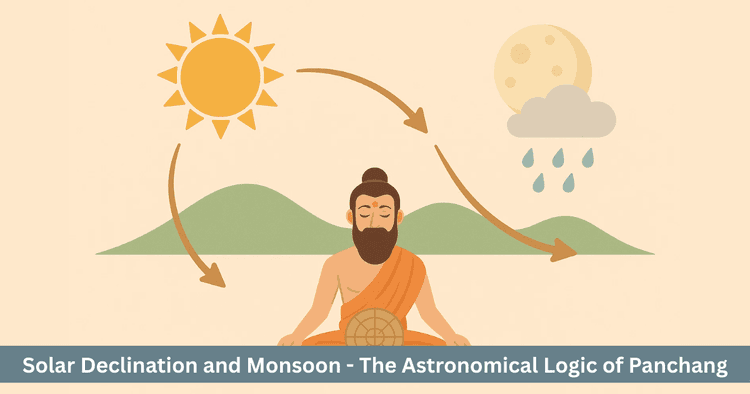
Table of Contents
This article is based on your Moon sign. To find your Moon sign, check the position of the Moon at your birth time. The zodiac sign where the Moon was placed in your birth chart is your Moon sign. This may differ from your Ascendant sign.
The astronomical logic of the Panchang's monsoon prediction is rooted in the annual cycle of solar declination the Sun's apparent north-south movement in the sky which is the primary driver of Earth's seasons. Ancient Indian astronomers understood that this solar journey, marking the transition between Uttarayana (northward motion) and Dakshinayana (southward motion), was the engine of the monsoon and they encoded this knowledge into the Panchang's framework.
Solar Declination and the Seasons
Due to Earth's axial tilt of approximately twenty-three point five degrees, the Sun's apparent position in the sky changes throughout the year. This angular height relative to the celestial equator is known as solar declination.
Summer Solstice (June twenty-one): The Sun reaches its maximum northern declination (plus twenty-three point five degrees), appearing directly over the Tropic of Cancer. This marks the peak of solar intensity in the Northern Hemisphere, leading to the intense heating of the Indian subcontinent.
Winter Solstice (December twenty-one): The Sun reaches its maximum southern declination (minus twenty-three point five degrees), appearing over the Tropic of Capricorn. This results in the Northern Hemisphere's winter.
Equinoxes (March twenty-one and September twenty-three): The Sun is directly over the equator (zero-degree declination), resulting in roughly equal day and night across the globe.
The Astronomical Logic of the Monsoon
The Indian monsoon is a direct consequence of the differential heating of land and sea, a process governed by solar declination.
Intense Heating (Uttarayana): As the Sun moves northward from the vernal equinox towards the summer solstice (Uttarayana), the Indian landmass heats up much faster than the surrounding Indian Ocean. This creates a powerful low-pressure system over the subcontinent.
Creation of a Pressure Gradient: The cooler, high-pressure air over the ocean is drawn towards the low-pressure area over the land. This movement of air carries vast amounts of moisture from the sea.
Monsoon Onset: The moisture-laden winds, upon reaching the land, rise, cool and condense to form rain clouds, marking the onset of the monsoon. This typically happens around the time of the summer solstice, when solar heating is at its maximum.
Panchang's Codification of Monsoon Science
The Panchang codifies this astronomical logic in several ways:
Uttarayana and Dakshinayana: The division of the year into these two solar halves is a fundamental feature of the Panchang. Uttarayana, the period of increasing solar energy, is recognized as the time of preparation for the monsoon. Dakshinayana, which begins after the summer solstice, is the period when the monsoon rains are expected to be active.
Rituals and Festivals: Key festivals in the Panchang are aligned with these solar milestones. Makar Sankranti marks the beginning of Uttarayana, while the Ashadha Hidden Nine Nights coincides with the summer solstice and the onset of the monsoon. These festivals serve as cultural markers for the changing seasons and the agricultural activities associated with them.
Nakshatra System: The transit of the Sun through specific nakshatras provides a more granular timeline for the monsoon's arrival and progress. The Sun's entry into the Ardra nakshatra around June twenty-first is a traditional marker for the monsoon's arrival, aligning perfectly with the astronomical peak of solar declination.
The Fundamental Physics of Solar Declination
Solar declination represents the angle between the Sun's rays and Earth's equator, a fundamental astronomical measurement underlying all Panchang calculations and monsoon prediction systems. At the equinoxes (March twenty and September twenty-two), solar declination equals zero degrees, meaning the Sun's rays strike Earth's equator perpendicularly, creating equal day-night length worldwide. At the solstices (June twenty-one and December twenty-one), solar declination reaches its extreme values: plus twenty-three point four degrees during summer solstice (Sun directly overhead at Tropic of Cancer, twenty-three point four degrees North latitude) and minus twenty-three point four degrees during winter solstice (Sun directly overhead at Tropic of Capricorn, twenty-three point four degrees South latitude).
This twenty-three point four-degree variation results from Earth's axial tilt relative to its orbital plane a tilt that remains essentially constant over human timescales but has gradually varied over geological epochs (ancient measurements indicate plus or minus twenty-three point seven degrees during Roman times). This tilt is the fundamental reason seasons exist: as Earth orbits the Sun, different hemispheres receive varying solar radiation intensity as the Sun's declination changes throughout the year.
Intertropical Convergence Zone and Panchang Timing
The Intertropical Convergence Zone (ITCZ), representing the belt of low pressure where northeast and southeast trade winds converge, follows Earth's solar declination throughout the year. As solar declination increases northward from December through June (Sun moving from Capricorn toward Cancer), the ITCZ shifts northward, creating atmospheric conditions favorable for monsoon development over the Indian subcontinent.
The June Solstice Transformation: The maximum northward solar declination (plus twenty-three point four degrees) occurs at the June solstice, positioning the ITCZ over northern India and causing the Southwest Monsoon onset. This astronomical event the Sun reaching its northernmost declination directly triggers monsoon establishment through atmospheric physics: intense solar heating of northern hemispheric landmasses creates pressure differentials driving winds from the cooler Indian Ocean toward superheated continental interiors.
Traditional Panchang systems capture this critical transition through Arudra Pravesha (Sun's entry into Ardra Nakshatra/Gemini, occurring approximately June twenty-one to twenty-two, within days of the summer solstice). By timing this astronomical observation as the primary monsoon-onset indicator, ancient meteorologists embedded knowledge of solar declination effects into accessible cultural calendars.
Solar Variability and Monsoon Strength Modulation
Beyond the fundamental solar-declination seasonal cycle, variations in solar activity (sunspot cycles, solar magnetic field strength) create modulated monsoon effects. Modern research demonstrates that:
Solar Maximum Years (peak solar activity):
North India receives enhanced rainfall through strengthened Low Level Jet circulation
Solar heating intensifies pressure differentials driving moisture-laden winds
Solar Minimum Years (reduced solar activity):
South India receives enhanced rainfall through strengthened Tropical Easterly Jet circulation
Reduced solar input weakens equatorial heating but enhances subtropical jet streams
Critical Implication: Solar activity variations create regional differentiation in monsoon rainfall, with North India favored during solar maxima and South India favored during solar minima. This explains why different Indian regions experience variable rainfall patterns even in years when national averages appear normal solar declination provides the universal monsoon framework but solar activity modulation creates regional variability requiring nuanced prediction systems.
The Arudra Pravesha: Ancient Mechanism for Monsoon Prediction
Declination Equality as Astronomical Marker
Vyatipata represents an astronomical instant when the magnitudes of the Sun and Moon's declinations are equal that is, both bodies occupy the same latitude relative to Earth's equator. Ancient Indian astronomers recognized this phenomenon as carrying profound meteorological significance.
Mathematical Basis: The Moon's maximum declination varies between eighteen point five degrees and twenty-eight point five degrees depending on the lunar node position (a cycle completing approximately every eighteen point six years). When the ascending node (Rahu) positions at the First Point of Aries, the Moon's maximum declination reaches twenty-eight point five degrees; when positioned one hundred eighty degrees away, maximum declination drops to eighteen point five degrees.
Monsoon Sensitivity: The timing of Vyatipata relative to monsoon onset indicates monsoon intensity expectations. When Vyatipata occurs during the monsoon season (June through September), it signals extreme rainfall potential due to reinforced gravitational effects of Sun and Moon aligned at similar declinations.
Why This Matters for Calendars and Farming
Because the seasonal system keys to the Sun's apparent motion, agricultural festivals and seasonal advisories remain season-true even as Gregorian dates drift year to year; panchangs thus provide a stable astronomical scaffold for sowing and harvest cultures across regions.
Aligning local crop calendars with solar-declination-based seasonal gates and with synoptic monsoon diagnostics (onset, active or break spells) blends ancient timing with modern meteorology for better field decisions under variable climate.
Modern Scientific Validation
Contemporary atmospheric science validates the Panchang's implicit solar-declination logic:
Solar Heating and Pressure Systems: Solar declination directly determines incident solar radiation at different latitudes. Maximum northward declination (plus twenty-three point four degrees) delivers maximum solar energy to northern Indian latitudes, creating intense heating, reduced pressure and moisture convergence the fundamental mechanism driving Southwest Monsoon onset.
Seasonal Wind Pattern Reversals: The Sun's declination progression from minus twenty-three point four degrees (December solstice) to plus twenty-three point four degrees (June solstice) and back triggers predictable wind pattern reversals:
- December solstice (minus twenty-three point four degrees): Northeast winds dominate; dry season in India
- March equinox (zero degrees): Transitional wind patterns; increased heating begins
- June solstice (plus twenty-three point four degrees): Southwest winds established; monsoon active
- September equinox (zero degrees): Secondary transitional period; monsoon withdrawal begins
Solar Activity Modulation: Beyond the fundamental solar-declination seasonal cycle, solar cycle variability (sunspot maxima and minima occurring approximately eleven years apart) creates modulated monsoon intensity with regional specificity. Northern India receives enhanced rainfall during solar maxima; Southern India during solar minima, creating differential regional rainfall patterns that single-factor predictions cannot capture.
Frequently Asked Questions
What is solar declination and why does it matter?
Solar declination is the angle of the Sun's rays relative to Earth's equator. It fundamentally governs land-sea heating differences that drive monsoon wind patterns, making it the primary control on India's monsoon.
Why does the Panchang use Arudra Pravesha to predict monsoons?
Arudra Pravesha occurs near the June solstice when solar declination reaches its northern maximum. This moment creates the atmospheric conditions maximum northern hemisphere heating that trigger monsoon establishment.
How do Sankrantis relate to solar declination?
Sankrantis mark the Sun's entry into each zodiac sign. These entry points occur at regular intervals when solar declination reaches specific values, effectively creating twelve declination checkpoint markers throughout the year.
Does the Intertropical Convergence Zone really follow solar declination?
Yes, satellite observations show the ITCZ follows the solar maximum northward from December through June. This zone's position directly over northern India in June creates the atmospheric conditions necessary for monsoon onset.
How does solar activity variation affect Indian monsoon patterns?
Solar activity cycles create regional differentiation: Northern India receives enhanced rainfall during solar maximum years; Southern India during solar minimum years. This explains regional rainfall variability despite similar national averages.
What does Sun Sign reveal about me?
My Sun SignDid you like it?
Author

Pt. Sanjeev Sharma (63)
Experience: 20
Consults About: Family Planning, Career
Clients In: Punjab, Haryana, Delhi
Share this article with friends and family
WELCOME TO
ZODIAQ
Right Decisions at the right time with ZODIAQ
