Using Panchang for Rain Prediction and Sowing Cycles
By Pt. Sanjeev Sharma
Integration of Ancient Agricultural Wisdom and Modern Meteorology
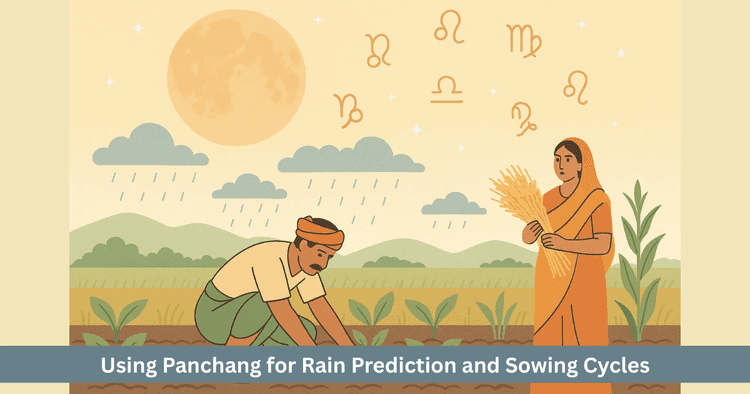
Table of Contents
This article is based on your Moon sign. To find your Moon sign, check the position of the Moon at your birth time. The zodiac sign where the Moon was placed in your birth chart is your Moon sign. This may differ from your Ascendant sign.
The Panchang or Hindu astrological almanac, has for centuries served as an indispensable guide for Indian farmers, providing a sophisticated system for predicting rainfall and determining the optimal timing for sowing, harvesting and other agricultural activities. This ancient practice, known as Agricultural Panchang, blends astronomical observation with a deep understanding of local environmental conditions, creating a holistic approach to agriculture that remains relevant even today.
Historical Foundation of Panchang-Based Rainfall Prediction
The practice of using Panchang for rainfall prediction extends back to Vedic times, with early masters including Garga, Parashara, Narada, Devala, Vashistha, Bhrigu and Varahamihira pioneering astro-meteorological science. This ancient knowledge demonstrates that Vedic seers attributed specific qualities cooling (soma) and heating (agni) to asterisms and planets, recognizing these qualities as fundamental to generating all weather phenomena.
Modern empirical validation confirms the historical claims: research analyzing rainfall predictions from nineteen forty-six to nineteen ninety-five shows that seventy-five to seventy-eight percent accuracy was achieved through Panchang-based predictions, with some years demonstrating eighty-nine percent accuracy for summer seasons and ninety percent for winter seasons, approaching or matching modern meteorological department predictions made through contemporary computational techniques.
The Arudra Pravesha Framework: Core Rainfall Methodology
Definition and Significance
Arudra Pravesha (Sun's entry into the Ardra constellation, occurring around June twenty-two) represents the single most important moment for annual rainfall prediction in Panchang systems. This specific astronomical event marks the Sun's transition into Rahu's constellation (Ardra, located in Gemini zodiac sign) and occurs precisely six months after Arudra Darshana (Moon's transit through Ardra during Full Moon in December).
The methodology operates on a principle of cosmic correspondence: prayers for rainfall initiated during Arudra Darshana in December materialize as tangible rainfall beginning on the day of Arudra Pravesha in June, with the exact moment of Sun's entry revealing rainfall character for the subsequent months.
Critical Factors for Arudra Pravesha Analysis
Professional rainfall prediction requires systematic evaluation of multiple Panchang components occurring at the exact moment of Arudra Pravesha:
| Factor | Favorable for Rain | Unfavorable for Rain |
|---|---|---|
| Day of Week (Vara) | Monday Wednesday Thursday Friday | Saturday Sunday (though limited data) |
| Tithi | 1 2 3 5 6 7 10 11 12 13 15 | 4 8 9 14 tithis Amavasya (New Moon) |
| Nakshatra (Moon's Star) | Rohini Mrigashira Pushya Uttara Phalguni Purvashada Uttarashada Uttara Bhadrapada Hasta Anuradha Shravana Dhanishta Shatabhishak Revathi | Bharani Ardra Aslesha Magha Chitra Vishaka Jyeshta |
| Yoga (Sun-Moon Combination) | Most Yogas except listed inauspicious ones | Atiganda Shoola Ganda Dhruvam Vyagatam Vyatipadam Brahmam Aindra Vydhruthi |
| Karana (Half-Tithi) | Most Karanas except listed inauspicious ones | Vishti Sakuni Chathushpaadam Nagavam Kimsthugnam |
| Lagna (Rising Sign) | Taurus Cancer Libra Pisces | Virgo (indicates stormy weather); others less favorable |
| Time of Entry (Kala) | Sunset Sunrise Midnight Night | Daytime (especially noon very unfavorable) |
| Moon's Position | Watery stars watery signs watery Lagna watery Navamsa | Non-watery placements indicate reduced rainfall |
Practical Application: If Arudra Pravesha occurs on Wednesday evening with the Moon in a watery constellation and Lagna in Cancer, excellent rainfall is predicted. Conversely, if entry occurs at noon with Moon in a dry constellation and Lagna in Virgo, severely reduced rainfall is anticipated.
The Seven Nadis System: Seasonal Weather Characterization
Nadi Chakra Framework
Beyond Arudra Pravesha analysis, Panchang systems employ Nadi Chakras (three systems: Dwinadi, Trinadi, Saptanadi) to characterize seasonal weather patterns. The Saptanadi (Seven Nadis) system most directly correlates to rainfall prediction:
| Nadi | Weather Effect | Rainfall Implication |
|---|---|---|
| Chanda (Moon) | Bright sunshine no rainfall | Drought conditions |
| Vata (Wind) | Sunshine and wind normal rainfall | Expected seasonal rainfall |
| Vanhi (Fire) | Strong hot wind (Westerlies) | Dry hot conditions |
| Soumya (Gentle) | Normal rainfall | Typical monsoon activity |
| Meera (Nectar) | Very good rainfall | Above-average rainfall season |
| Jala (Water) | Abundant rainfall | Substantial rainfall near-normal |
| Amrita (Immortal Nectar) | Heavy to very heavy rainfall | Risk of flooding excess moisture |
The Nadi governing a specific period determines that period's meteorological character.
Planetary Rulership and Rainfall Quantity
Meghadhipati: Lord of Clouds
Meghadhipati (Lord of Clouds) identifies the planet governing rainfall intensity and cloud formation for a given period. Determined by the planetary ruler of the weekday on which the Sun enters Ardra constellation, Meghadhipati directly predicts rainfall magnitude:
| Ruling Planet | Predicted Rainfall Quantity |
|---|---|
| Sun | Moderate rainfall |
| Moon | Very heavy rainfall |
| Mars | Scanty rainfall |
| Mercury | Good rainfall |
| Jupiter | Very good rainfall |
| Venus | Good rainfall |
| Saturn | Very low rainfall stormy wind |
Example Application: If Arudra Pravesha occurs on a Thursday (Jupiter's day), Jupiter becomes Meghadhipati, predicting very good rainfall for the coming monsoon season.
Nakshatra-Specific Rainfall Patterns
Rohini Nakshatra: Entry Point Indicator
The Rohini Nakshatra position at Arudra Pravesha provides critical rainfall specificity, with research establishing precise correlations:
Rohini on sixth Lunar Day: Poor rain predicted
Rohini on seventh Lunar Day: Average rain expected
Rohini on eighth Lunar Day: Good rain anticipated
Rohini on ninth Lunar Day: Good rain expected
Rohini on tenth Lunar Day: Excellent downpour predicted
This methodology extends historical empirical observations spanning centuries of monsoon tracking.
Regional Nakshatra-Based Rainfall Trends
Modern meteorological analysis (nineteen thirty-one to nineteen ninety rainfall data) correlates specific Nakshatras with regional rainfall patterns:
Ashlesha Nakshatra (third August to sixteenth August): Shows significant positive rainfall trend (ninety-five percent confidence level) across Vidarbha, Madhya Maharashtra and Konkan and Goa subdivisions. Notably, this period coincides with common monsoon breaks when rainfall typically decreases, suggesting that when Ashlesha receives rain during this period, it indicates unusual moisture persistence.
Chitra Nakshatra (tenth October to twenty-third October): Demonstrates significant negative rainfall trend (ninety-five to ninety-nine percent confidence) for Konkan and Goa and Madhya Maharashtra. This critical period marks Southwest Monsoon withdrawal and directly impacts Rabi crop success (winter crops), making reduced rainfall during Chitra periods a genuine agricultural concern.
Rainfall Variability Limitations: Research demonstrates coefficient of variation (measurement of rainfall unpredictability) of forty to eighty percent during peak monsoon season, indicating substantial year-to-year variability even within the same Nakshatra period. Consequently, exclusive reliance on Nakshatra-based agricultural planning produces inconsistent results.
Agricultural Planning: Sowing Cycles Using Panchang
Fundamental Principles for Crop Sowing
The Panchang provides comprehensive guidance for agricultural operations through analysis of five key components:
1. Moon Phase (Tithi and Lunar Cycle)
The waxing moon (Shukla Paksha) is traditionally considered highly favorable for sowing, as it represents growth and vitality phases. This lunar stage is believed to promote robust crop development and higher yields. Farmers specifically time seed planting to coincide with waxing moon phases when possible.
2. Planetary Influence (Vara)
Each weekday carries planetary energy affecting crop management. Monday (Somvar), governed by the Moon (associated with water and growth), proves ideal for irrigation scheduling and water-related agricultural activities. This day-based planning optimizes water resource management.
3. Stellar Mansion (Nakshatra)
Certain Nakshatras prove exceptionally favorable for specific crops. Rohini Nakshatra is considered highly auspicious for seed sowing, believed to promote robust growth and yield enhancement. Ancient agricultural texts correlate specific Nakshatras to particular crop types, with Rohini universally supporting general crop health.
4. Auspicious Union (Yoga)
The twenty-seven Yogas provide temporal windows combining Sun-Moon positions for optimal activity initiation. Farmers identify favorable Yoga periods for initiating crucial farming tasks like sowing and harvesting, aligning activities with supportive cosmic configurations to ensure enhanced productivity.
5. Sub-Period (Karana)
Half-tithi divisions enable fine-tuning of activity timing. By consulting Panchang for optimal Karana periods, farmers can schedule precise farming operations at energetically optimal moments within broader Tithi windows.
Complete Seasonal Sowing Workflow
Soil Preparation Timing
Farmers consult Panchang to identify auspicious periods for land preparation, avoiding inauspicious time windows and selecting moments when earth-related planets (particularly Moon in favorable positions) support soil work.
Seed Selection and Sowing
Specific crops are sown during their corresponding favorable Nakshatras. The waxing moon phase combined with auspicious Yoga configurations provides the optimal sowing window.
Watering Schedule
Irrigation timing aligns with beneficial planetary hours and Moon positions. Monday water activities, combined with favorable Tithi configurations, optimize crop hydration.
Pest Management
Farmers traditionally time pest control activities during inauspicious Yogas believed to harm destructive influences while minimizing harm to beneficial organisms.
Harvesting Selection
The culmination of agricultural cycles receives careful timing through Panchang analysis. Farmers identify auspicious harvest periods based on Moon phases and stellar positions, with Full Moon periods often considered favorable for grain collection to maximize quality and longevity.
Integration of Traditional and Modern Approaches
Complementary Systems Framework
Modern agricultural science recognizes that Panchang-based timing provides psychological and traditional significance while meteorological forecasting offers predictive accuracy for rainfall timing. Progressive farmers now employ a dual-system approach:
Use Panchang for auspicious timing of agricultural tasks, maintaining cultural continuity and psychological readiness
Consult meteorological forecasts for rainfall probability and seasonal expectations
Cross-reference both systems for comprehensive decision-making
Climate Change Considerations
Recent decades show rainfall pattern shifts affecting traditional Nakshatra correlations. While Ashlesha Nakshatra historically coincided with monsoon breaks, modern climate variations sometimes produce contrary patterns. Farmers must remain flexible, using Panchang as a framework while monitoring actual meteorological developments.
Practical Daily Implementation
Farmers consulting daily Panchangams can identify:
Optimal sowing dates combining favorable Tithi, Nakshatra and Moon phases
Ideal watering days aligned with Monday Vara (Moon) and beneficial water-element Nakshatras
Pest management windows during inauspicious periods believed to favor beneficial outcomes
Harvest scheduling synchronized with favorable lunar phases and stellar positions
Frequently Asked Questions
Are Panchang-based rainfall predictions accurate?
Research shows seventy-five to seventy-eight percent accuracy, reaching eighty-nine to ninety percent in some years. however accuracy varies by location and year, so combining with modern meteorological forecasting produces best results.
Which Nakshatra is most favorable for sowing?
Rohini Nakshatra is universally considered most auspicious for seed sowing. Pushya is also highly favorable for vegetable transplanting, while Bharani is generally avoided for sowing.
Does the Moon phase actually affect crop growth?
Some studies show modest correlations between lunar phases and rainfall but effects vary by location. Lunar cues should be used as complementary, not replacing modern meteorological guidance.
How can modern farmers use both Panchang and weather forecasts?
Use Panchang for traditional wisdom framework and cultural continuity, then trigger actual sowing based on soil moisture and real rainfall predictions. Time practical meteorological triggers within auspicious Panchang windows.
Is climate change affecting traditional Panchang patterns?
Yes, recent decades show rainfall pattern shifts affecting traditional Nakshatra correlations. Farmers need to remain flexible, using Panchang as a framework but monitoring actual meteorological developments.
Can Panchang help predict droughts or floods?
Panchang can indicate seasonal tendencies through Arudra Pravesha analysis and Nadi systems but modern meteorological systems provide more precise extreme weather forecasting. Best practice combines both approaches.
What does Nakshatra reveal about me?
My NakshatraDid you like it?
Author

Pt. Sanjeev Sharma (63)
Experience: 20
Consults About: Family Planning, Career
Clients In: Punjab, Haryana, Delhi
Share this article with friends and family
WELCOME TO
ZODIAQ
Right Decisions at the right time with ZODIAQ
