Vedic Meteorology - The Art of Reading Weather Through Panchang
By Pt. Suvrat Sharma
Panchang Signals, Star Mansions, Yogas, Planets, Lunar Days and Varahamihira’s Rainfall Prediction
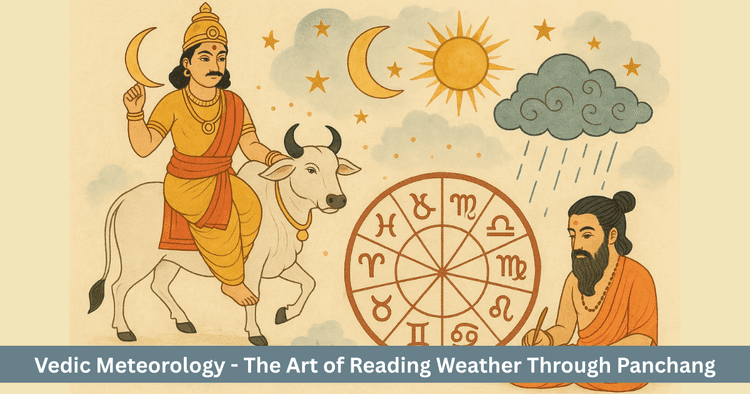
Table of Contents
This article is based on the Moon sign, which is central to Vedic astrology. Your Moon sign represents your mental and emotional nature. To find your Moon sign, you need your date of birth, exact birth time and place of birth, which can be determined using a reliable Panchang (Hindu calendar) or online Moon sign calculator.
Vedic meteorology is a traditional system of weather forecasting deeply integrated with the Hindu Panchang, utilizing astronomical observations to predict weather patterns, especially rainfall. This ancient art, detailed in texts like Varahamihira's Great Compilation, treats the cosmos as an interconnected system where the positions and movements of celestial bodies directly influence terrestrial weather.
Historical Foundation and Evolution
Vedic meteorology represents one of humanity's earliest systematic approaches to weather forecasting, with references appearing throughout ancient Indian texts including the Rigveda, Great Puranas, Parashara Compilation, Panini's Eight Chapters (500 BCE) and Cloud Garland (800 CE). The practice originated with legendary masters including Garga, Parashara, Narada, Devala, Vashistha, Bhrigu and Varahamihira, who pioneered the science of correlating celestial phenomena with terrestrial weather patterns.
This tradition extended beyond theoretical knowledge into practical application through the 12-Servitor System of pre-British India, where each village employed a Village Astrologer or Village Specialist in Earth Astrology. On Hindu New Year (first day of bright fortnight of first month), the village astrologer would deliver "Panchang Proclamation" readings predicting rainfall patterns, crop yields, general conditions, calamities and political stability for the entire community. This represented a comprehensive forecasting system supporting agricultural planning and resource management for entire villages.
The Panchang as Meteorological Tool
The Panchang, with its five core elements, serves as the foundational framework for Vedic meteorology. Each component provides a layer of information that, when synthesized, offers a comprehensive weather forecast.
The Five Limbs: A Synthesis of Celestial Data
Lunar Day: Based on the angular relationship between the Sun and Moon, influencing moisture patterns.
Weekday: The seven-day week, with each day linked to a celestial body affecting temperature and atmospheric pressure.
Star Mansion: The position of the Moon against the backdrop of 27 stellar regions correlating with specific rainfall behaviors.
Auspicious Time: Calculated from the combined positions of the Sun and Moon, predicting atmospheric disturbances.
Half-Day: A further division of the lunar day indicating subtle weather changes.
This multi-layered system provided a rich understanding of time, offering farmers precise weather guidance for specific agricultural activities.
Foundational Principles of Vedic Weather Forecasting
Cooling and Heating: The Dual Qualities
The philosophical foundation of Vedic meteorology assigns two fundamental qualities to all celestial bodies and asterisms: Cooling (soma) and Heating (agni). These qualities govern all phenomena in the universe, including weather systems. When planetary and astrological configurations emphasize cooling qualities, conditions favor cooling and precipitation; when heating dominates, heating and dryness result.
Planetary Rulers and Annual Rainfall Prediction
Vedic astrology employs a sophisticated annual prediction methodology using the King Planet (primary ruler based on planetary position at year's beginning) and Minister Planet (fourth house ruler from the King).
| Ruling Planet | Rainfall Prediction | Agricultural Outcome |
|---|---|---|
| Sun | Moderate rainfall | Mixed year; potential health issues, disasters |
| Moon | Abundant rainfall | Excellent harvest; good health; favorable conditions |
| Mars | Scanty, inadequate | Drought, famine, crop destruction, illness |
| Mercury | Excellent rainfall | Prosperous agricultural season |
| Jupiter | Good rainfall | Religious growth; abundant grain; economic stability |
| Venus | High rainfall | Material prosperity; granaries overflow |
| Saturn | Dry, erratic | Drought, political turmoil, warfare, agricultural distress |
This system enabled annual resource planning: rulers could anticipate tax revenues, farmers could prepare for drought or deluge and merchants could adjust trading strategies based on predicted agricultural outcomes.
Core Principles of Rainfall Prediction
Star Mansion and Planetary Gender Classifications
Vedic meteorology classifies Star Mansions and planets as masculine, feminine or neutral, with profound implications for weather generation:
Asterism-Based Rainfall Generation:
- Neutral Asterisms (Sun/Moon): Generate winds without precipitation
- Feminine Asterisms (Sun/Moon): Produce lightning and phosphorescence
- Gender Combinations: When Sun occupies a feminine asterism while Moon is in a masculine asterism (or vice versa), rainfall results
This classification recognizes complementary energetic interactions: opposing masculine-feminine configurations create atmospheric tension that resolves through precipitation, while neutral combinations generate wind without moisture generation.
Planetary Conjunction Mechanics
| Conjunction Type | Weather Effect | Intensity |
|---|---|---|
| Mars + Sun | Significant downpour | Heavy |
| Mars + Sun + Moon | Heavy, persistent rainfall | Very Heavy |
| Multiple planets in single sign | Pronounced precipitation | Variable |
| Off-season conjunctions with Moon | Intense rainfall regardless of season | Severe |
The inclusion of the Moon in planetary conjunctions acts as a rainfall amplifier, transforming moderate precipitation into heavy downpours even during typically dry seasons.
Mars Transitional Phenomena
Mars transitioning between zodiac signs within two days produces perceptible weather changes, particularly during rainy seasons, often leading to good rainfall. This rapid motion creates atmospheric instability that manifests as precipitation.
Major Planetary Sign Changes
When Jupiter, Saturn, North Node and South Node change zodiac signs especially transitioning into watery signs (Cancer, Scorpio, Pisces) significant weather transformations occur. The elemental nature of the sign entered determines atmospheric response: watery signs activate precipitation mechanisms, fiery signs intensify heating, earthy signs increase dust/wind phenomena and airy signs create variable, turbulent conditions.
Varahamihira: Pioneer of Indian Meteorology
Historical Significance
Varahamihira (6th century CE, flourishing in Ujjain, Central India) stands as the primary architect of ancient Indian meteorological science. His formulas for rainfall prediction, developed over 1500 years ago, remain relevant and applicable today. His revolutionary contribution emphasized combining careful observation of natural phenomena with rigorous mathematical calculation a methodology presaging modern scientific practice by over a millennium.
Great Compilation: Comprehensive Meteorological Text
Varahamihira's magnum opus, the Great Compilation, dedicates eight chapters to rainfall phenomena, drawing sophisticated parallels between cloud formation and human reproductive processes. The text conceptualizes rainfall prediction as observing cloud "conception" (formation), "pregnancy" (development) and "delivery" (precipitation) over a standardized 195-lunar-day cycle.
Beyond rainfall, the Great Compilation addresses comprehensive meteorological phenomena:
- Halos and optical phenomena around Sun and Moon
- Cloud formation and classification
- Wind patterns and directional significance
- Red skies at sunrise and sunset
- Dust storms and atmospheric disturbances
- Thunderbolt formation and lightning physics
- Meteor falls and astronomical events
This breadth demonstrates that Vedic meteorology integrated all observable atmospheric phenomena into a unified predictive framework.
Varahamihira's Seasonal Rainfall Model
Varahamihira's most operationally successful methodology involves predicting seasonal rainfall based on the Star Mansion of the first significant rainfall after Full Moon in May-June (marking approximate monsoon onset).
The 10-Class System
Varahamihira classified all 27 Star Mansions into 10 groups, with each group predicting distinct rainfall quantities. The predictive model converts ancient rainfall measurements (measured in ancient units, approximately 64 mm) into modern millimeter units for contemporary application.
Validation Across 16 Stations (1969-2018)
Testing Varahamihira's model against actual recorded rainfall revealed:
- High-accuracy stations (average error <10%): Junagadh, Anand, Godhra, Bharuch
- State-level average error: -7.9% (indicating slight tendency to over-predict)
- Regional variation: High rainfall stations showed under-prediction; low rainfall stations showed higher error margins due to greater climate variability
Critical Finding: Varahamihira's model demonstrated consistency with current understanding of rainfall distribution, validating a 1500-year-old methodology through modern empirical data.
Cloud Classification System
Vedic meteorology identifies four distinct cloud types, each generating characteristic rainfall patterns:
| Cloud Type | Rainfall Pattern | Geographic Effect |
|---|---|---|
| Whirling | Small, random showers | Most areas receive little or no rain |
| Enveloping | Uniform coverage | Rain spreads across entire land |
| Nourishing | Minimal quantity | Light drizzle, negligible accumulation |
| Abundant | Excessive downpour | Risk of flooding and waterlogging |
This classification enabled ancient farmers to anticipate not just whether rain would fall but how its distribution and intensity would affect agricultural outcomes across their territories.
The Art of Observation
Beyond the astronomical calculations of the Panchang, Vedic meteorology also incorporates a rich tradition of empirical observation of the natural world:
Cloud Forms: Ancient texts classify different types of clouds and their rain-bearing potential. The color, shape and movement of clouds are all considered important indicators.
Wind Patterns: The direction and intensity of the wind on certain auspicious days are used to predict the monsoon's trajectory and strength.
Animal Behavior: Changes in the behavior of certain animals and insects are also seen as signs of impending weather changes.
Sky and Cloud Signs: Halo around Sun/Moon, early anvil-shaped clouds and high cirrus bands are interpreted for imminent rain or clear spells in many regional rule-sets.
Bio-signs: Pre-monsoon wind reversals, ant and bird behaviors and frog calls are integrated as same-day or next-day cues, often validated within specific agro-ecological niches.
Modern Validation and Contemporary Relevance
Empirical Accuracy
Research analyzing predictions from 1946-1995 revealed that Panchang-based rainfall forecasting achieved 75-78% overall accuracy, with select seasons demonstrating 89% accuracy for summers and 90% for winters approaching or matching modern meteorological department predictions made through contemporary computational techniques.
Panchang Cues Used for Weather Reading
Star Mansion Blocks: Monsoon is segmented into 27-day and 13.5-day cycles tied to Star Mansions, with certain stars considered rain-bearing periods for nursery establishment and transplanting in many regions.
Lunar Phases: Full and new moon proximity is tracked for humidity, rainfall probability and storability; empirical studies find mixed but sometimes significant phase-rainfall associations, suggesting cautious, local use.
Weekday and Auspicious Time Filters: Weekday rulers and auspicious times are treated as supportive or adverse backdrops for starting rain-sensitive tasks, guiding whether to advance or delay operations by a day or two.
21st Century Method: Linking the Panchang with Forecasts
Create a star-based agricultural calendar for your micro-region, then gate actual sowing/transplanting based on soil moisture thresholds and a forecasted 3–5 day wet period, rather than relying solely on the Panchang. Use extended windows and a weekly approach to shift tasks by 24–72 hours within the same star block when model guidance conflicts with traditional signals, avoiding sowing in dry or washed-out conditions.
Practical Workflow for Farmers
Pre-season: Identify the agro-climatic zone, calculate 30-year averages for monsoon onset/withdrawal, and prepare a star-based calendar that lists fallback crops/varieties for normal, delayed, or deficit-onset scenarios.
In-season: Biweekly, mark favorable star periods and overlay forecasts from the meteorological department sub-division; act when forecast probability aligns with the Panchang window, otherwise delay based on moisture and forecast triggers.
Post-harvest: In multiple locations, follow long-standing Panchang practices around full moon/new moon periods supported by humidity patterns, scheduling drying and storage near decadal mini-windows to reduce moisture-related spoilage.
Limitations and Precautions
Locality matters: Rules valid in Andhra or Saurashtra may not apply in the Northeast or Deccan Plateau; always ground-truth with data from your nearest station before operational adoption.
Forecasts take priority: Treat the Panchang as a cultural-scientific framework; let short- and medium-range forecasts and local moisture guide sowing/transplanting decisions. Use the Panchang primarily to fine-tune actions within safe meteorological windows.
Integration with Modern Technology
Contemporary agricultural science increasingly recognizes that Panchang-based timing provides psychological preparation and cultural continuity, while forecast-based predictions provide accuracy. Progressive systems now use a dual-framework approach:
Consult the Panchang for auspicious timing guidance and traditional alignment.
Cross-reference with modern weather forecasts for rainfall probability.
Integrate both frameworks for comprehensive agricultural decision-making.
Frequently Asked Questions
Q1: How does Vedic meteorology differ from modern weather forecasting?
Vedic meteorology uses astronomical indicators from the Panchang (tithi, nakshatra, yoga), whereas modern forecasts rely on satellite data and computer models. Combining both gives the best results: the Panchang provides seasonal structure, while modern forecasts provide short-term accuracy.
Q2: Is Panchang-based rainfall prediction scientifically validated?
Yes, partially. Studies from 1946–1995 showed 75–78% overall accuracy, reaching 89–90% for summer/winter. Gujarat research reported 69% accuracy for extreme rainfall events using traditional methods, though location-specific validation is necessary.
Q3: How do Varahamihira’s 1,500-year-old models still work today?
Varahamihira’s star-based rainfall classification showed only -7.9% average error across 16 stations (1969–2018), demonstrating remarkable stability with modern data. His method captures the fundamental astronomical patterns of seasonal rainfall cycles that have remained consistent for centuries.
Q4: How can farmers practically use Vedic meteorology?
Create a star-based agricultural calendar, then cross-validate with modern weather forecasts. Begin key operations (sowing, transplanting) only when Panchang windows and forecast probabilities align, prioritizing soil moisture and forecast triggers.
Q5: What are the limitations of Vedic meteorology?
Rules are location-specific; a signal valid in one region may fail in another. Use the Panchang as a cultural framework but rely on short-term forecasts and local soil moisture for primary decision-making.
What does Nakshatra reveal about me?
My NakshatraDid you like it?
Author

Pt. Suvrat Sharma (63)
Experience: 20
Consults About: Family Planning, Career
Clients In: Punjab, Haryana, Delhi
Share this article with friends and family
WELCOME TO
ZODIAQ
Right Decisions at the right time with ZODIAQ
