Bhoomi Poojan Muhurat and Foundation Ritual: Auspicious Timings, Astrological Factors and Sacred Procedures
By Pt. Sanjeev Sharma
A complete guide to auspicious timings, directions, dates, nakshatras and Vastu principles for beginning construction
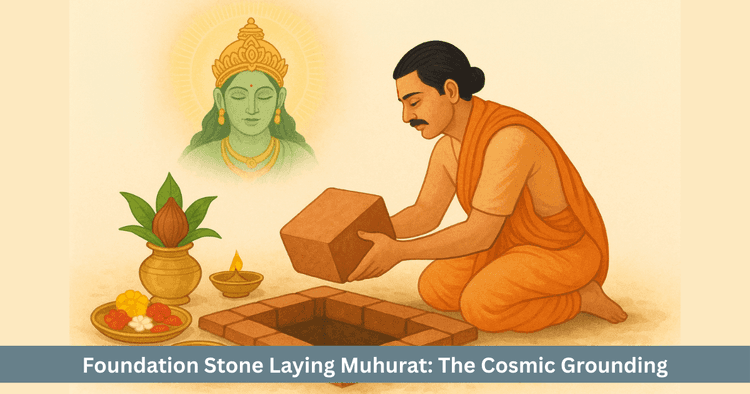
Table of Contents
Introduction: The Union of Earth and Heaven
The Foundation Stone Laying Muhurat, also called Bhumi Pujan or Shilanyasa, marks the sacred moment when human intention energetically unites with the Earth element, initiating a construction project, be it a home, temple or commercial building, under cosmic alignment that ensures longevity, prosperity and peace. Earth is far more than inert matter. According to Hindu philosophy, Earth is a conscious living entity revered as the Earth Goddess. The ritual of Bhumi Pujan pacifies the five elements and honors their harmony. The foundation stone symbolizes the seed of the building's destiny. Muhurat timing acts as astrological DNA, imprinting health, wealth and positive vibes on the structure. Specific planets and Nakshatras inscribe subtle vibrations for the inhabitants' future fortune.
When a construction project begins, it is not merely a physical process. It is an energetic journey. If this journey begins in alignment with cosmic forces, the structure remains fortified with spiritual qualities throughout its existence. The Vedas and Puranas clarify that when construction commences, it is not merely stones and bricks being assembled but an energetic foundation being established. If this foundation is laid during celestial alignment, the structure transcends material form and becomes imbued with spiritual properties.
Part One: The Spiritual Meaning of Bhumi Pujan
Earth Element and Its Consciousness
In Hindu philosophy, Earth is not considered inert matter. Earth is worshipped as a goddess possessing living consciousness. She provides us nourishment, grants us shelter and fulfills all our material needs. When we commence construction upon the Earth, we are seeking permission from this goddess. We are telling her that we wish to build upon her body and we will do so with respect and gratitude.
The five great elements that form creation's foundation, Earth, Water, Fire, Air and Space, are all interconnected. When construction commences, all these elements are affected. The Bhumi Pujan ritual pacifies all five elements and ensures their harmonious coordination. This is why Bhumi Pujan is not merely a cultural practice but a scientific process that balances the environment. When these five elements remain in harmony, the building becomes a space of wellness, peace and prosperity.
The Foundation Stone: The Seed of Destiny
The foundation stone is considered the seed of a building's destiny. When this stone is placed, the cosmic energy of that moment imprints itself upon the stone. Thereafter, this stone continuously transmits this energy throughout the entire building structure. If this energy is positive, all inhabitants are influenced by positivity. If the energy is negative, negative consequences follow.
The Muhurat timing determines this energy completely. When a foundation stone is placed during an auspicious Muhurat, the positive planetary energy of that moment becomes stabilized within the stone. Then throughout the entire construction period, this positive energy operates. After construction completes, inhabitants continue benefiting from this energy. This is not superstition but cosmic law. Every action imprints itself upon the universe and the universe responds accordingly.
Vastu Purusha and Directional Principles
Vastu science introduces the concept of Vastu Purusha, a cosmic force residing on every piece of land. Different directions connect with different deities and elements. For a residential home, the northeast direction is most favorable because it represents spiritual purity. The northeast is called Ishan, the corner of God, where water element energy predominates. Water symbolizes purity. Therefore the northeast is considered the most sacred direction. When a home's foundation is placed in the northeast, inhabitants naturally remain connected with spirituality.
| Direction | Sanskrit Name | Purpose | Associated Element | Benefit |
|---|---|---|---|---|
| Northeast | Ishan | Residence | Water | Spiritual purity, harmony |
| Southeast | Agneya | Commercial | Fire | Growth, expansion, wealth |
| East | Purva | Temple | Sun | Divine illumination |
| North | Uttara | Education | Mercury | Wisdom, knowledge |
Part Two: Astrological Factors for Foundation Stone Laying Muhurat
Factor One: Tithi (Lunar Day)
The Tithi is extremely critical for Bhumi Pujan. Auspicious Tithis are Dwitiya, Tritiya, Panchami, Saptami, Dashami and Ekadashi. These lunar days symbolize growth, prosperity and stability. Dwitiya brings peace and harmony. Tritiya encourages intelligence and balance. Panchami provides health and well-being. Saptami represents purity. Dashami brings good fortune and strength. Ekadashi is spiritually powerful for protection.
Tithis to absolutely avoid are Amavasya (new moon) and Chaturdashi (14th tithi). Amavasya is considered the day of darkness and is inauspicious for new beginnings. Chaturdashi is also avoided because it represents waning energy.
Factor Two: Nakshatra (Lunar Constellation)
The Nakshatra's position determines construction quality. The best Nakshatras are Rohini, Uttar Phalguni, Hasta, Swati, Anuradha and Shravana. Rohini is considered most favorable for construction because it ensures structural stability and beauty. Uttar Phalguni is excellent because it symbolizes growth. Hasta is the constellation of skill and success.
| Nakshatra | Quality | Construction Benefit |
|---|---|---|
| Rohini | Construction, stability | Strong, beautiful structure, longevity |
| Uttar Phalguni | Growth, expansion | Expansion, prosperity, success |
| Hasta | Skill, work | Skilled craftsmanship, quick completion |
| Swati | Independence, balance | Balanced structure, comfortable home |
| Anuradha | Success, support | Project success, support received |
| Shravana | Hearing, knowledge | Peaceful home, meditation space |
Nakshatras to avoid include Mula, Ashlesha and Jyeshtha. Mula is considered the constellation of destruction. Ashlesha represents deep complexities. Jyeshtha is the constellation of obstacles.
Factor Three: Weekday (Vara)
Different weekdays governed by different planets have different effects on Bhumi Pujan. Monday (Moon) brings mental peace ideal for homes. Wednesday (Mercury) brings communication and intellect. Thursday (Jupiter) is the day of knowledge and prosperity. Friday (Venus) brings comfort and convenience.
Saturday (Saturn) is generally avoided for homes because Saturn represents delays and obstacles. however if Saturn is strong, Saturday becomes acceptable because Saturn brings foundational strength. Sunday (Sun) brings health but is considered less favorable for buildings because the Sun's hot energy is excessive.
| Weekday | Planet | Home Favorability | Benefit |
|---|---|---|---|
| Monday | Moon | Excellent | Mental peace, emotional security |
| Wednesday | Mercury | Excellent | Communication, intellect, practicality |
| Thursday | Jupiter | Excellent | Knowledge, prosperity, protection |
| Friday | Venus | Excellent | Comfort, beauty, convenience |
| Saturday | Saturn | Moderate | Longevity, foundational strength |
| Sunday | Sun | Low | Health (but less preferred) |
Factor Four: Planetary Positions
Planetary positions at the time of Bhumi Pujan determine construction success. Jupiter must be strong because it is the planet of knowledge and protection. Venus must be unafflicted because it brings comfort and convenience. Mars must be in good position but not retrograde, as retrograde Mars causes work delays.
Saturn must remain unafflicted. If Saturn is afflicted, construction experiences delays and financial problems. Rahu and Ketu must also be considered because these shadow planets create impediments if afflicting benefic planets.
Factor Five: Season and Sun's Position
Uttarayan period (mid-January to mid-July) is most favorable for Bhumi Pujan. During this time, the Sun is on its northward journey, considered favorable by Jupiter's presence. This period is optimal for planting seeds, construction and new beginnings.
The Shukla Paksha or waxing moon is also preferred because it symbolizes growth. A construction project requires growth energy. Eclipse periods are always avoided because planetary energies become disrupted during eclipses. Solar transit periods in Scorpio and Capricorn are also avoided because these represent harsh and inert energies.
Part Three: Directional Guidance and Vastu Guidelines
Northeast Direction for Residences
A home's foundation stone should ideally be placed in the northeast direction. The northeast is called Ishan Kone, the corner of God, where water element energy predominates. Water represents purity. Therefore the northeast is considered the most sacred direction. When a home's foundation is placed in the northeast, inhabitants naturally remain spiritually connected.
Southeast Direction for Commercial Buildings
Commercial buildings or offices should have their foundation placed in the southeast direction, called Agneya Kone. This direction contains fire element energy. Fire energy symbolizes activity, momentum and expansion. When a commercial building's foundation is placed in the southeast, business grows rapidly. Profits are easily obtained.
East Direction for Temples
Temple foundations should be placed in the east direction, the sunrise direction representing divine light. The east is most favorable for inviting divine energy into temples. When a temple's foundation is placed in the east, the divine energy within becomes activated with each sunrise.
North Direction for Educational Centers
Schools, colleges or libraries should have foundations placed in the north direction, considered Kubera's direction (Kubera is the deity of wisdom, knowledge and prosperity). When an educational institution's foundation is placed in the north, knowledge abundance flows through that location.
Part Four: The Bhumi Pujan Ritual Sequence
Phase One: Site Purification (30-45 minutes)
On the day of Bhumi Pujan, the location where the foundation stone is to be placed must first be purified. The site is washed with Ganges water because Ganges water is considered supremely sacred. If Ganges water is unavailable, water from any sacred river or sacred well may be used.
The site is then covered with cow dung, considered a purifier in Hindu tradition. Then a mixture of turmeric and vermillion powder is sprinkled on the site. Turmeric is considered a carrier of positive energy. Vermillion represents power. This purification cleanses the space of all negative residual energies.
Phase Two: Mantras and Invocation (20-30 minutes)
After site purification, the Earth Goddess and Vastu Purusha are invoked through mantras. The primary mantra is Om Vasundharay Namah, meaning "O Earth Goddess, I bow to you." Then Vastu Shanti Puja is performed, bringing peace to the location and clearing all negative energies.
Nandi Puja is also conducted. Nandi, the vehicle of Ganesha, is worshipped for obstacle removal. Nandi worship removes all construction obstacles. These mantras are not mere sounds but energy carriers. When properly recited, they attract cosmic energy.
Phase Three: Foundation Stone Installation (10-15 minutes)
The foundation stone is now placed. It is made from gold, silver or prominent metal. Nowadays, most use silver or copper stones. A swastika symbol is inscribed on the stone representing auspiciousness.
When the stone is placed, Om Namo Bhagavate Vasudevay Namah is chanted. It is crucial that the placement occur during the precise Muhurat time. If the time has passed, the stone placement may require repetition.
Phase Four: Havan and Fire Ritual (20-30 minutes)
After foundation stone placement, Havan is performed. Fire is worshipped with various materials. Fire is considered a purifier. When materials are offered to fire, it sanctifies them and transmits them skyward. Thus, Bhumi Pujan's energy reaches the heavens and broadcasts to the universe.
Havan includes offerings of clarified butter, rice, lentils and nuts. Each material has significance. Clarified butter symbolizes prosperity. Rice symbolizes good health. Lentils symbolize strength. Nuts symbolize longevity.
Phase Five: Blessings and Conclusion (15-20 minutes)
After Havan, elders and priests offer blessings for the project. All family members are encouraged to participate in worship. This integrates the entire family's positive intention into the project.
Prasad (blessed offerings) is then distributed. Prasad is considered sacred, the blessing of God. After the ritual, positive energy permeates the location. Construction can now proceed with energy and purpose.
Part Five: Scientific and Energetic Perspective
Geomagnetic Balance Activation
The ritual activates geomagnetic balance. Earth possesses its own magnetic field. When large structures are constructed, they affect this magnetic field. Mantras and yantras balance this magnetic field. This is not merely religious belief but scientific fact.
Neutralization of Negative Energies
Through mantras, negative energies become neutralized. Yantras (geometric designs) attract positive energy. Ganges water, cow dung, turmeric and vermillion used in Bhumi Pujan are all natural antiseptics. They carry real antibacterial properties, not merely symbolic significance.
Energy of Human Intention
When a family performs Bhumi Pujan ritual, their positive intention and emotions become energy. This energy accumulates in that location. During construction, this positive energy permeates throughout the building. This is scientific fact supported by quantum physics regarding collective consciousness.
Moon Cycles and Planetary Radiation
Muhurat timing aligns with lunar cycles and planetary radiation patterns. Different lunar phases carry different energetic frequencies. Different planets emit different vibrations. When Bhumi Pujan occurs during positive phases of these energies, the building receives these positive frequencies.
Part Six: Practical and Psychological Benefits
Confidence and Emotional Bonding
Bhumi Pujan ritual strengthens family confidence. When families know they have properly sanctified the land, they gain assurance that the building is being constructed under blessed hands. This reduces construction-related anxieties.
The ritual emotionally bonds the family with the building. When family members participate in the ritual, they develop deep connection with the structure. The building ceases being merely bricks and mortar but becomes a living extension of the family itself.
Construction Cooperation and Coordination
After Bhumi Pujan ritual, clear cooperation and coordination emerges among construction workers, contractors and architects. Disputes disappear. Everyone works toward a unified goal. Construction completes on time and within budget.
Reduction of Delays and Obstacles
When Bhumi Pujan is performed at the correct Muhurat, construction encounters no obstacles. Frequently, when Bhumi Pujan is done without Muhurat consideration, numerous problems arise, legal issues, worker shortages, weather complications, financial strain.
Conversely, when Bhumi Pujan is performed at the correct Muhurat, construction completes without hindrance. This is not luck but cosmic assistance. When working in alignment with the universe, the universe facilitates your work.
Multi-Generational Blessings
Bhumi Pujan is performed not merely for current construction but for generations to come. When foundations are laid through sacred methods, all residents, first generation, second generation, third generation, benefit from positive energy. The building becomes a blessing, not merely a property.
Part Seven: Auspicious Bhumi Pujan Timings for 2025-2026
November 2025
November 2025 contains multiple auspicious dates for Bhumi Pujan. Recommended dates:
November 5 (Wednesday) - Ashwini Nakshatra - Ekadashi - Highly Recommended November 8 (Saturday) - Pushya Nakshatra - Panchami - Top Choice November 10 (Monday) - Revati Nakshatra - Saptami - Top Choice November 12 (Wednesday) - Rohini Nakshatra - Dashami - Highly Recommended
December 2025
December (Paush month) is excellent for Bhumi Pujan. Good dates include:
December 1 (Friday) - Dhanishtha - Excellent December 8 (Friday) - Pushya - Ultra-Auspicious December 13 (Wednesday) - Hasta - Very Good
January-February 2026
January-February (Magha and Phalgun months) represent peak season for Bhumi Pujan. Recommended dates:
January 15 (Thursday) - Rohini - Ultra-Auspicious February 12 (Thursday) - Ashwini - Ultra-Auspicious
Conclusion: The Union of Earth and Heaven
An ancient saying states: When a foundation stone is laid in alignment with celestial rhythm, the walls stand not only on earth but on blessings. Foundation Stone Laying Muhurat represents a cosmic handshake anchoring every building in harmony with universal forces.
This ensures your construction project follows a path of safety, success, longevity and spiritual harmony. When choosing the correct Muhurat, you are not merely selecting a date. You are selecting an energetic blueprint that will define your building's entire life.
Through Bhumi Pujan ritual, you ask the Earth whether you may build on this sacred location. You pray to the heavens for blessings on your construction. You tell the universe this is not merely for personal gain but for a family's and generations' futures.
That sentiment, that intention, that consciousness, that is all the universe requires. Then your construction ceases being merely a physical structure but becomes a sacred space.
Frequently Asked Questions
Question 1: What should we do if we could not perform Bhumi Pujan during the correct Muhurat?
Answer: If circumstances prevent Bhumi Pujan during the correct Muhurat, do not worry. Bhumi Pujan can be performed on any auspicious day. however identify a good Muhurat as soon as possible and perform the ritual. If even this proves impossible, purify and worship your land anyway. God sees intention, not dates.
Question 2: How many people should participate in Bhumi Pujan?
Answer: All family members, especially those who will inhabit the building, should participate. The more participants, the more positive energy integrates. Neighbors may also be invited so community positivity contributes.
Question 3: Is Bhumi Pujan necessary for buildings other than homes?
Answer: Yes, temples, offices, factories, schools, all buildings require Bhumi Pujan. Directions and Nakshatras may vary by building type but Bhumi Pujan remains essential for all.
Question 4: If problems arise during construction, what should we do?
Answer: If problems occur during construction, perform Vastu Shanti Puja immediately. This helps resolve obstacles. Sometimes a small ritual resolves major problems.
Question 5: When should we first enter the home after Bhumi Pujan?
Answer: After construction completes several months later, perform Griha Pravesh at an auspicious Muhurat. Griha Pravesh (home entry) is equally important as Bhumi Pujan and should receive equal ritual attention and timing consideration.
What does Nakshatra reveal about me?
My NakshatraDid you like it?
Author

Pt. Sanjeev Sharma (63)
Experience: 20
Consults About: Family Planning, Career
Clients In: Punjab, Haryana, Delhi
Share this article with friends and family
WELCOME TO
ZODIAQ
Right Decisions at the right time with ZODIAQ
