Griha Pravesh Muhurat: The Sacred Science of Perfect Home Entry Timing
By Pt. Nilesh Sharma
The Complete Methodology for Calculating Perfect Timing to Enter New or Renovated Homes
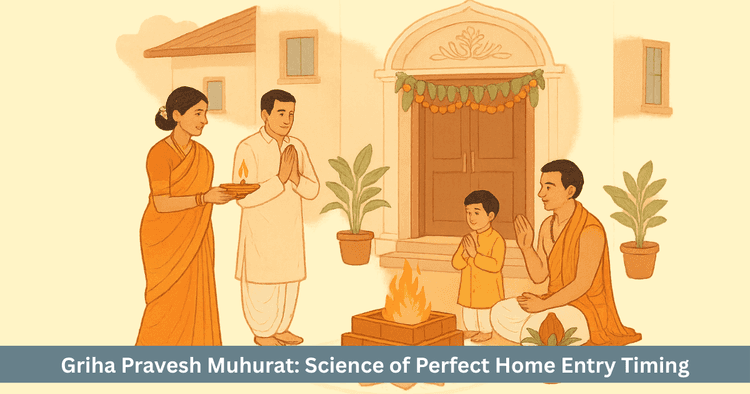
Table of Contents
Opening Reflection
A house becomes a home when consciousness enters it at the right time. This profound truth, drawn from the Vastu Purusha Sukta, represents far more than poetic sentiment. It encapsulates centuries of Vedic observation regarding how the timing of entry into a dwelling space fundamentally shapes the energetic, emotional and material trajectory of everyone who resides within that space. Moving into a new home is far more than a logistical exercise of boxes, furniture and change-of-address forms. In Vedic tradition, it represents a sacred transition, a moment when the collective energy of the family merges with the home's energy for the first time. The Sanskrit term Griha Pravesh literally means house entry but in Hindu tradition it represents something far deeper and more consequential. It is spiritual, inviting positive cosmic and divine energies into the dwelling. It is energetic, aligning the vibration of the home with planetary and elemental harmony. It is practical, ensuring health, wealth, peace and longevity for all residents. In Vedic cosmology, every space possesses a living energy called Vastu Purusha, the cosmic being whose body forms the blueprint of the house. Entering at the correct muhurat awakens this energy in a friendly, cooperative state, establishing foundations of prosperity and peace that persist for the entire duration of residence. This comprehensive guide reveals the complete methodology for calculating the perfect timing to enter a new or renovated home, one of Vedic astrology's most sophisticated and transformative applications.
Part One: Understanding the Three Types of Griha Pravesh
Before calculating a muhurat, one must understand which type of entry is being performed, as each requires distinct astrological requirements and different levels of ritual intensity.
Type One: Apoorva Griha Pravesh, First Entry Into New Construction
Apoorva Griha Pravesh refers to entering a newly constructed home for the very first time. This is the most auspicious type of home entry because the space has never been inhabited. It carries no accumulated energy patterns from previous residents. The Griha Pravesh ritual essentially charges the space with positive vibrations from its inception, establishing the foundational energetic blueprint that will persist throughout the home's existence. Since this is the inaugural entry, the muhurat selected has the strongest influence on the home's entire energy trajectory. therefore this timing must be chosen with utmost care and precision. Professional astrologers often invest substantial time identifying the most auspicious possible date for Apoorva Griha Pravesh because of its profound and lasting impact. A practical example would be a new apartment purchased or constructed, with the family entering for the first time after completion.
Type Two: Sapoorva Griha Pravesh, Re-Entry After Gap
Sapoorva Griha Pravesh refers to entering a home that was previously occupied but has been vacated, typically due to renovation, repairs, relocation abroad or extended absence. Multiple scenarios may require Sapoorva entry, including major renovations or room reconstructions where walls have been altered or the entire interior layout has changed, returning from extended foreign residence lasting one or more years, repairs following natural calamities such as fire or earthquake damage or situations where the family resided elsewhere for several months or years. Since the space carries memory of previous occupation, Sapoorva muhurt emphasizes purification rituals alongside timing to clear residual energies before the family's re-entry. This ensures that previous occupants' energy patterns do not influence the current residents' lives. A practical example would be an ancestral home after ten years abroad or an ancestral property after major renovation.
Type Three: Dwandwah Griha Pravesh, Entry After Major Reconstruction
Dwandwah Griha Pravesh refers to entering a home that has been extensively rebuilt or reconstructed, often following significant damage or complete structural overhaul. Scenarios requiring Dwandwah treatment include reconstruction after fire, earthquake or natural disaster, complete structural rebuilding where walls, roof and foundation have been replaced or converting a structure so extensively that it is essentially a new building despite maintaining the same footprint. This type is treated similarly to Apoorva Griha Pravesh because the home's fundamental structure has been renewed, essentially resetting its energetic blueprint. The distinction from Apoorva lies primarily in the inclusion of specific purification rituals designed to cleanse residual trauma energy from the preceding damage event.
Part Two: The Critical Exclusions, Days and Periods to Absolutely Avoid
The Griha Pravesh calculation begins not with identifying auspicious dates but by systematically eliminating inauspicious ones. This exclusion process is equally important as identifying favorable dates, as entering during a prohibited period can negate all auspiciousness of the muhurat calculation and create lasting negative consequences.
Exclusion One: Five Lunar Months to Completely Avoid
Certain entire lunar months are considered unsuitable for Griha Pravesh and should be avoided without exception. These five prohibited months represent periods when universal energies are fundamentally opposed to new beginnings and establishment in property.
| Month | Period | Reason | Status |
|---|---|---|---|
| Ashadha | June to July | Part of Chaturmas; Lord Vishnu's sleep begins | AVOID |
| Shravana | July to August | Chaturmas continues; monsoon season begins | AVOID |
| Bhadrapada | August to September | Chaturmas transition; spiritual weakness | AVOID |
| Ashwin | September to October | Contains Pitru Paksha ancestor honoring period | AVOID |
| Pausha | December to January | Winter solstice; heaviness and stagnation energy | AVOID |
The reasoning behind these prohibitions is rooted in Vedic philosophy. Chaturmas refers to a four-month period from July through October when Lord Vishnu is believed to sleep in yogic meditation. During this period, new auspicious undertakings are strictly prohibited because the cosmic support for new beginnings is fundamentally withdrawn. Pitru Paksha refers to the ancestor honoring period from mid-September to mid-October, reserved exclusively for honoring deceased ancestors. New ventures during this sacred period are strictly prohibited because initiating ventures diverts energy away from ancestral duties and conflicts with the sacred purpose of the period. The practical implication is significant: if the home is ready during these months, one should postpone entry rather than forcing a suboptimal muhurat. The astrological impact of entering during prohibited periods can persist for years, creating continuous obstacles, financial strain or family discord.
Exclusion Two: Kharmas, Universally Inauspicious Solar Periods
Kharmas refers to specific solar months when the Sun occupies particular zodiac signs, considered inherently inauspicious for all major activities. These periods are fundamentally opposed to new ventures.
| Period | Solar Month | Dates |
|---|---|---|
| Sagittarius (Dhanu) | Kharmas | November 22 to December 21 |
| Pisces (Meena) | Kharmas | February 20 to March 21 |
Kharmas periods are avoided because they are associated with challenging energies and traditionally reserved for spiritual practices and introspection rather than major life transitions. During Kharmas, the cosmic field is not receptive to establishment activities. For 2025-2026, this means avoiding November 22 through December 21, 2025 (Sagittarius Kharmas) and February 20 through March 21, 2026 (Pisces Kharmas). Some astrologers make exceptions for compelling circumstances but Kharmas are generally avoided.
Exclusion Three: Eclipse Periods, Cosmic Disruption
Both solar and lunar eclipses are considered periods of cosmic imbalance and must be strictly avoided. The prohibited window extends from the eclipse day itself, approximately two to three days before the eclipse and approximately two to three days after the eclipse. Eclipses represent temporary disruption in the natural cosmic order. Initiating major life events during these periods invites instability and disruption that can undermine all auspiciousness calculations. Planning guidance suggests avoiding scheduling Griha Pravesh within five to ten days of any eclipse to be safe. For 2025-2026, lunar eclipses occur on September 18, 2025 and March 13-14, 2026, while solar eclipses occur on October 2, 2025.
Exclusion Four: Shukra Tara Asta and Guru Tara Asta, Planet Combustion Periods
These are perhaps the most critical exclusion factors for Griha Pravesh, yet they are often overlooked by those unfamiliar with advanced astrological principles. Combustion or Asta, occurs when Venus or Jupiter come extremely close to the Sun, within approximately ten to twelve degrees, becoming burnt by the Sun's rays and losing their beneficial power temporarily. This period is called Tara Asta. The duration typically spans forty to fifty days.
| Planet | Duration | Effect |
|---|---|---|
| Venus Combustion (Shukra Tara Asta) | 40-50 days | Loss of comfort, pleasure, marital happiness |
| Jupiter Combustion (Guru Tara Asta) | 40-50 days | Loss of wealth, wisdom, protection |
These periods matter critically for Griha Pravesh because Venus represents comfort, aesthetics and pleasure in home environment. When combusted, home comfort and family happiness are compromised regardless of favorable calendar calculations. Jupiter represents wealth, wisdom and overall prosperity. Combusted Jupiter leads to financial difficulties and family discord within the home. The combined effect means that if either planet is combusted, the home becomes energetically weak regardless of how auspicious the calendar date appears. The critical action is to always verify the preferred muhurat date is not during Shukra Asta or Guru Asta. Professional Panchang calendars explicitly mark these periods.
Exclusion Five: Rahu Kaal, The Daily Inauspicious Window
Every single day contains a Rahu Kaal, an inauspicious ninety-minute window when Planet Rahu's negative influence is strongest. These daily windows vary by weekday and are calculated astrologically.
| Weekday | Rahu Kaal Time (Standard IST) |
|---|---|
| Sunday | 4:30 AM to 6:00 AM |
| Monday | 7:30 AM to 9:00 AM |
| Tuesday | 3:00 PM to 4:30 PM |
| Wednesday | 12:00 PM to 1:30 PM |
| Thursday | 1:30 PM to 3:00 PM |
| Friday | 9:00 AM to 10:30 AM |
| Saturday | 10:30 AM to 12:00 PM |
Important to note: these timings vary by geographic location and season. For specific location calculations, one should consult local Panchang or an astrologer. The practical application is straightforward: if the selected muhurat time falls within Rahu Kaal, shift the entry to a different time window on the same day or select another date entirely.
Exclusion Six: Amavasya and Krishna Paksha, Lunar Weakness
Amavasya or new moon day should be completely avoided for Griha Pravesh. This day represents darkness and weak energy depletion, where auspicious power is minimal. The entire Krishna Paksha or waning moon phase is considered less favorable than Shukla Paksha because the Moon's light is decreasing, symbolizing diminishing energy. however some astrologers permit Krishna Paksha dates if no other options exist but Shukla Paksha or waxing moon is strongly preferred.
Exclusion Seven: Pitru Paksha, Ancestor Period
Pitru Paksha spans approximately mid-September to mid-October, with exact dates varying yearly. This period is a sacred fortnight dedicated to honoring deceased ancestors. All auspicious activities, including Griha Pravesh, are strictly prohibited during this time. The prohibition exists because initiating new ventures during Pitru Paksha is believed to invite ancestral interference and disrupt the sacred ancestor-honoring ritual.
Exclusion Eight: Family-Specific Exclusions
Even if the calendar date is auspicious, avoid Griha Pravesh if there has been a recent death in the family, with typically thirteen days of mourning minimum required, though some traditions observe extended periods. Similarly, avoid entry if there is a pregnant female family member with delivery expected within two to three months, if the family is experiencing severe illness of any member, if major litigation or legal disputes are ongoing or if the family is in a period of inauspiciousness per their own astrological charts. In these cases, consultation with an astrologer for remedies or postponement guidelines is strongly recommended.
Part Three: Identifying Auspicious Lunar Months
After eliminating unsuitable periods, the next step is identifying which lunar months are inherently auspicious for Griha Pravesh. Four lunar months stand out as ideal for home entry.
The Four Ideal Lunar Months
Magha (Mid-January to Mid-February)
Magha achieves the highest auspiciousness level of five stars, representing exceptional suitability for Griha Pravesh. This winter month represents crystallization and establishment, associated with consolidation and setting foundations. Jupiter is often favorably placed during this period and winter solstice energy supports grounding and stability. Multiple auspicious dates are typically available throughout the month. The practical advantage includes relatively few weather disruptions in most of India during January-February, making logistics easier for the moving process.
Phalgun (Mid-February to Mid-March)
Phalgun achieves five-star auspiciousness, representing a spring month that symbolizes renewal and fresh beginnings. This month is associated with flowering and manifestation. Holi, the festival of new beginnings, falls in this month, amplifying new energy throughout the cultural atmosphere. Natural seasonal energy supports hope and positivity. Multiple auspicious dates are typically available mid-February through early March. however one must avoid late March, which overlaps with Kharmas or the Pisces period.
Vaishakh (Mid-April to Mid-May)
Vaishakh achieves five-star auspiciousness and is associated with prosperity and expansion. This summer month represents energy and vitality and it serves as the traditional new year season in some Indian calendars. It is excellent for new family ventures and wealth creation. The optimal dating window spans April 15 through May 15, though one must avoid late April edges. Early April may still be influenced by Kharmas, so careful verification is necessary.
Jyeshtha (Mid-May to Mid-June)
Jyeshtha achieves four-star auspiciousness, representing a month of prosperity and completeness associated with mature growth. This month often has available auspicious dates and generally permits Griha Pravesh. The optimal dating window spans May 15 through June 10 approximately. however late May transitions toward Ashadha and early June should be avoided if possible, as Chaturmas begins after June 15.
| Month | Period | Auspiciousness | Status | Notes |
|---|---|---|---|---|
| January | Full month | 5 stars Excellent | GO | Full month available |
| February | Full month | 5 stars Excellent | GO | Full month available |
| March | Full month | 3 stars Moderate | CAUTION | Avoid after March 20 (Kharmas) |
| April | Full month | 3 stars Moderate | CAUTION | Avoid until April 14; then good |
| May | Full month | 4 stars Very Good | GO | Full month auspicious |
| June | Full month | 3 stars Moderate | CAUTION | Avoid after June 10 (Chaturmas begins) |
| July | Full month | 1 star Avoid | NO | Chaturmas begins |
| August | Full month | 1 star Avoid | NO | Chaturmas continues |
| September | Full month | 1 star Avoid | NO | Chaturmas and Pitru Paksha |
| October | Full month | 2 stars Poor | CAUTION | Pitru Paksha makes most unsuitable |
| November | Full month | 3 stars Moderate | CAUTION | Avoid after November 21 (Kharmas) |
| December | Full month | 2 stars Poor | AVOID | Pausha considered inauspicious |
Part Four: The Core Panchang Factors, Selecting Auspicious Days
Once an auspicious month has been identified, detailed calculations using five Panchang elements must be performed to pinpoint the exact date and time.
Element One: Tithi (Lunar Day) Selection
Most auspicious Tithis for Griha Pravesh appear exclusively in Shukla Paksha or the waxing moon phase, representing increasing light and growing positive energy.
| Tithi | Number | Auspiciousness | Duration | Best For |
|---|---|---|---|---|
| Dwitiya | 2nd | 5 stars Excellent | ~24 hours | Beginning with prosperity |
| Tritiya | 3rd | 5 stars Excellent | ~24 hours | All ceremonies and new starts |
| Panchami | 5th | 4 stars Very Good | ~24 hours | Bringing wealth into home |
| Saptami | 7th | 5 stars Excellent | ~24 hours | Perfect for home entry |
| Dashami | 10th | 3 stars Good | ~24 hours | Acceptable but less ideal |
| Ekadashi | 11th | 4 stars Very Good | ~24 hours | Sacred day with spiritual benefits |
| Dwadashi | 12th | 3 stars Good | ~24 hours | Acceptable for entry |
| Trayodashi | 13th | 4 stars Very Good | ~24 hours | Auspicious for ceremonies |
Tithis to never use include Chaturthi (4th, Rikta or empty, associated with loss), Navami (9th, Rikta, inauspicious for ventures), Chaturdashi (14th, Rikta, obstacles and darkness), Purnima (full moon, too intense and creates imbalance) and Amavasya (new moon, darkness and negative forces).
Element Two: Nakshatra (Lunar Constellation) Selection
Most auspicious Nakshatras for Griha Pravesh provide specific planetary and spiritual blessings.
| Nakshatra | Ruling Deity | Symbolism | Benefit |
|---|---|---|---|
| Rohini | Brahma (Creator) | Steady, creative growth | Brings stability and comfort |
| Mrigashira | Mars | Gentle, searching, care | Brings warmth and compassion |
| Uttara Phalguni | Sun | Permanence, success | Excellent for lasting prosperity |
| Chitra | Tvastr (Craftsman) | Creativity, beauty | Attracts aesthetic harmony |
| Anuradha | Mitra (Friendship) | Friendship, support | Strengthens family bonds |
| Revati | Pushan (Nourishment) | Nourishment, protection | Brings care and abundance |
| Uttara Ashadha | Vishnu | Victory, completion | Ensures successful establishment |
| Uttara Bhadrapada | Ahir Budhanya | Wealth, depth | Brings prosperity and spirituality |
Moderately auspicious options include Krittika, Ashwini, Punarvasu, Pushya, Hasta and Swati, which can be used if no better options are available. Nakshatras to avoid include Ardra, Mool and Ashlesha, associated with challenging energies and sometimes Magha and Jyeshtha, which are associated with obstacles in certain traditions.
Element Three: Weekday (Vara) Selection
| Weekday | Ruling Planet | Energy | Benefit |
|---|---|---|---|
| Monday | Moon | Nurturing, peaceful | Brings emotional harmony |
| Wednesday | Mercury | Communicative, intelligent | Supports clear family communication |
| Thursday | Jupiter | Prosperity, expansion | HIGHEST PREFERENCE |
| Friday | Venus | Beauty, comfort, love | Brings aesthetic harmony |
| Sunday | Sun | Success, authority | Attracts success and positivity |
Weekdays to avoid include Tuesday, ruled by Mars and bringing aggressive energy that creates disputes and Saturday, ruled by Saturn and bringing heavy energy that causes financial strain.
Element Four: The Golden Rule, Sthira Lagna (Fixed Ascendant)
This represents the great secret of Griha Pravesh calculation. The birth chart of the home must have a fixed sign rising on the Ascendant at the moment of entry. The four fixed signs are Taurus, Leo, Scorpio and Aquarius.
The science behind fixed Lagna is substantial and consequential. If a movable sign (Aries, Cancer, Libra, Capricorn) is used, the home is astrologically born with a destiny of movement and the family will astrologically move out quickly, resulting in job transfers, property sales and uprooting events. If a dual sign (Gemini, Virgo, Sagittarius, Pisces) is used, the home is born with instability and the family remains in a constant state of questioning whether they should stay. The home will not feel like a permanent, stable base. Only a fixed sign fixes the family to the home, ensuring long and stable residence, permanent establishment and deep roots in the community.
Element Five: The Critical Houses, Calculating the Muhurat Chart
Once the fixed Lagna is set, the astrologer ensures the birth chart of the home is strong. The Lagna or first house must be strong, preferably with benefic planets such as Jupiter, Venus, Moon or Mercury, ensuring the overall health of the home is good. The fourth house, representing the home and happiness, must be very strong and aspected by benefics, ensuring the physical building is sound and the family derives emotional happiness from it. The eighth house, representing longevity, must be empty, as malefic planets here such as Mars, Saturn or Rahu bring destruction, chronic repairs or a short life for the building.
Optimal placement involves Jupiter, Venus and Mercury in Kendra houses (1, 4, 7, 10) or Trikona houses (1, 5, 9). Malefics should ideally be placed in the 3rd, 6th or 11th houses, where they fight off problems for the home rather than causing internal damage.
Part Five: Practical Step-by-Step Griha Pravesh Calculation
Step One: Define Your Timeline
The first practical action is deciding when the home becomes ready for occupancy. This might be the construction completion date, renovation finish date or move-in readiness date. Simultaneously, consider whether the family can wait one to two months for an ideal muhurat or must move sooner. This decision often shapes the entire calculation process.
Step Two: Identify Auspicious Months Within Timeline
Using the month-by-month guidance provided, identify which lunar months fall within the acceptable timeline and are inherently auspicious. For example, if the home is ready October 15, 2025, October is avoided due to Pitru Paksha, November is partially acceptable but problematic after November 21, December should generally be avoided as Pausha is considered inauspicious but January 2026 and February 2026 are excellent. The decision would be to plan for January or February 2026 muhurat if October and November are problematic.
Step Three: Consult Panchang for Auspicious Dates
Within the selected month, consult a detailed Panchang to identify dates with favorable Tithi, favorable Nakshatra, favorable weekday and avoidance of Rahu Kaal, eclipse periods, Shukra or Guru Asta or family-specific exclusions. The practical output should be a list of three to five potential dates, each with multiple options for time windows.
Step Four: Cross-Verify Using Multiple Sources
Online tools such as DrikPanchang.com, AstroSage.com and HousingGyan.com offer Griha Pravesh-specific calculators. Professional consultation with an astrologer who specializes in muhurat calculation and has established reputation provides personalized guidance. Cross-verification using at least two independent sources is essential, as discrepancies between sources should be investigated.
Step Five: Personalize Based on Family Birth Charts
If significant variations exist between family members' astrological profiles, consult an astrologer regarding whether the selected date aligns with the primary resident's Dasha or planetary period, whether Jupiter and Venus transits are favorable for the family and whether any personal doshas require consideration.
Step Six: Check Practical Logistics
Verify the muhurat time is venue-specific by confirming timing accounts for the specific location's longitude and latitude, weather-practical by avoiding dates with extreme weather forecasts, family-practical with guests, family and priests able to attend the scheduled time and professional-practical with movers, builders and contractors available as needed.
Step Seven: Confirm Final Muhurat
Get written confirmation from the astrologer noting exact date and time including the start and duration window. Note any auspicious Choghadiya if applicable, note specific rituals and their sequence and inform all participants including family, priests and vendors.
Part Six: The Griha Pravesh Ritual Sequence
Understanding what occurs during the muhurat helps ensure everything happens in the correct sequence with proper intention and awareness.
Pre-Muhurat Preparation
The day before Griha Pravesh requires thorough preparation. Home cleansing involves thorough cleaning with water and neem leaves to remove negative energy accumulation. External decoration includes entrance decoration with fresh flowers, mango leaf garlands hung at the main door, rangoli or colored powder designs created and lamps prepared for lighting. Sacred preparation involves filling a Kalash or sacred water pot and placing it at the entrance with a coconut placed on top and fresh mango leaves arranged, along with incense and oils prepared for use during rituals.
During Muhurat
Primary rituals must occur in proper sequence. Entry with deity involves the head of household carrying an idol or image of Lord Ganesh, entering through the main door with the right foot first and placing the deity in the northeast corner of the home. Ganesh Puja, a worship ritual honoring Ganesh the remover of obstacles, involves offering flowers, fruits and sweets, ringing bells and blowing the conch. The boiling milk ritual is highly symbolic, fresh milk boiled in a new vessel naturally overflows, symbolizing prosperity and abundance flowing into the home, with milk distributed as Prasad or blessed offering. The sacred fire ritual or Havan involves sacred fire ignited with specific mantras and herbal offerings made to the fire, purifying the home energetically. Vastu Puja involves worship of Vastu Purusha, acknowledging the home's spatial sanctity. Navagraha Puja involves worship of the nine planets, mitigating planetary afflictions and invoking planetary blessings. Tulsi Puja, if applicable, involves worship of the sacred basil plant, planted in the northeast area to represent family health and spirituality. Lakshmi Puja, optionally performed, involves invoking Lakshmi the goddess of wealth to attract prosperity to the new home. Satyanarayana Katha involves recitation of a sacred story and Lord Vishnu worship as a blessing ceremony. Finally, Aarti, a sacred lamp waving ceremony, concludes the formal muhurat ritual with all family members participating. The complete Griha Pravesh ritual typically takes two to four hours depending on the extent of ceremonies.
Part Seven: Post-Griha Pravesh, Sustaining Positive Energy
The muhurat marks the beginning, not the end, of the home's positive evolution. Ideally, the family should reside in the home for a minimum of three days after Griha Pravesh to ground the positive energy. Recommended practices include performing daily prayers or meditation, chanting mantras such as Om, Gayatri Mantra or the family's preferred mantras, keeping lamps lit in the prayer area, avoiding arguments or negativity during the first few days and receiving well-wishers and family to create positive memories. Long-term Vastu compliance sustains the positive energy initiated by the muhurat through ongoing alignment: keep the entrance bright, clean and organized; maintain the northeast as a spiritual or prayer area representing the purest energy; place the stove ideally in the southeast of the kitchen; place the master bedroom in the southwest with the bed facing a favorable direction; orient living areas east or north for light and air; and avoid clutter, stagnant energy and negative objects throughout. Re-activation rituals performed annually, typically on the anniversary, help maintain and rejuvenate the home's positive energy through simple Ganesh Puja, lighting lamps throughout the home, offering flowers and sweets and family gathering with positive intention-setting.
Conclusion: From Calculation to Sanctified Entry
Calculating the perfect Griha Pravesh Muhurat is an exercise in harmonizing multiple dimensions of knowledge including astronomical precision with exact planetary positions, astrological wisdom through Panchang factors and house analysis, spiritual tradition through rituals, mantras and symbolism and practical reality encompassing logistics, family constraints and location. This convergence transforms a home entry from a mere logistical transition into a sacred synchronization with cosmic forces. The process requires patience, attention to detail and often professional guidance. Yet the investment pays dividends in the form of a home energetically optimized for prosperity, harmony, health and sustained happiness. Whether choosing an elaborate multi-day ritual or a simple prayer during the calculated muhurat, the intention remains constant: inviting cosmic blessing into the new dwelling space and establishing sacred foundations for years of family joy and prosperity.
Frequently Asked Questions
Question One: What If I Cannot Wait for an Ideal Muhurat Because of Job Transfer or Other Urgent Circumstances?
While waiting for an ideal muhurat is recommended, life circumstances sometimes demand immediate action. If urgent circumstances require moving before an ideal date, select the next best available auspicious date rather than a highly inauspicious one. Perform whatever rituals are possible within the practical constraints. Many astrologers suggest performing a simple Ganesh Puja and Navagraha Puja even if elaborate ceremonies cannot be arranged. Some traditions allow performing the complete Griha Pravesh ritual retroactively, within seven days after entry, to sanctify the entry. Consult an astrologer who can identify the most auspicious possible date within the forced timeline and suggest remedies to strengthen the entry's auspiciousness.
Question Two: If My Family Members Have Conflicting Birth Chart Indicators, Whose Chart Should Take Priority?
When family members have conflicting astrological indicators, the primary resident or head of household typically takes priority in traditional practice. however if another family member will have a particularly challenging Dasha or transit during the proposed date and that person is equally important to the household dynamics, consult an astrologer about whether both can be accommodated or whether one date serves the family better overall. Some astrologers recommend selecting a date that is at minimum not actively harmful to any family member, even if it is not maximally beneficial for all simultaneously. Professional guidance in such situations is highly valuable.
Question Three: What Is the Difference Between Griha Pravesh and Vastu Puja?
Griha Pravesh is the entry ritual performed at the auspicious muhurat selected through detailed astrological calculation. Vastu Puja is a component ritual within Griha Pravesh that specifically honors the Vastu Purusha or spatial energy of the home. Griha Pravesh encompasses Vastu Puja along with Ganesh Puja, Navagraha Puja and other component rituals. Vastu Puja alone, without timing consideration, may be performed but lacks the astrological optimization that complete Griha Pravesh provides.
Question Four: Can Griha Pravesh Be Performed for Rented Accommodations or Only for Owned Homes?
Griha Pravesh is traditionally performed for homes where the family intends to establish long-term residence, typically owned properties. For rented accommodations, a simpler blessing ritual or Ganesh Puja may be performed but traditional Griha Pravesh calculations become less relevant for temporary dwellings. however if renting with the intention to stay for several years or longer, a simplified muhurat-based entry ritual can still provide spiritual benefit.
Question Five: What Should Be Done If Unforeseen Events (Emergency, Illness) Prevent Entry on the Scheduled Muhurat?
If unforeseen events prevent entry on the scheduled muhurat, consult the astrologer immediately to identify the next available auspicious window. Most astrologers maintain flexibility and can quickly identify alternative dates if the original becomes impossible. Some traditions allow entry within twenty-four hours of the originally scheduled muhurat if only minor delays occur. Never force entry on an inauspicious date simply because the scheduled date became difficult. Instead, reschedule for the next available auspicious time.
Get your accurate Kundali
Generate KundaliDid you like it?
Author

Pt. Nilesh Sharma (63)
Experience: 20
Consults About: Family Planning, Career
Clients In: Punjab, Haryana, Delhi
Share this article with friends and family
WELCOME TO
ZODIAQ
Right Decisions at the right time with ZODIAQ
