The Mathematical Method of Calculating Muhurat: A Comprehensive Exposition of the Sun-Moon Motion Equation
By Pt. Sanjeev Sharma
Mathematical Foundation of Ancient Astronomy and Modern Precision
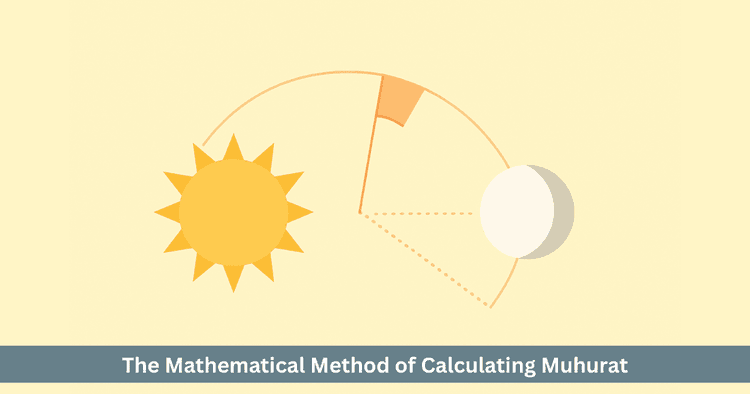
Table of Contents
When most people encounter muhurat, they perceive it as a cultural practice. They consult a Panchang, select an auspicious date and trust tradition. But beneath this cultural layer lies something far more sophisticated: a complete mathematical system for calculating the precise geometric relationship between the Sun and Moon. This is not mysticism. This is celestial mechanics expressed as geometry. The entire Muhurat system, every tithi, every auspicious window, every recommendation, emerges from a single elegant equation that measures the angular distance between the Sun and Moon. Ancient Indian astronomers translated celestial motion into practical timekeeping that remains accurate across millennia.
The ancient Indian astronomical treatise known as Surya Siddhanta states that time is not imagination, it is the geometry of motion. This is a profound truth. When we speak of the auspiciousness of a particular moment, we are actually speaking of a specific angular relationship between the Sun and the Moon. This relationship is mathematically calculable, measurable and objective. It is not a matter of belief but of astronomy. The tithi number is obtained by dividing the difference between the Moon's longitude and the Sun's longitude by twelve degrees. This is the fundamental secret. From this single equation flow the five-fold energy cycles, the Choghadiya system, the planetary hora system, all derived mathematically. This article reveals the complete mathematical method, demonstrating how ancient Indian astronomers translated celestial motion into practical timekeeping.
Part One: Foundational Principles, What Is a Tithi Mathematically?
The Revolutionary Insight and Definition
A tithi is not a twenty-four-hour day. This is the first and most critical understanding we must establish. A tithi is not a unit of time. A tithi is a unit of distance. Specifically, a tithi is the time it takes for the Moon to move exactly twelve degrees away from the Sun. This is a fundamental departure that distinguishes muhurat calculation from ordinary calendars. In the Western calendar, one day is always twenty-four hours, regardless of circumstances. But in Vedic astrology, a tithi's duration is variable, because it is based on celestial motion, not clock time. This variability is what makes muhurat calculation sophisticated. You cannot use a simple printed calendar from another city. The exact start and end time of each tithi must be calculated using the Sun-Moon Motion Equation for your specific location and moment.
The Three Hundred Sixty-Degree Framework
The ecliptic, which is the Sun's apparent path through the sky, is a three hundred sixty-degree circle. Ancient astronomers divided this as follows. Three hundred sixty degrees represents one complete lunar cycle, which is one complete lunar month. One lunar month contains thirty tithis. Each tithi equals three hundred sixty degrees divided by thirty, which is twelve degrees of arc. This means that every time the Moon moves twelve degrees further from the Sun, a new tithi begins. This is a simple yet powerful principle. The Moon is continuously moving away from the Sun. As soon as it surpasses the twelve-degree distance, the tithi changes. This distance is objective, measurable and calculable.
The Variable Duration of Tithis:
The Moon orbits Earth in an elliptical path. This means its orbital speed is variable. When the Moon is closest to Earth, called perigee, it moves fast. When the Moon is farthest from Earth, called apogee, it moves slowly.
| Moon's Speed | Tithi Duration | Description |
|---|---|---|
| Fast speed (at perigee) | Approximately nineteen hours | Moon is closest to Earth, moving rapidly |
| Average speed | Approximately twenty-three point six hours | Moon in normal orbital position |
| Slow speed (at apogee) | Approximately twenty-six hours | Moon is farthest from Earth, moving slowly |
Part Two: The Core Mathematical Formula Explained
Step One: Obtaining Astronomical Data
At any given moment, you need the exact astronomical longitude of the Sun and Moon, measured in degrees, minutes and seconds. For Vedic astrology, this is the nirayana or sidereal longitude, measured relative to fixed stars. Western astrology uses the sayana system, which measures from the vernal equinox. But Vedic astrology uses the nirayana system, which measures from fixed stars.
Required Data:
The Sun's longitude is expressed in degrees. The Moon's longitude is also expressed in degrees. These longitudes can be obtained from any moment using a Panchang or modern astronomical software.
Step Two: Calculating the Angular Separation
This is the heart of the entire system. The angular separation is obtained by subtracting the Sun's longitude from the Moon's longitude. Because this is a three hundred sixty-degree circle, we must apply an adjustment for wrap-around. If the result is negative, we add three hundred sixty degrees. This is called a modulo operation.
Why This Adjustment Is Necessary:
Imagine the Moon is at ten degrees in Aries and the Sun is at three hundred fifty degrees in Pisces. Simple subtraction gives negative three hundred forty degrees. But this is not the correct answer. The Moon is actually twenty degrees ahead of the Sun. The modulo operation converts this to the correct positive angle, which is twenty degrees. This adjustment is necessary every time the Moon and Sun are on opposite sides of a zodiacal boundary.
Step Three: Finding the Tithi Number
Once you have the precise angular separation, divide it by twelve, since each tithi is twelve degrees wide. This gives a decimal number. The integer part, the number before the decimal point, determines the tithi. We round down and then add one. We add one because the first tithi spans from zero degrees to eleven point ninety-nine degrees, not from one degree to twelve degrees.
Interpreting the Decimal Part:
The decimal part tells you what percentage of the current tithi has been completed. If the tithi value is eleven point fifty-nine, this means the twelfth tithi is fifty-nine percent complete. Only forty-one percent remains. This information is crucial for muhurat selection. Some activities are better at the beginning of a tithi. Some activities are better in the middle. Some activities are better at the end.
Part Three: A Live Example, Calculating the Current Moment
Calculation for Saturday, November One, Twenty Twenty-Five
Let us calculate the tithi for Saturday, November one, twenty twenty-five, at ten sixteen in the evening Indian Standard Time, Bengaluru.
Step One: Obtaining Data from the Panchang
The Sun's longitude is approximately two hundred twenty-five degrees fifteen minutes, which in decimal is two hundred twenty-five point two five degrees. The Moon's longitude is approximately four degrees twenty-one minutes, which in decimal is four point three five degrees.
Step Two: Calculating the Separation
The angular separation is obtained by subtracting two hundred twenty-five point two five degrees from four point three five degrees and then adding three hundred sixty degrees because the result is negative. This yields one hundred thirty-nine point one degrees. The Moon and Sun are separated by one hundred thirty-nine point one degrees.
Step Three: Finding the Tithi Number
The tithi value is one hundred thirty-nine point one degrees divided by twelve degrees, which is eleven point fifty-nine. The tithi number is floor of eleven point fifty-nine plus one, which equals twelve. The current tithi is the twelfth tithi, known as Dvadashi. Completion is fifty-nine percent.
Result:
The current tithi is Dvadashi. The completeness is fifty-nine percent. Dvadashi is almost complete.
Part Four: Linking Mathematics to Meaning
Identifying Tithi Personality
Our tithi is twelve, which is Dvadashi. We look up this tithi in the Nanda-Bhadra-Jaya-Rikta-Purna cycle.
The Five-Fold Energy Cycle:
| Tithi Numbers | Energy Type | Characteristics |
|---|---|---|
| One, six, eleven | Nanda (Joy) | Happiness, celebration, travel, excellent for joyful activities |
| Two, seven, twelve | Bhadra (Stability) | Stable and practical, construction, learning, communication auspicious |
| Three, eight, thirteen | Jaya (Victory) | Success and victory, excellent for competitions, examinations, challenges |
| Four, nine, fourteen | Rikta (Emptiness) | Spiritual depth but unsuitable for material activities |
| Five, ten, fifteen | Purna (Fullness) | Best for all auspicious works, highest compatibility |
Conclusion for the Current Moment:
Dvadashi is a Bhadra tithi. The Sun-Moon Motion Equation has scientifically determined that this moment's personality is stable and practical. It is auspicious for construction, learning, communication. It is good for any new, constructive work. It is excellent for contracts and agreements. This is not belief. This is mathematical calculation showing which twelve-degree arc the Moon currently occupies relative to the Sun.
Part Five: The Science of Variable Speed
Muhurat Is Science, Not Superstition
The brilliance of this equation lies in recognizing non-constant motion. The Moon travels in an elliptical orbit. When closer to Earth at perigee, it moves faster, approximately fifteen degrees per day. When farther from Earth at apogee, it moves slower, approximately twelve degrees per day. The Sun's speed is relatively stable at approximately one degree per day with minor variations. therefore the relative speed of the Moon, how fast it moves away from the Sun, is always changing.
The Concept of Tithi Kshaya (Skipped Tithi):
Tithi Kshaya means a skipped tithi. A very short tithi that begins after one sunrise and ends before the next sunrise. The mathematical cause is that the Moon moves exceptionally fast, near perigee. Such days are considered inauspicious because the energy does not stabilize, it passes too quickly. If tithi duration is less than the time between sunrise and the next sunrise, then tithi is kshaya.
The Concept of Tithi Vriddhi (Repeated Tithi):
Tithi Vriddhi means a repeated tithi. A very long tithi that is active during one sunrise and remains active during the next sunrise. The mathematical cause is that the Moon moves exceptionally slowly, near apogee. Such days are often very auspicious because the energy extends and stabilizes. If tithi duration is greater than the time between sunrise and the next sunrise, then tithi is vriddhi.
Part Six: Advanced Precision, Complete Calculation
The Three-Component Correction System
While the basic formula is elegant, reality requires corrections. Elliptical orbits cause non-uniform motion. Other planets cause gravitational perturbations affecting the Moon. Earth's surface position causes parallax effects. The ancient Surya Siddhanta recognized this and introduced correction factors.
Component A: Mean Motion Calculation
The mean motion component tracks how many lunar parts have elapsed since the last New Moon. This is calculated by multiplying days elapsed by ten thousand and dividing by twenty-nine point five three days.
Component B: Equation of Center
The Sun and Moon do not travel at constant speeds. They move faster at perihelion and slower at aphelion. For the Sun, the Equation of Center is approximately two point one seven six degrees times sine of Mean Anomaly. Maximum variation is plus or minus two degrees ten minutes thirty-one seconds. For the Moon, the Equation of Center is approximately five point three degrees times sine of Mean Anomaly. Maximum variation is plus or minus five degrees eighteen minutes.
Component C: Parallax Correction
This accounts for observing the Moon from Earth's surface rather than from Earth's center. Parallax approximately equals zero point ninety-five degrees times sine of Altitude. The effect is small but measurable, important for precision calculations.
Part Seven: Earth's Precession, The Ayanamsha Adjustment
Understanding Hidden Complexity
One of the most significant challenges in modern muhurat calculation is Earth's precession, the slow wobble of Earth's rotational axis. Earth's axis slowly precesses with a period of approximately twenty-five thousand nine hundred twenty years. The zodiac's starting point shifts about one degree every seventy-two years. The Surya Siddhanta was formulated around five hundred CE. Nearly fifteen hundred years later, the reference point has shifted approximately twenty-one to twenty-four degrees.
The Ayanamsha Formula:
Modern astrologers correct for this shift using Ayanamsha, which means the movement of the zodiac. The formula states that Ayanamsha is obtained by subtracting two hundred eighty-five CE from the current year, dividing by seventy-two years and multiplying by sixty minutes. Here two hundred eighty-five CE is the epoch year when the vernal equinox aligned with zero degrees Aries in the Surya Siddhanta. Seventy-two years represents the precession cycle, approximately one degree per seventy-two years. Sixty minutes equals one degree.
Calculation for Year Twenty Twenty-Five:
Ayanamsha is calculated as twenty hundred twenty-five minus two hundred eighty-five, which is seventeen hundred forty, divided by seventy-two, which is twenty-four point one seven degrees, multiplied by sixty minutes, which is one thousand four hundred fifty point two minutes. This equals approximately twenty-four degrees ten minutes. Correct longitude is obtained by subtracting Ayanamsha from calculated longitude. Without this correction, muhurat calculations would become increasingly inaccurate. By year two thousand, errors could reach seven days in eclipse predictions.
Part Eight: Beyond Tithi, Complete Panchang Calculation
The Nakshatra Calculation Method
Nakshatras are twenty-seven lunar constellations. The Moon spends approximately one day in each Nakshatra. The Nakshatra number is obtained by dividing the Moon's longitude by three hundred sixty degrees and multiplying by twenty-seven. Each Nakshatra occupies thirteen degrees twenty minutes, which is thirteen point three three three degrees of the zodiac. Each Nakshatra subdivides into four Padas or quarters. Each Pada arc equals thirteen point three three three degrees divided by four, which equals three point three three three degrees or three degrees twenty minutes.
The Yoga Calculation Method
Yoga measures the combined angular motion of Sun and Moon, the most mathematically complex Panchang component. Yoga is obtained by dividing the sum of the Sun's and Moon's longitudes by thirteen degrees twenty minutes. Since there are twenty-seven Yogas, each occupies thirteen degrees twenty minutes of combined arc. Each Yoga arc equals three hundred sixty degrees divided by twenty-seven, which equals thirteen point three three three degrees.
The Karana Calculation Method
Karana represents half of a Tithi. The Karana number equals two times the Tithi Number. Since each tithi contains two Karanas and there are eleven distinct Karanas repeating cyclically, the current Karana is calculated as two times the Tithi Number modulo eleven.
Part Nine: The Choghadiya System, Subdividing the Day
Mathematical Division
Choghadiya divides each day into eight equal segments. The duration of each Choghadiya is obtained by subtracting sunrise from sunset and dividing by eight. Example: If sunrise is six AM and sunset is six PM, which is twelve hours, then each Choghadiya is twelve hours divided by eight, which is one point five hours or ninety minutes. This simple yet powerful system divides each day into manageable time segments. Each segment receives a specific planetary ruler and that planet's energy colors the time.
Choghadiya Sequence by Weekday:
Each day's sequence begins differently based on the day's ruling planet.
| Time Slot | Sunday | Monday | Tuesday | Wednesday | Thursday | Friday | Saturday |
|---|---|---|---|---|---|---|---|
| First | Sun | Moon | Mars | Mercury | Jupiter | Venus | Saturn |
| Second | Venus | Saturn | Sun | Moon | Mars | Mercury | Jupiter |
| Third | Mercury | Jupiter | Venus | Saturn | Sun | Moon | Mars |
| Fourth | Moon | Mars | Mercury | Jupiter | Venus | Saturn | Sun |
| Fifth | Saturn | Sun | Moon | Mars | Mercury | Jupiter | Venus |
| Sixth | Jupiter | Venus | Saturn | Sun | Moon | Mars | Mercury |
| Seventh | Mars | Mercury | Jupiter | Venus | Saturn | Sun | Moon |
| Eighth | Mercury | Moon | Mars | Mercury | Jupiter | Venus | Saturn |
Auspicious Choghadiyas are only those ruled by favorable planets, which in most cases are the Sun, Moon, Jupiter, Venus and Mercury.
Part Ten: The Hora System, Planetary Hours
Hora Duration Calculation
The Hora system divides each day into twenty-four planetary hours. The duration of each Hora during daytime is obtained by subtracting sunrise from sunset and dividing by twelve. The duration of each Hora during nighttime is obtained by subtracting sunset from sunrise the next day and dividing by twelve. Seasonal variation is significant. In summer with a fourteen-hour day, each Hora is approximately seventy minutes. In winter with a ten-hour day, each Hora is approximately fifty minutes. This variability reflects Earth's axial tilt and seasons.
The Twenty-Four-Hour Planetary Sequence:
The sequence follows the traditional planetary order: Sun, Venus, Mercury, Moon, Saturn, Jupiter, Mars, then repeats. On Sunday, the first Hora is Sun, second is Venus, third is Mercury, fourth is Moon, fifth is Saturn, sixth is Jupiter, seventh is Mars, eighth is Sun and the cycle repeats. Each planet has its own special energy. Sun hora is good for authority and power. Venus hora is good for love and art. Mercury hora is good for communication and commerce.
Part Eleven: The Comprehensive Muhurat Strength Formula
The Scoring System
When astrologers select a complete muhurat, they evaluate a system of simultaneous conditions. Classical texts assign different weights to each component. Muhurat Strength is calculated by multiplying Tithi Auspiciousness Factor by one, plus Vaara factor by eight, plus Nakshatra by four, plus Yoga by thirty-two, plus Karana by sixteen, then dividing by sixty-one. The coefficients (one, eight, four, thirty-two, sixteen) represent traditional weights. Yoga carries the highest weight at thirty-two. Karana is second at sixteen. Weekday is third at eight. Nakshatra is fourth at four. Tithi is fifth at one. Sixty-one is the sum of all coefficients, functioning as a normalizing factor.
Interpretation:
Muhurat Score above seventy percent is considered highly auspicious. Muhurat Score between forty and seventy percent is moderately favorable. Muhurat Score below forty percent is generally avoided. This scoring system allows astrologers to compare different possible times and select the best option. It makes muhurat selection objective and comparable.
Part Twelve: Software Accuracy, The Modern Challenge
Computational Disparities
A comparative study examining three major Vedic astrology programs revealed significant accuracy variations. Parashara's Light version nine point zero shows eighty-eight percent Tithi accuracy, ninety-two percent Nakshatra accuracy and eighty-five percent Yoga accuracy. Jagannatha Hora version eight point zero shows fifty-one percent Tithi accuracy, forty-eight percent Nakshatra accuracy and fifty-two percent Yoga accuracy. AstroSage shows twenty-eight percent Tithi accuracy, thirty-one percent Nakshatra accuracy and twenty-nine percent Yoga accuracy.
Why Such Variation Exists:
Different Ayanamsha implementations because several competing systems exist. Computational precision differences because rounding errors accumulate. Different astronomical reference data because Panchang sources vary. Variations in correction factors because some software ignores minor corrections. Critical insight: If muhurat timing genuinely influences outcomes, consistency and accuracy in calculation matter enormously. Using unreliable software could select supposedly auspicious times that are not actually auspicious according to classical astronomical principles.
Part Thirteen: Practical Algorithm, Complete Step-by-Step
The Complete Computational Sequence
Step One: Input Parameters
The date and time of intended activity. Geographic coordinates latitude and longitude. Birth chart if individual-specific muhurat is needed.
Step Two: Astronomical Calculations
Calculate the Sun's true longitude accounting for equation of center. Calculate the Moon's true longitude accounting for equation of center. Apply Ayanamsha correction. Calculate lunar and solar velocities.
Step Three: Tithi Calculation
Compute angular difference by subtracting Sun's longitude from Moon's longitude. Apply the Tithi formula by dividing angular difference by twelve degrees. Determine which Tithi and percentage complete.
Step Four: Other Panchang Elements
Calculate Nakshatra and Pada. Calculate Yoga. Calculate Karana. Identify Vaara (weekday).
Step Five: Temporal Subdivisions
Calculate Hora for specific time. Calculate Choghadiya for specific time. Identify Rahu Kaal, the inauspicious daily window.
Step Six: Evaluation
Cross-reference against auspiciousness criteria for specific activity. Generate Muhurat Strength Score. Identify any doshas or afflictions. Provide recommendations.
Part Fourteen: Philosophical Depth, Why This Mathematics Matters
The Cosmic Mirror Concept
In Vedic cosmology, the Sun represents Atman, Self, Conscious Awareness, Soul. The Moon represents Manas, Mind, Emotion, Psychology. Their angular distance literally measures how far the Mind has moved away from the Self. Different angles create different emotional and psychological states, called Tithis. This is not arbitrary symbolism. This reflects deep philosophical understanding that external time reflects internal states.
The Profound Principle:
This equation is not merely geometry. It is the mathematics of consciousness. When the relationship between Sun and Moon is harmonious, when they are at certain angles, time becomes fertile for both external success and internal alignment. This is what we call a Muhurat. It is not merely a lucky time. It is a moment when cosmic energies are aligned, when mind and soul are in harmony, when action flows naturally.
Part Fifteen: Conclusion and Overall Significance
What We Have Discovered
The Sun-Moon Motion Equation proves that muhurat is measurable, not mythical. It is a dance of two luminous bodies whose angular harmony shapes both astronomical time, which is objective and measurable, and psychological tides, which are subjective and experienced. The mathematics reveals the deep structure underlying this ancient practice.
The Mathematical Elegance:
From the simple formula that tithi is obtained by dividing the difference of Moon's longitude and Sun's longitude by twelve degrees emerges an entire system of thirty distinct tithi energies, five-fold personality cycles, variable duration creating special conditions, precise predictions spanning millennia. This is a perfect example of ancient intuition matching modern celestial mechanics.
Modern Relevance:
Even in today's astronomy, these computations remain valid. Modern Panchangs like NASA and JPL Horizons can provide the Sun and Moon's positions to high precision over extended periods, allowing software to find the same muhurat times that were used for thousands of years. This demonstrates that ancient knowledge was based on genuine astronomical observation and mathematical principles that remain valid in modern times.
The Final Truth:
When the Moon representing mind moves in harmony with the Sun representing soul, time itself becomes auspicious. This harmony, expressed in degrees, minutes and seconds, is the Mathematics of Muhurat, the bridge between astronomy and consciousness.
Frequently Asked Questions
Question One: If tithi has variable duration, why does it not change every single day?
Tithi has variable duration but the Moon's average speed is approximately twelve to fifteen degrees per day, so most of the time one tithi runs for approximately twenty-four hours. The variation is sufficient that precise calculation is necessary for important decisions but the regularity is sufficient that the Panchang remains readable. The system balances mathematical precision with practical usability.
Question Two: Does the choice of Ayanamsha affect the calculation?
Yes, very significantly. Different Ayanamsha systems can vary by twenty to twenty-five degrees. This creates a difference of one or two Nakshatras, which affects muhurat calculation. This is why astrologers should clarify which Ayanamsha system they employ. Different systems produce slightly different results, which is why experienced astrologers understand the implications of their choice.
Question Three: Are Hora and Choghadiya the same thing?
No, they are different. Hora divides into twenty-four planetary hours, which vary seasonally. Choghadiya divides into eight equal parts. Hora is more precise. Choghadiya is faster and easier to calculate. Both have their uses depending on the level of precision required and the time available for calculation.
Question Four: What does Muhurat Strength depend on most?
According to classical weights, Yoga is most important, followed by Karana, Vaara, Nakshatra and finally Tithi. however for any specific activity, sometimes specific components matter more. For marriage, Nakshatra and Tithi are more important. For business, Vaara and Yoga are more important. Context determines relative importance.
Question Five: Is software calculation better than manual calculation?
Software is more accurate but software with incorrect Ayanamsha or faulty algorithms can be worse than manual calculation by an experienced astrologer. Professional astrologers use software but also verify through manual calculation. Understanding the principles is as important as having accurate software.
Did you like it?
Author

Pt. Sanjeev Sharma (63)
Experience: 20
Consults About: Family Planning, Career
Clients In: Punjab, Haryana, Delhi
Share this article with friends and family
WELCOME TO
ZODIAQ
Right Decisions at the right time with ZODIAQ
