How Ancient India Designed the Perfect Calendar
By Pt. Suvrat Sharma
Lunisolar System, Intercalary Months, Panchangand Astronomical Precision
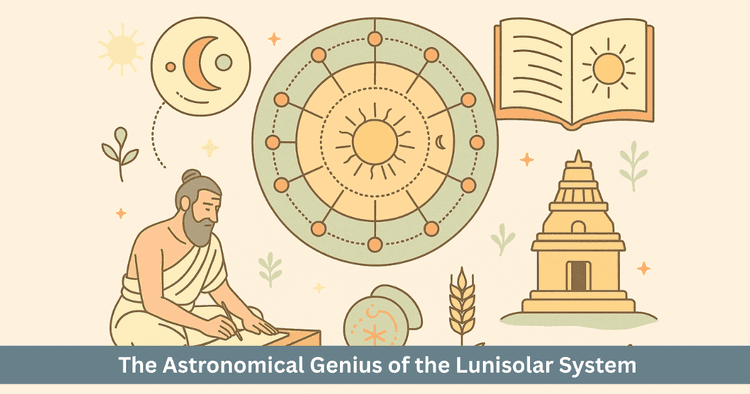
Table of Contents
The ancient Indian calendar system, as codified in texts like the "Sun Science" treatise, represents a remarkable achievement in the history of science and culture, creating what many consider to be a "perfect" calendar by masterfully synchronizing lunar, solar and sidereal cycles. This intricate system, known as a lunisolar calendar, was not just a tool for timekeeping but a comprehensive framework that integrated daily life, religious rituals and agricultural practices with the rhythms of the cosmos.
The Genius of the Lunisolar System
Unlike purely solar calendars (like the Gregorian) that track the seasons or purely lunar calendars that follow the phases of the moon, the ancient Indian calendar harmonizes both. This was a sophisticated solution to a fundamental astronomical problem: the lunar year (approximately 354 days) is about 11 days shorter than the solar year (approximately 365 days).
To resolve this discrepancy, Indian astronomers devised the system of Extra Month or the intercalary month. By adding an extra lunar month to the calendar approximately every two and a half to three years, they ensured that festivals and seasons remained aligned. This prevented the "seasonal drift" that plagues purely lunar calendars, where festivals can occur in any season over time. This elegant solution allowed for the precise timing of religious rituals based on the lunar cycle, while also keeping the calendar tethered to the agricultural year, which is governed by the sun.
A Framework of Unprecedented Accuracy
The astronomical knowledge that underpinned this calendar system was astonishingly advanced for its time. The "Sun Science" treatise, a foundational text of Indian astronomy dating back to at least the 4th century CE, contains calculations that are remarkably close to modern scientific values.
Length of the Year: The "Sun Science" treatise calculated the length of the sidereal year (the time it takes the Earth to orbit the Sun relative to the fixed stars) to be 365.2563627 days, a figure that is virtually identical to the modern value of 365.256363004 days. This level of precision was unparalleled in the ancient world.
Planetary Diameters: The text also provides estimates for the diameters of planets that are remarkably accurate. For example, its estimate for the diameter of Mercury is 3,008 miles (modern value: 3,032 miles) and for Saturn, it is 73,882 miles (modern value: 74,580 miles), both with an error of less than 2%. It even estimated the diameter of the Earth to be 8,000 miles, only a slight overestimation of the modern value of 7,928 miles.
Prediction of Eclipses: The "Sun Science" treatise provides detailed methods for predicting both solar and lunar eclipses, calculating their timing, duration and visibility with impressive accuracy. This demonstrates a deep understanding of the geometric relationship between the Sun, Moon and Earth.
The Five Limbs: A Synthesis of Celestial Data
The genius of the Indian calendar is not just in its accuracy but in its ability to synthesize multiple streams of astronomical data into a practical daily guide. This is embodied in the Five-Part-Calendar, which is based on five key elements:
- Lunar Day: Based on the angular relationship between the Sun and Moon
- Weekday: The seven-day week, with each day linked to a celestial body
- Star Mansion: The position of the Moon against the backdrop of 27 constellations
- Auspicious Time: Calculated from the combined longitudes of the Sun and Moon
- Half-Day: A further division of the lunar day
This multi-layered system provided a rich and nuanced understanding of time, allowing for a level of specificity in religious and daily life that was unmatched by other ancient calendars.
Origins and Ancient Foundations
The Hindu calendar system has its roots deeply embedded in the Vedic era, with the earliest traces of Indian chronology (science of Time) and chronometry (scientific measurement of Time) belonging to this ancient period. The Rigveda mentions sophisticated timekeeping methodologies and one verse specifically states observations about solar movements. Ancient texts explicitly mention the shift in the Sun's relative location towards north for 6 months and south for 6 months, demonstrating careful astronomical observation.
The earliest reference to an organized calendar dates back to 6676 BCE with the Seven-Sages calendar, known in modern contexts as the Vedic calendar. This ancient system illustrates humanity's ability to harmonize daily life with nature's cycles, representing a testament to the observational prowess of ancient Indian ancestors who relied on natural phenomena to organize their societies.
Vedic Astronomy: The Science Behind Timekeeping
Vedic astronomy (the Vedic science of astronomy) was developed as the primary field for tracking and predicting the movements of astronomical bodies to keep time and fix the day and time for Vedic rituals. This study became one of the six ancient Vedic Sciences (ancillary sciences connected with the Vedas), demonstrating its fundamental importance to Vedic culture. Yukio Ohashi states that this Vedic Science field developed from actual astronomical studies during the ancient Vedic Period, making it one of humanity's earliest systematic approaches to astronomy.
The texts of Vedic astronomy sciences gained such respect that they were translated into the Chinese language during the 2nd and 3rd centuries CE, with Rigvedic passages on astronomy found in historical Chinese works. This international adoption underscores the sophistication and accuracy of the system.
The Lunisolar Design: Balancing Sun and Moon
The fundamental brilliance of the ancient Indian calendar lies in its lunisolar design, which ingeniously integrates both solar and lunar cycles simultaneously. This represented a revolutionary approach to timekeeping that solved a problem that plagued other ancient civilizations: the mismatch between lunar and solar years.
The Mathematical Challenge
A lunar month (or synodic month) is precisely 29 days, 12 hours, 44 minutesand 3 seconds long. Twelve such months constitute a lunar year of 354 days, 8 hours, 48 minutesand 36 seconds. Conversely, a solar year is approximately 365 days, creating an 11-day discrepancy annually. Over time, this gap would cause lunar-based festivals to drift through seasons, disrupting agricultural activities and religious observances.
Ancient Indian scholars solved this problem through the insertion of Extra Month (intercalary months) extra months inserted approximately every 2.5 years (specifically: every 30 months on average, since 60 solar months equal 62 lunar months). Evidence of this advanced practice appears in the Rigveda itself, which explicitly references intercalary months inserted to preserve correspondence between a whole solar year and 12 lunations.
Sun, Moon and Days in Integrated Framework
The Indian calendar operates on a sophisticated principle: "In the Indian calendar, seasons follow the sun; months follow the moon; and days, both the sun and the moon." This three-layered integration ensured:
- Seasons remained tied to solar movement (ensuring agricultural synchronization)
- Months followed lunar phases (maintaining ritual and traditional significance)
- Days incorporated both celestial bodies (creating the Lunar Day system)
The Lunar Day System: A Unique Innovation
The Lunar Day (lunar day) represents one of the most ingenious components of the Indian calendar design. Lunar Days are calculated scientifically using the difference of the longitudinal angle between the position of the Sun and the Moon. A Lunar Day is technically defined as "the time required by the combined motions of the Sun and Moon to increase (in a bright fortnight) or decrease (in a dark fortnight) their relative distance by twelve degrees of the zodiac."
Because of this geometric definition, Lunar Days are allowed to vary in length between approximately 21.5 and 26 hours, depending on the orbital mechanics of both bodies. This sophistication meant that:
- A Lunar Day could begin in the middle of an afternoon and end the next afternoon
- Occasionally, a Lunar Day would be "omitted" (skipped) when two consecutive days shared the same Lunar Day
- The Lunar Day might not correspond exactly to the calendar day at sunrise
As historian David Pingree noted: "The basic traditions of Indian astronomy imposed on these external systems its peculiar stamp and transformed the science of other regions to something unique to India."
Five-Element Framework
The Panchang integrates the five Pancha Bhootas (cosmic elements) into agricultural guidance:
| Element | Associated Star Mansions | Agricultural Function |
|---|---|---|
| Earth | Rohini, Moola, Uttara Phalguni | Fertility, seed vitality, root development |
| Water | Pushya, Anuradha, Shatabhishak | Moisture retention, nutrient transport |
| Air | Mrigashira, Swati, Dhanishtha | Aeration, microbial activity |
| Fire | Bharani, Purva Phalguni, Purva Ashadha | Transformation, drying, ripening |
| Ether | Revati, Ashwini, Uttara Ashadha | Preservation, post-harvest quality |
Astronomical Texts and Calculations
Ancient Indian astronomers kept precise time by observing and calculating the cycles of Sun, Moon and planets through sophisticated astronomical texts in Sanskrit. These include:
| Text | Author/Period | Contribution |
|---|---|---|
| Rigveda Astronomy | Ancient (1500 BCE) | Astronomical observations |
| Aryabhata's Work | Aryabhata (5th century) | Solar calculations and year measurements |
| Romaka & Five Treatises | Latadeva & Varahamihira (6th century) | Planetary motion and calculations |
| Mathematical Astronomy | Brahmagupta (7th century) | Advanced mathematical astronomy |
| Celestial Calculations | Lalla (8th century) | Celestial body calculations |
| Sun Science Treatise | 5th-10th century | Comprehensive astronomical methodology |
These texts presented remarkably similar estimates of the sidereal year, with slight variations demonstrating continuous refinement.
Precision and Measurement Standards
Ancient Indian astronomers achieved extraordinary precision in timekeeping. They calculated their calendrical measurements to the accuracy of a truth (29.63 microseconds). Furthermore, through their pursuit of accurate tracking of celestial bodies for calendar purposes, they computed the mean diameter of the Earth as very close to the actual 12,742 kilometers (7,918 miles) a remarkable achievement accomplished centuries before modern instruments.
The calendar's accuracy was so exceptional that it became popular in Nepal, Tibet, Thailand and Java, as well as in the Islamic West and other Southeast Asian regions. Several Indian astronomical texts were translated during historical dynasties (581-907 CE), spreading this sophisticated knowledge across Asia.
Comparison with Other Calendar Systems
The Indian calendar design fundamentally differed from the Western (Gregorian) approach. The Gregorian calendar adds arbitrary extra days to months and struggled with accuracy for centuries the original Julian Calendar was 11 minutes and 14 seconds too long annually, accumulating to 14-day seasonal errors by the 16th century CE.
In contrast, the Indian calendar maintains the integrity of lunar months while inserting entire extra months once every 32-33 months, ensuring that festivals and crop-related rituals always fall in appropriate seasons. This means Hindu festivals like Diwali always fall between late October and early November, while Islamic lunar festivals shift through seasons annually due to the absence of intercalary adjustments.
The Gupta Era Refinement
During the Gupta era (320-550 CE), the Hindu calendar received significant refinement through the work of Aryabhata and Varahamihira (5th-6th century). These astronomers built upon the astronomical tradition of Vedic Astronomy, which had been standardized in earlier works known as the "Sun Science" treatise. Their refinements represented the culmination of over a millennium of careful astronomical observation and mathematical development.
Legacy of Science and Culture
The ancient Indian calendar was not just a scientific achievement; it was a cultural one. It provided a common framework that connected diverse communities across the subcontinent, allowing for the celebration of shared festivals and the observance of common rituals. While regional variations existed, the underlying principles remained the same, a testament to the power and elegance of the system.
In designing a calendar that was both astronomically precise and culturally resonant, ancient Indian astronomers created a system that has endured for millennia, continuing to shape the lives of hundreds of millions of people to this day.
Frequently Asked Questions
Question 1: Why is the intercalary month (Extra Month) necessary?
The lunar year is 11 days shorter than the solar year, causing lunar-based festivals to drift through seasons over time. Adding an extra month every 2.5 years ensures festivals always fall in their intended seasons Diwali always in October-November, Makar Sankranti in January maintaining agricultural and ritual synchronization.
Question 2: How does a Lunar Day differ from a regular calendar day?
A Lunar Day is based on the Sun-Moon angular position, not midnight, causing it to vary from 21.5 to 26 hours in length. Occasionally a Lunar Day completely skips a calendar day (called omitted Lunar Day), precisely reflecting actual astronomical movements rather than arbitrary date boxes.
Question 3: How impressive is the Sun Science treatise's precision?
It calculated the sidereal year as 365.2563627 days, differing from modern measurement (365.256363004) by only 12 seconds per thousand years. Mercury's diameter estimate was within 2% of modern value unparalleled accuracy a thousand years before telescopes existed.
Question 4: How does the Indian calendar differ from the Gregorian?
The Gregorian adds one day every 4 years, while the Indian adds an entire extra month every 3 years. Result: Hindu festivals always fall in their original seasons, whereas Islamic lunar festivals shift through seasons yearly due to lack of intercalation.
Question 5: Does modern India still use this calendar?
Yes, India's National Calendar has been used for official purposes since 1950and Hindu, Sikh, Buddhist communities use traditional Panchang for festivals and rituals. Regional Panchangs remain widely consulted across different states for important decisions.
Get your accurate Kundali
Generate KundaliDid you like it?
Author
Pt. Suvrat Sharma (63)
Experience: 20
Consults About: Family Planning, Career
Clients In: Punjab, Haryana, Delhi
Share this article with friends and family
WELCOME TO
ZODIAQ
Right Decisions at the right time with ZODIAQ
