Astronomical Instruments Used in Regional Panchangs
By Pt. Amitabh Sharma
Evolution of Astronomical Instruments from Ancient Gnomon to Modern Digital Software
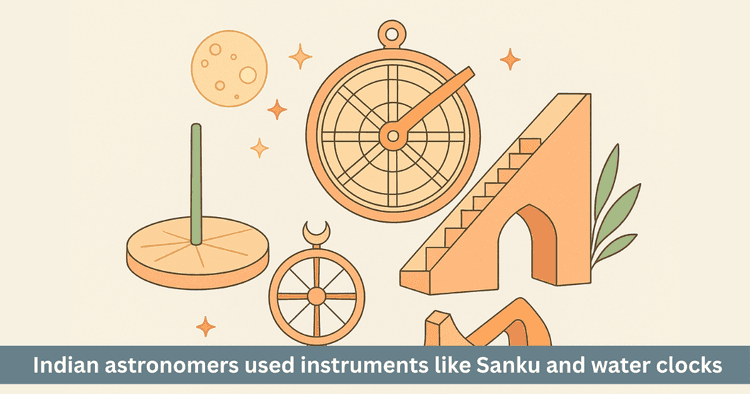
Table of Contents
The creation of regional Panchangs has historically relied on a sophisticated array of astronomical instruments, known as Yantras, to observe and measure celestial movements. These tools, ranging from simple gnomons to large-scale masonry observatories, formed the backbone of Indian astronomy, allowing for the precise calculations needed to create accurate almanacs. Each innovation demonstrates a commitment to improving astronomical measurement accuracy in service of Panchang calculations.
Ancient Vedic Astronomical Instruments
Sanku (Gnomon) The Shadow Measurer
The Sanku, meaning vertical stick or shadow-caster in Sanskrit, represents one of the most fundamental and enduring astronomical instruments in Indian tradition. Dating back to at least the Vedic period, the Sanku appears in the works of Aryabhata (476 CE), Varahamihira, Brahmagupta and Bhaskara II.
Instrument Design and Function:
- A vertical rod (traditionally made of ivory, metal or wood) placed on a horizontal plane
- Used to cast shadows at specific times of day to determine celestial and terrestrial measurements
- Primary applications included determining cardinal directions, calculating latitude, measuring time and predicting seasonal transitions
Principle: The angle between the gnomon and its shadow correlates directly with the Sun's altitude above the horizon a relationship fundamental to all subsequent astronomical calculations.
Variations: Over centuries, Sanku designs evolved to include calibrated scales for more precise angle measurement, multiple Sankus at different locations for comparative measurements and integration with water clocks for simultaneous temporal measurements.
| Aspect | Description |
|---|---|
| Period | Vedic (~1500 BCE) onward |
| Accuracy | ±30 minutes |
| Technique | Shadow observation |
| Applications | Time, latitude, seasons |
Armillary Sphere (Gola-Yantra) The Celestial Model
The armillary sphere, called Gola-Yantra in Sanskrit (where Gola means sphere and Yantra means instrument), represents one of the most sophisticated astronomical instruments developed in ancient India.
Historical Documentation:
First mentioned in the works of Aryabhata (476 CE), indicating knowledge dating back at least 1,500 years. Detailed technical descriptions appear in the Gola-Dipika (composed 1380-1460 CE by Paramesvara).
Unique Indian Innovation:
The Indian armillary sphere differed fundamentally from Greek models. Greek versions were based on ecliptical coordinates (zodiac-centered reference frame), while Indian versions were based on equatorial coordinates (celestial pole-centered reference frame). This equatorial coordinate system proved superior for tracking Nakshatra (lunar mansion) positions and calculating their celestial coordinates.
Instrument Structure and Function:
The Gola-Yantra consisted of concentric metal rings representing the celestial sphere's major circles including the equatorial circle, ecliptic circle, meridian circles and horizon circles. It included a rotating internal sphere allowing adjustable observations, sighting mechanisms for precise angle measurements and graduated scales for recording positions.
Applications in Astronomical Calculations:
- Determining precise celestial coordinates of stars and planets
- Tracking lunar mansion positions (crucial for Nakshatra calculations in Panchangs)
- Visualizing celestial mechanics and planetary movements
- Verifying theoretical astronomical predictions against observed positions
Sophisticated Versions: Water-driven versions incorporated flowing water mechanisms to slowly rotate the internal celestial globe, creating a dynamic model of the night sky's apparent rotation an early example of precision mechanical engineering.
Clepsydra/Water Clock (Ghati-Yantra and Kapala-Yantra)
Water clocks served as essential timekeeping instruments for astronomical calculations and rituals.
Two Primary Designs:
1. Sinking-Pot Clepsydra (Standard Ghati-Yantra):
- A pot with a small hole at the bottom placed in a larger water basin
- As water gradually entered through the hole, it filled and sank after a fixed interval (typically 24 minutes, called a Ghatika)
- Simple, reliable and required minimal maintenance
- Extensively documented in Gupta and medieval period inscriptions
2. Floating-Bowl Clepsydra (Kapala-Yantra):
- A bowl-shaped vessel with calibrated interior markings
- Float mechanism allowed more precise time measurement
- Bowl gradually filled through a hole, with specific fill levels indicating fixed time intervals
- Greater accuracy and precision than sinking-pot models
Accuracy and Limitations:
Accuracy range was ±5-10 minutes, respectable for pre-mechanical timekeeping. Limitations included vulnerability to water temperature changes, evaporation rates and hole wear. Mitigation involved regular recalibration against celestial observations using the Sun's position.
| Clock Type | Accuracy | Limitations | Application |
|---|---|---|---|
| Ghati-Yantra | ±5-10 min | Water temp, wear | Ritual timing |
| Kapala-Yantra | ±2-5 min | Thermal drift | Temple rituals |
Medieval Period Instruments
Cross-Staff (Yasti-Yantra)
The cross-staff, known as Yasti-Yantra (where Yasti means staff), evolved from simple observational rods into sophisticated angle-measuring devices by the time of Bhaskara II (1114-1185 CE).
Evolution of Design:
- Simple version: Single calibrated stick with notches marking angle intervals
- V-shaped versions: Two sticks forming adjustable angle for measuring celestial separations
- Advanced versions: Graduated scales, sighting vanes and multiple arms for simultaneous observations
Applications:
- Measuring angular distances between celestial bodies
- Calculating the Moon's position relative to stars
- Determining angles for latitude determination
Phalaka-Yantra (Board Instrument)
Bhaskara II invented the Phalaka-Yantra, consisting of a rectangular board with specific geometric markings.
Design Features:
- Central pivot point with rotating index arm
- Calibrated circumferential markings
- Pin casting shadows for time measurement
- Geometric trigonometric markings for calculations
Function: Determined time from the Sun's altitude by using trigonometric relationships an early application of mathematical functions to astronomical measurement.
Kapala-Yantra (Equatorial Sundial)
An equatorial sundial designed to measure the Sun's azimuth (compass position) with precision. The gnomon shadow's position on the equatorial plane directly indicates compass direction and time.
Kartari-Yantra (Scissors Instrument)
A sophisticated composite instrument combining two semicircular boards arranged in a scissor-like configuration. This allowed simultaneous angular measurements in different planes, enabling complex three-dimensional astronomical observations.
Islamic Influence: The Astrolabe
Historical Introduction to India
The astrolabe, called Ustarlab or Yantra-Raj in Sanskrit, was introduced to India from the Islamic world around 1370 CE.
Key Historical Figures:
Mahendra Suri (court astronomer of Firuz Shah Tughluq, 1309-1388 CE): Prepared the first Sanskrit monograph on astrolabes in 1370, titled Yantra-Raj (The King of Instruments).
Padmanabha (~1400 CE): Described a different astrolabe design, possibly from an alternate Islamic source.
Mulla Chand: Humayun's court astronomer who used astrolabes to determine times of royal births.
Astrolabe Design and Function
The astrolabe represents a flat representation of an armillary sphere, converting three-dimensional celestial mechanics into two-dimensional calculations.
Key Components:
- Central pivot: Connecting element holding rotating alidade (sighting rod)
- Alidade: Revolving rod with perpendicular wings for sighting celestial bodies
- Back side quadrant: With plumb bob and graduated scale for altitude measurements
- Front side disks: Removable latitude plates allowing calculation for different locations
- Trigonometric scales: Graphical representations of sine and tangent values
- Holding ring: Central hand grasp for positioning the instrument
Trigonometric Application:
The astrolabe incorporated graphical trigonometry through parallel lines representing trigonometric functions, 12 or more divisions on the shadow square and calculations performed graphically by measuring proportional line lengths.
Indian Adaptations:
Rather than simple importation, Indian astronomers modified astrolabe designs by creating versions optimized for Indian latitude observations, incorporating Sanskrit labeling and modifying angle scales to match Indian astronomical measurement conventions. They combined astrolabe calculations with traditional Surya Siddhanta methods.
Padmanabha's Nocturnal Instrument
Nocturnal Polar Rotation Instrument:
Padmanabha (c. 1400 CE) invented a remarkable instrument using polar star observations for time determination.
Design:
- Rectangular board with slit and set of pointers
- Concentric graduated circles
- Designed for observing bright stars Alpha and Beta Ursa Minor
Function and Principle:
Time and astronomical quantities were calculated by adjusting the slit to directions of these polar stars. The back side contained a quadrant with plumb line and index arm. Thirty parallel lines inside the quadrant enabled graphical trigonometric calculations. After determining Sun's altitude with the plumb, time was calculated graphically.
Innovation: One of the earliest instruments to explicitly employ graphical trigonometry using proportional lengths to perform complex mathematical calculations.
Jantar Mantar Observatories Monumental Architecture as Instrument
Historical Establishment
The Jantar Mantars represent a revolutionary approach to astronomical observation constructing massive masonry structures that serve simultaneously as buildings and precision instruments.
Builder and Purpose:
- Constructed by Maharaja Sawai Jai Singh II of Jaipur (1688-1743 CE) starting in 1723
- Primary objective: Revising astronomical tables and the calendar for accurate Panchang calculations
- Five observatories built at: Jaipur, Delhi, Varanasi, Ujjain and Mathura
Jaipur Jantar Mantar UNESCO World Heritage
The Jaipur site represents the largest, most comprehensive and best-preserved of India's historic observatories, recognized as a UNESCO World Heritage Site in 2010.
Scale and Instruments:
- Consists of 19-20 major fixed instruments ranging from a few feet to 90 feet in height
- All instruments designed for naked-eye observation (no telescopes or lenses)
- Instruments carved from stone and masonry with remarkable precision
- Each instrument specifically designed for particular astronomical measurements
Primary Instruments at Jantar Mantar Jaipur
1. Samrat Yantra (Emperor's Instrument):
- The world's largest stone sundial (approximately 90 feet tall)
- Massive triangular structure with angle matching local latitude
- Shadow cast on floor indicates precise time
- Can measure time to within seconds precision
2. Jai Prakash Yantra (Jai's Light Instrument):
- Hemispherical structure with gridlines
- Observer stands inside the hemisphere to observe celestial coordinates
- Maps the celestial sphere onto a tangible structure
- Particularly valuable for confirming positions calculated by other instruments
3. Ram Yantra (Rama's Instrument):
- Cylindrical walls with altitude markings
- Determines altitude and azimuth of celestial bodies
- Combines two cylinders for comprehensive angular measurements
4. Misra Yantra (Mixed/Compound Instrument):
- Composite instrument combining multiple measurement functions
- Can simultaneously measure time, altitude, azimuth and declination
Architectural and Instrumental Innovations
Monumental Scale: Large size increases precision by providing longer baselines for angle measurement.
Fixed Permanent Instruments: Unlike portable instruments, these allowed repeat observations from exact same positions.
Architectural Precision: Stone construction provided stability and durability for centuries of repeated observations.
Integration of Mathematics and Architecture: Each structure embodies specific trigonometric and geometric relationships.
Astronomical Accuracy
Despite being 18th-century structures relying solely on naked-eye observation, the Jantar Mantars achieved:
- Time measurement precision: ±2 seconds
- Angular measurement accuracy: ±3-4 arc seconds
- Planetary position predictions accurate within historical standards
- Eclipse predictions matching computed modern values
Modern Digital Instruments for Panchang Calculation
Contemporary Computational Methods
Modern Panchang calculations employ sophisticated digital instruments and algorithms representing the 21st-century evolution of astronomical instruments.
Modern Applications:
Modern applications like Kadigai (meaning Clock) represent cutting-edge development with features including real-time GPS/Location-based calculations providing location-specific accuracy previously impossible, integration of Vedic algorithms with modern astronomical ephemeris data and sophisticated algorithms calculating Tithi with millisecond precision, Nakshatra positions, Yoga and Karana values, Rahu Kaal and Ayanamsa.
Calculation Precision:
Modern digital instruments can calculate to precision levels of ±1 second. Real-time location sensing allows personalized calculations for exact positions. Cloud-based databases track planetary positions using NASA ephemeris data. Multiple calculation methods are integrated for comparative accuracy.
Hybrid Analog-Digital Instruments:
Recent innovations combine traditional and modern approaches. The Panchanga Clock represents an integrated miniature computer running sophisticated Panchanga algorithms that displays real-time Panchang components and astronomical data typically available only in annual printed Panchangs.
Comparative Precision Evolution
| Instrument/Period | Approximate Era | Measurement Precision | Technique | Application |
|---|---|---|---|---|
| Sanku (Gnomon) | Vedic (~1500 BCE) | ±30 minutes | Shadow observation | Time, latitude, seasons |
| Water Clock (Ghati) | Classical (~500 CE) | ±5-10 minutes | Water flow rate | Ritual timing |
| Armillary Sphere | Classical (~500 CE) | ±1-2 degrees | Physical ring positioning | Star catalogs |
| Astrolabe | Medieval (~1370 CE) | ±15-30 minutes | Graphical trigonometry | Time, latitude, altitude |
| Jantar Mantar | Early Modern (~1730) | ±2-4 arc seconds | Monumental geometry | Panchang tables, eclipses |
| Modern Software | Contemporary (2000+) | ±1 second | Digital algorithms + GPS | Real-time Panchang, predictions |
Frequently Asked Questions
What was the primary function of the Sanku? The Sanku measured the length and direction of shadows cast by the Sun to determine cardinal directions, latitude, time and seasonal transitions.
How did the Ghati-Yantra work? A pot with a small hole in the bottom was placed in water. The pot filled through the hole and sank after a fixed time interval (24 minutes or one Ghatika), marking the passage of time.
Why was Jantar Mantar important? It represented the first large-scale attempt to use giant stone structures as precision astronomical instruments, achieving remarkable accuracy without telescopes.
What was the significance of the astrolabe in India? Adopted in the 14th century, it was combined with traditional Surya Siddhanta methods by Indian astronomers for hybrid observational and calculational approaches.
How accurate are modern digital Panchangs? Modern software provides precision up to ±1 second, using GPS technology and NASA ephemeris data for unparalleled accuracy.
Get your accurate Kundali
Generate KundaliDid you like it?
Author
Pt. Amitabh Sharma (56 Years)
Experience: 20
Consults About: Family Planning, Career
Clients In: Punjab, Haryana, Delhi
Share this article with friends and family
WELCOME TO
ZODIAQ
Right Decisions at the right time with ZODIAQ
